

At its core, search engine optimisation copywriting is about creating content that works for two very different audiences: search engine algorithms and actual human shoppers. For Australian retailers, this means writing persuasive, keyword-rich copy that not only boosts your product visibility on Google but also convinces customers to click "add to cart." It’s a balancing act aimed at driving qualified organic traffic that actually converts into sales.
The New Playbook for Retail SEO Copywriting
The ground is shifting under the feet of Australian retail leaders. Traditional SEO copywriting, that once-reliable process of manual keyword research and careful content tweaks, is no longer enough to keep you competitive. Winning on the digital shelf today demands a complete shift in strategy. We need to move away from tedious, page-by-page efforts and embrace AI-powered, scalable workflows that can optimise tens of thousands of SKUs in days, not years.
This new playbook is being written by the rise of agentic commerce. AI assistants like Amazon's Rufus and Google's AI Overviews are quickly becoming the new gatekeepers for product discovery. To prepare for the future of retail search, we have to fundamentally change how we think about content. It’s not just about keywords anymore; it's about creating structured, AI-friendly product data that conversational agents can easily understand and recommend to shoppers.
The biggest hurdle for many retailers is their reliance on generic, duplicated supplier content. This is a double-edged sword: it not only risks penalties from search engines but also fails to build a unique brand voice, leading to a weak presence on the digital shelf. The fix lies in AI workflow automation for retail, which can systematically transform basic supplier feeds into unique, optimised product descriptions at a scale that was previously unimaginable. This transition from manual SEO to AI SEO is critical for reducing retail content bottlenecks.
This modern approach is built on a few key pillars:
- Product Data Enrichment: This is where it all starts. It’s about taking raw, often incomplete supplier data and turning it into a rich, structured source of truth for every single product. This forms the backbone for everything else.
- AI SEO at Scale: Instead of writing copy manually, retailers must adopt AI-powered content workflows. These systems can generate unique, SEO-ready copy for your entire product catalogue, smashing content bottlenecks and ensuring brand consistency.
- Agentic Search Optimisation: Your content needs to be structured for AI agents. This means focusing on factual attributes, clear benefits, and conversational language that answers the complex questions users will ask their AI shopping assistants. You can learn more about how to implement advanced AI SEO for ecommerce in our detailed guide.
- Advanced Visual Search: For categories like fashion, furniture, or electronics, AI image recognition and tagging are non-negotiable. Automating the creation of descriptive alt tags and metadata makes your products discoverable through visual search platforms like Google Lens.
This isn’t just about being more efficient; moving from manual SEO to AI-driven SEO is a strategic necessity. As Australia's SEO investment landscape changes, the money is clearly moving towards AI SEO services and automation.
Projected SEO spending in Australia is set to hit $1.5 billion in 2025. Here’s the critical part: traditional SEO tactics now make up only 45% of search marketing budgets. The rest is flowing into AI and LLM optimisation (25%), content creation (20%), and technical infrastructure (10%).
This data tells a clear story: retail leaders who get on board with retail content automation and scalable SEO solutions will be the ones who dominate the future of work in retail. Those who stick to outdated, manual methods risk becoming invisible.
For a deeper dive, exploring these essential retail SEO best practices will help ensure your content is fully geared for discovery. The new playbook is here, and it’s powered by data, automation, and a sharp understanding of the AI-driven consumer journey.
Traditional SEO Copywriting vs AI-Powered Retail SEO
To really understand the shift, it helps to see the old and new approaches side-by-side. The contrast in this AI SEO vs Traditional SEO comparison highlights why clinging to manual methods is no longer a viable option for retailers with large catalogues.
| Attribute | Traditional SEO Copywriting | AI-Powered Retail SEO |
|---|---|---|
| Scale & Speed | Manual, page-by-page. Slow and resource-intensive. | Automated across thousands of SKUs in days. |
| Content Source | Often relies on generic supplier feeds. | Creates unique, brand-aligned content from data. |
| Focus | Keywords, meta descriptions, and on-page elements. | Structured data, factual attributes, and conversational answers. |
| Audience | Primarily Google's crawlers and human readers. | AI agents, visual search, and human shoppers. |
| Consistency | Varies by writer and over time. Hard to maintain. | Ensures consistent brand voice and quality across the entire catalogue. |
| Adaptability | Slow to react to market trends or algorithm changes. | Continuously optimises based on real-time data and performance. |
The table makes it obvious: the future of retail SEO isn’t about doing the old things better, it’s about embracing a completely new, technology-driven way of working. It's the only way to keep up and get ahead.
Build Your Foundation with Enriched Product Data
Great SEO copywriting doesn't start with a blank page. It starts with your product data.
For Australian retailers managing thousands of SKUs, the raw, often messy feeds from suppliers are a massive headache. But they're also a huge untapped opportunity. The key is to stop thinking about them as just data files and start treating them as strategic assets through product data enrichment.
This is all about transforming basic, fragmented supplier info into a robust, SEO-ready foundation. It means methodically finding and filling the gaps in attributes, specs, and features for every single item in your catalogue. Think of it as creating a 'single source of truth' for your entire range.
This enriched data becomes the bedrock for everything else. It fuels your product descriptions, powers your faceted search filters, and creates the detailed feeds that emerging AI shopping agents need to find you. Without this solid foundation, any attempt at scaling your SEO is built on shaky ground.
This visualisation shows the shift you need to make, moving away from old-school manual methods toward an automated, future-focused approach.
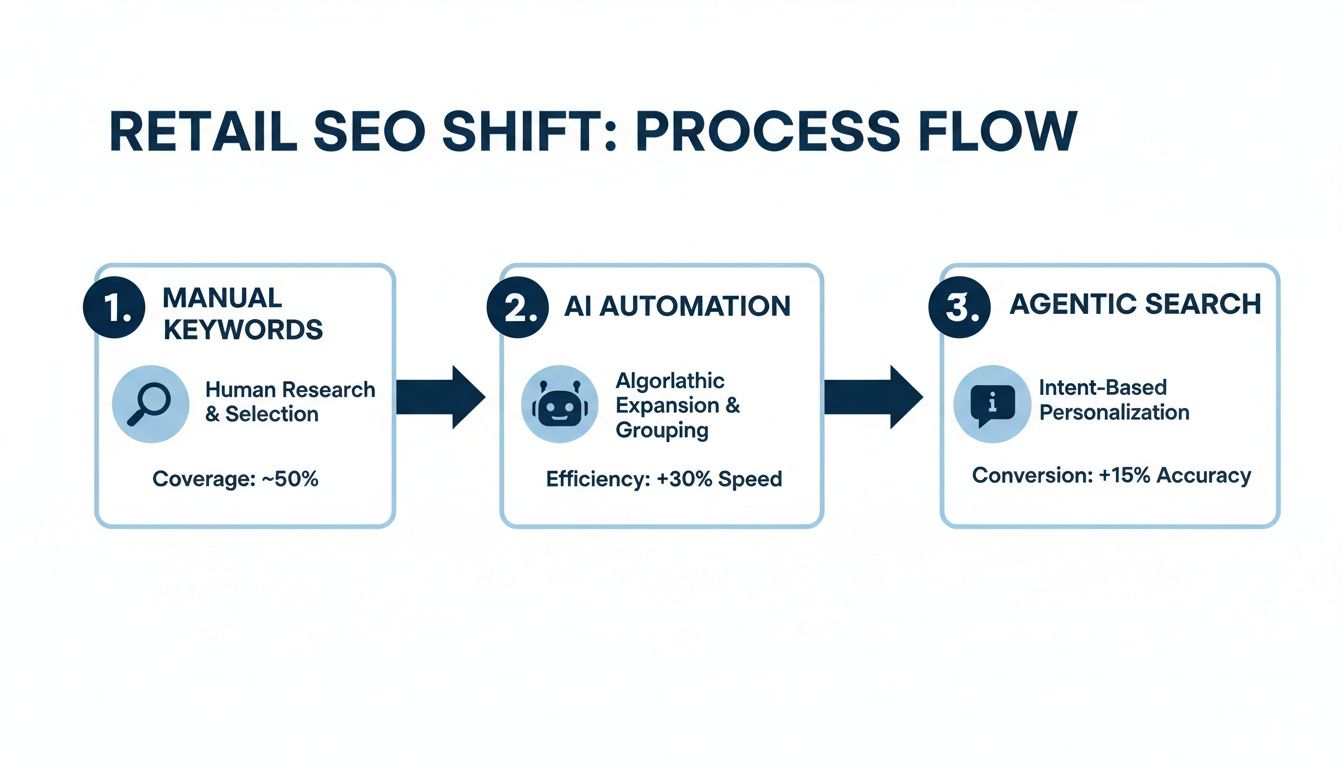
This evolution from manual keywords to AI automation isn't just a trend; it's the new operational standard for winning on the digital shelf.
From Supplier Feeds to Strategic Assets
Your first move is to stop accepting supplier content as-is. This generic info is usually riddled with duplicated phrases, inconsistent terms ("navy" vs. "dark blue"), and missing details that are crucial for both customers and search engines. Fixing this supplier content duplication is fundamental to avoiding duplicate content penalties and establishing your own brand voice.
The goal is to standardise and structure your data. With an automated content workflow, you can parse thousands of SKUs, flag inconsistencies, and enrich product listings with the information that’s missing.
For a fashion retailer, this might mean programmatically adding data points like:
- Fit Type (e.g., slim, regular, relaxed)
- Fabric Composition (e.g., 98% cotton, 2% elastane)
- Occasion (e.g., formal, casual, workwear)
This structured data is vital for SKU-level SEO, letting you create highly specific, long-tail content that captures customers who know exactly what they want. For a deeper dive into this stage, our guide on effective product data sourcing for retailers offers a comprehensive look at building your data pipeline.
The Role of AI in Product Data Enrichment
Let's be realistic: manually enriching a catalogue of 10,000+ products is impossible. It creates a massive retail content bottleneck. This is exactly where AI-powered optimisation becomes non-negotiable. Modern retail efficiency tools use AI to automate this process at a speed and scale that traditional teams just can't match.
AI agents for retail efficiency can analyse raw supplier feeds, identify missing attributes by comparing them against a master data model, and even infer specifications from product titles or images. This turns a chaotic jumble of data into a clean, structured, and powerful marketing asset.
For instance, an AI model can look at the title "Breville Barista Express Espresso Machine BES870" and instantly extract and structure these attributes:
- Brand: Breville
- Product Type: Espresso Machine
- Model Name: Barista Express
- Model Number: BES870
This is retail SEO automation in action. It’s not just about doing things faster; it's about achieving a level of detail and consistency that is simply out of reach manually. This enriched data then becomes the fuel for everything that follows: generating unique descriptions, optimising for AI shopping, and making sure your products are ready for the agentic commerce future. This is the foundation that lets you build a powerful, and scalable, SEO content strategy.
Create Unique Content at Scale and Eliminate Duplication
Duplicate content is the silent killer of your digital shelf performance. It's a massive problem for Aussie retailers. When your product pages are just a copy-paste of the generic descriptions from your suppliers, you’re not just failing to build a unique brand voice, you're actively kneecapping your search visibility. Google rewards originality, and seeing the same text on multiple sites can get your pages buried, or worse, penalised.
The real challenge is scale. If you’re an eCommerce manager looking after a catalogue with 10,000 SKUs, manually rewriting every single product description is an operational nightmare. It's a guaranteed bottleneck for your retail content pipeline. This is where moving from old-school manual SEO to an AI SEO workflow becomes a game-changer. It’s not about replacing your team, but giving them the tools to deliver scalable SEO solutions.
By setting up AI workflow automation, you can systematically tackle that mountain of duplicated supplier content across your entire inventory. This isn't just about spinning text. It’s about automating product descriptions to transform generic, uninspired supplier copy into unique, on-brand narratives that actually connect with your customers and satisfy search algorithms. It’s how you crush content bottlenecks for good and build a real competitive advantage.
Building Your Automated Content Workflow
A truly effective automated content workflow does more than just rephrase existing text. It uses that rich product data we talked about earlier as a foundation to generate entirely new, high-quality copy from the ground up. The process is a smart collaboration between AI agents and human oversight, making sure you get both efficiency and brand consistency.
A solid workflow usually looks something like this:
- Data Ingestion: The system pulls from your enriched product feed, using structured attributes like brand, material, colour, and key features as the raw ingredients.
- AI Generation: Custom-trained AI models, which have been aligned with your brand's specific tone of voice, generate unique product descriptions, titles, and meta descriptions from that structured data.
- Human-Led QA: Your team then reviews batches of the AI-generated content. Their job isn’t to rewrite everything. It's to act as a quality control layer, spot-checking for accuracy, brand voice, and overall polish.
This blend of human + AI collaboration in SEO is where the future of work in retail is heading. It frees your team from the grind of repetitive writing and lets them focus on more strategic work, like quality control and optimisation strategy. The end goal is to produce unique, compelling copy for every single SKU, whether you’re working on fashion SEO optimisation or complex electronics SEO optimisation.
Real-World Examples in Retail
To see how this plays out in the real world, let's look at a couple of different retail spaces.
For fashion SEO optimisation, a generic supplier description for a dress might just say: "Blue midi dress. 100% cotton. Made in Vietnam." An AI-powered workflow, using enriched data points, can turn that into something much better: "Embrace effortless style with our Azure Blue Cotton Midi Dress. Crafted from breathable, 100% organic cotton, this piece features a flattering A-line silhouette and delicate button-down front, perfect for a sun-drenched day in Sydney. Pair it with your favourite sandals for a chic, casual look."
Now, let's take electronics SEO optimisation. A supplier feed for a TV might list the bare facts: "65-inch 4K UHD Smart TV. HDR support." An automated workflow can flesh this out into SEO-rich copy that sells: "Immerse yourself in cinematic brilliance with the new 65-inch 4K UHD Smart TV. Experience lifelike colour and stunning clarity thanks to advanced HDR technology. With seamless access to all your favourite streaming apps, it's the ultimate centrepiece for your home entertainment system."
In both examples, the AI workflow created unique product descriptions that are not only better for SEO but are also far more persuasive for shoppers.
By automating product descriptions, a retailer can shift from optimising a handful of hero products to achieving SKU-level SEO across their entire catalogue. This systematic approach is the only way to ensure every single product is pulling its weight and contributing to your overall digital shelf performance.
Ensuring Quality with Human-in-the-Loop QA
While AI brings the speed and scale, it’s the human oversight that guarantees the quality. A critical piece of any retail content automation strategy is the human-led AI content QA process. This isn’t about micromanaging the AI; it's about setting the guardrails and keeping things on track.
Your team’s role evolves. They become:
- Prompt Engineers: Refining the instructions given to the AI to constantly improve the quality of its output.
- Brand Voice Auditors: Regularly reviewing samples to ensure the copy always sounds like your brand.
- Performance Analysts: Connecting content changes to ranking improvements and conversion rates to fine-tune the process over time.
This approach finally provides a duplicate content SEO fix that works at a massive scale, without sacrificing the little details that define your brand.
For a deeper dive into the frameworks and technologies that make this possible, our guide on creating SEO content at scale for retailers gives you the full picture. By combining AI's raw power with human expertise, you can finally solve the duplication problem and build a catalogue filled with high-performing, original content.
Optimise Your Catalogue for Visual and AI Search
In Australian retail today, a picture is absolutely worth a thousand keywords. SEO copywriting isn't just about the words on a page anymore. Visual search has become a massive discovery channel, and if your images aren't properly optimised, you're just leaving sales on the table.
This is especially true for visually-driven industries like fashion, furniture, and beauty. More and more, customers are using tools like Google Lens to find products they spot in the wild. Without the right metadata, your products are completely invisible to these high-intent searches.

The future of retail search is tied directly to your visual content. Making sure your product images are aligned with how both humans and AI agents discover products is non-negotiable for any serious eCommerce strategy.
AI Image Recognition: The Game-Changer for Retail
Let's be realistic: manually tagging thousands of product images is an impossible task for any retail team. This is where AI image recognition and tagging come in as essential retail efficiency tools.
AI models can scan every single product image in your catalogue and automatically generate the descriptive, keyword-rich metadata that search engines need. This covers everything from alt tags and file names to the structured data that helps AI agents understand precisely what an image contains.
For instance, an AI can look at a photo of a handbag and instantly spit out tags like:
- "tan leather tote bag"
- "gold hardware details"
- "crossbody strap"
- "women's work accessory"
Applying this level of detail consistently across thousands of SKUs drastically improves your digital shelf performance in visual search. It’s a perfect example of AI turning a mind-numbing manual job into a powerful, automated strategic advantage.
AI doesn't just see a "shoe"; it identifies it as a "women's black leather stiletto heel with a pointed toe." This detailed fashion product image SEO is precisely what allows your products to match specific, long-tail visual search queries, connecting you with customers at the exact moment of inspiration.
This automated process ensures every visual asset you own contributes directly to your SKU-level SEO, boosting visibility and driving more qualified traffic to your site.
Aligning Visuals for Agentic Commerce
With the rise of agentic commerce, AI shopping agents will soon be browsing your catalogue on behalf of customers. These agents depend heavily on structured, descriptive data to make their recommendations, and your image metadata is a huge part of that equation.
Well-optimised images, packed with accurate tags, give AI agents the context they need to recommend your products with confidence. Think about a query like, "Find me a waterproof hiking boot under $200 with ankle support." The AI needs to understand not just text but also the visual cues and attributes tagged to your product images to give a good answer.
This is why building a clean, structured data foundation is so critical. To get a deeper dive on this, it's worth learning how to build a high-quality product feed for AI search to ensure your visual content is fully compatible with the next generation of search.
A Practical Checklist for Metadata Optimisation
To get your catalogue ready for current and future search tech, you need a systematic approach. A great starting point is to implement something like an Amazon Listing Audit Checklist with AI Optimization to keep things consistent.
The table below breaks down the key elements you need to focus on and shows where AI can automate the heavy lifting.
Retail Metadata Optimisation Checklist
| Element | Optimisation Goal | AI Automation Opportunity |
|---|---|---|
| File Names | Use descriptive, keyword-rich names (e.g., brand-product-colour.jpg). |
Automatically rename files based on product attributes from your enriched data feed. |
| Alt Tags | Write clear, descriptive sentences explaining the image for accessibility and SEO. | Generate natural language alt tags using image recognition and product data. |
| Image Titles | Provide additional context that can appear on hover, reinforcing keywords. | Create optimised title tags based on product name, brand, and key features. |
| Structured Data | Use Schema markup to explicitly tell search engines what the image shows. | Automatically generate and implement image object schema for every product picture. |
By systemising your approach with these strategies, you create a powerful link between your written copy and your visual content. It ensures your SEO copywriting efforts cover every possible angle of how a customer might discover your products.
Future-Proof Your Copy for AI and Agentic Commerce
The game has changed. Retail search is becoming a conversation, and the old SEO playbook of chasing blue links on a results page is already gathering dust. We're now firmly in the era of agentic commerce, where AI assistants like Google's AI Overviews and Amazon's Rufus are the new personal shoppers. This isn't some far-off future; it demands a radical rethink of how we write product content right now.
To stay in the game, your content has to be easily digestible for these AI agents. They need to understand and, more importantly, trust your product information. We call this 'AI-compatible SEO content'. It’s less about stuffing in keywords and more about providing structured, factual data that directly answers the complex questions your customers are now asking their AI assistants.
And this shift is happening fast. The search landscape is being completely redrawn by AI. Recent Australian data shows that a staggering 65% of searches now end without a click because AI summaries are providing the answer directly. Australia is leading the charge in global AI search adoption at 1.42 AI queries per person, and 49% of Australians have already used generative AI, a jump from 38% the previous year. You can dig into more of these Australian search usage statistics on SearchScope.com.au.
The takeaway is simple: if your content isn't optimised for AI agents, you're about to become invisible to a huge chunk of your audience.
Structuring Content for AI Agents
To win in this new world of generative AI SEO, your copy needs to be built on a foundation of structured data, not just creative flair. AI agents don't 'read' your pages like a human. They parse them, hunting for factual, verifiable information to build their recommendations.
This means you need to get granular with your product details.
- Atomic Facts: Break everything down into small, digestible facts. Forget long paragraphs. Think lists of attributes like "Material: 100% Australian Merino Wool," "Weight: 250gsm," and "Origin: Victoria, Australia."
- Clear Benefit Statements: Connect the dots for the AI. For instance, "The 250gsm Merino wool provides natural temperature regulation, keeping you warm in winter and cool in summer." It's direct and unambiguous.
- Comparative Language: Make it easy for AI to compare your products against competitors. Use consistent terms for features across your entire catalogue. This helps agents evaluate options and recommend your product.
This structured approach is the backbone of any AI-compatible SEO content strategy. It’s what ensures your products aren't just found, but actively recommended.
The core principle here is to make your product information as clear and unambiguous as possible. An AI agent should be able to look at your page and confidently tell a user, "Yes, this product meets all of your specific requirements."
From Keywords to Conversational Answers
The next step is a mental shift. Stop thinking about simple keywords and start thinking about complex, conversational questions. What would a real customer ask an expert in-store? Write content that answers those questions head-on.
Let's take a high-end camera as an example:
- Old Keyword Focus: "4K mirrorless camera"
- New Conversational Focus: "What is the best mirrorless camera for shooting fast-action sports in low light?"
To answer that question, your copy needs explicit details about sensor performance, ISO range, and autofocus speed. This detailed, answer-first approach to search engine optimisation copywriting is crucial for achieving high digital shelf performance today. The goal is a perfect human + AI collaboration in SEO, where your team's expertise fuels the structured data that AI agents crave.
This change in strategy is fundamental to adapting your ecommerce operations for what's next. To go deeper, check out our guide on building the retail tech stack for an agentic future. By future-proofing your copy today, you're setting your brand up to not just survive but thrive in the new world of agentic shopping and the future of work.
Got Questions? We've Got Answers
Shifting from manual SEO to an AI-powered approach can bring up a few questions. It's a big move. Here are some of the most common ones we hear from retail leaders, along with some straight answers.
How Is AI SEO Really Different from What We're Doing Now?
The biggest change is moving from manual, page-by-page work to automated, catalogue-wide workflows. Traditional retail SEO means having someone painstakingly optimise pages one at a time, a process that’s completely impossible when you have a massive product catalogue.
The difference with AI SEO is that we can use AI agents to handle tasks like product data enrichment, generating unique descriptions, and optimising image metadata across thousands of SKUs all at once. It’s the only practical way to achieve true SKU-level SEO and get consistent digital shelf performance.
Can AI Actually Sound Like Our Brand?
Yes, but it needs a human in the driver's seat. The best results always come from a human + AI collaboration.
Your team sets the stage by providing brand guidelines, examples of your tone of voice, and the overall strategic direction. The AI models are then trained on that input to generate content that sounds like you. A human-led AI content QA process is the final step, ensuring every piece of copy is polished and perfectly on-brand. It’s the perfect blend of AI’s speed and human expertise.
How Do I Measure the ROI on This?
Tracking the return on investment for retail content automation is actually quite direct, and it ties back to the retail metrics you already care about:
- Better Organic Rankings: Watch the search visibility climb for product and category pages that were previously buried.
- Higher Conversion Rates: When content is rich with attributes and answers customer questions upfront, add-to-cart rates naturally increase.
- Faster Time-to-Market: Measure the massive drop in the time it takes to get new products live. This is a huge efficiency gain, especially during new season launches.
- Lower Operational Costs: Simply compare the investment in AI workflow automation against the salary costs of a large, manual content team. The difference is usually pretty stark.
Are You Trying to Make My Copywriting Team Redundant?
Absolutely not. This is about upskilling your team, not replacing them. Your copywriters can finally stop the mind-numbing task of writing thousands of similar product descriptions and move into more strategic roles.
They become AI workflow managers, brand voice guardians, and performance analysts. They start using generative AI for retail teams as a tool to amplify their impact, shifting their focus from tactical grunt work to strategic oversight.
This shift empowers your team to focus on high-value tasks that actually drive growth, rather than getting bogged down in manual creation. It’s about enhancing their capabilities, not making them obsolete. This is a core part of the future of work in retail.
How Does This Apply to Our Physical Stores in Australia?
AI-driven SEO is a massive advantage for multi-channel retailers. For Australian retailers in particular, local SEO copywriting is a goldmine.
‘Near me’ searches have shot up by 500% since 2015 in Australia. Even more importantly, 76% of people who make a location-based search on their phone visit a store within 24 hours. AI can generate locally-optimised content at scale, making sure your "click and collect" product pages show up for geo-specific searches and drive real foot traffic into your stores. You can read more about these Australian local SEO insights at Netstripes.com.
Ready to move from manual SEO to an AI-powered future? Optidan AI delivers the scalable SEO solutions and automated content workflows your retail business needs to win on the digital shelf. See how we can enrich your product feeds and create thousands of unique, optimised pages in a matter of days. Visit Optidan.com to learn more.
