


In Australian retail, an SEO content writer is no longer just a wordsmith. They have become the strategic architect behind your digital shelf, responsible for turning generic supplier product feeds into unique, brand-aligned assets that sell.
This role is absolutely critical for getting your brand ready for the future of agentic commerce, where AI agents like Amazon's Rufus and Perplexity are starting to drive product discovery. For retail leaders and ecommerce managers, finding a writer with this specific skill set is a top priority for achieving genuine retail efficiency and scalable SEO solutions.
From Keywords to Commerce: The New Retail SEO Writer

The job of an SEO content writer in Australian e-commerce has completely changed. Gone are the days of just stuffing keywords into product descriptions. Today’s retail leaders need a specialist who understands the complex dance between product data, brand voice, and the algorithms powering both traditional search and AI shopping assistants. This is the shift from manual SEO to AI SEO.
This new blueprint requires a writer who thinks like a data strategist. Their main job is to tackle one of the biggest headaches for large retailers: correcting duplicated supplier content. By rewriting and enriching thousands of product descriptions through automated content workflows, they build a unique voice that stands out to customers and search engines, avoiding penalties and boosting digital shelf performance.
The Agentic Search Imperative
The rise of agentic shopping is the real force behind this shift. A modern SEO content writer has to create content that is not only easy for humans to read but is also structured for machines to understand. This is where AI-driven SEO becomes non-negotiable for any forward-thinking retail team.
Content has to be clear, factual, and optimised so AI agents can parse it and make recommendations. This really boils down to:
- Product Data Enrichment: Taking basic supplier feeds and turning them into detailed, structured content with all the right attributes, benefits, and specifications for effective multi-channel product optimisation.
- Unique SKU-Level Content: Making sure every single product page offers something different, moving far away from the old copy-paste approach by fixing supplier content duplication.
- AI-Compatible Formatting: Using clean headings, lists, and structured data that AI agents can easily interpret to answer a shopper's query, a core principle of agentic search optimisation.
Getting this right ensures your product catalogue is ready for the next wave of retail search, where AI-led discovery is the new norm.
A top-tier retail SEO content writer is your first line of defence against retail content bottlenecks and your greatest asset in preparing for an AI-first commercial world. They are the human intelligence behind your AI workflow automation for retail, ensuring brand consistency and quality at scale.
Driving Commercial Outcomes
At the end of the day, it's all about commercial results. In the cut-throat Australian eCommerce space, a skilled SEO content writer is vital, especially when 93% of online experiences begin with a search engine and 75% of users never click past the first page. It’s no wonder Australian businesses are on track to spend $1.5 billion on SEO services in 2025.
To truly own the role, a retail SEO writer must master effective content creation strategies, as this forms the very foundation of their work. They are directly on the hook for improving rankings, lifting conversions, and securing your brand’s visibility. By optimising content at scale across tens of thousands of pages, they deliver real, measurable improvements to your bottom line, showcasing the power of scalable SEO solutions.
What It Takes to Be an AI-Ready Retail SEO Writer
So, what separates a good writer from a great one in today’s retail game? It is not about elegant prose or clever headlines anymore. The most valuable SEO content writer for an e-commerce brand is a unique blend of tech-savvy, strategist, and creative, all rolled into one.
Think of them as the critical link between raw product data and a high-performing digital shelf. Their job goes way beyond just writing; it directly impacts your visibility, how customers engage with your products, and whether you're ready for the next wave of AI-powered shopping. This skillset is becoming seriously sought after, marking a huge shift in how retailers need to think about their online content and the future of work in retail.
And the demand is growing fast. As Australian businesses pour more into their SEO efforts, the earning potential for writers with the right expertise is climbing. In Australia, a skilled professional can pull in an average salary of around $80,000, a number that proves just how vital this role is to driving real e-commerce results. You can read the full research on SEO professional earnings to see the trend for yourself.
The traditional SEO writer's playbook is quickly becoming outdated. Today's environment, driven by AI and massive product catalogues, demands a new set of skills. The focus has shifted from just writing for humans and basic search engines to structuring data for intelligent systems, all while maintaining a strong brand voice. This is the core difference between AI SEO vs traditional SEO teams.
Essential Skills for a Modern Retail SEO Content Writer
| Skill Area | Traditional SEO Writer | AI-Ready Retail SEO Writer |
|---|---|---|
| Data Handling | Works from a simple brief; limited data interaction. | Transforms raw supplier feeds into structured, enriched content via product feed optimisation. |
| Content Strategy | Focuses on keywords and on-page SEO for Google. | Eliminates duplicate content and builds a unique brand voice at scale. |
| Technical SEO | Understands meta tags, H1s, and basic schema. | Masters structured data, AI-readability, and agentic search optimisation principles. |
| Tools & Workflow | Uses word processors and basic keyword research tools. | Integrates with AI platforms and automated content workflows for retail efficiency. |
| Core Goal | Rank a handful of "money pages" on Google. | Optimise the entire product catalogue for visibility across all search platforms, including AI agents. |
This table is not just a comparison; it is a roadmap. The writer on the right is not just a better writer, they are a strategic asset who understands that modern retail performance is built on a foundation of clean, structured, and unique content.
Let's break down the three core pillars that define this role.
Mastery of Product Data Enrichment
At its heart, the modern retail writer's job starts with data. They need to be experts in product data enrichment, the art of turning a sparse supplier feed into compelling, optimised, and structured content that both customers and AI can understand. This is not just about tweaking a few bullet points; it is a strategic overhaul of your product catalogue SEO.
This skill involves:
- Spotting the Gaps: Quickly identifying what is missing from raw supplier data. Think attributes, key specifications, and customer benefits that AI agents and shoppers need to make a decision.
- Structuring for Machines: Organising all that information logically. We’re talking clear headings, lists, and semantic tags that let AI shopping agents parse your content in a split second.
- Optimising at Scale: Applying these principles across thousands of SKUs, using smart, AI-assisted workflows to keep things fast and consistent, a key component of optimising product feeds efficiently.
A writer who nails this can turn a basic product catalogue into your most powerful sales tool, ready for human shoppers and the future of AI search.
Strategic Correction of Duplicated Content
One of the biggest silent killers for large retailers is supplier content duplication. Copying and pasting the same generic descriptions from manufacturers across hundreds of sites is a surefire way to get penalised by search engines and wash out your brand identity. This is where a duplicate content SEO fix becomes critical.
An AI-ready SEO writer is your frontline defence against this. They are pros at systematically finding and rewriting duplicated content, creating unique product stories that actually sound like your brand. This is not just cleanup; it is a critical task for dominating the digital shelf and building authority. If you want to dig deeper, you can learn more about balancing AI automation and brand voice in our article.
The ability to de-duplicate content at scale is not just a cleanup task. It is a fundamental strategy for building a unique, competitive advantage on search engine results pages and preparing for agentic search optimisation.
Deep Understanding of AI SEO Principles
Finally, any forward-thinking SEO writer has to be fluent in AI SEO. This means they get how generative AI and agentic search systems, like ChatGPT, Perplexity, and Amazon's Rufus, discover, evaluate, and recommend products. It is a whole new ball game requiring next-gen SEO for retailers.
Their content needs to be built to answer specific questions, clearly and factually. This includes using AI image recognition to tag visual assets, making sure everything from the alt text on a t-shirt to the metadata on a laptop is perfectly optimised for a machine to read. This is where human skill and AI efficiency meet to build scalable SEO solutions that last.
By mastering these core skills, a retail SEO writer shifts from being a simple wordsmith to a strategic driver of retail performance, ready to tackle the AI-powered future head-on.
Building an AI-Powered Retail Content Workflow
Let's be honest, manual content creation is the biggest bottleneck in retail. It slows down product launches, kills your ability to react to market shifts, and just does not scale. Moving from that slow, manual grind to a smart system powered by both humans and AI is not just a nice-to-have anymore, it is about survival. A modern, AI-powered content workflow is what lets you manage thousands of pages with speed and precision.
This new model is not about replacing your expert SEO content writer. It is about giving them a promotion. Instead of being buried in repetitive, low-value tasks, they become the strategic brain overseeing an automated system. This frees up your team to focus on what actually moves the needle: brand voice, quality control, and high-level optimisation. This is the future of work in retail.
The process kicks off by taking in raw supplier product feeds, which are often a complete mess of inconsistent data. From there, AI tools do the initial heavy lifting, enriching product data, structuring information, and spitting out a first draft. This is where your writer steps in, taking the AI's raw output and turning it into polished, on-brand content that sells.
This new process flow shows how an SEO writer's skills evolve, moving from a technical foundation to data enrichment and, finally, to AI-powered optimisation.
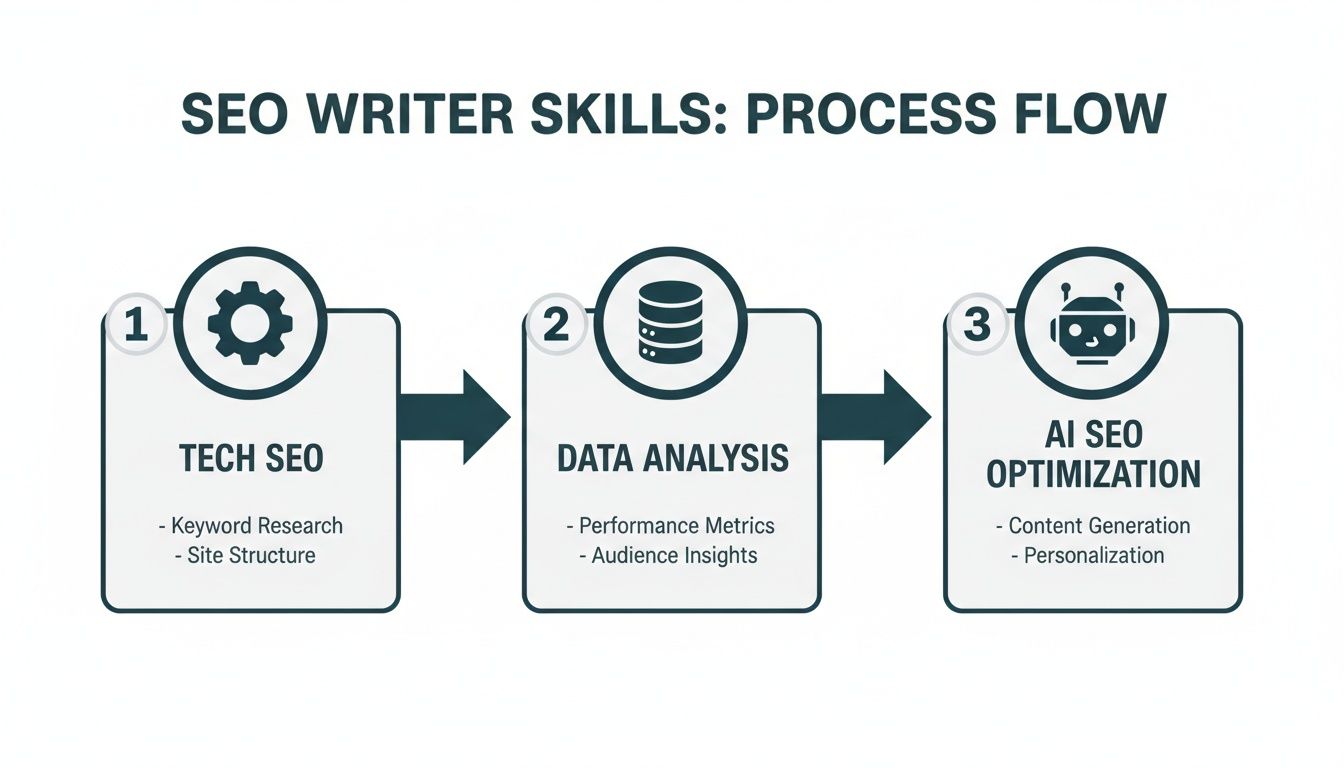
It is clear the modern writer is not just a creative. They are a technical, data-driven strategist who uses AI as a tool to scale their expertise.
From Manual Grind to Automated Scale
The old way, having writers manually churn out every single product description, is completely unsustainable for retailers with thousands of SKUs. An AI-powered workflow flips this broken model on its head.
It is a system built for SEO at scale, letting your business manage massive product catalogues without the quality nose-diving. This automated content workflow is the engine that drives next-gen retail SEO and is a cornerstone of AI-powered retail transformation.
The impact is huge, particularly in Australia where AI adoption is completely changing search behaviour. The country leads the world with 1.42 AI queries per person, and that trend has a direct impact on e-commerce. A massive 65% of searches now end without a click thanks to AI summaries and answer boxes, which means retailers have to make their product content machine-readable from the get-go. For writers, this means ditching old methods and creating AI-friendly frameworks that feed these new AI agents.
The Writer's Role in an AI Workflow
In this new setup, the SEO content writer's job becomes far more strategic. They are no longer just producers; they are editors, strategists, and guardians of quality. Their expertise is applied at critical moments to make sure the final output hits brand standards and performance targets.
Their key responsibilities now include:
- Setting the AI's Tone: The writer is crucial for configuring the AI's brand voice. They provide the guidelines and examples that ensure every piece of generated content sounds like it came from your company, not a robot.
- Strategic Quality Assurance: They review and polish AI-generated drafts, fixing errors, improving clarity, and adding that creative touch machines just cannot replicate. This human-led AI content QA is vital for maintaining customer trust.
- Advanced Optimisation: While AI handles the basic SEO, the writer focuses on advanced tactics. This means optimising for long-tail keywords, perfecting internal linking, and making sure the content is structured for agentic search.
- Enriching Visuals with Data: A key task is overseeing AI image recognition and tagging. For categories like fashion or furniture, ensuring every image has accurate, descriptive alt text is a game-changer for visibility and a core part of image SEO for ecommerce.
An AI workflow does not diminish the value of a skilled writer; it amplifies it. By automating the mundane, you free up your best talent to focus on the high-impact strategic work that drives digital shelf performance and conversions.
This approach turns your content operations from a cost centre into a scalable performance driver. By integrating your writer into a system that blends human expertise with machine efficiency, you create a powerful engine for growth.
And to really get the most out of every piece of content, look into effective content repurposing strategies that fit your new AI-powered workflow. It is a smart way to ensure the great content your team produces gets seen across multiple channels, boosting its value and giving it a longer life.
How to Write a Brief That Delivers Maximum ROI

An unclear brief is the fastest way to get back content that misses the mark. If you want your SEO content writer to deliver commercially effective work from day one, you need a briefing document that leaves absolutely nothing to chance.
This is not about just handing over a list of keywords. It is about arming your writer with the strategic context they need to win.
For retail leaders, this means crafting a blueprint for performance, not just a set of instructions. A powerful brief connects the writer's words directly to tangible business goals, whether that is improving your digital shelf performance or future-proofing your catalogue for agentic search optimisation. It shifts them from a task-doer to a strategic partner who is invested in your bottom line.
The best briefs are built on rock-solid clarity. They kill any ambiguity around your target audience, brand voice, and specific SEO objectives, setting the stage for content that actually moves the needle. This is especially vital when you're looking to optimise at scale, where one perfectly crafted brief can guide the creation of thousands of high-performing pages.
Core Components of a High-Performance Brief
To get the best work out of your SEO content writer, every brief needs a few non-negotiable elements. Think of this as your pre-flight checklist before launching any content project, from a single category page to a full product feed optimisation. A detailed brief slashes the back-and-forth, cuts down on revisions, and gets your content to market faster.
Your checklist must include:
- Audience Persona: Who are we really talking to? Get specific about their pain points, what drives them, and how much they already know. Are they a trade professional hunting for specs or a beauty & cosmetics shopper looking for benefits?
- Brand Voice & Tone: How do we want to sound? Provide clear do's and don'ts. Is your brand professional and technical, like for an electronics SEO optimisation project, or is it aspirational and sensory for fashion SEO optimisation?
- Commercial Objectives: What is the goal here? Define what success looks like. Are we trying to boost add-to-carts, lift category page rankings, or drive sign-ups to a loyalty program?
- SEO Parameters: Give them the hard targets. This means primary and secondary keywords, internal linking instructions, and any specific goals for metadata optimisation at scale.
Structuring for AI and Agentic Search
As we barrel towards the agentic commerce future, your briefs have to evolve. It is not enough to write for human readers and Google anymore. You need to explicitly brief your writer to create content that is also machine-readable and primed for SEO for AI agents like ChatGPT and Rufus.
This means your brief must get technical about the content's structure. Specify the need for clear, factual language that cuts the marketing fluff. Mandate the use of structured formats, bullet points for features, numbered lists for instructions, and clean H2s and H3s that break down information logically. This is a fundamental part of building AI-compatible SEO content that will perform in this new retail search landscape.
The modern retail brief is a strategic document that aligns human creativity with machine intelligence. It instructs the writer not just on what to write, but how to structure information for both human persuasion and AI-driven discovery.
For example, when briefing for unique product descriptions SEO, tell your writer to pull key attributes from supplier feeds and present them in a consistent format. This process of product data enrichment is absolutely crucial for AI agents, which rely on structured data to compare products and make recommendations. By including these instructions, you ensure every piece of content you create contributes to your readiness for the future of work in retail, where human + AI collaboration in SEO becomes the standard.
Finally, one of the most powerful things you can do is provide clear examples. Include links to best-in-class content from your own site or even a competitor. For a deeper dive, pointing your writer to resources on the best practices for writing content for your website can give them valuable context and dramatically improve the final result. It is a simple step that can save hours of revisions and help your writer nail it on the first go.
Measuring the True Impact of Your SEO Content
So, you have invested in a skilled SEO content writer. How do you actually prove it is paying off? In retail, vanity metrics like impressions and clicks just do not cut it. You need to see a clear line connecting their work to real commercial outcomes.
That is where the right key performance indicators (KPIs) come in. They justify the investment and show how high-quality content directly impacts the bottom line.
The real value of an expert writer shines through in their ability to lift your digital shelf performance across the entire catalogue. This is not just about hitting page one for a few keywords; it is about measuring genuine customer engagement and a smoother path to purchase. It is about business impact.
Core KPIs for Retail Content Performance
To get a true picture of your return on investment, you need to track the metrics that matter. These numbers tell the story of how your content is performing, from the first click all the way to checkout.
- Improved Search Rankings: Are you climbing the ladder for high-intent product and category keywords? Seeing your products rise in the ranks for terms that scream "I'm ready to buy" is the first sign of effective retail SEO automation.
- Organic Traffic Growth: Keep an eye on the non-paid traffic flowing to your key category and product pages. A great writer does not just attract any traffic; they attract qualified shoppers who are actively looking for what you sell.
- Lower Bounce Rates: When content hits the mark and answers a shopper’s question, they stick around. A noticeable drop in bounce rates on your critical landing pages is a clear signal that the writer is creating relevant, engaging experiences.
- Increased Conversion Rates: At the end of the day, great content sells. You need to measure the uplift in add-to-carts and completed checkouts from organic search. An expert writer should be a major contributor to your ecommerce conversion rate optimisation efforts.
Measuring Readiness for Agentic Search
Beyond these traditional metrics, forward-thinking retailers are now measuring something else: their content's 'AI readiness'. With AI shopping assistants and agentic search becoming the new norm, the structure and quality of your content is more critical than ever.
This is a whole new layer of measurement, and it is all about gauging your preparedness for the future of retail search.
An SEO content writer's impact here is measured by their ability to produce AI-compatible SEO content. This means moving away from old-school keyword stuffing and towards creating factual, clearly structured information that machines can easily understand and trust.
Measuring AI readiness is no longer a "nice-to-have." It is a direct assessment of your brand’s ability to compete in a world where AI agents make purchasing recommendations. The writer’s role in structuring product data for this new reality is absolutely critical.
To see how you stack up, start auditing your content against these benchmarks:
- Structured Data Implementation: Is your product information, from specs to benefits, organised in a clean, machine-readable format?
- Content Uniqueness Score: What percentage of your product descriptions are truly unique versus just copied from supplier feeds? A higher uniqueness score is essential for both Google and AI agents.
- Factual Accuracy and Clarity: Does the content prioritise clear, factual statements over fluffy marketing jargon? For SEO for AI agents, facts always win.
By tracking these advanced metrics alongside your traditional KPIs, you get the complete picture of your writer’s impact. This data-driven framework does not just prove ROI; it builds a rock-solid case for continued investment in a content strategy that is ready for whatever comes next in commerce.
Frequently Asked Questions
Hiring a skilled SEO content writer can feel like a minefield, especially when you are trying to get your retail business ready for an AI-driven future. Here are the answers to the questions we hear most often from Australian e-commerce leaders, designed to give you clarity and confidence.
What Is the Difference Between an SEO Content Writer and a Copywriter?
While both work with words, an SEO content writer and a copywriter have fundamentally different jobs. A copywriter’s world revolves around persuasion, they craft sharp, punchy text for ads, landing pages, and emails to drive a single action, like a click or a sale. Think of them as the closers.
An SEO content writer in retail plays a much broader game. Their goal is to attract, engage, and inform both shoppers and search algorithms. This means creating detailed content for product descriptions, category pages, and guides that answer customer questions, build authority, and climb the search rankings. They are the architects of your digital shelf performance, not just writers of ad copy.
How Does an SEO Writer Handle Duplicated Supplier Content?
Fixing supplier content duplication is one of the most critical jobs for a modern retail SEO writer. Simply copying and pasting generic manufacturer descriptions is an SEO death sentence, it tanks your rankings and makes your brand look just like everyone else.
A skilled writer does not just edit this content; they transform it. Their process looks like this:
- Audit the Catalogue: First, they hunt down every instance of duplicated or thin content across your product feeds.
- Strategic Rewriting: Next, they create unique product descriptions that actually sound like your brand and speak to your customers.
- Product Data Enrichment: Finally, they add the missing details, benefits, and specs that make each product page genuinely useful to a shopper and easy for an AI agent to understand.
This is not just a cleanup job. It is how you build a competitive moat around your product catalogue.
A great SEO content writer does not just fix duplicate content, they transform it into a powerful asset. They turn a major SEO liability into a distinct advantage that improves rankings and reinforces your brand identity at every touchpoint.
Should Our SEO Writer Use AI Tools?
Yes, but with the right strategy. The conversation is no longer about if an SEO writer should use AI, but how. A top-tier writer does not use AI to replace their skills, they use it to amplify them. They should be experts at using AI to drive retail content automation.
This human + AI collaboration in SEO works best this way:
- AI for Efficiency: The writer uses AI to generate first drafts, summarise dense technical specs, or handle initial product data enrichment from raw supplier feeds.
- Human for Quality: The writer then steps in to provide the crucial layer of quality control, refining the brand voice, fact-checking details, and adding the creative flair that machines cannot replicate.
An expert uses AI as a powerful assistant, not a crutch. This frees them up to focus on high-value strategic work, making SEO at scale possible without sacrificing an ounce of quality.
What Makes a Writer Ready for Agentic Search?
A writer is ready for agentic search optimisation when they understand how to write for machines as well as they write for people. The future of retail search belongs to AI agents like Google’s AI Overviews and Perplexity, which need clean, factual, and perfectly structured information to recommend products.
An agentic-ready writer creates AI-compatible SEO content by focusing on:
- Factual Clarity: They prioritise clear, unambiguous facts over vague marketing fluff.
- Structured Formatting: They use headings, bullet points, and tables to organise information in a way that is easy for an AI to parse.
- SKU-Level Detail: They ensure every single product page contains rich, specific attributes that an AI agent can grab for direct comparisons.
This skill set is no longer a nice-to-have. It is absolutely essential for any retailer who wants to stay visible as agentic commerce becomes the new normal.
Ready to transform your retail content from a bottleneck into a performance engine? Optidan AI provides the AI-powered workflows and optimisation frameworks to help your team deliver high-quality, unique, and agentic-ready content at scale. Discover how our platform prepares your digital shelf for the future of commerce by visiting https://optidan.com.
