


Writing content for a website isn't just about filling a blank page. It's a strategic process of creating unique, SEO-optimised product descriptions and category pages that genuinely answer customer questions while being perfectly structured for search engines.
This is especially critical for Australian retailers stuck with generic supplier data. You need to transform that basic information into compelling content that boosts your digital shelf performance and gets you ready for the future of AI-driven search and agentic commerce.
From Manual Bottlenecks to AI-Powered Efficiency

For most Australian retail leaders, the idea of writing unique content for thousands, or even tens of thousands, of products feels completely overwhelming. The traditional, manual approach is slow, expensive, and just can't keep up with the pace of modern ecommerce. It creates massive retail content bottlenecks, leaving teams bogged down by duplicated supplier copy while trying to carve out a distinct brand voice.
Let's be honest, that old way of working is broken. The challenge isn't simply producing more words; it’s about creating optimised, structured product content that actually performs at scale. This means finally moving beyond those generic supplier feeds and tackling the duplication penalties that are tanking your search rankings.
The Shift to Scalable SEO Solutions
The future of retail belongs to those who make the leap from manual SEO to AI SEO. In Australia’s buzzing ecommerce scene, where there are now over 26 million online shoppers, content has become a make-or-break factor. It's no surprise that Australian businesses are set to pour $1.75 billion into the SEO market this year, a surge driven by AI adoption that is fundamentally changing how product pages get made.
This new playbook is all about using retail content automation to do what was once impossible: optimising 10,000+ pages in a matter of days, not years. It's about building a solid, efficient AI workflow that turns your entire product catalogue into a powerful asset for driving real visibility and revenue.
By embracing AI-powered content workflows, you’re not just writing content faster. You’re building a foundation for the future of retail search, preparing your business for agentic shopping and the evolution of AI agents in ecommerce.
To illustrate the difference, let's compare the old way with the new.
Manual vs AI-Powered Content Workflows
This table breaks down the core differences in efficiency, scale, and strategic outcomes between traditional content creation and a modern, AI-driven approach for retailers.
| Metric | Traditional Manual Process | AI-Powered Automation |
|---|---|---|
| Time to Market | Weeks or months for a few hundred pages. | Days for thousands of pages. |
| Scalability | Limited by team size and budget; not scalable. | Scales instantly across the entire catalogue. |
| Cost Per Page | High, due to intensive manual labour. | Drastically lower, enabling site-wide optimisation. |
| Consistency | Varies by writer, leading to brand voice issues. | Consistent brand voice and SEO rules applied everywhere. |
| Data Gaps | Often leaves missing attributes and thin content. | Enriches product data to fill gaps automatically. |
| Strategic Focus | Tactical, focused on a few "money pages." | Strategic, optimising every SKU for performance. |
| Future Readiness | Not prepared for AI agents or structured data needs. | Built for agentic search and modern discovery. |
As you can see, sticking with a manual process leaves you at a significant disadvantage. The AI-powered approach isn't just about speed; it's about building a more robust, competitive, and future-proof content system.
Embracing Next-Gen SEO for Retailers
Modern retail SEO demands a strategic, technology-first mindset. This is built on a few key pillars of a modern digital content strategy:
- Product Data Enrichment: This is where you turn basic supplier feeds into detailed, unique, and customer-centric product stories that sell.
- AI Image Recognition: Think automatically generating descriptive alt tags for your entire fashion or furniture catalogue, making your visual assets work much harder for SEO.
- Agentic Search Readiness: It’s about structuring content so it's easily understood and favoured by AI shopping agents like ChatGPT, Perplexity, and Amazon's Rufus.
Making this strategic pivot is absolutely essential for improving your digital shelf performance. Once you understand the principles of producing content at scale, you can ensure every single SKU contributes to your brand's visibility and conversion goals, giving you a real competitive edge in a crowded market.
Building Your Foundation With Strategic Keyword Mapping
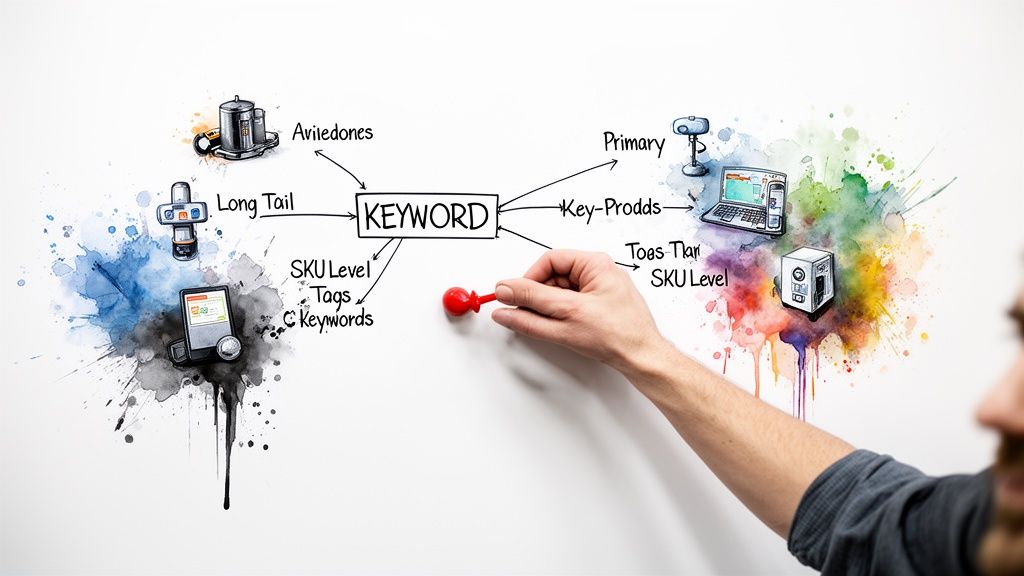
Before your team writes a single word, you need a solid keyword strategy. This is non-negotiable.
Far too many Australian retailers miss the mark by chasing broad, generic terms. They completely overlook the high-intent, SKU-level queries that actually drive sales. It’s an oversight that leads directly to wasted effort and poor performance on the digital shelf.
A smart strategy is the absolute bedrock of successful retail SEO. It’s all about mapping primary and long-tail keywords to specific product and category pages. This ensures every single piece of content has a clear purpose and speaks directly to a target audience.
Moving Beyond Generic Keyword Lists
The old way of doing things, chasing high-volume "head" terms, just doesn't cut it anymore. Especially not for retailers juggling thousands of products.
Your customers are using incredibly specific phrases to find exactly what they want, and your keyword strategy has to reflect that behaviour. This means shifting your mindset from old-school manual SEO to a more intelligent, AI-driven approach where data guides every single decision. It requires a deep dive into how real people search for products in categories like fashion, furniture, or electronics.
For a more detailed breakdown, you can learn more about what is keyword research and see how it forms the basis of any scalable SEO solution.
The goal isn't just to find keywords; it's to understand user intent at a granular level. Are they researching, comparing, or ready to buy? Mapping keywords to each stage of the buyer's journey is critical for creating content that converts.
Preparing for the Future of Retail Search
The next frontier is already here: agentic search optimisation. AI shopping agents like ChatGPT, Perplexity, and Amazon's Rufus are fundamentally changing how products get discovered. These AI agents don’t browse websites like we do; they rely on structured, query-focused content to provide answers and recommendations.
Your keyword mapping has to account for this shift. It involves identifying the conversational, question-based keywords that your content can directly answer. Taking this proactive approach ensures your product catalogue is visible not just to human searchers, but to the AI assistants guiding their purchasing decisions.
Integrating Agentic Search Optimisation
To get your catalogue ready for the future of agentic commerce, your keyword strategy should include:
- Question-Based Keywords: Start targeting queries like, "what is the best wool jumper for winter in Melbourne?" or "are Bosch dishwashers energy efficient?". This is exactly how people talk to AI agents.
- SKU-Level SEO: Go deeper than category pages. You need to identify long-tail keywords for individual products. Think "men's black R.M. Williams boots size 10" instead of just "men's boots."
- Attribute-Focused Terms: Weave in keywords related to specific features, materials, or benefits. This is the detailed information AI agents use for comparison. Good examples include "organic cotton baby clothes" or "smart TV with Dolby Atmos."
By building this level of detail into your keyword map from day one, you create a powerful foundation for your entire content workflow. It’s what allows AI-powered tools to perform product data enrichment at scale, turning generic supplier feeds into thousands of precisely optimised pages.
This strategic mapping is the first and most critical step in moving away from slow, manual processes to a dynamic, AI-powered content engine. It bridges the gap between your product data and your customer's intent, ensuring every page is primed for visibility and conversion. To make sure your content effectively leverages this strategy, you might consider getting specialised help from SEO Copywriting Services.
Crafting High-Conversion Page Templates That Scale
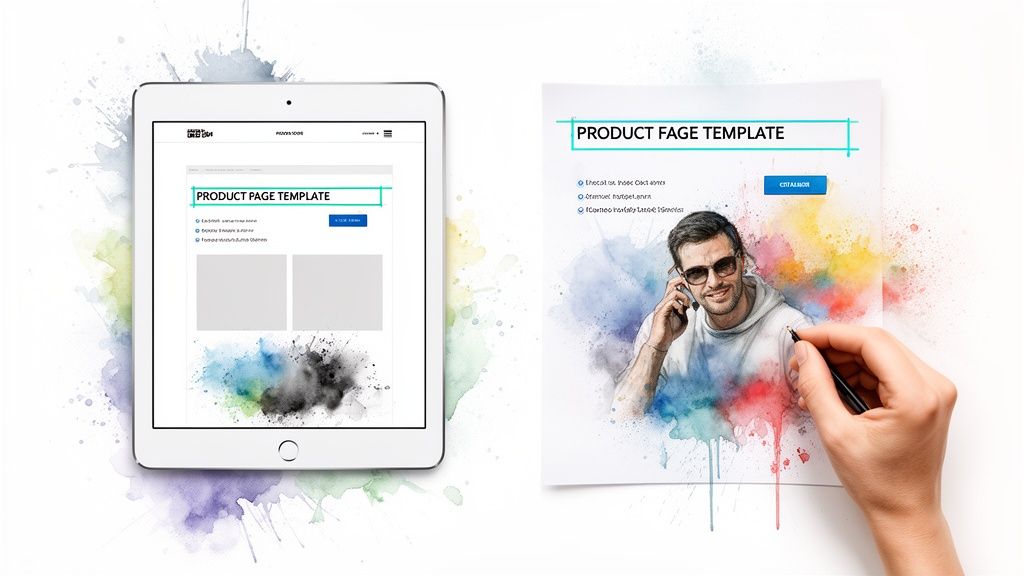
A consistent, optimised template is the absolute backbone of any content strategy that needs to scale. It’s the framework that lets you turn raw supplier data into unique, high-performing pages right across your product catalogue.
Without solid templates, any attempt at retail content automation quickly turns to chaos. You end up with a mess of inconsistent pages that don't connect with customers or impress search engines.
The idea is to design clear blueprints for your key retail pages, especially your product and category pages. These templates have to do more than just hold information; they need to be built from the ground up for both AI SEO and human conversion. This means embedding on-page best practices directly into the structure, ensuring every page, whether it's your first or your ten-thousandth, is set up to win from the moment it goes live.
The Anatomy of an Optimised Product Page Template
Your product page template is where the real work gets done. It’s the final stop on the customer journey and your single best shot at making a sale. As you shift from manual SEO to AI-driven workflows, this template needs to be bulletproof so automated systems can populate it perfectly every time.
Here are the core parts of a high-performance product page:
- SEO Title Tag: Think formulaic but flexible. A good structure often combines the product name, a key attribute, the brand, and the category. For instance: Brand X Model Y Waterproof Hiking Boot – Men’s Outdoor Footwear.
- Meta Description: This is your elevator pitch. It needs to be a compelling, benefit-focused summary under 160 characters that includes a call-to-action and your main keyword.
- Unique Product Description: This is where you move beyond bland supplier-speak. Focus on the benefits, real-world use cases, and sensory details that actually solve a customer's problem.
- Structured Data Readiness: Your template must be designed to easily incorporate schema markup for products, reviews, and availability. This is non-negotiable for agentic search optimisation.
- AI-Generated Alt Tags: The template has to account for descriptive, keyword-rich alt tags for every image. For verticals like fashion or furniture, AI image recognition SEO can automate this entire process.
A well-designed template acts as a guardrail for your AI content engine. It ensures that even when generating thousands of unique product descriptions, the output remains brand-aligned, structurally sound, and optimised for digital shelf performance.
Getting this right is a big deal. Just look at Australia’s digital ad spend, which hit a massive $19.9 billion. Of that, digital channels claimed $14.5 billion, and social media ads alone shot up to $4.26 billion. This shows just how fierce the competition for online attention is, making optimised, conversion-focused page content more critical than ever.
Engineering a Powerful Category Page Template
Category pages aren't just for navigation; they're powerful SEO assets in their own right. A classic mistake is to leave them as thin, product-grid-only pages with zero unique content. An effective template fixes this by integrating content specifically designed to capture those broader, higher-funnel search terms.
Your category page template should have dedicated spots for:
- Introductory Content: A 150-200 word section right at the top of the page. This is prime real estate to introduce the category, weave in primary keywords, and guide the user. Both people and search crawlers love it.
- Buying Guide Snippets: Think short, helpful bits of content that answer common questions about the category. For example, a "Men's Suits" page might have a quick guide on choosing the right fit or material.
- Internal Linking Modules: Use these to strategically link to subcategories, related categories, or key products. This helps spread authority around your site and makes it easier for users to find what they need.
Using AI-powered workflows, you can populate these content sections across hundreds of category pages, turning them from simple product lists into genuinely valuable resources. This is a core part of moving beyond old-school methods and tackling issues like supplier content duplication head-on. If you want a deeper dive on building these pages, our guide on how to create a content page has a full walkthrough.
To make this crystal clear, here’s a breakdown of the essential on-page elements your templates should cover for each key retail page type.
Essential On-Page Elements For Retail Page Types
| Element | Product Page (SKU-Level) | Category Page | Campaign Landing Page |
|---|---|---|---|
| Primary Keyword Intent | Transactional (e.g., "buy Nike Air Max 90") | Informational/Navigational (e.g., "men's running shoes") | Transactional/Informational (e.g., "summer sale") |
| SEO Title Tag | Required, highly specific | Required, broader term | Required, campaign-focused |
| Meta Description | Required, benefit-driven CTA | Required, category overview | Required, offer-focused CTA |
| Unique Body Content | Yes, detailed product story | Yes, introductory text & guides | Yes, persuasive copy |
| Schema Markup | Product, Review, Offer | CollectionPage, Breadcrumb | Varies based on content |
| Internal Linking | To related products, category | To subcategories, top products | To key product/category pages |
| Call-to-Action (CTA) | "Add to Cart", "Buy Now" | "Shop Now", "View Collection" | "Shop the Sale", "Learn More" |
This checklist ensures you’re not missing any crucial pieces when building out your templates. Each element plays a role in telling both search engines and customers that your page is the best answer to their query.
Ultimately, crafting these templates is a strategic move to future-proof your retail business. It’s about creating a system where human oversight guides AI-driven execution, letting you achieve SKU-level SEO and dominate the digital shelf with speed and efficiency that just wasn't possible before.
Enriching Product Data and Eliminating Duplicates
Generic supplier feeds are the silent killer of retail SEO. They flood your site with duplicated, uninspired content that fails to connect with customers and actively harms your search rankings.
Breaking free from this cycle is probably the single most important step you can take to improve your digital shelf performance. It’s also fundamental to getting ready for the future of agentic commerce.
The solution is a strategic process called product data enrichment. This isn't just about rewriting a few sentences; it's about transforming basic, often duplicated, supplier information into rich, structured, and unique product content that both search engines and shoppers actually value. Think of it as the core of any modern retail SEO automation strategy.
It means turning a simple list of features into a compelling story about customer benefits. It’s the difference between listing "100% merino wool" and explaining how that wool keeps you warm on a cold Melbourne morning without feeling bulky. This is how you write website content that truly converts.
From Supplier Feed to Unique Asset
The first, and biggest, challenge is tackling supplier content duplication head-on. When hundreds or even thousands of retailers are using the exact same product descriptions, Google sees it as low-value, repetitive content. To stand out, you have to build a unique brand voice across your entire catalogue.
This is where AI-powered content workflows become essential for any retailer who's serious about SEO at scale. Instead of having a team manually rewrite thousands of pages, a classic retail content bottleneck, an AI engine can ingest your supplier feed and automatically generate unique descriptions for every single SKU.
The goal here is to create an automated content workflow where the AI does the heavy lifting of drafting, and your human team provides the strategic oversight. This human-led AI content QA ensures brand consistency and factual accuracy, allowing you to achieve SKU-level SEO across 10,000+ pages in days, not years.
This move from manual SEO to AI SEO is fundamental. It frees up your team to focus on creating genuinely helpful content that answers customer questions, a key factor for success in both traditional search and the emerging world of AI agents.
Automating Uniqueness and Quality
An effective automated system for creating unique product descriptions relies on a few key components:
- Data Transformation Rules: Your AI workflow should be set up to parse supplier data, identify key attributes (like material, size, colour, features), and then use them as building blocks for new content.
- Brand Voice Integration: The system needs to be trained on your specific brand voice. This ensures every description sounds like it came from your team, not a robot.
- Benefit-Led Copywriting: The AI should be prompted to translate features into tangible customer benefits, always answering the "what's in it for me?" question for the shopper.
For retailers in visually driven sectors like fashion or furniture, this process has to extend beyond just text. The visual elements of your product pages are just as critical for SEO and user experience.
The Critical Role of AI Image Recognition
Product images are one of your most valuable assets, yet they're often completely neglected from an SEO perspective. AI image recognition SEO changes this by automatically analysing your product photos and generating highly descriptive, keyword-optimised alt tags.
This is a complete game-changer for categories like fashion SEO or furniture image tagging.
Imagine an AI that can identify a "blue linen A-line midi skirt with side pockets" just from a photo and create the perfect alt tag. This not only improves accessibility but also provides powerful ranking signals to search engines for very specific, high-intent queries. It’s a core part of a holistic ecommerce content optimisation strategy.
This level of detail is exactly what AI shopping agents like Amazon's Rufus and Perplexity look for. They rely on structured, descriptive data, both textual and visual, to make recommendations. By optimising your images at scale, you make your entire catalogue more compatible with the future of retail search. To get a deeper understanding of how this works, discover the full scope of product feed enrichment and its impact on your bottom line.
By combining AI-driven text generation with intelligent image optimisation, you create a powerful, scalable system. It corrects duplicated content, enriches your product data, and builds a unique, authoritative presence on the digital shelf that is ready for whatever comes next.
Implementing a Human-Led AI Quality Workflow
AI brings incredible speed and scale to the table, but it's human oversight that guarantees quality. This is what protects your brand integrity and ensures the content actually connects with your customers.
While content automation can churn out thousands of unique product descriptions in a single day, a solid quality assurance (QA) process is non-negotiable.
This is where the future of work in retail really clicks into place through Human + AI collaboration. The idea isn't to replace your team, but to supercharge their abilities. A well-designed workflow lets AI handle the repetitive heavy lifting, freeing up your experts to focus on strategic review and creative fine-tuning.
This partnership is the key to finally breaking through those stubborn content bottlenecks. It lets you achieve the dream of creating optimised at scale content, transforming your entire catalogue while upholding the quality your customers have come to expect.
Structuring a Human-in-the-Loop QA Process
An effective QA workflow is built on clear guidelines and checkpoints. It’s a systematic way for your team to review AI-generated drafts, making sure they hit all your standards for brand voice, factual accuracy, and SEO alignment. This human-led check is critical for avoiding the common pitfalls of unchecked automation.
For any retail leader exploring AI workflows for ecommerce, putting a structured review process in place is the most important guardrail you can have. It’s what turns a powerful tool into a reliable part of your team's daily operations.
This simple diagram shows the core flow of turning raw supplier data into a unique, valuable asset using an AI engine.
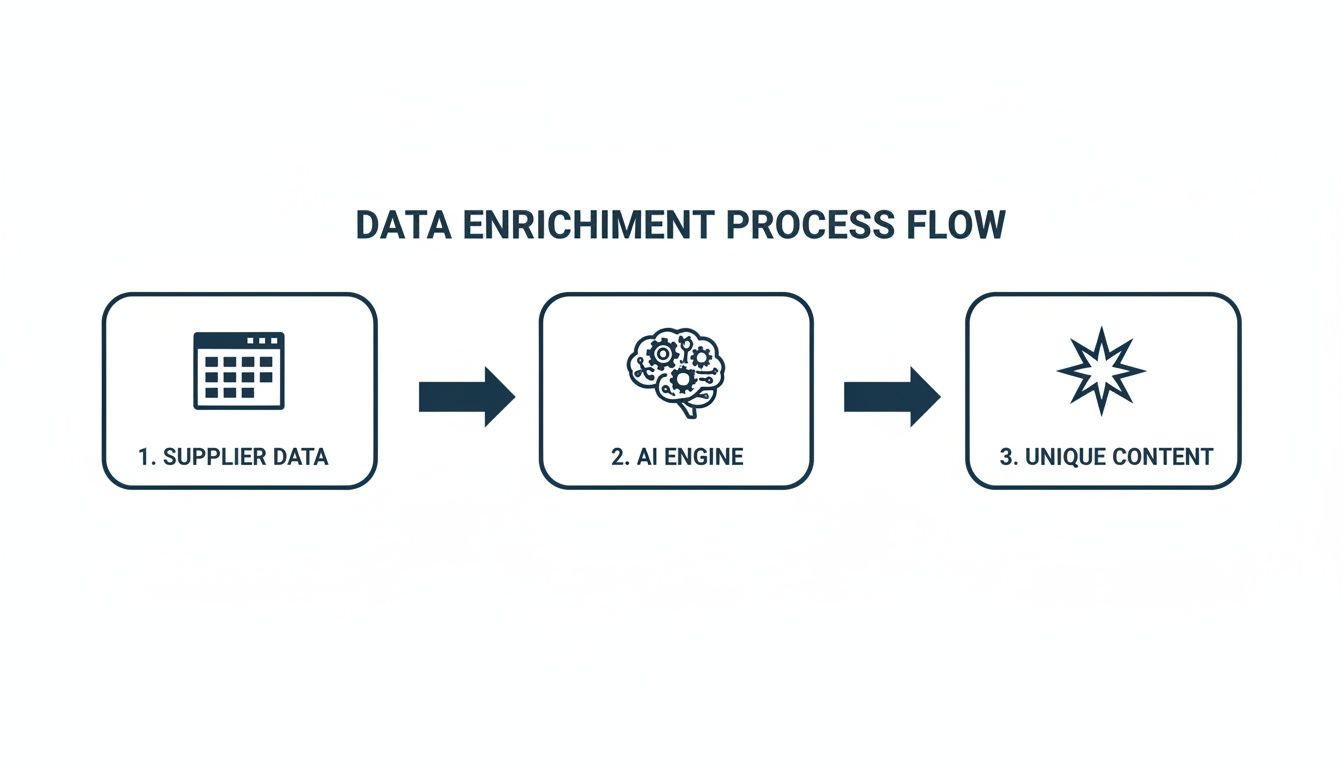
As you can see, AI acts as a powerful transformation layer. It takes inconsistent supplier information and restructures it into optimised content, ready for your digital shelf.
Your Practical QA Checklist for AI Content
To make your team's review process as efficient as possible, give them a practical checklist for every piece of AI-generated content. This keeps everything consistent and ensures all the crucial bases are covered before anything goes live.
- Brand Voice Consistency: Does the tone match our brand guidelines? Is the language right for our audience (e.g., technical for electronics, aspirational for fashion)?
- Factual Accuracy: Are all the product specs, materials, and dimensions correct? This is absolutely vital for electronics SEO optimisation and furniture.
- SEO Alignment: Does the copy naturally weave in the target keywords for SKU-level SEO? Are the meta title and description optimised and within length limits?
- Benefit-Led Language: Has the AI successfully turned features into customer benefits? Does it answer the shopper's "what's in it for me?" question?
- Originality Check: Is the content genuinely unique? Run it through a plagiarism checker to make sure you’re dodging any supplier content duplication issues.
This structured review process is the essence of next-gen SEO for retailers. It combines the efficiency of AI agents for retail with the strategic insight of your human experts, delivering both speed and quality.
This approach defines the difference between traditional SEO teams and modern, AI-powered retail operations. It’s about building a system that can handle the demands of today’s digital shelf while preparing for the future of agentic commerce.
By following these steps, you’re not just writing content for a website; you’re building a scalable, intelligent content engine. For more detailed guidance, our article on how to review writing provides a deeper framework for your team.
Frequently Asked Questions
Shifting from old-school content creation to workflows powered by AI can bring up a lot of questions. For retail leaders and ecommerce managers in Australia, figuring out how to use these new strategies is the key to improving your digital shelf and getting ready for what's next in retail search. Here are some of the most common questions we get about writing website content with AI, scaling SEO, and getting product data right.
How Can AI Help With Writing Content for a Retail Website?
Think of AI as a massive accelerator for your retail content. Its main job is to automate the creation of unique product descriptions, category pages, and meta tags, pulling directly from the supplier data you already have. This finally lets your team get past the manual roadblocks that have been holding back your content strategy for years.
The biggest wins for retailers include:
- Wiping Out Duplicate Content: AI algorithms can take thousands of generic supplier descriptions and rewrite them into unique, on-brand copy, helping you avoid painful SEO penalties.
- Getting SEO Done at Scale: You can apply SEO best practices, like working in the right keywords and optimising metadata, across your entire catalogue of 10,000+ SKUs in a tiny fraction of the time it would take a human team.
- Freeing Up Your People: By taking over the repetitive drafting work, AI allows your content and marketing experts to focus on higher-value work, like planning campaigns and creative strategy.
This is what the move from manual SEO to AI SEO is all about. It’s not about replacing people; it’s about giving them powerful tools to make their work more efficient and impactful.
What Is Product Data Enrichment and Why Is It Important?
Product data enrichment is the process of turning basic, often duplicated, supplier info into unique, detailed, and structured content. It’s about adding layers of value to that raw data, transforming a simple feature list into a product story that actually sells.
This is non-negotiable for modern SEO and digital shelf performance. Search engines, especially in the era of generative AI, are prioritising original, high-quality content that gives real value to the user. Enriched data helps you show up for specific long-tail keywords, gives shoppers a much better experience, and makes your products easier for AI shopping agents to find. For categories like fashion or electronics, this means including details on materials, compatibility, and how to use the product, which are all critical for getting the sale.
Is It Safe to Rely on AI for All My Website Content?
While AI offers incredible scale, a "human-in-the-loop" approach is always the best way to go. Think of it as a Human + AI collaboration. The AI should do the heavy lifting, drafting thousands of pages, but a human needs to be there for the final polish.
A human-led AI content QA process is the key to balancing speed with quality. It ensures you get the massive efficiency gains of automation without sacrificing the brand voice, trust, and accuracy your customers expect. This is the foundation of the future of work in retail teams.
This collaborative model is what makes next-gen SEO for retailers so powerful. Your team sets the strategy and gives the final sign-off, while the AI executes at a scale that was impossible just a few years ago.
How Do AI Workflows Prepare My Site for Agentic Search?
Agentic search optimisation is all about structuring your content so that AI agents like ChatGPT, Perplexity, and Amazon's Rufus can easily understand and use it to answer people's questions. These AI agents don’t browse websites like a person does; they parse structured data to find direct answers.
AI-powered content workflows are built for this new reality. They're brilliant at:
- Creating highly structured, consistent content across thousands of pages.
- Integrating detailed product attributes and specs that AI agents need.
- Using AI image recognition SEO to generate descriptive alt tags, giving crucial visual context for categories like furniture and fashion.
By automating product data enrichment and making sure your content is detailed and well-organised, you make your entire catalogue AI-compatible. This sets your brand up for visibility in the emerging world of agentic commerce.
What's the Difference Between AI SEO vs Traditional SEO Teams?
The main difference comes down to scale, speed, and strategic focus. A traditional SEO team often works page by page, manually optimising a handful of high-priority pages. This creates huge content bottlenecks and means large parts of a retail catalogue never get optimised at all.
An AI SEO approach, backed by AI-powered content workflows, completely changes the game. It allows a small team to manage the optimisation of an entire product catalogue. The focus shifts from manual work to strategic oversight, data analysis, and workflow management. This is a massive leap forward in retail efficiency, turning SEO from a slow, tactical job into a fast, strategic driver of business growth.
Ready to move beyond manual bottlenecks and unlock the true potential of your product catalogue? Optidan AI provides the AI-powered content workflows you need to enrich product data, eliminate duplicates, and achieve SEO at scale. Transform your retail content strategy and prepare for the future of agentic commerce. Learn more at Optidan.
