


Product Feed Enrichment is the process of turning basic, raw supplier data into unique, structured, and optimised product content that drives sales.
For retail leaders and ecommerce managers, this means taking a simple feed entry like 'Jacket – Blue – Large' and transforming it into a compelling, SEO-rich description that captures customer attention and skyrockets your search visibility. It’s the critical step that separates a generic product listing from a high-performing digital shelf.
The Growing Need for Product Feed Enrichment in Australian Retail
If you're an Australian retailer managing tens of thousands of products, your reliance on generic supplier data is a significant and growing liability. In a market this competitive, simply listing products is not enough.
The core problem is the widespread use of duplicated supplier content. This practice doesn't just create a bland, cookie-cutter customer experience; it actively harms your SEO rankings and dilutes your brand's unique voice. This is where strategic Product Feed Enrichment ceases to be optional and becomes essential for commercial survival and achieving scalable SEO solutions.
The process is straightforward in theory: take raw data and layer on value. We're talking unique product descriptions, detailed attributes, and optimised metadata. This enriched content is structured to perform, ensuring your products don't just sit there—they stand out. This is how retail efficiency tools transform your catalogue.
From Manual SEO to AI-Powered Scale
Not long ago, enriching a massive product catalogue was a logistical nightmare. It created huge content bottlenecks for retail teams. Manually rewriting thousands of product pages could take months, sometimes years, hindering any attempt at SEO at scale.
But the shift from manual SEO to AI SEO has completely changed the game. AI workflow automation for retail now lets you achieve optimised content at a scale that was previously unimaginable, transforming 10,000+ pages in just a few days. This AI-powered retail transformation isn't about replacing people; it’s about amplifying their capabilities through human + AI collaboration in SEO.
You can learn more about how to leverage AI to manage and enrich your product feeds in our detailed guide.
Preparing for the Future of Retail Search
This need for high-quality, structured data is only becoming more urgent with the rise of Agentic Search Optimisation.
AI shopping agents, like Google's AI Overviews and Rufus, depend on deeply structured, factual, and unique product information to make their recommendations. If your content is generic and duplicated from a supplier, you're practically invisible to these systems. The future of retail search belongs to those with enriched, AI-compatible SEO content.
Product feed enrichment is no longer just an SEO tactic. It is a foundational requirement for competing in the new era of Agentic Commerce. Retailers who invest in creating AI-compatible SEO content today are the ones who will secure their visibility in the future.
In Australia's fast-moving ecommerce scene, this strategy is what separates the leaders from the laggards. The consumer goods sector is a massive market, projected to hit $252.7 billion in revenue by 2025, with over 85,000 businesses all fighting for the same eyeballs.
Enriching your product feeds by adding detailed descriptions, specifications, and the right keywords cuts through the chaos of raw supplier data. It boosts your visibility on platforms like Google Shopping and gets your entire catalogue ready for the next wave of AI-driven commerce. You can read the full research on the Australian consumer goods market for more insights.
This guide will give you a practical framework to build a scalable, automated content workflow to do exactly that.
Right, let’s get this workflow humming. Moving from talking about Product Feed Enrichment to actually doing it is where you start seeing genuine results. Building an AI-powered workflow is not just about plugging in a new tool, it is about creating a repeatable, scalable system that finally pulls your retail operation out of the slow lane of manual content creation.
Think of it as building a smarter content engine that works around the clock to improve your digital shelf performance.
First things first, you need to wrangle all your data sources. Most retailers are drowning in a messy mix of supplier feeds. Some come in as CSV files, others via direct API connections, and a few still land through old-school FTP drops. A solid AI workflow starts by pulling all these different feeds into one central spot. We have gone deeper on how API-driven workflows are transforming retail data enrichment before, but the core idea is simple: get everything in one place.
Once consolidated, this raw, messy data is mapped to a single master data model. This creates a single source of truth for your entire product catalogue, finally fixing the endless headache of inconsistent and fragmented product info. This is a core function of AI agents for retail efficiency.
Automating Content Generation With AI Agents
With a clean, unified data model in place, the AI agents can get to work. These are not generic chatbots; they are trained on your specific brand guidelines, your best-performing content, and your unique tone of voice. This ensures every piece of content they generate sounds like it came from your team, just a whole lot faster.
These AI agents in ecommerce are built for retail efficiency and can automatically:
- Generate unique product descriptions: They take basic supplier bullet points and spin them into compelling, SEO-ready narratives. This directly solves the supplier content duplication problem that harms so many retailers' rankings. This is the essence of automating product descriptions.
- Create optimised titles and metadata: The AI analyses search trends and keyword data in real-time to write titles and meta descriptions that are built to be found.
- Extract and structure attributes: Agents can scan messy, unstructured descriptions and pull out critical details like material, dimensions, or compatibility. They then structure this information neatly for faceted search and comparison tools on your site.
This process is what turns raw data into compelling, ready-to-publish content that actually sells, a perfect example of retail content automation.
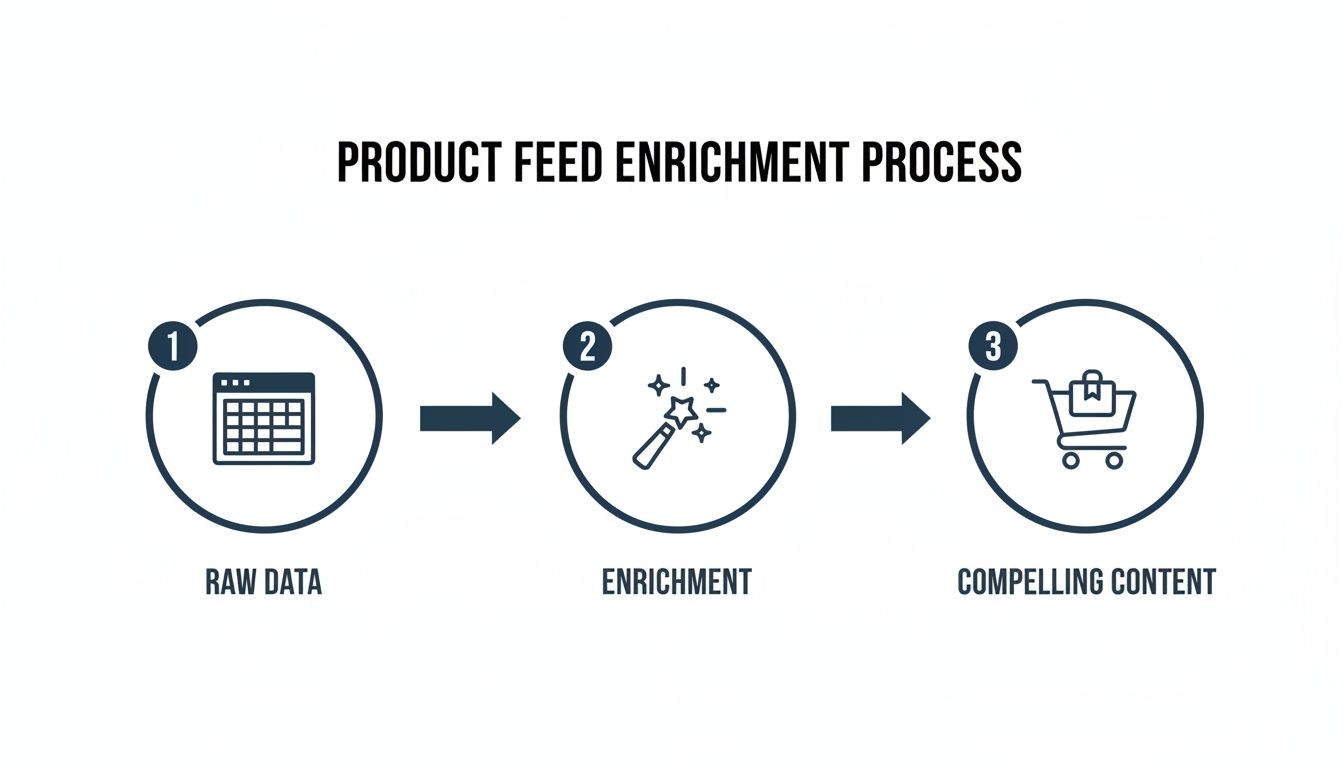
As you can see, the workflow is a methodical process. It takes unstructured supplier feeds and transforms them into highly structured, customer-focused content that powers your entire digital shelf.
To truly appreciate the jump in efficiency, let's compare the old way with the new way for a typical retailer with 10,000 SKUs.
Manual vs AI-Powered Enrichment Workflow Comparison
| Task | Manual Workflow (Estimated Time) | AI-Powered Workflow (Estimated Time) | Key Benefit of AI |
|---|---|---|---|
| Data Consolidation & Mapping | 40-80 hours | 8-16 hours | Automated ingestion and mapping rules cut setup time drastically. |
| Product Description Writing | 800-1,200 hours | 20-40 hours | Generates unique content at a scale impossible for human teams. |
| Attribute Extraction & Tagging | 300-500 hours | 10-20 hours | Scans and structures thousands of SKUs in minutes, not weeks. |
| SEO Title & Meta Optimisation | 150-250 hours | 5-10 hours | Leverages real-time data for higher search visibility. |
| Quality Assurance & Review | 100-150 hours | 20-30 hours | Human oversight focuses on strategy and exceptions, not grunt work. |
| Total Estimated Time | 1,390-2,180 hours | 63-116 hours | Over 95% reduction in time-to-market for fully enriched content. |
The numbers don't lie. An AI-powered workflow is not just an incremental improvement, it is a fundamental shift in how quickly and effectively you can get optimised content live.
Using AI Image Recognition For Deeper Insights
Product content is more than just words. For categories like fashion, furniture, and electronics, the visuals do most of the talking. This is where AI image recognition adds another powerful layer to your workflow. It analyses product photos to pull out valuable attributes that are often missing from supplier data.
For instance, an AI can look at a dress and automatically tag it with attributes like 'v-neck', 'floral print', 'midi length', and 'A-line silhouette'. This AI image recognition SEO capability is massive. These tags can be used to dramatically improve on-site filtering, make your internal search smarter, and generate specific alt text for better image SEO for ecommerce. Picking the best AI photo generator for e-commerce visuals is also key, as it can speed up asset creation while keeping everything on-brand.
By automating the tagging of visual attributes, retailers give shoppers a much richer way to discover products while making their entire catalogue ready for visual search platforms. This is the practical difference between old-school manual SEO and modern AI SEO.
This automated approach to metadata optimisation at scale ensures every single asset you have, text or visual, is working hard to bring in traffic and drive sales.
For Australian ecommerce retailers, this level of automation is more than a nice-to-have; it's a necessity for navigating supply chain pressures. With inventories constantly shifting (recent figures showed a $1,916 million drop in a single quarter, with retail trade falling $791 million), you need every available SKU working at peak performance. An enriched feed helps you do just that by maximising discoverability and providing details that reduce returns, helping you capture growth even when the market is volatile.
Ultimately, an AI-powered workflow is about building a system that delivers optimised content at scale. It’s the engine that allows a retailer to enrich 10,000+ product pages in days, not months, giving them a clear competitive edge in a crowded market.
Getting Your Enriched Content Ready for Agentic Search

The future of retail search isn't on the horizon, it’s already here, and AI is running the show. Having a richly detailed product feed is not just about tweaking your current SEO performance anymore. It's the absolute baseline for what is coming next: Agentic Search Optimisation.
AI shopping assistants like ChatGPT, Perplexity, and Google’s AI Overviews are completely changing how people find and buy things. These systems do not just scan for keywords. They analyse, compare, and recommend products based on highly structured, factual, and incredibly detailed data.
To these AI agents, generic supplier content is basically invisible. If your product descriptions are thin, duplicated across a dozen other sites, or missing specific attributes, your products will not even be considered. This is the new reality of AI Shopping SEO.
Structuring Data So AI Can Understand It
To make your content AI-compatible, you have to start thinking like a machine. AI agents need data that is unambiguous, meticulously organised, and loaded with context. They are looking for cold, hard facts, not marketing fluff.
This is where we see a huge shift from traditional SEO teams to a human + AI collaboration model. Your team's job is no longer about manually stuffing keywords into pages. It's about strategically structuring data that an AI can parse, trust, and act on. This is the core of preparing for the agentic commerce future.
Here’s where to focus your efforts:
- Granular Attribute Tagging: Go way beyond the basics like ‘colour’ and ‘size’. For a sofa, this means tagging for ‘fabric texture’ (e.g., bouclé, velvet), ‘seat firmness’ (e.g., firm, plush), and ‘style’ (e.g., mid-century modern, coastal). This is the kind of SKU-level SEO that AI agents devour.
- Factual, Unambiguous Descriptions: AI agents prioritise facts over feelings. Focus on clear, objective details: dimensions, materials, certifications, and compatibility. Instead of "a beautiful, high-quality speaker," an AI-friendly description would be: "Bluetooth 5.2 speaker with 20-hour battery life, IPX7 waterproof rating, and recycled ABS plastic construction."
- Schema Markup for Every Attribute: Implementing detailed Product Schema is no longer optional. Use it to explicitly define every attribute, from GTINs and MPNs to energy efficiency ratings. This structured data is a direct hotline to AI search crawlers, ensuring they understand your product perfectly.
Agentic search demands a completely new level of precision. Your product data must be structured not just for human eyeballs but for machine interpretation. The retailers who get this right will own the AI-powered digital shelf.
Optimising for Conversational and Comparative Questions
Search behaviour is changing. It is becoming more conversational. Customers are now asking AI agents complex questions like, "Find me a waterproof jacket under $300 that's good for hiking in Tasmania and made from sustainable materials."
Your enriched content must be built to answer these multi-layered queries on the spot. This means your product data needs to contain all those distinct data points: a specific waterproof rating, price, suitable activities, location-specific use cases, and material composition.
Without this level of detail, your product simply will not make the AI's shortlist. For a deeper dive into this, you can explore preparing your product catalogue for agentic search to make sure your strategy is ready for what's coming.
And this is not just about organic search. High-quality, enriched product feeds are also critical for successful paid ad campaigns. The detailed attributes you add for agentic search directly improve ad targeting and relevance, which is a cornerstone of effective Google Ads management on platforms like Google Shopping, seriously boosting your return on investment.
Looking ahead, AI-powered product feed enrichment is set to explode in Australia's ecommerce scene. You can see parallels in other industries; for instance, the animal feed additives market is projected to surge from USD 171.1 million in 2025 to USD 615.9 million by 2035. Ecommerce product enrichment is on a similar trajectory, with AI redefining product catalogues at an incredible pace. Just as technology optimises inputs in one sector, AI enriches raw product data into hyper-relevant, SEO-optimised content that drives conversions.
This AI-powered retail shift isn't about throwing out what works. It’s about supercharging your team's expertise with scalable AI workflows. The future of work in retail lies in this synergy, where humans drive the strategy and quality control, and AI delivers the speed and scale needed to compete and win.
Ensuring Quality and Measuring Digital Shelf Performance

Rolling out an AI-powered content workflow is a huge win for retail efficiency, but let's be honest: speed without quality is just a fast way to create problems. SEO at scale needs a quality control process that can keep up. Automation lets your team enrich tens of thousands of SKUs in days, but a solid, human-led quality assurance (QA) framework is what makes sure every single one of those SKUs actually drives value.
This isn't about micromanaging the AI. It is about smart oversight. The future of work in retail is this exact human + AI collaboration, where your team focuses on high-level validation and protecting the brand while AI does all the heavy lifting. Your QA process becomes the crucial checkpoint that turns AI-generated content into high-performing, brand-aligned assets.
This hybrid model is also your best weapon against one of the biggest SEO risks for retailers: supplier content duplication. An automated plagiarism audit should be your first line of defence. It scans every new description against the original supplier feeds and the rest of the web to guarantee uniqueness and keep you clear of search penalties.
Building a Human-Led AI Content QA Framework
A strong QA workflow is built on three pillars: ensuring your enriched content is unique, on-brand, and factually correct. This is where your team’s expertise shines, refining the output from your retail content automation engine.
Your framework needs to systematically check:
- Uniqueness and Plagiarism: Use automated tools to confirm every new description is 100% original. This is non-negotiable for fixing duplicate content SEO issues and building site authority.
- Brand Voice Consistency: Does the AI content actually sound like your brand? Your team should spot-check a sample of enriched listings to make sure the tone, style, and language are a perfect match for your brand guidelines.
- Factual Accuracy: AI is powerful, but it’s not infallible. The human QA process has to confirm that critical attributes generated by the AI, like materials, dimensions, or compatibility, are correct. This is absolutely vital in technical categories like electronics SEO optimisation.
This human-in-the-loop system is the secret to quality assurance at scale. It clears content bottlenecks, letting your team approve thousands of pages quickly, confident they meet brand standards without having to write every single word from scratch.
Measuring the Impact on Your Digital Shelf
Once your high-quality, enriched content goes live, the real test begins. Is it actually moving the needle? Measuring digital shelf performance is how you prove the ROI of your investment in product feed enrichment and build the case to scale it further. Vague metrics will not fly; you need to track tangible results.
Key performance indicators to keep a close eye on include:
- Organic Rankings for SKU-Level Keywords: Are your newly enriched product pages starting to pop up for long-tail, high-intent searches? Track keyword positions for specific products, not just broad categories.
- Click-Through Rate (CTR) from SERPs: Enriched titles and meta descriptions are far more compelling. A rising CTR is a clear signal that your optimised content is grabbing searchers' attention.
- On-Page Engagement: Look at metrics like bounce rate and time on page. Detailed, unique descriptions and attributes should keep shoppers hooked and reduce the number of people leaving your site.
- Conversion Rate: This is the ultimate test. A lift in the add-to-cart and purchase rates for enriched products directly connects your content work to revenue.
To really isolate the impact of your enrichment efforts, A/B testing is a must. Pit a batch of enriched pages against their original, untouched versions. The data you get from these tests provides cold, hard proof of the value that unique, detailed, and AI-compatible content brings to your ecommerce content optimisation strategy. For a deeper dive into these metrics, you can learn more about what goes into measuring digital shelf performance.
Common Product Feed Enrichment Pitfalls to Avoid
Diving into an AI-powered enrichment strategy is a huge step forward for any Australian retailer. The rewards are massive, but the path is littered with potential missteps that can kill your momentum and water down your results. From our experience helping retailers scale up their automated content workflows, we’ve seen the same hurdles come up time and time again.
The good news? They are all avoidable.
Getting this right is what separates a smooth, automated system that boosts your digital shelf performance from a slow, manual grind that never quite gets off the ground.
Forgetting the Single Source of Truth
One of the most common mistakes we see is retailers trying to enrich product data without first creating a unified data model. It is a classic case of building on shaky ground. They will pull from dozens of inconsistent supplier feeds, each with its own weird formatting, missing info, and random quirks.
Trying to run AI enrichment on top of that chaos is a recipe for disaster. The AI gets confused, spitting out inconsistent descriptions and factual errors that your team then has to spend hours fixing manually. The fix is to consolidate everything first. Map all your incoming data to a master product schema to create a clean, reliable foundation. Only then can your AI agents work with accurate information.
Over-Reliance on AI Without Human Oversight
Generative AI for retail teams is an absolute workhorse, but it is not a "set and forget" magic button. A huge mistake is trusting the AI’s output 100% without a solid, human-led quality assurance process in place. This is how you end up with product descriptions that sound slightly off-brand, contain subtle inaccuracies, or just completely miss the nuance that makes a product appealing.
The sweet spot is a human + AI collaboration. Let the AI do the heavy lifting, generating thousands of descriptions at scale. But your team must provide that final strategic check. This human-led AI content QA ensures every single product page is not only unique but also perfectly on-brand and factually correct.
An AI-powered workflow without a human quality gate is not automation; it is just creating potential problems faster. The future of work in retail is pairing AI's scale with human expertise, not replacing one with the other.
Neglecting Image and Metadata Optimisation
Everyone focuses on the text, but so many retailers ignore the huge SEO potential hiding in their product images. Failing to enrich your image data is a massive missed opportunity, especially if you are in a visual-heavy industry like fashion or furniture. This isn't just about alt tags and file names; it is about using AI image recognition to generate detailed, descriptive tags.
Think about a sofa. AI can automatically generate tags like 'oak finish', 'tapered legs', and 'mid-century modern style'. This kind of furniture image tagging SEO makes your products discoverable in image-based searches and dramatically improves your on-site filtering. It’s a direct upgrade to the customer experience and your search visibility.
Applying a One-Size-Fits-All Enrichment Strategy
Different products need different approaches. A strategy that works brilliantly for electronics SEO optimisation, which is all about tech specs and compatibility, will completely fail for fashion SEO optimisation, where emotive language and style attributes are key.
Too often, retailers use a single generic prompt or template across their entire catalogue. A much smarter way is to develop category-specific enrichment strategies. This ensures the AI generates content that’s not just optimised for search but actually resonates with the right audience for each product vertical, whether it’s pharmacy, beauty, or homewares. Digging into why supplier data is holding back retail performance often reveals just how tailored this process needs to be. This is how basic product data enrichment becomes a serious conversion tool.
To help you sidestep these common issues, we have put together a quick-reference checklist. Use this to audit your own enrichment process and plug any gaps before they turn into bigger problems.
Enrichment Pitfall Prevention Checklist
| Potential Pitfall | Preventative Action | Tool/Process to Use |
|---|---|---|
| Inconsistent Data Foundation | Consolidate all supplier feeds into a single, standardised product schema before enrichment. | PIM (Product Information Management) software, custom data mapping scripts. |
| "Set and Forget" AI | Implement a two-step QA process: AI-driven checks followed by human review for brand voice and nuance. | AI content checkers (e.g., Grammarly Business), dedicated internal QA team/process. |
| Ignoring Visual SEO | Use AI to automatically generate descriptive alt text, file names, and detailed image tags for every product. | AI image recognition APIs, bulk image optimisation tools. |
| Generic Content Strategy | Develop category-specific AI prompts and enrichment rules based on customer intent for each vertical. | Custom prompt library, A/B testing software for content variations. |
| Poor Attribute Mapping | Ensure all key attributes (colour, size, material) are correctly mapped and populated in the master schema. | Data validation rules within your PIM or ecommerce platform. |
| No Performance Tracking | Set up analytics to track the impact of enriched content on page views, conversion rates, and rankings. | Google Analytics, SEO performance monitoring tools (e.g., Ahrefs, Semrush). |
This checklist isn't exhaustive, but it covers the major hurdles that can trip up even experienced teams. By thinking ahead and putting these preventative actions in place, you set your enrichment strategy up for sustainable, long-term success.
Your Top Questions About Product Feed Enrichment, Answered
When you are looking at a full-scale product data enrichment strategy, a few key questions always come up. Here are the most common ones we hear from Australian ecommerce managers thinking about AI-powered enrichment, quality control, and the future of retail search.
How Fast Can AI Really Enrich a Massive Catalogue?
Speed to market is always a top concern. Manually enriching a catalogue of 20,000 products could easily tie up your content team for months, if not longer. This is where an AI-powered content workflow completely changes the game.
Once the initial setup is done, which involves mapping your data and training the AI models on your specific brand voice, the content generation itself is incredibly fast. For a catalogue that size, creating unique descriptions, titles, and metadata can often be done and dusted within a week.
This is followed by a streamlined, human-led AI content QA process to lock in brand alignment and factual accuracy before anything goes live. It’s the very essence of achieving SEO at scale.
Is Google Going to Penalise AI-Generated Product Descriptions?
This is a totally valid concern, and one we hear a lot. The short answer is no, as long as the content is high-quality and genuinely helpful to the shopper. Google's guidelines are clear: they penalise spammy, low-value content, regardless of whether a human or AI wrote it.
In fact, high-quality product feed enrichment using AI actually lines up perfectly with what Google wants. It fixes nagging supplier content duplication issues, adds rich, useful details for shoppers, and massively improves the user experience. The key is having a solid, human-led QA process to ensure the final output is valuable and trustworthy. It is a powerful tool for ecommerce content quality assurance.
What's the Difference Between Feed Optimisation and Feed Enrichment?
These two terms are often thrown around together, but they tackle different parts of the process. Getting the distinction right is crucial for building a strategy that actually improves your digital shelf performance.
- Product Feed Optimisation is mostly about meeting the technical specs for channels like Google Shopping or Meta. Think formatting data correctly, making sure GTINs are present, and hitting the right image sizes. It is about compliance and technical correctness.
- Product Feed Enrichment is a much deeper, more strategic game. It is about adding new value and context that was not there before. This means turning a basic supplier title into a keyword-rich, SEO-friendly one, generating unique narrative descriptions, and even using AI image recognition SEO to tag visual attributes.
Here's a simple way to think about it: Optimisation is making sure the machines can read your data. Enrichment is making sure both machines and humans are compelled by it.
How Does AI Keep Our Brand Voice Consistent Across Thousands of Products?
Maintaining brand consistency across a huge number of SKUs is a massive headache, but it’s an area where modern generative AI for retail teams truly shines. This is not about using some generic, off-the-shelf tool; it’s about creating a custom content engine trained specifically on your business.
The process starts by fine-tuning the AI models using your brand's unique assets. We feed it your style guides, tone of voice documents, and even examples of your best-performing content. The AI learns your specific language, phrasing, and brand personality, effectively creating an AI agent that acts as a scalable extension of your marketing team.
The final human-led AI content QA step ensures every single piece of content perfectly reflects your brand before it gets published. This guarantees consistency at a scale that manual teams could only dream of, making human + AI collaboration in SEO central to the future of work in retail.
Ready to turn your messy supplier data into a high-performing asset? Optidan AI uses advanced AI workflows to create thousands of unique, SEO-ready product pages in days, not months. It’s time to eliminate content bottlenecks, fix duplicate content for good, and get your catalogue ready for the future of agentic commerce.
Discover how Optidan can elevate your digital shelf performance by visiting https://optidan.com.
