

So, what exactly is an AI Product Feed? Think of it as a dynamic system that uses artificial intelligence to automatically enrich, standardise, and optimise all the data in your product catalogue.
This isn't your old-school static feed, which is little more than a simple spreadsheet. An AI-powered feed acts more like a team of expert digital merchandisers, constantly working to improve your product content to drive visibility and sales across every single channel. For Australian retailers, this shift from tedious manual updates to AI workflow automation is quickly becoming non-negotiable.
From Static Catalogue To Strategic Asset

Imagine your traditional product feed as a printed catalogue. The information is fixed, often pretty basic, and the idea of updating it for thousands of SKUs is a soul-crushing task. An AI Product Feed completely transforms this static list into the central nervous system of a modern retail operation. It’s a foundational leap from manual SEO to AI SEO, built for genuine scale and efficiency.
For retail leaders and ecommerce managers, the biggest headache is often just managing a massive product catalogue while trying to stay ahead of where retail search is headed. This is precisely where AI-driven systems give you a serious edge. Instead of wrestling with inconsistent supplier data, you can deploy AI agents for retail efficiency to do all the heavy lifting.
This technology directly solves several massive pain points for retailers:
- Product Data Enrichment: It takes sparse, uninspired supplier feeds and turns them into optimised, structured product content that’s rich with detail, compelling for both your customers and search algorithms.
- Correcting Duplicated Supplier Content: AI can rewrite thousands of generic supplier descriptions in your brand's unique voice, fixing those pesky duplicate content SEO issues once and for all.
- Optimised at Scale: AI-powered content workflows can process and enhance over 10,000 product pages in days. A task like that would take a traditional team months, if not longer.
Preparing for the Future of Search
The rapid rise of AI shoppers like ChatGPT, Perplexity, and Amazon's Rufus signals a huge change in how people find products. We're entering the era of agentic commerce, where AI agents will search and even make purchases on behalf of users. These agents don't browse websites; they rely on highly structured, detailed, and accurate data to do their job.
An AI-enriched product feed is your ticket to getting ready for this new world. By providing machine-readable, AI-compatible SEO content, you make sure your products are actually visible and chosen in these new AI-driven shopping environments.
An AI Product Feed isn't just about cleaning up data. It’s about structuring your entire catalogue to be understood, interpreted, and recommended by the AI systems that are quickly becoming the new gatekeepers of online retail. This is the foundation for winning on the digital shelf.
Core Capabilities of an AI Feed
The capabilities here go way beyond just generating text. For retailers in sectors like fashion or furniture, AI image recognition and tagging are game-changers. This tech can automatically analyse product images to generate descriptive alt tags and attributes, like "slim-fit cotton shirt" or "mid-century modern oak sideboard", massively improving your image SEO for ecommerce at scale.
To see how AI Product Feeds fit into the bigger picture of how AI is shaking up online retail, it's worth exploring some of the best AI tools for ecommerce.
Ultimately, this intelligent automation leads to real, measurable improvements in your digital shelf performance. We're talking better rankings, more visibility, and higher conversions. As we cover in our guide on the future of product feeds, training AI to understand and sell your brand is now a strategic must-do.
Shifting From Manual SEO To Scalable AI Optimisation
For years, retail SEO has been a labour-intensive grind. Ecommerce managers and their teams have spent countless hours manually writing product descriptions, fiddling with metadata, and trying to make sense of inconsistent supplier feeds. This old-school approach creates huge retail content bottlenecks, holding back product launches and hurting data quality across the whole site.
The real problem is scale. A manual workflow might just about work if you have a hundred products. But it completely falls apart when you’re dealing with thousands, or even tens of thousands, of SKUs. The result? Inconsistent brand messaging, countless missed SEO opportunities, and a content team that's always playing catch-up. This is exactly where the shift from manual SEO to AI SEO becomes a necessity for survival, not just growth.
This isn't just about doing things faster; it's about changing the entire game. It’s a move away from a reactive, task-by-task model to a proactive, strategic one. AI-powered content workflows get rid of that manual friction, letting retailers operate with a level of scale and precision that was simply out of reach before.
The Bottleneck Of Traditional SEO Workflows
Traditional retail SEO is linear and painfully slow. It usually involves a long chain of manual hand-offs between merchandisers, copywriters, and SEO specialists. A new product line from a supplier can kick off a process that takes months before the items are properly optimised and finally live on the site.
This process is riddled with problems:
- Time-to-Market Delays: Manually creating content for hundreds of new products can drag on for weeks. That’s valuable inventory sitting in a warehouse instead of being sold.
- Inconsistent Quality: With multiple writers and editors involved, keeping a consistent brand voice is a constant battle, leading to a disjointed customer experience.
- Supplier Content Duplication: Using generic supplier descriptions is the fast way to get products online, but it’s also a direct ticket to SEO penalties for duplicate content, which hurts your entire site's authority.
These bottlenecks hit your revenue and ability to react to the market. While your team is busy fixing basic data errors, your competitors are already grabbing market share. A great example of how this shift works in practice is understanding how retail AI maximizes margin with digital tagging price optimization.
AI-Powered Retail Transformation At Scale
AI Product Feeds offer a completely different path. By bringing in retail content automation, you can process, enrich, and optimise enormous supplier feeds in just a few days. An AI system can take the raw data for 10,000+ products and automatically generate unique, SEO-ready product descriptions, titles, and metadata that all align with your brand voice.
This is what SEO at scale looks like. You’re moving beyond tiny, page-by-page tweaks to a holistic, catalogue-wide optimisation strategy. This is where the real business case for AI SEO shines, giving you a clear competitive edge. For a deeper dive, our guide on automating retail at scale breaks down how to move from manual updates to fully autonomous workflows.
The goal of AI SEO is not to replace human experts, but to empower them. It automates the repetitive, time-consuming tasks of content creation and data standardisation, freeing up your team to focus on high-level strategy, creative campaigns, and performance analysis.
This human-AI partnership is the future of retail. AI handles the sheer volume, while your team provides the strategic oversight and quality control. This model makes SKU-level SEO possible across your entire inventory, ensuring every single product page is a finely tuned asset, ready to attract and convert customers and prepare you for the next wave of agentic commerce.
Let's look at how the old and new worlds stack up. The difference between a traditional, manual process and an AI-driven one is stark, especially when you're managing a large product catalogue.
| Attribute | Traditional SEO | AI SEO |
|---|---|---|
| Speed | Weeks or months to launch new products | Days or hours to process entire feeds |
| Scale | Limited to a few hundred SKUs at a time | Handles 10,000+ SKUs simultaneously |
| Consistency | Varies by writer, leading to brand drift | Perfectly consistent brand voice and quality |
| Strategic Focus | Team bogged down in manual, repetitive tasks | Team focused on strategy, analysis, and growth |
As you can see, the shift isn't just an upgrade, it's a fundamental change in capability. AI workflows don't just do the same work faster; they enable a level of strategic depth and market agility that's impossible to achieve manually. This is how modern retailers win.
Enriching Product Data and Eliminating Duplication
The real magic of an AI Product Feed is its power to fix two of the most stubborn problems in ecommerce: shoddy data quality and the SEO headache of duplicated content. Anyone who's worked with supplier feeds knows how inconsistent they can be. Often, you get little more than a product name, a SKU, and a generic, uninspired description that hundreds of other retailers are also using.
This creates a massive content bottleneck and actively hurts your performance on the digital shelf.
An intelligent feed goes way beyond simply pulling in data. It acts as an automated content engine, taking that sparse supplier info and transforming it into rich, structured, and unique product content that actually sounds like your brand. This is product data enrichment in action, a process where AI systematically improves the quality and depth of your catalogue information at a massive scale.
For retailers, especially in visual-heavy sectors like fashion and furniture, this isn't just a nice-to-have. It's about survival. It’s the difference between a product page that gets buried and one that ranks, engages, and converts.

From Generic Supplier Feeds to Unique Brand Stories
Relying on supplier-provided descriptions is one of the biggest mistakes an online retailer can make. When dozens of websites feature the exact same text, search engines flag it as supplier content duplication. This signals low-quality, unoriginal content, which can lead to significant SEO penalties and drag down rankings across your entire site.
AI-powered content workflows are the only practical solution to this widespread issue. Instead of manually rewriting thousands of descriptions, an AI system can generate unique, compelling, and SEO-optimised content for every single product in your catalogue. This isn't just about dodging penalties; it's about carving out a distinct brand identity.
This automated process ensures every product tells a story that is uniquely yours, strengthening your brand voice and creating a far better customer experience. You can learn more about how API-driven workflows are transforming retail data enrichment and see how this technology delivers both efficiency and quality.
A common misconception is that AI-generated content is generic. With the right training and human-led QA, AI can produce highly nuanced, on-brand descriptions that capture the specific emotional and functional benefits of your products, creating a consistent narrative that generic supplier feeds could never achieve.
AI Image Recognition for Visual Search Readiness
For categories like fashion, furniture, electronics, and beauty, the product imagery does most of the talking. But images without descriptive metadata are practically invisible to search engines. AI image recognition and tagging is a game-changing capability that automates this crucial but mind-numbingly tedious task.
AI models can analyse a product image and automatically generate highly specific tags and descriptive alt text. An image of a dress isn't just a "dress." AI can identify it as a "blue floral-print A-line midi dress with short sleeves." That level of detail is an absolute goldmine for SEO.
- Fashion SEO Optimisation: AI can tag attributes like neckline, sleeve length, pattern, and fabric type, making your products discoverable through highly specific, long-tail search queries.
- Furniture Image Tagging SEO: It can identify materials ("solid oak," "bouclé fabric"), style ("mid-century modern," "industrial"), and features ("integrated storage," "modular design").
- Alt Tag Optimisation for Retail: This automation ensures every single image contributes to your site’s accessibility and SEO performance, a task that is impossible to manage manually at scale.
This automated metadata makes your entire catalogue ready for the future of visual and agentic search. AI agents rely on this structured data to understand what a product is and looks like, allowing them to make far more accurate recommendations.
Achieving Content Quality Assurance at Scale
The final piece of the puzzle is maintaining quality. The goal of retail content automation isn't to remove humans from the process, but to elevate their role. A robust AI workflow must include a human-led AI content QA step.
This human-in-the-loop model ensures that while AI handles the sheer scale and speed, your team provides the final strategic oversight and brand approval. This powerful combination of AI efficiency and human expertise allows retailers to maintain impeccable brand integrity across tens of thousands of product pages.
This scalable SEO solution directly improves your digital shelf performance by ensuring every product is presented with unique, detailed, and accurate information. The result? Better rankings, increased visibility, and a more compelling shopping experience that drives conversions and builds lasting customer trust.
Preparing Your Catalogue For Agentic Search And AI Shopping
The future of retail search isn't about people typing keywords into a search bar anymore. We're moving into the era of agentic commerce, where AI assistants like Google's AI Overviews, Perplexity, and Amazon's Rufus are becoming personal shopping agents, finding and recommending products for their users. If you want to win in this new world, your product catalogue has to speak their language.
This means making a fundamental shift in strategy toward Agentic SEO. Old-school SEO was all about matching keywords to what a human might search for. Agentic SEO is completely different; it’s about structuring your product data so AI models can understand, interpret, and, most importantly, trust it. These AI agents don't browse websites like we do; they pull data directly from product feeds to find the perfect answer to a user's request.
A standard product feed with basic titles and descriptions is as good as invisible to them. To even compete, your catalogue needs a major upgrade into a rich, machine-readable source of truth that makes your content AI-compatible.
From Keywords To Structured Attributes
The biggest change is leaving simple keywords behind and entering a world of structured attributes and semantic richness. An AI agent doesn't just look for "running shoes." It's trying to understand the why behind the query, like, "What are the best lightweight running shoes for a marathon runner with neutral pronation?"
To answer a question that specific, the AI needs structured data points, not a description stuffed with keywords. This is where an AI Product Feed becomes absolutely essential.
It takes your catalogue and enriches it with the granular, specific details that an AI can instantly understand:
- Performance Features: "Lightweight foam midsole," "carbon-fibre plate," "high-abrasion rubber outsole."
- User Suitability: "Best for neutral pronation," "ideal for long-distance," "suitable for road running."
- Material Composition: "Engineered mesh upper," "recycled polyester laces."
This level of detail transforms a simple product listing into a comprehensive data asset. The AI agent can now confidently match your product to a highly specific user need, making it far more likely to get the recommendation over a competitor's.
Making Your Content AI-Compatible
AI shopping agents depend on detailed specifications and semantic relationships to make their decisions. They have to understand not just what your product is, but why it's the right choice for a particular person in a specific situation. An AI-optimised feed builds this understanding for them, at scale.
In the age of agentic commerce, your product feed is no longer a simple data file. It is the primary training material you provide to the AI models that will decide whether to recommend your product or a competitor's. A vague or incomplete feed is like training an AI to ignore you.
Think of it like providing a complete dossier for every single item you sell. This includes detailed specs, use cases, compatibility information, and even the emotional benefits. For instance, a furniture retailer would stop at "brown leather sofa" and instead specify "top-grain aniline leather," "kiln-dried hardwood frame," and "mid-century modern design." These are all critical signals AI agents use for things like furniture image tagging SEO and product matching. If you're looking to upgrade your content, you can learn more by exploring how to start transforming enterprise product pages for agentic search.
Winning in an AI-Led Shopping World
The move from human-led queries to AI-led discovery is the biggest shake-up to retail search in over a decade. Retailers who keep banking on old-school keyword optimisation are going to see their digital shelf performance slide as their products become invisible to this new generation of AI gatekeepers.
Getting your catalogue ready for this future means investing in retail SEO automation and product data enrichment. A properly optimised AI Product Feed is the non-negotiable foundation. It ensures that when an AI agent goes shopping, your products aren't just visible, they're the most compelling and logical choice. This is how you secure your spot in the future of retail search.
The Business Case For AI Feed Technology In Australia
For Australian retailers, the conversation around AI has shifted from a "what if" to a "right now." Investing in AI product feed technology isn't a forward-thinking experiment anymore; it’s a strategic necessity to compete and win.
The local market is adapting fast, and retailers who drag their feet risk being left behind by more agile, data-driven competitors. The business case isn't just about efficiency, it's about securing market leadership as retail becomes increasingly automated.
The pressure to adopt these tools is definitely mounting. An industry snapshot shows 77% of Australian and New Zealand retailers see AI agents as essential to compete in the next year, with 74% planning to boost their AI spending to match. This isn't just talk; it's directly linked to performance. Salesforce’s ANZ retail data connects advanced personalisation and feed automation to a 7% year-over-year growth in online sales during peak periods like Cyber Week. You can dig deeper into the rise of retail AI in Australia.
Quantifying The Return On AI Investment
The benefits of AI-powered content workflows go way beyond simple cost savings. They create a powerful ripple effect across the entire business, delivering measurable lifts in key metrics that hit the bottom line. It's a clear path to higher revenue and a stronger market position.
The biggest wins are seen in three core areas:
- Increased Conversion Rates: By enriching product data and creating unique, compelling descriptions, AI feeds deliver a far better customer experience. This detailed, high-quality content answers customer questions before they're asked, building trust and leading to higher conversion rates right down to the SKU level.
- Higher Average Order Value (AOV): A well-structured AI feed is the engine for smarter cross-selling and up-selling. By understanding product relationships and attributes, the system can power recommendation engines that suggest relevant add-ons, encouraging customers to put more in their carts.
- Significant Productivity Gains: Automating product descriptions and data enrichment frees your team from thousands of hours of manual, repetitive work. This shift allows your skilled people to focus on high-value strategic work like market analysis, campaign planning, and customer engagement, amplifying their impact.
Building A Competitive Moat For The Future
Beyond the immediate financial returns, investing in AI product feeds is a defensive move for the future of retail. As agentic search and AI shopping become the norm, the quality of your underlying product data will determine your visibility. A catalogue optimised for AI agents is simply more discoverable.
Adopting scalable SEO solutions like AI feed automation isn't just an IT upgrade; it's a core business decision. It directly fixes the content bottlenecks that slow growth, future-proofs your brand for the shift to agentic commerce, and empowers your teams to operate with unprecedented speed and scale.
This is the essence of human + AI collaboration in SEO. By arming retail teams with AI efficiency tools, Australian businesses can finally break through the limits of manual processes.
The result is a more resilient, agile, and profitable operation ready for the AI-powered retail transformation that’s already here. This investment secures your digital shelf performance today and builds the foundation for sustained growth tomorrow.
A Practical Framework For Implementing AI Product Feeds
So, you're ready to make the switch to an AI product feed? Great. But moving from theory to reality needs a solid plan. Think of this as your roadmap, a structured approach that combines smart technology with the irreplaceable expertise of your team. The goal isn't to replace people, but to set up automated content workflows that empower them to do their best work.
The first step, before you can even think about enriching your product catalogue, is a thorough audit of what you already have. You need to get a really firm grip on the current state of your data. This means digging into supplier feeds, hunting down inconsistencies, flagging missing attributes, and figuring out just how much duplicated supplier content is floating around your SKUs.
Auditing Data and Defining Enrichment Rules
Once you've got a clear picture of your data's health, it's time to define your enrichment rules. This is where your team's expertise becomes the AI's guide. You set the standards for your brand voice, pinpoint the SEO keywords that matter, and define the specific product attributes your customers actually care about. This is also where you start thinking about agentic search optimisation.
This is the most critical part of the human + AI partnership. You're essentially teaching the AI what "good content" looks like for your brand. This simple process turns a messy pile of raw data into a strategic asset, ready to power your product listings across every channel, from Google Shopping to social commerce platforms.
If you need a hand structuring this planning phase, our downloadable action plans template can help you map out all your key milestones.
Establishing Human-Led AI Content QA
With your rules in place, the AI can get to work, automating product descriptions and enriching data on a scale that would be impossible for a human team. But technology on its own is never the full answer.
The most effective systems always include a human-led AI content QA workflow. This ensures that while the AI handles the heavy lifting and the sheer volume, your team provides that final, strategic check. They're the ones who will catch the subtle nuances and make sure every single piece of content is perfectly aligned with your brand. It removes the content bottlenecks holding your retail business back, without ever sacrificing quality. It frees up your team from tedious manual writing and lets them focus on high-value strategy and performance analysis. That's a huge boost to your retail efficiency.
This infographic breaks down how this process drives real business results.
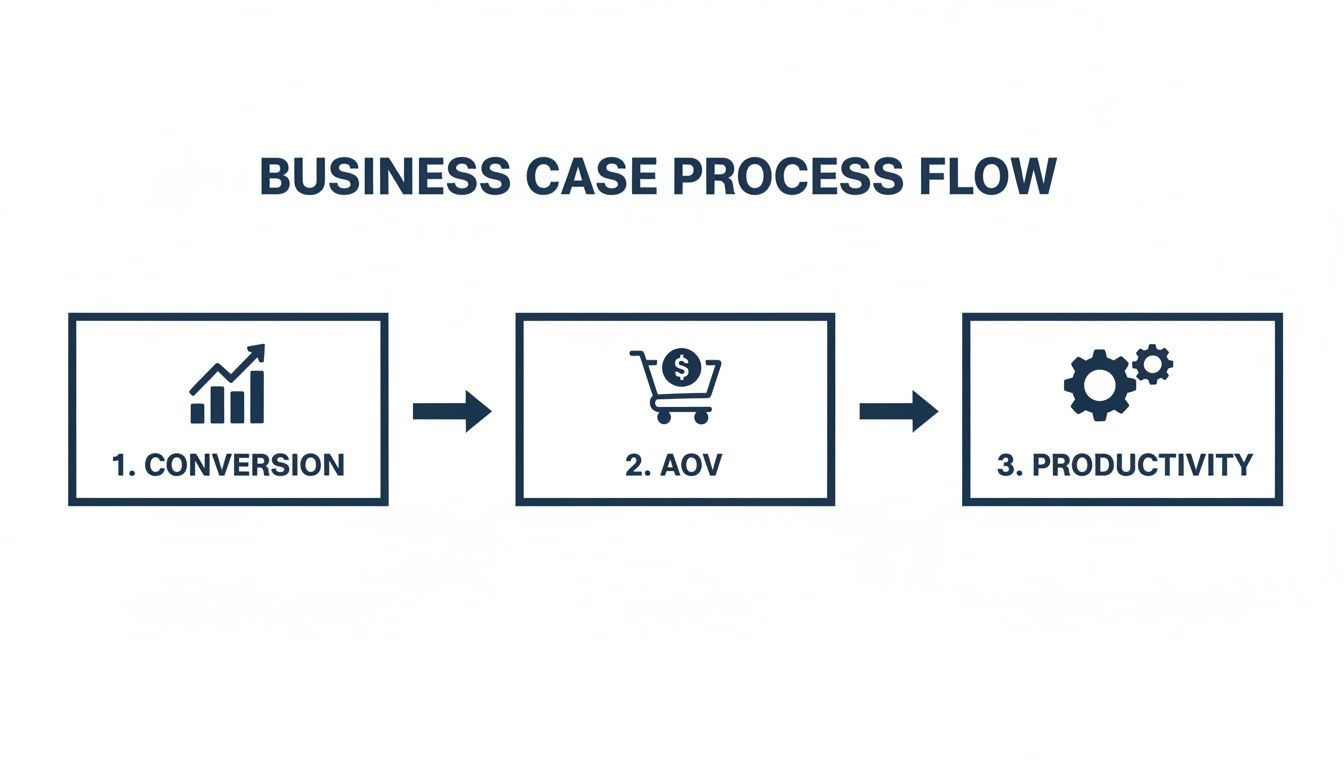
As you can see, it’s a clear path from implementing AI product feeds to seeing measurable lifts in conversions, average order value, and your team's overall productivity.
Managing Trust in the Australian Market
Finally, a successful rollout has to consider the local vibe. Government tracking shows AI adoption is on the rise in Australian retail, but public sentiment tells a more complex story. There’s a conditional acceptance, with a lot of caution around data privacy and trust.
This has a direct impact on how you design your AI feed systems, especially when it comes to personalisation. To keep your customers' confidence, you need strong data governance and total transparency about how AI is being used to make their shopping experience better. By tackling these concerns head-on, you build a foundation of trust that will support your AI-powered retail transformation for years to come.
Frequently Asked Questions About AI Product Feeds
We get a lot of questions from Australian retail leaders trying to get their heads around AI and product data. Here are some of the most common ones.
What’s The Main Difference Between A Standard Feed And An AI Feed?
Think of a standard product feed as a static spreadsheet. It’s a passive list of basic product data that needs someone to constantly babysit it with manual updates to keep it useful.
An AI Product Feed is something else entirely. It's a dynamic, intelligent system that actively cleans up, enriches, and optimises your data at scale. It can write unique descriptions, tag images, fix errors from supplier feeds, and structure everything perfectly for modern AI SEO and the new wave of shopping agents. In short, it turns a simple data file into your most powerful strategic asset.
How Does An AI Product Feed Prepare My Business For Agentic Search?
Agentic search, the technology behind tools like ChatGPT and Google's AI Overviews, doesn’t browse websites like a human. It ingests and analyses data feeds to find the perfect answer for a user's question.
These AI agents need highly structured and incredibly accurate data to make recommendations. An AI Product Feed enriches your catalogue with the granular details that these agents thrive on, like ‘slim-fit’ or ‘sustainably-sourced cotton’. This deep, structured information makes your products contextually relevant, ensuring they show up in AI-generated shopping results and securing your digital shelf performance for the future.
This level of detail makes your products AI-compatible. It ensures they are not just seen but selected by the next generation of AI-driven shopping tools. It’s the essential foundation for agentic search optimisation.
What’s The First Step To Implement This Technology?
The first move is always a comprehensive data audit. You need to get a clear picture of your current product data sources, paying close attention to the raw supplier feeds you’re working with.
Look for the gaps. Pinpoint inconsistencies, missing information, and the amount of supplier content duplication sitting in your catalogue. Understanding the true quality of your foundational data is what builds the business case for bringing in a retail content automation platform to solve these core challenges efficiently.
Ready to transform your product catalogue and get ahead of the future of retail? Optidan AI provides the scalable SEO solutions you need to automate content creation, eliminate duplication, and win on the digital shelf. Discover how Optidan AI can reshape your eCommerce strategy.
