


Imagine trying to run a retail business where every product's details are scattered across dozens of different spreadsheets, supplier emails, and random folders on a shared drive. That's the reality for many companies, and it's a recipe for chaos.
Product Information Management (PIM) is the solution. Think of it as the single source of truth for every single product you sell. It’s the central system retailers use to pull in, clean up, enrich, and then push out all that product information, making sure everything is consistent and accurate, no matter where a customer sees it.
Your Digital Headquarters for Product Content
A PIM system is essentially the digital headquarters for your entire product catalogue. Without one, you're stuck in that messy world of supplier spreadsheets and siloed data, which inevitably leads to inconsistent product details, painfully slow product launches, and poor digital shelf performance.
A PIM takes this operational chaos and turns it into a clean, automated workflow. It acts as a command centre where all those messy supplier feeds are pulled in, standardised, and organised. This is where the real work begins, the critical process of product data enrichment. This turns basic, often generic, supplier data into compelling, customer-focused content that actually drives sales. For any business serious about growth, centralisation is the first step away from tedious manual SEO tasks and toward a scalable, modern strategy using AI workflow automation for retail.

From Manual Chaos to Centralised Control
For retail leaders and ecommerce managers, the shift from manual processes to a PIM is profound. It’s about moving beyond just listing products to strategically managing the information that actually powers your business. The core function of a PIM is to solve the most common retail content bottlenecks right at the source, creating a solid foundation for scalable growth.
Here’s a look at the key problems a PIM is built to fix:
- Correcting Duplicated Supplier Content: It provides a systematic way to overwrite generic supplier descriptions, helping you dodge SEO penalties and build a unique brand voice across thousands of products.
- Eliminating Inconsistencies: It ensures a product’s price, specs, and marketing copy are identical whether a customer finds it on your website, your mobile app, or a third-party marketplace.
- Slashing Time-to-Market: By automating content workflows, your teams can launch new products or entire collections in a matter of days, not weeks or months.
- Enabling SEO at Scale: It creates a structured, reliable data source that's perfect for AI-powered optimisation, making it possible to create unique, high-performing content for over 10k+ pages in days.
The table below gives a clearer picture of this transformation.
PIM at a Glance: From Manual Chaos to Centralised Control
For retailers still managing product data by hand, the move to a PIM system is a game-changer. This table breaks down the 'before and after' across key parts of the business.
| Operational Area | Without PIM (Manual Approach) | With PIM (Centralised System) |
|---|---|---|
| Data Accuracy | Inconsistent details across channels, high error rates. | Single source of truth, consistent and accurate everywhere. |
| Time-to-Market | Slow, manual updates delay product launches by weeks. | Automated workflows launch products in days. |
| Team Efficiency | Teams waste hours fixing data and chasing information. | Centralised access, clear ownership, and less admin work. |
| Customer Experience | Poor product info leads to confusion and returns. | Rich, reliable content builds trust and reduces returns. |
| SEO & Visibility | Duplicated supplier content hurts search rankings. | Unique, optimised content boosts visibility at scale. |
Switching to a PIM isn't just an IT upgrade; it's a fundamental shift in how you manage the core of your ecommerce operation, moving from reactive fixes to proactive control.
A PIM isn't just another database; it's an operational engine. It’s the foundational layer that makes scalable SEO, efficient retail operations, and AI-driven commerce possible. Without that single source of truth, AI has nothing reliable to learn from.
The Foundation for Agentic Commerce
Ultimately, understanding what Product Information Management is means seeing its role in future-proofing your business. As AI agents and sophisticated search systems become more influential in how people shop, they will rely on structured, accurate, and rich data to make decisions.
A PIM provides this essential structure. You can learn more about how a PIM organises this complex information in our guide to product data. It’s your first and most critical step in building a retail operation that’s ready for the future of work in retail, where speed, consistency, and data quality are what really determine who wins.
How PIM Powers Next Generation AI SEO
Traditional SEO is changing. For retail leaders, the game is no longer just about ranking on a search results page, it’s about being recommended by an AI agent. This new frontier, shaped by generative AI like ChatGPT, Perplexity, and Google’s AI Overviews, requires a completely different playbook. A Product Information Management (PIM) system is no longer just a nice-to-have operational tool, it's the non-negotiable foundation for next-generation AI SEO.
AI agents don't "browse" your website like a human does. They ingest and analyse structured data to find the absolute best answer or product recommendation for a user’s question. If your product data is messy, inconsistent, or just a copy-paste from a supplier, these systems will simply skip over you. They'll recommend a competitor with cleaner, richer, and more reliable information every time. This is where a PIM gives you a decisive competitive edge.
Think of a PIM as the central engine for creating AI-compatible SEO content. It organises all your product attributes, specs, and marketing copy into a logical, structured format that AI can easily understand and trust. It's the bedrock of any serious agentic search optimisation strategy.
From Duplication Penalties to Unique Content at Scale
One of the most persistent headaches for large-scale retailers is supplier content duplication. Using the same generic product descriptions provided by your suppliers across hundreds of websites is a fast track to poor search visibility and a weak brand voice. A PIM tackles this problem head-on by creating a clear workflow to overwrite and enhance this basic data.
Instead of manually rewriting thousands of product descriptions, a task no one has time for, a PIM allows for retail content automation. It becomes the single source of truth from which unique, compelling descriptions can be generated at scale. The process looks something like this:
- Ingesting Supplier Feeds: Raw, often duplicated, data from all your suppliers is pulled into one central place.
- Enriching with Unique Attributes: Brand-specific details, style notes, key benefits, and other unique selling points are systematically added.
- Generating Optimised Content: Using this newly enriched data, AI-powered content workflows can create thousands of unique product descriptions that avoid SEO penalties.
This structured approach transforms your product catalogue from a potential liability into a genuine asset, ready for the future of how people find and buy products. The ability to manage and automate this is a core benefit of modern product data enrichment automation, ensuring every single product page is unique and valuable.
Building a Foundation for Agentic Commerce
The future of work in retail will be defined by human + AI collaboration in SEO. A PIM system is the perfect facilitator for this partnership. It handles all the heavy lifting of data organisation and standardisation, which frees up your marketing and SEO teams to focus on high-value work like strategy, creativity, and the human-led AI content QA of AI-generated content.
This shift prepares your business for what’s being called agentic commerce, a world where AI agents act on behalf of consumers to find and purchase products. In this environment, your digital shelf performance depends entirely on the quality and structure of your product data.
A PIM provides the organised, attribute-rich data that AI agents require to make confident recommendations. Without this structured foundation, your products are effectively invisible in the emerging world of agentic shopping.
Furthermore, a PIM’s ability to serve up rich, structured product data is essential for optimising content in the evolving landscape of AI-driven SEO. This readiness is crucial for every retail category, from fashion SEO optimisation to complex electronics. A PIM’s structured data also supercharges visual search, enabling AI image recognition SEO by automatically tagging images with relevant attributes like "linen blend" or "mid-century modern design," making them instantly discoverable.
By centralising and structuring your product information, you are building the essential infrastructure to not just compete, but win in the new era of AI-powered retail transformation.
Unpacking The Core Components Of A Modern PIM
To really get what a PIM does, you need to look under the bonnet. A modern PIM system is much more than a simple database; it’s a suite of tools built to solve the biggest content bottlenecks in retail. For anyone managing thousands of SKUs, understanding these components is the key to unlocking scalable growth and getting ready for the future of retail search.
At its heart, a PIM is built around four essential pillars. They all work together to turn messy, raw data into a powerful commercial asset, driving efficiency, consistency, and a better customer experience across all your digital touchpoints.
Data Consolidation and Ingestion
The journey starts by bringing order to chaos. Retailers are constantly swamped with data from countless sources: supplier feeds in different formats, ERP systems holding stock levels, and spreadsheets full of marketing copy. The data consolidation component acts as a central intake hub, pulling all this disconnected information into one place.
This is the first step in correcting duplicated supplier content. By standardising incoming data, a PIM makes it possible to spot and flag generic information that could be killing your SEO performance. It creates a clean, organised foundation before any optimisation work begins, preventing the classic "garbage in, garbage out" problem that plagues manual workflows.
Product Data Enrichment and Automation
Once the data is all in one place, the real value creation begins. Product data enrichment is the process of turning basic supplier specs into compelling, brand-aligned content that connects with customers and search agents. This is where modern PIMs really shine, offering powerful AI workflow automation for retail.
Workflows can be set up to:
- Automate Product Descriptions: Automate the creation of thousands of unique product descriptions, a crucial step for SKU-level SEO.
- Apply Consistent Attributes: Make sure every product has a complete and consistent set of attributes, like material, colour, and dimensions. This is vital for faceted search and AI agent queries.
- Localise Content: Adapt product information for different regions, including language, sizing, and pricing, making global expansion much smoother.
This is a fundamental shift from manual SEO to AI SEO, enabling optimised at scale operations that just weren't possible before. To see how these workflows function in a modern tech stack, explore our deep dive into how API-driven workflows are transforming retail data enrichment.
This concept map shows how PIM acts as the central hub, turning raw content into an asset that powers AI agents and enhances SEO.
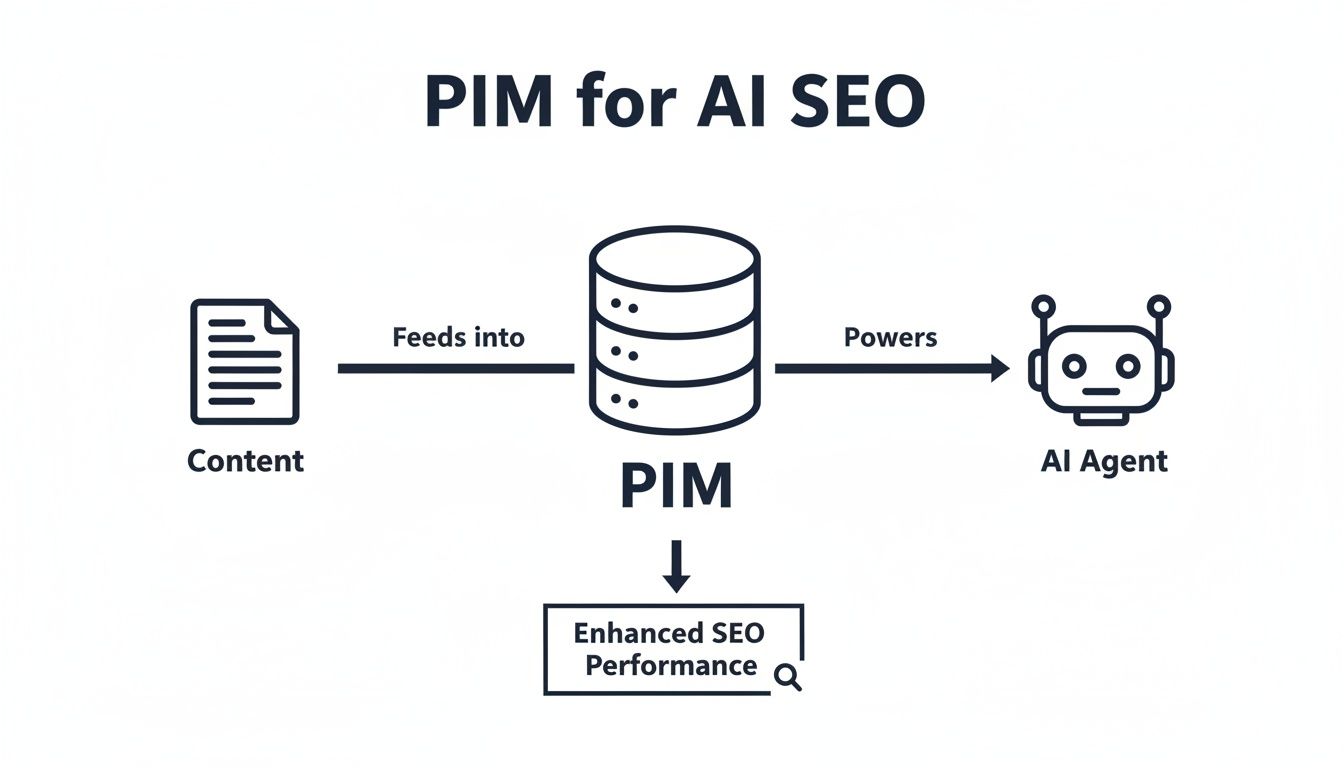
The image makes it clear that a PIM isn't just a storage system, but an active processing engine that’s essential for getting ready for agentic search.
Integrated Digital Asset Management (DAM)
Product information isn't just text. High-quality images, videos, and spec sheets are critical for conversions. A modern PIM includes integrated DAM capabilities, linking every digital asset directly to its corresponding product. For specialised needs, you might consider engaging professional product photography services to ensure your visuals are as rich and engaging as your text.
This is especially important for verticals like fashion and furniture, where visuals drive purchasing decisions. AI-powered image recognition and tagging within the PIM can automatically analyse images and generate descriptive alt tags and metadata. This boosts image SEO for ecommerce and ensures products show up in visual searches for terms like "art deco armchair" or "floral midi dress," directly improving your digital shelf performance.
A PIM with an integrated DAM transforms your media library from a simple storage folder into an intelligent, searchable, and optimised asset that actively drives discovery and sales.
Multi-Channel Syndication
Finally, once your product data is complete, accurate, and enriched, it needs to get out there. The syndication component automates the distribution of this optimised content to all your sales channels, including your ecommerce website, mobile app, marketplaces, and social media platforms.
This ensures absolute consistency everywhere a customer interacts with your brand, building trust and reducing confusion. The rapid evolution of PIM solutions reflects this necessity; the market saw a 20.10% compound annual growth rate between 2019 and 2023. By 2024, cloud-based PIMs now make up 63.5% of the market, which shows just how vital centralised, cloud-accessible data has become for multi-channel product optimisation.
PIM vs ERP and MDM: A Clear Guide for Retailers
For any retail leader, the alphabet soup of enterprise software, including ERP, MDM, and PIM, can be a huge point of confusion. They all manage data, but they have fundamentally different jobs. Getting this right is critical for building a tech stack that drives growth instead of creating bottlenecks.
A simple way to think about it is to picture these systems as specialised departments in your business. Each has a distinct role, and forcing one to do another’s job just leads to friction, wasted effort, and poor results.
ERP: The Finance Department
Your Enterprise Resource Planning (ERP) system is the operational backbone of the business, kind of like a combined finance and logistics department. Its entire world revolves around transactional data.
Think of it as the system that answers questions about:
- Inventory levels and stock movements.
- Purchase orders and supplier invoices.
- Financial records and accounting.
- Supply chain logistics and order fulfilment.
An ERP knows how many of a product you have and where it is, but it knows next to nothing about the rich, customer-facing content that drives ecommerce content optimisation. It was built for operational efficiency, not for crafting compelling product stories that boost your digital shelf performance.
MDM: The Central Records Office
Master Data Management (MDM) takes a much broader view. Imagine it as your company’s central records office, responsible for keeping a single, authoritative version of critical data across the entire organisation. This isn’t just about products; it includes master data for customers, suppliers, employees, and locations.
An MDM’s main job is to ensure data consistency and governance across every business unit. While it might hold basic product data like a SKU or a brand name, it doesn’t have the specialised tools needed for the deep enrichment that modern retail demands. It’s a generalist, not a marketing and sales specialist.
An MDM ensures you have one correct version of a supplier's name across your business. A PIM ensures you have a unique, SEO-optimised description for every product that supplier provides, ready for agentic search.
PIM: The Marketing and Sales Department
This brings us to Product Information Management (PIM). If the ERP is finance and the MDM is central records, the PIM is your dedicated marketing and sales department for product data. Its one and only job is to manage, enrich, and syndicate the customer-facing information that drives conversions and powers your AI SEO strategy.
A PIM is purpose-built to handle the complex, creative, and commercial side of your product catalogue that ERP and MDM systems simply ignore. It’s all about turning basic supplier feeds into optimised at scale content. This means workflows for correcting supplier content duplication, generating unique product descriptions, and managing digital assets like images and videos. Understanding the difference between PIM, DAM, and product optimisation platforms is key to appreciating this specialised role.
To make it even clearer, here’s a quick breakdown of how these systems fit together in a typical retail environment.
PIM vs. Other Enterprise Systems: A Retailer's Guide
This table clarifies the specific functions and primary users of PIM compared to related enterprise systems, helping retailers understand where each fits.
| System | Primary Function | Data Focus | Key Users |
|---|---|---|---|
| PIM | Manages and enriches customer-facing product information for sales channels. | Marketing descriptions, images, SEO data, attributes, specifications. | Ecommerce Managers, Marketers, Merchandisers. |
| ERP | Manages core business operations and transactions. | Inventory, orders, pricing, financial data, supply chain logistics. | Operations, Finance, Supply Chain Teams. |
| MDM | Creates a single, consistent source of master data across the enterprise. | Core data entities (product, customer, supplier) for consistency. | Data Governance Teams, IT, Business Analysts. |
| PDM | Manages technical data and engineering specifications during product development. | CAD files, technical drawings, parts lists, engineering changes. | Product Designers, Engineers, R&D Teams. |
Each system has its lane. Trying to use an ERP for marketing copy or an MDM for detailed product attributes is like asking your accounting team to run a social media campaign, it’s just not what they’re built for.
Ultimately, while all these systems are important, only a PIM gives you the tools for the future of work in retail, where human + AI collaboration in SEO is non-negotiable. It’s the critical link that turns raw operational data into the rich, structured content needed to win in an era of agentic commerce.
Building the Business Case for PIM Investment
For any retail executive, a new tech investment has to pull its weight with clear, measurable value. A Product Information Management (PIM) system isn't just another line item for the IT budget; it's a strategic investment that hits revenue, efficiency, and your ability to compete down the line. It’s about turning features into tangible ROI, giving you the hard data needed to get that budget signed off and drive real change.

The most immediate win? A dramatic cut in your time-to-market. Manual content workflows are a massive bottleneck, dragging out new product launches and seasonal collection drops. A PIM automates these grinding processes, letting teams launch thousands of SKUs in days, not months. You start capturing sales opportunities that would have otherwise been lost to delays.
Quantifying the Efficiency Gains
Beyond pure speed, a PIM brings huge operational efficiencies to the table. Just think about the hours your marketing, merchandising, and ecommerce teams burn chasing down correct product specs, fixing inconsistent data, and manually updating endless spreadsheets. Retail content automation wipes out these low-value tasks.
This frees up your best people to focus on work that actually grows the business, like market analysis, campaign strategy, and human-led AI content QA. It’s a core piece of building a business ready for the future of work in retail, where human + AI collaboration in SEO is the new standard. This shift from manual busywork to strategic thinking is one of the strongest arguments for a PIM.
Enhancing Digital Shelf Performance and Conversions
Better product storytelling leads directly to higher conversion rates. A PIM is the engine that makes this happen, allowing you to move beyond bland supplier descriptions to create rich, compelling, and consistent content across every single channel. This is absolutely critical for digital shelf performance.
Think about the impact of enriched content in key retail areas:
- Fashion SEO Optimisation: Adding attributes like "organic cotton" or "slim fit" makes your products easier to find and filter.
- Furniture SEO Services: Including detailed dimensions, materials, and assembly instructions builds the confidence a customer needs to click "buy."
- Electronics SEO Optimisation: Providing crystal-clear technical specs and compatibility info prevents customer confusion and abandoned carts.
This level of detail doesn't just improve the customer experience. It also provides the structured data needed for agentic search optimisation, ensuring your products get recommended by the new wave of AI shopping assistants.
A PIM system positions your product catalogue not just to be listed, but to be chosen. It’s the difference between having a digital presence and having a competitive digital advantage in the era of agentic commerce.
Just as importantly, giving customers accurate and detailed information upfront has a direct impact on your bottom line by cutting down on costly product returns. When a customer knows exactly what they’re buying, the chance of a return due to mismatched expectations plummets.
A Strategic Investment in Future Growth
Ultimately, investing in a PIM is about future-proofing your retail operation. It’s the foundational layer you need to compete in a world increasingly shaped by AI agents in ecommerce and sophisticated search algorithms. The market's rapid growth backs this up.
The global PIM market was valued at USD 3.67 billion in 2023 and is projected to hit USD 20.66 billion by 2032. This shows just how essential this technology has become for managing modern retail complexity. You can dig into the research behind these figures on Fortune Business Insights.
Making the case for a PIM means framing it not as a cost centre, but as a growth engine. It’s an investment in speed, efficiency, customer satisfaction, and readiness for the future of AI-powered commerce, making it one of the most strategic moves a retail leader can make.
How to Choose and Implement the Right PIM
Picking the right Product Information Management (PIM) system is a massive decision for any retailer. This isn't just about buying software; it's about investing in a platform that grows with you and gets you ready for the coming wave of agentic commerce. The right PIM becomes the central engine for your entire retail content strategy.
When you start looking at your options, zero in on systems built for the realities of modern retail. Scalability is completely non-negotiable. Your chosen PIM has to handle an ever-expanding product catalogue without slowing down. Also, look for native AI capabilities that can power workflows like automating product descriptions or AI image recognition, these are essential for doing SEO at scale.
Finally, seamless integration is a must. A PIM should plug into your existing tech stack, like Shopify or Magento, without any friction. This kind of connectivity is the bedrock of a resilient and efficient retail operation.
A Roadmap for Successful PIM Implementation
Implementing a PIM isn’t just an install; it’s a structured process that overhauls how your business manages product content. While every project has its quirks, a successful rollout usually follows a clear path designed to minimise headaches and maximise value from day one. It’s about making the leap from manual SEO to AI SEO, powered by a far more capable system.
Here’s a high-level look at the key stages:
- Audit and Define: First, you need to get a clear picture of what you have. Audit all your existing product data to find the inconsistencies and glaring gaps. At the same time, define your new, standardised data model, locking in the attributes and structure you’ll need for top-tier product feed optimisation.
- Configure and Integrate: With your model defined, it's time to set up the PIM and connect it to your ERP, ecommerce platform, and any other critical systems. Getting this right ensures data flows cleanly from the get-go.
- Migrate and Enrich: Now, you can start moving your existing data into the PIM. This is the perfect time to kick off the product data enrichment process. You can finally fix chronic issues like supplier content duplication and start seriously lifting your content quality.
- Train and Empower: A new system is only as good as the people using it. Get your teams trained up so they can use the PIM effectively. This step is vital for building a culture of human-led AI content QA, where human expertise guides the AI's efficiency.
- Syndicate and Optimise: With enriched content ready to go, start pushing it out to your sales channels. From here, it's about continuously monitoring performance and tweaking your workflows to improve digital shelf performance and drive better results.
The real goal of implementation isn't just to install software. It’s to embed a new, more efficient way of working into your retail DNA. This is how you finally break through content bottlenecks and build scalable SEO solutions.
This structured approach doesn't just make the transition smoother; it also helps you tackle the bigger challenges hitting the industry. Many retailers are pushed towards PIM adoption by new regulatory compliance needs or the sheer complexity of managing omnichannel assortments, as noted in reports on the growing PIM market on ResearchAndMarkets.com.
To see how a PIM fits into your wider technology strategy, take a look at our guide on building the retail tech stack for an agentic future.
Frequently Asked Questions About PIM
We get a lot of questions from retail leaders about Product Information Management. Here are the most common ones, with some straight answers.
How Long Does a Typical PIM Implementation Take?
This really depends on the size of your catalogue and how messy your data is to begin with. But a modern, cloud-based PIM can get you wins much faster than you might think.
We often see an initial phase, maybe focusing on a single brand or product line, go live in as little as 3-4 months. A full rollout is typically done and dusted in 6-12 months. The trick is to take an agile approach, tackle your biggest content headaches first. This way, you start seeing real improvements in your retail content automation and digital shelf performance without waiting for a massive, year-long IT project to finish.
Can a PIM Integrate With Our Existing Ecommerce Platform?
Absolutely. In fact, if it can't, it's not a modern PIM. Today's solutions are built to connect seamlessly with the tools you already use. They use APIs and ready-made connectors to sync your optimised product data with major platforms like Shopify and Magento, not to mention your ERP, CRM, and marketing tools.
This connectivity is what makes a PIM so powerful. It ensures your single source of truth for product information is actually reflected everywhere, which is critical for multi-channel product optimisation. It’s the foundation for automated content workflows that finally put an end to manual copy-pasting and the errors that come with it.
Is PIM Only for Very Large Retailers?
Not anymore. While it's non-negotiable for enterprises juggling millions of SKUs, a PIM delivers huge value for any retailer who's struggling with inconsistent supplier data, selling across multiple channels, or bogged down by manual content updates.
If managing product information is eating up your team's time and slowing down your ability to get new products to market, a PIM will give you a strong return, regardless of your size. It’s all about making the shift from manual SEO to AI SEO, a move that helps any business looking to grow without adding headcount.
How Does PIM Help With Correcting Duplicated Supplier Content?
This is one of the biggest problems a PIM solves. It acts as a central command centre where you can systematically find and replace all that generic, duplicated supplier copy. You can set up automated workflows for product data enrichment, transforming basic supplier specs into unique, on-brand content that’s optimised for both your customers and for AI search agents.
This process is the only way to fix supplier content duplication issues at scale. By creating unique descriptions for every single product, you avoid getting penalised by search engines and start building a brand voice that stands out. It's how you prepare your catalogue for the future of agentic search optimisation.
Optidan AI is the content and optimisation platform built for retailers preparing for an AI-led future. We help you transform messy supplier feeds into high-quality, structured content that makes your products discoverable and desirable to both human shoppers and AI agents. Learn more at https://optidan.com.
