


It’s a frustratingly common scenario for any retail leader: you know a product is in stock, but customers swear they can’t find it anywhere on your site. This disconnect almost always happens when your product data speaks a completely different language from your customers.
This gap is a silent revenue killer, turning guaranteed sales into missed opportunities and quietly chipping away at your digital shelf performance.
The Gap Between Your Catalogue and Customer Searches

At its core, the product findability problem is a translation issue. Your internal catalogue uses one language, while your customers use another.
A shopper might search for a "waterproof hiking jacket for winter," but your ecommerce system only knows the product by its technical supplier name, like "Alpine Pro Shell TX-500." The jacket is right there, but for all intents and purposes, it’s invisible.
This isn’t just an IT headache; it's a major commercial bottleneck. Every time a search returns zero results, you risk losing a customer who walks away assuming you don’t stock what they need. We dive deeper into this issue in our guide on why zero-result searches happen on ecommerce sites.
The table below breaks down exactly where this disconnect happens.
Common Gaps in Product Findability
| Problem Area | Retailer's Perspective (Catalogue Language) | Customer's Perspective (Search Language) | Impact on Revenue |
|---|---|---|---|
| Product Naming | "Men's Active Runner Model #78B" | "Men's running shoes for flat feet" | Lost sales, high bounce rate |
| Features & Benefits | "Poly-tech fabric, 10k breathability" | "Lightweight jacket for rainy days" | Poor filter results, cart abandonment |
| Categorisation | "Homewares > Kitchen > Storage" | "Airtight containers for pantry" | Difficult navigation, user frustration |
| Colour & Style | "Colour: #008080" | "Teal dinner plates" | Inaccurate search, missed cross-sells |
As you can see, the language gap is everywhere. What’s logical for a warehouse isn’t helpful for a customer trying to make a purchase.
Understanding the Mismatch
The root cause? An over-reliance on raw supplier feeds. This data is built for logistics and inventory management, not for customer-facing search. It’s stripped of all the rich, descriptive language that people actually use when they shop.
The main points of failure usually include:
- Technical Jargon: Supplier feeds are full of model numbers, product codes, and industry-specific terms that mean absolutely nothing to the average person.
- Missing Attributes: Critical details like colour, material, intended use ("for hiking," "for formal events"), and compatibility are often left out entirely.
- Lack of Synonyms: Your system might not know that "runners," "trainers," and "sneakers" all refer to the exact same product category.
From Manual Fixes to AI-led Content
For years, the only way to fix this was through painstaking manual SEO work, a slow, expensive, and completely unscalable process for catalogues with thousands of SKUs.
The future of retail search demands a shift away from this grind. AI-powered content workflows can now automate product data enrichment, turning basic supplier feeds into optimised, structured content that anticipates what customers are looking for.
For a modern retailer, true digital shelf performance isn't just about being in stock. It’s about being findable. If your content doesn't speak your customer's language, your products might as well not exist.
By correcting duplicated supplier content and creating unique, helpful product descriptions, you build a much stronger SEO foundation. This is absolutely critical for the new wave of agentic search, where AI shopping agents will rely on highly structured data to find and recommend products.
Automating this process allows you to achieve optimisation at scale, optimising tens of thousands of pages in days, which is a scale that’s simply impossible for traditional SEO teams. The solution is clear: you have to align your content with your customer's language.
Diagnosing the Root Causes of Poor Product Findability
When a customer searches for something you absolutely stock but comes up empty-handed, it's almost never a single point of failure. It's usually a cascade of hidden issues tangled up in your product data, site architecture, and content strategy. Uncovering these weak spots is the first step to building a digital shelf that actually performs.
Think of a poor site taxonomy like a completely disorganised warehouse. All the products are technically in there somewhere, but without a logical system for shelving and labelling, finding anything specific is a nightmare. This is exactly what happens online when your product content isn't structured to match how real people search.
The Problem with Thin Supplier Content
A huge part of the problem often comes from relying too heavily on raw, unedited supplier content. This data was created for logistics and inventory management, not for marketing or convincing a customer to buy. As a result, it’s usually crammed with technical jargon, internal model numbers, and vague descriptions that miss the mark on the language your customers actually use.
When you just import these feeds directly onto your site, you’re creating several critical problems:
- Duplicate Content Penalties: Search engines like Google actively penalise sites that use the same generic descriptions found on hundreds of other retail websites. Correcting this supplier content duplication is a crucial first step to improving your search visibility.
- Missing Searchable Attributes: Supplier feeds almost never include the rich, descriptive details customers search for. Think terms like "machine-washable," "outdoor dining," "vegan leather," or "compatible with iPhone 15." Without this data, your products are completely invisible to anyone using those phrases.
- Poor User Experience: Vague, technical content forces shoppers to guess. This leads to frustration, high bounce rates, and abandoned carts. Fixing duplicated supplier content is a fundamental first step in any effective retail SEO automation strategy.
Flawed Site Search and Taxonomy Logic
It's not just about the content on the page; the logic powering your on-site search and navigation plays a massive role in whether a product gets found. An ineffective search function is like having a store assistant who doesn’t understand plain English. For a deeper analysis, you can explore our guide on why on-site search fails for large retailers.
Your site's structure, or taxonomy, has to be intuitive. If a customer looking for "men's dress shoes" has to click through a confusing path like "Footwear > Men's > Formal > Oxford," you’re going to lose them. A logical structure, paired with powerful faceted navigation (your filters), lets customers quickly narrow down huge catalogues to find exactly what they need. But this whole system is crippled by incomplete product data.
Poor on‑site search and navigation silently kill conversions in a market that's only getting bigger. The online shopping industry in Australia is forecast to hit AUD $64.9 billion in 2025, which just magnifies the cost of having invisible products. We know that 9.8 million Australian households shopped online in 2024, but that doesn't mean conversion is easy. When your site search, filters, and product copy don’t reflect how Australians actually search, for things like “school shoes size 6 girls” or “Click & Collect Brisbane CBD,” customers will just assume you don’t have what they need and leave. This proves that structured, attribute-rich content isn't just a nice-to-have; it's revenue protection.
The Shift to Scalable SEO Solutions
Once you start diagnosing these root causes, it becomes pretty clear that the old way of doing things won't work. Manually fixing thousands of SKUs just isn't a viable strategy for any modern retailer. This is where AI SEO and retail content automation come into play.
The frustration of "we definitely stock this" is a data problem, not an inventory problem. Solving it requires a strategic shift from manual fixes to automated, AI-powered product data enrichment that operates at the speed and scale of your business.
After you've pinpointed why products aren't being found, the next logical step is to figure out how to improve ecommerce conversion rates by fixing these foundational issues. By putting scalable SEO solutions in place, you can turn your product catalogue from a liability into a powerful asset that drives discovery, engagement, and ultimately, sales.
How Product Data Enrichment Powers Modern Retail
After you’ve diagnosed the weak spots in your catalogue, the next step is connecting the problem to the solution. The core issue behind poor product findability almost always traces back to raw supplier feeds. They’re often filled with technical jargon, internal codes, and completely miss the critical details your customers are actually searching for.
This is where product data enrichment becomes your most powerful tool.
Think of it as the process of transforming basic, functional supplier data into compelling, structured, and search-optimised content. It’s not just about adding a few keywords; it’s about fundamentally restructuring your product information to serve the customer first. This enriched data is the fuel for your entire ecommerce engine.
This concept map shows just how easily disconnected data, poor taxonomy, and broken search logic can lead to invisible products.
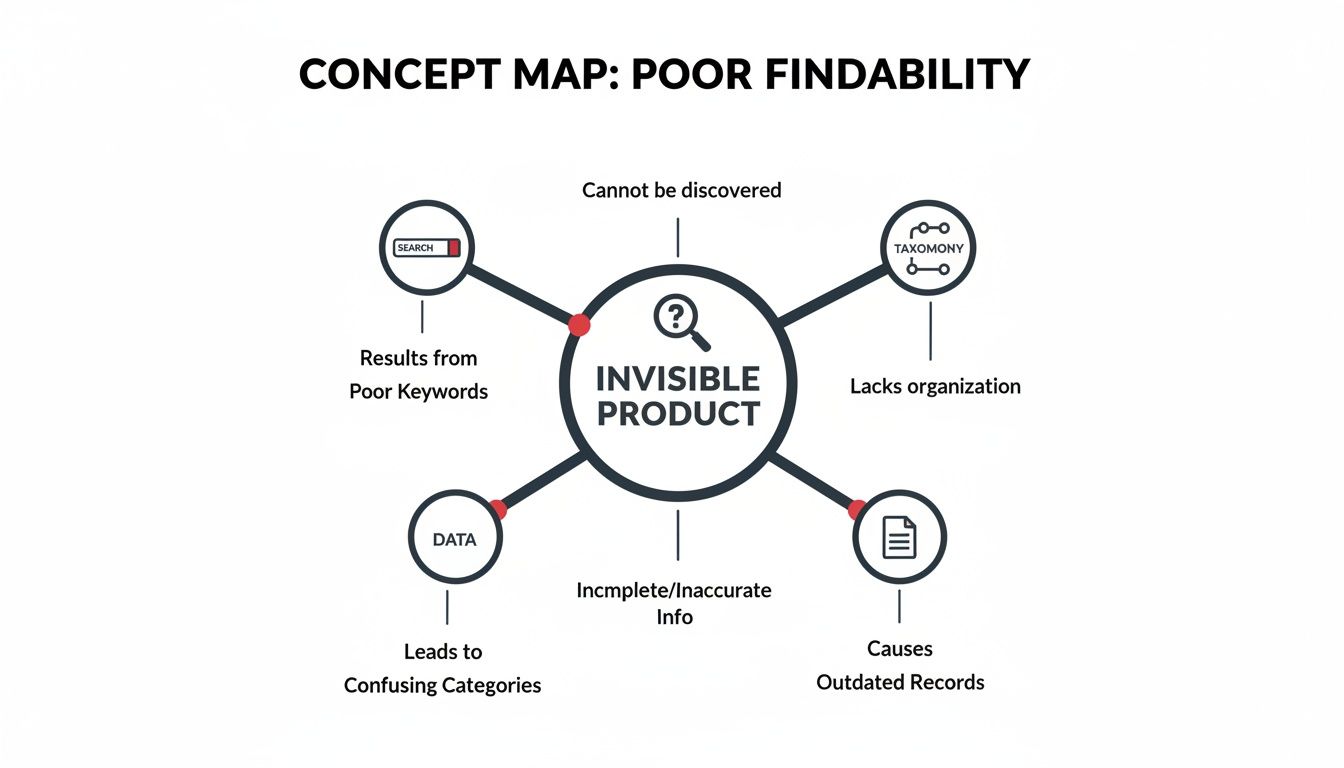
As you can see, each branch represents a critical failure point that stops customers from finding the products you definitely sell.
Turning Raw Feeds into Revenue Drivers
Supplier feeds are built for logistics, not for marketing. They provide a skeleton, but it’s your job to add the muscle and personality. Taking this on manually is a huge retail content bottleneck, requiring massive teams to rewrite thousands of SKUs one by one. This is exactly where AI agents for retail efficiency create a scalable, competitive advantage.
An automated content workflow can ingest dozens of raw supplier feeds and kick off the enrichment process instantly. This involves:
- Standardising Formats: Getting consistency across all suppliers for attributes like size, colour, and dimensions.
- Extracting Key Attributes: Using AI image recognition and tagging to spot features straight from product photos, like a "V-neck" on a dress or a "stainless steel finish" on an appliance, critical for fashion and electronics SEO.
- Generating Unique Descriptions: Correcting duplicated supplier content by creating original, keyword-rich descriptions that highlight customer benefits, not just technical specs.
This kind of automation allows for true SEO at scale, turning a months-long project into a matter of days. You can learn more about how to achieve this with our insights on product data enrichment automation.
Powering a Smarter Shopping Experience
Enriched product data doesn’t just improve your Google rankings; it directly enhances the on-site customer journey. When your product data is detailed and structured, you unlock several key functionalities that improve product findability in ecommerce.
Product data enrichment is the foundational layer for modern retail. It transforms a passive catalogue into an active sales tool that powers faceted navigation, improves search results, and prepares your business for the future of agentic commerce.
Well-structured data lets you build a powerful faceted navigation system. Those filters on the side of a category page, like "Brand," "Colour," "Size," and "Material," are only as good as the data feeding them. Without enrichment, a search for "black leather boots" might completely miss products labelled "Boot, BLK" in the original supplier feed.
Even more importantly, this detailed, attribute-driven content is precisely what AI agents like Google’s AI Overviews and Amazon's Rufus will use to answer complex queries. Optimising for this now is essential for future-proofing your digital shelf performance. By implementing SKU-level SEO through automated supplier feed enrichment, you build the foundation needed to not only solve today's findability issues but also to thrive in the new era of AI-powered retail.
Moving from Manual SEO to AI-Powered Content Workflows
For years, the standard approach to fixing product findability was a slow, manual grind. An in-house team or an agency would get the monumental job of rewriting thousands of product descriptions, one SKU at a time. This traditional model, while well-intentioned, is simply no longer viable for modern retailers managing huge catalogues.
The old process is inherently slow, expensive, and riddled with inconsistency. A human writer, no matter how skilled, can only produce a handful of unique, optimised descriptions per day. Trying to scale this across a catalogue of 10,000+ products turns into a multi-year project, and by the time you're done, search trends and customer language have already changed. It's a classic retail content bottleneck that just burns resources with minimal return.
In sharp contrast, an AI-powered content workflow represents a fundamental shift in both strategy and execution. This is the core difference between old-school SEO and the next-gen SEO for retailers.
The Limits of Manual Optimisation
Manual optimisation just can't keep up with the complex reality of Australian shoppers. Today’s discovery journeys are fragmented, meaning every weak content touchpoint becomes a leak in your sales funnel.
Online shoppers in Australia now use an average of 4.8 different touchpoints before buying, spanning search engines, social media, your own site, and word of mouth. When your product content isn't consistent and optimised for each of those channels, products you definitely sell become invisible. To get a sense of the scale of this, you can explore the full 2025 commerce report from IAB Australia.
The sheer scale makes manual efforts unsustainable. Imagine trying to align thousands of SKUs with constantly shifting keywords, competitor messaging, and customer review sentiment. It’s an impossible task for a human team.
AI workflow automation doesn't replace your expert team; it amplifies their strategic impact. It frees them from the granular, repetitive task of content creation, allowing them to focus on high-level strategy, campaign planning, and human-led AI content QA.
How AI Content Workflows Drive Efficiency
An AI-powered system operates with a speed and consistency that manual teams can't touch. Instead of writing line by line, it analyses massive datasets to generate unique, keyword-rich, and brand-aligned content at an incredible scale.
This retail content automation involves a few key processes:
- Data Analysis: The AI sifts through search trends, customer reviews, and competitor data to pinpoint the exact language and features customers are looking for.
- Content Generation: It uses these insights to generate thousands of unique product descriptions, titles, and metadata optimised for both search engines and human shoppers. For more on this, check out our guide on writing effective content for your website.
- Image Optimisation: Using AI image recognition, it can automatically tag product images with descriptive alt text, like "women's black leather ankle boots," improving fashion SEO and accessibility.
Making this leap from manual SEO requires a deep dive into comprehensive AI Search Optimization, which has become a critical step in modern automated content workflows. Let’s compare the two approaches side-by-side.
Traditional SEO vs AI SEO for Retail
The table below breaks down the practical differences between a manual approach and an AI-powered workflow for optimising a retail catalogue. It highlights how automation doesn't just speed things up, it transforms the business outcomes you can achieve.
| Task | Traditional SEO Team (Manual) | AI SEO Workflow (Automated) | Key Business Outcome |
|---|---|---|---|
| Product Description Writing | Writes 5-10 descriptions per day, per person. Prone to inconsistency. | Generates thousands of unique, brand-aligned descriptions in hours. | Complete catalogue optimisation in weeks, not years. |
| Keyword Research | Manually researches keywords for a small set of priority products. | Continuously analyses search trends across the entire catalogue. | Content stays aligned with real-time customer search behaviour. |
| Attribute Enrichment | Manually adds missing specs like 'material' or 'colour' one by one. | Identifies and fills data gaps across thousands of SKUs automatically. | Improved faceted search and filter accuracy on-site. |
| Image Alt Text | Manually writes alt text for new images, often skipped on large uploads. | Uses image recognition to generate descriptive alt text for all images. | Better image search visibility and improved site accessibility. |
| Content Updates | Updates content seasonally or when performance issues are flagged. | Monitors and adjusts content in near real-time based on new data. | Proactive optimisation that captures trends as they emerge. |
This strategic shift is about more than just efficiency; it's about building a content foundation that is prepared for the future of retail search. As agentic search optimisation becomes more important, AI-generated structured data will be essential for AI shopping agents to find and recommend your products.
By adopting AI-powered workflows, retailers can finally achieve optimisation at scale, turning a chronic content bottleneck into a powerful engine for improving digital shelf performance, boosting rankings, and ensuring customers can always find the products you definitely sell.
Preparing Your Catalogue for Agentic Search
Solving today's product findability issues isn't just about recovering lost sales this quarter. It’s about future-proofing your entire retail operation for the biggest shift in search behaviour since the smartphone. We're talking about the rise of agentic commerce, a new world driven by powerful AI assistants like Google's AI Overviews and Amazon's Rufus. This is fundamentally changing how customers discover and buy products.
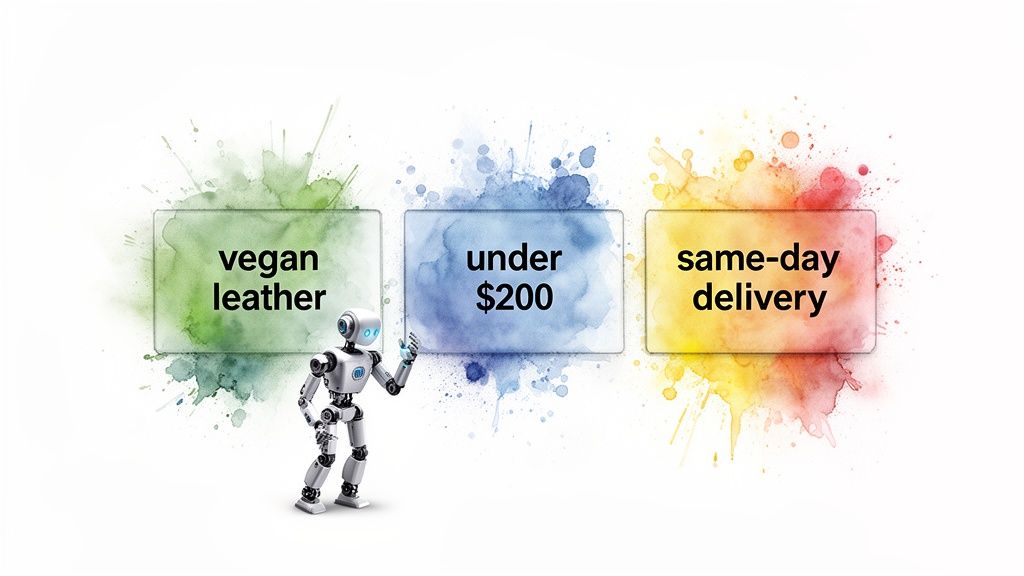
This new reality requires a new approach: agentic search optimisation. Unlike traditional SEO, which chases keywords, agentic SEO is all about creating highly structured, attribute-rich, machine-readable product data. It's the kind of data AI agents can easily understand and query. Your generic, unstructured, or duplicated supplier content? It will simply be ignored.
What AI Agents Need from Your Product Data
Think of an AI shopping agent as the ultimate personal shopper. It doesn't just look for keywords; it executes complex, multi-layered commands on behalf of a user. This marks a critical evolution in the future of work in retail, where collaboration between humans and AI in SEO becomes standard practice.
For example, a customer won't just search for "boots" anymore. They’ll ask their AI agent to find something far more specific:
"The best vegan leather ankle boots under $200, with a zip closure, available for same-day delivery in Melbourne."
To fulfil a request like this, the AI agent isn't scanning blog posts. It’s querying specific, structured data points across millions of products to find the perfect match.
If your product data doesn't explicitly state "Material: Vegan Leather," "Price: 189.95," "Closure: Zipper," and "Delivery Options: Same-Day Melbourne," your product is invisible. This is the new frontier of digital shelf performance.
From Keywords to Structured Attributes
This shift means we have to move away from keyword-stuffing and dive deep into product data enrichment. Every single product attribute becomes a potential filter for an AI agent, making data accuracy and granularity more important than ever. The agentic commerce future is built on data, not just descriptive prose.
To get ready, your automated content workflows must focus on:
- Attribute Extraction: Using tools like AI image recognition and tagging to identify and label features like "crew neck," "mahogany finish," or "USB-C port."
- Structured Data Implementation: Making sure all this data is marked up correctly so AI agents can parse it reliably, every single time.
- SKU-Level SEO: Optimising every single product with a complete set of attributes, not just your bestsellers.
Manually achieving this level of detail across large catalogues is impossible. AI workflows for ecommerce are no longer a nice-to-have; they are a strategic imperative for survival.
Retailers who invest in retail content automation and scalable SEO solutions now will own the future of retail search. Those who keep relying on thin, duplicated supplier content will find their products are not just hard to find, they won't be found at all. The work you do today to solve product findability is your direct on-ramp to success in the agentic era.
Your Action Plan: Aligning Content with How Customers Actually Talk
Let's cut to the chase. Closing the gap between your catalogue and your customers is the single most effective way to solve product findability. This isn't just about tweaking a few keywords; it's a strategic realignment that directly hits your digital shelf performance, rankings, and, most importantly, revenue. That gut-wrenching feeling of knowing a product is in stock but completely invisible to shoppers? We can fix that, systematically.
This plan is about moving your operation from slow, manual SEO slogs to a modern, AI-powered content workflow. It’s about building a solid foundation of structured, customer-centric data that doesn’t just meet today’s search demands but gets you ready for the agentic commerce future that’s already here.
Start with an Audit: Find the Gaps
First things first, you need to run a comprehensive audit to figure out exactly where the disconnect is. You need to gather intelligence from both sides of the search bar, comparing what your internal data says with what real-world customers are doing. This diagnosis is the bedrock of your entire optimisation strategy.
Your audit should zoom in on two key areas:
- On-Site Search Performance: Dive into your internal search logs. Every query that returns "no results" is a customer handing you their exact language on a silver platter. These are direct signals that your current product data doesn't recognise.
- Supplier Data vs. Customer Language: Put your raw supplier feeds side-by-side with keyword data from Google Search Console. This is where you'll spot the glaring gaps between technical jargon like "TX-500" and what customers are actually searching for, like a "waterproof winter jacket."
Going through this process will give you a clear map of your findability weaknesses, showing you exactly what needs to be fixed and why.
Build a Product Data Enrichment Strategy
Once you've identified the gaps, the solution is product data enrichment. This is where you transform those basic, often duplicated, supplier feeds into a powerful asset for both your customers and for search engines. It's the engine that drives modern retail content automation.
Aligning your content with customer language isn't just an SEO task, it's a commercial imperative. It’s the central solution to unlocking higher rankings, better conversions, and ensuring the products you definitely sell are always found.
This strategy needs AI workflow automation for retail to handle the sheer scale of the job. An AI-powered system like Optidan AI can ingest multiple supplier feeds and get to work optimising product feeds efficiently. It standardises formats and extracts those critical attributes that power your faceted search. This is also how you fix supplier content duplication, by generating unique, benefit-led descriptions at a scale that's simply impossible for manual teams.
Adopt an AI-Powered Content Workflow
To bring this strategy to life, you need to shift from traditional, clunky processes to an AI-powered content workflow. This approach gives you the speed and scale required to manage huge catalogues and stay ahead of constantly shifting search trends. The real magic happens with human + AI collaboration in SEO.
This modern workflow uses AI agents for retail efficiency to do the heavy lifting of content generation and optimisation. This could involve using AI image recognition and tagging for fashion SEO optimisation or furniture image tagging SEO, automatically creating rich metadata that makes products easier to discover.
Your team’s role changes from tedious manual writing to strategic oversight and quality control. You establish a human-led AI content QA process to make sure every single piece of content is perfectly aligned with your brand voice.
By adopting this plan, you can turn a chronic retail content bottleneck into a streamlined engine for growth. The end goal is simple: when a customer looks for a product you sell, they always find it.
Frequently Asked Questions
Here are a few common questions we hear from ecommerce managers and retail leaders about fixing product findability and bringing AI into their SEO workflows.
How Can We Identify the Specific Search Terms Our Customers Use?
Start with your own data. Your on-site search logs are a goldmine, especially the queries that return "no results," which is your customers telling you exactly what they're looking for in their own words. Next, jump into Google Search Console to see the organic search terms people are using to land on your site. Look for the gaps between their language and your product titles.
Don't forget to look at customer reviews, support tickets, and social media comments. People leave clues everywhere. An AI SEO platform can automate this entire process, digging through thousands of data points to find high-value keyword gaps between your catalogue and what real people are actually typing into search bars.
How Can We Manage Data Enrichment from Dozens of Suppliers?
This is the classic retail content bottleneck, and it’s precisely what AI workflow automation was built to solve. Instead of having your team manually rewrite every single supplier feed, an AI platform can pull in all those different feeds, standardise the data, and enrich it automatically based on rules you've set.
It can generate unique product descriptions, pull key attributes from messy, unstructured text, and even use AI image recognition to fill in the blanks. This completely changes the game, turning a painful, SKU-by-SKU slog into a scalable, automated workflow. You can enrich thousands of pages in days, not months.
Will Using AI for Product Content Make Our Brand Sound Robotic?
That’s a fair question, and the answer is no, not if you do it right. A human-led AI content QA process is absolutely essential. Modern AI content platforms aren't just generic text spinners; they can be trained on your specific brand voice and style guides. The goal isn't to replace your team but to give them superpowers through human + AI collaboration in SEO.
The AI does the heavy lifting, generating the foundational content at scale. Then, your human experts review, refine, and give it the final polish. This way, you get the massive efficiency boost of automation while ensuring every piece of content is perfectly on-brand. For a more detailed look into this area, you can find answers in our complete guide to Agentic AI SEO content optimisation FAQs.
Ready to transform your product catalogue and make sure customers can always find what they're looking for? Optidan AI provides the AI-powered content workflows you need to achieve SEO at scale. Visit Optidan to learn more and book a discovery call.
