


Messy, incomplete, and duplicated supplier data is the hidden handbrake on your retail performance. It kicks off a domino effect of poor search visibility, frustrating customer experiences, and operational chaos that directly eats into your bottom line in Australia's cut-throat retail market.
The Hidden Bottleneck in Australian Retail

For too long, Australian retailers have treated supplier data as a simple back-office task. The reality is the quality of this data is a core driver of your digital shelf performance. When product feeds land with missing attributes, generic descriptions, or blurry images, the consequences are immediate and severe.
This isn't just an IT headache, it's a critical growth blocker. These foundational data issues undermine everything from your AI SEO strategy to your inventory management, creating a retail content bottleneck that manual fixes can no longer handle. Bad data actively sabotages your ability to rank, convert, and compete in the era of agentic search.
Quantifying the Impact on the Australian Market
The scale of this problem is massive. In Australia, poor supplier data quality directly contributes to stock inaccuracies that cost retailers billions each year. With total retail sales hitting over AUD 37.3 billion monthly and online retail alone accounting for around AUD 4.7 billion in June 2025, the stakes are incredibly high.
Without accurate supplier data, this growing market faces plummeting customer satisfaction and a sluggish response to demand, directly torching profitability.
The core challenge is simple: you can't build a high-performing ecommerce operation on a foundation of flawed data. Every inconsistent SKU and duplicated description erodes your competitive edge and readiness for the future of retail search.
Let's break down exactly how these data issues manifest across your business. The table below shows the direct link between a specific data problem and its impact on your KPIs.
Immediate Impacts of Poor Supplier Data on Retail KPIs
| Data Problem | Impact on Digital Shelf | Impact on Operations | Impact on Customer Experience |
|---|---|---|---|
| Incomplete Attributes | Poor search filtering, lower organic rankings | Inaccurate stock replenishment, forecasting errors | Frustrating site navigation, abandoned carts |
| Inconsistent SKUs | Duplicated product listings, cannibalised SEO | Phantom stock, overselling, fulfilment errors | Confusion, receiving the wrong item, returns |
| Poor Feed Formats | Failed product imports, missing images/specs | Manual data entry, delays in getting products live | Outdated product info, negative reviews |
| Delayed Updates | Wrong pricing/stock shown, lost sales | Inability to react to market trends, stockouts | "Out of stock" messages, loss of trust |
As you can see, what starts as a "data entry" issue quickly snowballs into lost sales, wasted operational hours, and unhappy customers. These aren't isolated incidents, they are symptoms of a systemic problem.
Shifting from Manual Fixes to AI-Powered Solutions
The old approach of manually fixing supplier data, one product page at a time, is broken. It’s slow, expensive, and just can’t keep up. To achieve genuine SEO at scale, you need a completely new strategy based on AI workflow automation for retail.
This is where technologies like product data enrichment come in. Instead of just fixing typos, these systems transform raw, inconsistent supplier feeds into thousands of optimised, unique, and search-ready product pages. They are essential for getting your business ready for the new era of agentic commerce, where structured, detailed data is the price of entry for being seen by AI agents.
You can dig deeper into the complexities involved by reading our guide on the challenges of supplier product feeds for retailers.
Diagnosing the Supplier Data Problem
Let’s get real about the symptoms of bad supplier data that Australian retailers are fighting every single day. Forget theory. A raw supplier feed isn't just unfit for purpose anymore, it's an active liability, silently killing your digital shelf performance and eating into your profits.
The problem often kicks off with something as simple as inconsistent Stock Keeping Units (SKUs). One supplier sends you "BLK-TEE-M," while another uses "TSHIRT-BLK-MED." These small differences are enough to break your inventory systems, creating phantom stock, overselling, and forcing you to cancel orders. Nothing erodes customer trust faster.
This initial disconnect snowballs into a terrible customer experience. A shopper lands on your site and tries to filter by colour, material, or size, but they hit a dead end. If your supplier data is missing those crucial details, your faceted search is useless, and that frustrated customer is gone.
The Anatomy of a Failing Product Feed
The issues aren't isolated, they're a chain reaction that runs from your backend right to the customer-facing digital shelf. Every weak link drags down your overall performance.
Here are the key symptoms I see time and time again:
- Missing Product Attributes: These are the details vital for filters and search, like material for a dress or dimensions for a table. Without them, your products are basically invisible to anyone using your site's search bar, especially AI agents.
- Generic Descriptions: This is the root cause of supplier content duplication. When you use the same manufacturer description as dozens of other retailers, you kill your search rankings and make your brand completely forgettable.
- Inconsistent Data Formats: Dates, measurements, and categories that don't match your system’s format create a massive retail content bottleneck. Someone has to spend hours manually cleaning it all up.
- Low-Resolution Imagery: Grainy, unappealing supplier photos make your product pages look amateur and untrustworthy. That’s a direct hit to your conversion rates and hurts your fashion SEO optimisation.
To properly diagnose the problem, you first need to understand how to solve data quality issues that are quietly holding you back. Fixing these core failures is the first step toward building a system that can actually scale.
Connecting Data Failures to Search Performance
The line between poor data and poor search rankings is direct and unforgiving. Search engines actively penalise duplicate content. That means using those generic supplier descriptions is pushing your pages down the search results. This is a critical breakdown in ecommerce content quality assurance.
For the 85,000+ businesses in Australian consumer goods retail, the struggle is real. Poor-quality data leads directly to lost sales, higher return rates, and a damaged reputation. It’s an industry-wide problem that hampers growth and inflates costs.
Without detailed, structured data, your products are also unprepared for the future of retail search. AI agents and advanced search engines rely on rich attributes to answer complex queries, rendering basic product feeds obsolete.
What’s more, incomplete data makes it impossible to optimise at the SKU level. Proper SKU-level SEO demands unique titles, detailed descriptions, and specific attributes for every single product variation. You can’t achieve that at scale when the foundational data from your supplier is broken. This is exactly why product feed optimisation has moved from a "nice-to-have" to the essential first step in any modern retail SEO strategy.
Ultimately, digging into these issues reveals a fundamental data disconnect. You can learn more about how to align supplier feeds with search performance in our guide. The way forward isn’t about more manual fixes. It’s about embracing AI workflow automation for retail to turn this critical weakness into your biggest competitive advantage.
Moving From Manual Fixes to AI Workflows
The old way of fixing supplier data is fundamentally broken. Relying on a team member to manually correct product pages one by one is slow, expensive, and completely unscalable. For a retailer with thousands of SKUs, it’s like trying to empty the ocean with a bucket.
This manual grind is the main reason supplier data continues to hold back retail performance. It creates a permanent retail content bottleneck, where new products are delayed from going live, descriptions stay generic, and countless SEO opportunities are missed. Shifting to modern, AI-powered content workflows isn't just an upgrade, it’s a necessary evolution to survive and grow.
The Power of Product Data Enrichment
At the heart of this shift is Product Data Enrichment. This is the process of taking thin, basic supplier feeds and systematically turning them into thousands of fully optimised, unique, and search-friendly product pages. Instead of just correcting mistakes, AI proactively enhances the data.
An automated system can spot missing attributes and fill them in, standardise inconsistent formatting across thousands of lines, and write compelling, unique descriptions that match your brand voice. This is how you achieve SEO at scale, moving from a reactive, piecemeal strategy to a proactive, holistic one.
The goal of AI SEO is not to replace human expertise but to amplify it. AI handles the repetitive, high-volume tasks that overwhelm teams, freeing up your experts to focus on strategy, brand voice, and final quality assurance. This is the core of human + AI collaboration in SEO.
Automating at a Technical Level
The practical applications of this technology are a game-changer for retail efficiency. Just look at the challenge of image optimisation, a critical but mind-numbingly slow task.
- AI Image Recognition & Tagging: For categories like fashion or furniture, AI can analyse a product image and automatically generate descriptive tags. It can identify that a dress is "v-neck, floral print, midi-length," or a sofa is "three-seater, velvet, mid-century modern." This is vital for furniture image tagging SEO.
- Alt Tag Optimisation for Retail: This same tech can then write descriptive alt tags for every single image in your catalogue. A job that would take a human team months can now be done in hours, massively boosting your image SEO for ecommerce.
- Metadata Optimisation at Scale: AI workflows can also generate optimised meta titles and descriptions for every single product, ensuring each page is perfectly primed for search engines from day one.
This diagram shows the damaging journey of poor supplier data, from its raw form to its negative impact on search performance.
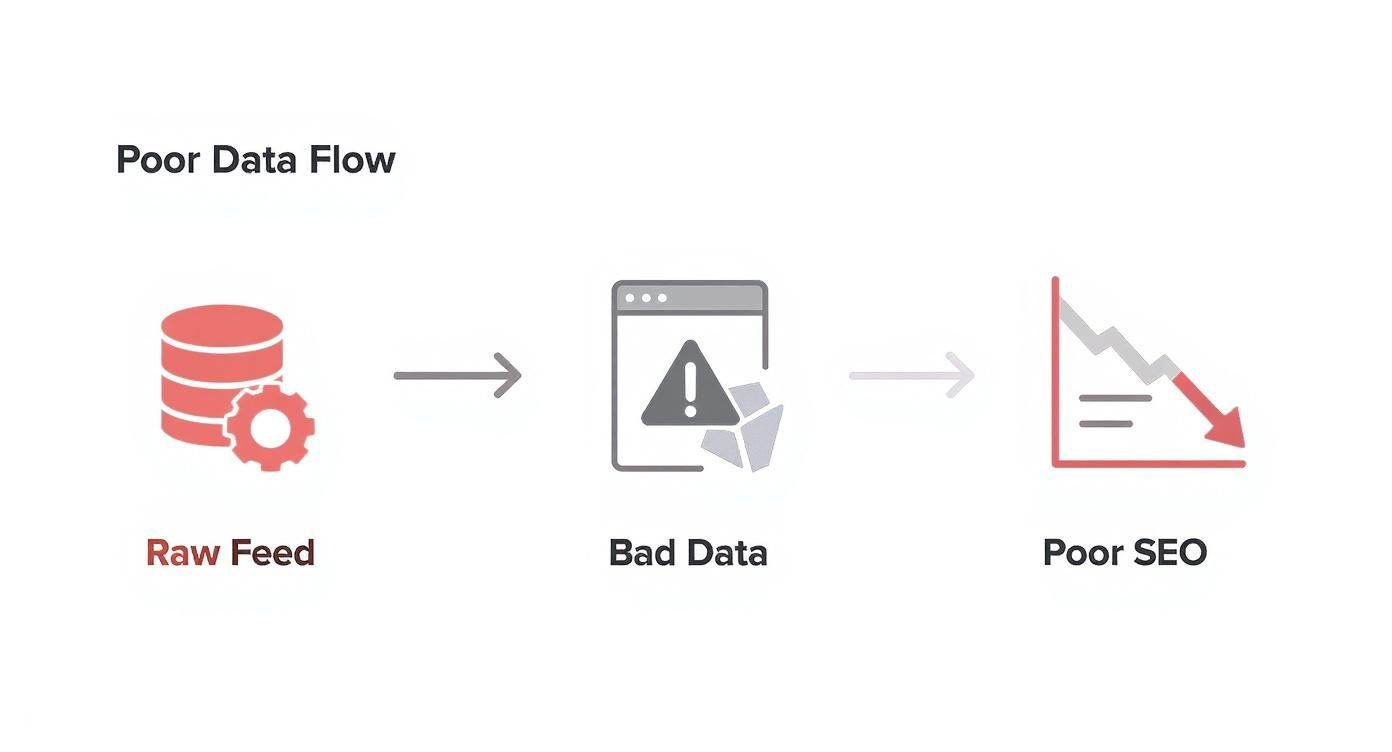
As you can see, the problem starts with a raw feed, deteriorates into bad data, and ultimately tanks your SEO, highlighting just how critical it is to intervene early.
Achieving Speed and Scale in Retail SEO
The biggest advantage here is the sheer speed and scale it brings to the table. Retailers can finally clear their content backlogs and optimise entire catalogues in a matter of days, not months or years. This rapid optimisation is essential for launching new collections, reacting to market trends, and staying ahead of the competition.
This leap in efficiency signals a core change in the future of work in retail. It allows teams to move beyond tedious manual updates and embrace a more strategic role, guided by human + AI collaboration in SEO. For a deeper dive into this transition, you can learn more about automating retail at scale with autonomous workflows.
This isn't just about doing the same old tasks faster. It's about enabling a level of product catalogue SEO that was previously impossible, making sure every single product contributes positively to your digital shelf and your bottom line.
Solving Duplicate Content and Defining Your Brand
One of the most damaging and common SEO mistakes in retail is simply copying and pasting generic manufacturer descriptions onto your product pages. This practice floods your site with duplicate content, making you invisible to search engines and indistinguishable from countless competitors selling the exact same products.
It’s a critical error that directly suppresses your digital shelf performance. When your product pages echo the same text as dozens of other sites, you give search engines zero reason to rank you. You're effectively telling them your site offers no unique value. This is the heart of the supplier content duplication crisis, and it's a huge reason why so many retailers are being held back.
The only way forward is to create unique, compelling product descriptions. This isn't just about dodging SEO penalties, it's about carving out a distinct brand voice that actually connects with customers and builds loyalty.
From Identical to Individual with AI SEO
Manually rewriting thousands of product descriptions is a non-starter for most retail teams. It's a classic retail content bottleneck that forces compromises and leads to massive missed opportunities. This is exactly where the shift from slow, traditional processes to AI-powered content workflows becomes a game-changer for achieving SEO at scale.
Instead of a copywriter grinding through one page at a time, an AI SEO platform can generate thousands of unique, on-brand product descriptions in a matter of days.
This is how it works:
- Automating Product Descriptions: The AI uses your base supplier data as a starting point, then rewrites and enriches it to create original, engaging descriptions that align with your brand’s specific tone of voice.
- Ecommerce Content Quality Assurance: The platform can analyse the generated content for uniqueness, keyword density, and readability, ensuring a high standard is maintained across your entire catalogue.
- Unique Product Descriptions SEO: By stamping out duplication, you signal to search engines that your pages are valuable, high-quality resources. This is fundamental to improving your rankings.
As you work to clean up these inconsistencies, understanding data deduplication techniques is crucial for maintaining a clean and accurate product catalogue for the long haul.
The Human + AI Collaboration Model
Bringing AI into the mix doesn't mean sidelining your expert team. The future of retail work is a powerful Human + AI collaboration in SEO. The AI does the heavy lifting, the repetitive, large-scale content generation, which frees up your team to focus on high-value strategic tasks.
This model isn't about replacing people. It's about giving your team the tools to achieve a much higher standard of ecommerce content quality. AI provides the scale, while your human experts provide the final strategic oversight and brand nuance.
This approach creates an incredibly efficient and scalable system. While the AI generates initial drafts for thousands of pages, your team steps in to perform the final human-led AI content QA. They ensure the tone is perfect, key selling points are highlighted, and the content truly reflects your brand's promise. Overcoming brand voice challenges is a common hurdle, but this collaborative model provides a clear, effective path forward.
Comparing Traditional SEO vs AI-Powered SEO for Retail
The difference between the old way and the new way is stark, especially when you look at speed, scale, and the strategic outcomes for a retail business. The table below breaks down just how much has changed.
| Process | Traditional SEO Team | AI-Powered Content Workflow | Key Outcome |
|---|---|---|---|
| Description Writing | Manually writes descriptions one by one, a slow process. | Generates thousands of unique descriptions automatically. | Speed to market for new product lines is dramatically increased. |
| Content Uniqueness | Relies on manual checks, which can be inconsistent. | Systematically ensures every description is unique. | Duplicate content SEO fix is achieved across the entire catalogue. |
| Scalability | Struggles to manage catalogues over 1,000 SKUs. | Optimises 10,000+ pages in days, overcoming bottlenecks. | True scalable SEO solutions for large and growing retailers. |
| Team Focus | Bogged down in repetitive writing and data entry tasks. | Freed up for strategy, QA, and competitor analysis. | Increased retail teams and AI efficiency and higher job satisfaction. |
Ultimately, this shift means moving from being a passive receiver of supplier data to an active creator of a unique brand experience. By fixing the duplicate content problem, you don't just improve your search visibility. You build a brand that stands out, connects with customers, and drives sustainable growth.
Preparing Your Data for Agentic Commerce
Looking ahead, highly structured and attribute-rich data is no longer just a nice-to-have, it's the absolute foundation for the future of retail. We are entering the era of agentic commerce, where AI assistants will completely change how customers discover and buy things. For retailers still wrestling with messy supplier data, this shift is an urgent, existential threat.
The rise of AI agents like Google’s AI Overviews and Amazon's Rufus signals a move away from simple keyword searches. We're heading towards complex, conversational queries. A customer won’t just search for a "black dress." Instead, they’ll ask their AI agent, "Find me a black, midi-length, v-neck dress made from linen, available for delivery to Sydney by Friday."
In this new world, generic, thin supplier data will be completely invisible. AI agents can only recommend products they understand, and they understand them through detailed, structured data attributes. This makes agentic search optimisation a top priority.

Building the Foundation for Agentic Search Optimisation
To get found and recommended by these new AI shopping agents, your product data has to be flawless. This loops directly back to the immediate need for product data enrichment. The work you do today to clean, structure, and enhance your supplier feeds is precisely what will future-proof your business.
This is where all the pieces we've discussed click into place to get you ready for this shift:
- SKU-Level SEO: Making sure every single product variation has a unique, detailed description and a complete set of attributes.
- AI Image Recognition SEO: Using AI to generate rich, descriptive tags for every image, capturing details like style, material, and features that AI agents can actually read.
- Metadata Optimisation at Scale: Creating optimised titles and descriptions that are not just keyword-rich, but attribute-rich for machine readability.
These are the essential building blocks of AI-compatible SEO content. Without them, your products simply won't have the data an AI agent needs to consider them a relevant match for a customer's complex request. You can learn more by exploring our detailed guide on preparing your product catalogue for agentic search.
Overcoming Australia's Data Fragmentation Challenge
This forward-looking strategy is particularly critical for Australian retailers, who are already dealing with significant operational hurdles. The complexity and fragmentation of local supplier data systems create delays and errors that hold back omnichannel performance.
Many retailers suffer from 'blind spots' in their stock data, a problem caused by error-prone manual audits and inconsistent supplier feeds. The manual effort needed to fix this data consumes huge amounts of labour, inflating operational costs when wages and logistics are already on the rise.
The transition to agentic search optimisation raises the stakes. If your current systems can't even guarantee accurate stock levels due to poor data, you are fundamentally unprepared for an AI-driven future that demands perfect, attribute-level detail.
From Manual SEO to AI SEO Readiness
This change requires a new mindset. It's about moving from traditional, manual SEO tactics to a scalable, AI SEO strategy. This isn't just about optimising for keywords anymore, it's about structuring your entire product catalogue for machine comprehension.
The future of agentic shopping and the future of work in retail is one where AI workflows for ecommerce are standard. These automated systems are the only way to enrich and maintain the level of data quality required across tens of thousands of SKUs. The retailers who embrace this AI-powered retail transformation now will be the ones who thrive in the next generation of AI-driven search, leaving competitors with messy data far, far behind.
Supplier Data FAQs
Retail leaders and ecommerce managers often get stuck on the same supplier data problems. Here are some straightforward answers to the most common questions we hear about ditching manual fixes for AI-powered solutions that actually improve performance.
How Can We Start Improving Supplier Data on a Limited Budget?
The best way is to start small and prove the ROI. Kick things off with a data audit of your top-selling categories. This will quickly show you the most critical gaps holding back your digital shelf performance.
Focus on product data enrichment for these high-impact products first. Nail the fundamentals, like writing unique descriptions to get rid of supplier content duplication and optimising your images with accurate alt tags. Many AI SEO services offer pilot programs, which let you show the value of retail SEO automation on a small scale before you go all-in on a full catalogue overhaul.
What's the Real Difference Between Standard SEO and AI SEO for Retail?
The biggest difference is scale. Traditional SEO is a manual, page-by-page slog. For a retailer with thousands of SKUs, it’s not just slow, it's impossible to manage effectively and creates massive content bottlenecks.
AI SEO, on the other hand, brings automation and intelligence into the mix to achieve SEO at scale. It uses AI-powered content workflows to enrich thousands of product pages at once, generating unique descriptions and applying AI image recognition SEO for precise tagging. You’re essentially shifting from slow, piecemeal optimisation to a scalable system that readies your entire catalogue for today's search engines and the future of agentic commerce. This is the key strategic difference between AI SEO vs Traditional SEO.
Will AI Content Automation Make Our SEO Team Redundant?
Absolutely not. It’s going to empower them. This is a key part of the future of work in retail. AI is built to take on the repetitive, high-volume tasks that are bogging your team down right now, like automating product descriptions for an entire product range.
This shift frees up your expert team to move from tedious execution to high-value strategic work. They can finally focus on defining brand voice, running deep competitor analysis, and managing the critical human-led AI content QA process.
The future is all about Human + AI collaboration in SEO. Think of AI as an efficiency engine that helps your team achieve a level of ecommerce content optimisation that was never possible before. They can concentrate on the strategic thinking that drives real growth and gets you ready for agentic search optimisation.
Ready to stop letting poor supplier data dictate your performance? Optidan AI transforms your raw product feeds into thousands of optimised, unique, and search-ready pages in days, not months. Our platform uses AI-powered content workflows to fix duplicate content, enrich product attributes, and prepare your business for the future of retail search.
Learn how Optidan AI can unlock your retail performance today.
