


That 'no results found' page is more than just a minor glitch; it's a direct leak in your revenue pipeline. For any retail leader or ecommerce manager, figuring out why zero-result searches keep happening on ecommerce sites is the first step to winning back those lost sales.
The culprits are usually invisible gaps in your product data, a fundamental disconnect between how your customers actually search and the information you have given them to find products.
The Silent Conversion Killer Hiding on Your Site
A "no results found" page isn't just a technical hiccup. It's a dead end for your customer. Research shows that these failed searches can cause a 10–15% drop in on-site conversions as shoppers with high intent simply give up and leave.
This isn't some minor IT ticket to be fixed later. It's a critical flaw in your digital shelf performance that demands immediate attention. Every single failed search represents a missed sale and a customer you have probably just lost to a competitor with a smoother experience.
The problem runs deeper than you might think. Your customers use natural, varied, and often imperfect language. They might search for a "lounge" when your product data only lists "sofa," or look for a "raincoat" when your supplier’s feed calls it a "waterproof shell." These small vocabulary gaps are the main reason zero-result searches keep happening.
From Manual Fixes to AI-Powered Solutions
The old way of manually adding synonyms or tweaking keywords one by one just doesn't work at scale anymore. Modern retail demands a smarter strategy built on AI SEO and automated content workflows.
The real issue is often generic supplier content. It is usually duplicated across dozens of sites and lacks the rich details needed for a good search experience. Fixing this means rethinking your entire product catalogue, moving from basic data feeds to enriched, structured data that is ready for the future of search.
Key areas where this gap becomes a major bottleneck include:
- Missing Keywords: Your product data does not include the terms customers actually use, like "eco-friendly" or "machine washable."
- Incomplete Attributes: Crucial details like material, style, or compatibility are missing, making it impossible for customers to filter their searches.
- Lack of Synonyms: Your system cannot connect related terms like "sneakers" and "runners" or "handbag" and "purse."
- Supplier Content Duplication: Using the same generic descriptions as everyone else hurts your SEO and fails to highlight what makes your products unique.
Fixing these issues is crucial for preparing your catalogue for the rise of agentic commerce. As you can learn more in our guide on why your website is invisible to AI search, AI shopping agents like Google's AI Overviews and Amazon's Rufus depend on deeply structured data to make recommendations.
By implementing AI-driven product data enrichment, you can finally close these discovery gaps at scale. You can turn those frustrating dead-ends into seamless conversion paths. This is the foundation of a resilient ecommerce strategy, ensuring your products are always findable, no matter how a customer decides to search.
How to Uncover Your Search Blind Spots
Before you can fix the problem, you need to see it clearly. For many retail leaders, the true scale of their zero-result search issue is a massive blind spot. It is not just a few odd queries; it is a systemic breakdown in on-site discovery that is quietly chipping away at your bottom line.
Diagnosing this problem always starts with a deep dive into your site search logs. This raw data is a goldmine. It reveals exactly what your customers are looking for but failing to find, telling a story of missed opportunities, rising frustration, and critical gaps in your product catalogue.
This is not a minor technical glitch. As the hierarchy diagram below shows, these seemingly small search failures cascade into significant business challenges, and it all stems from poor product data.
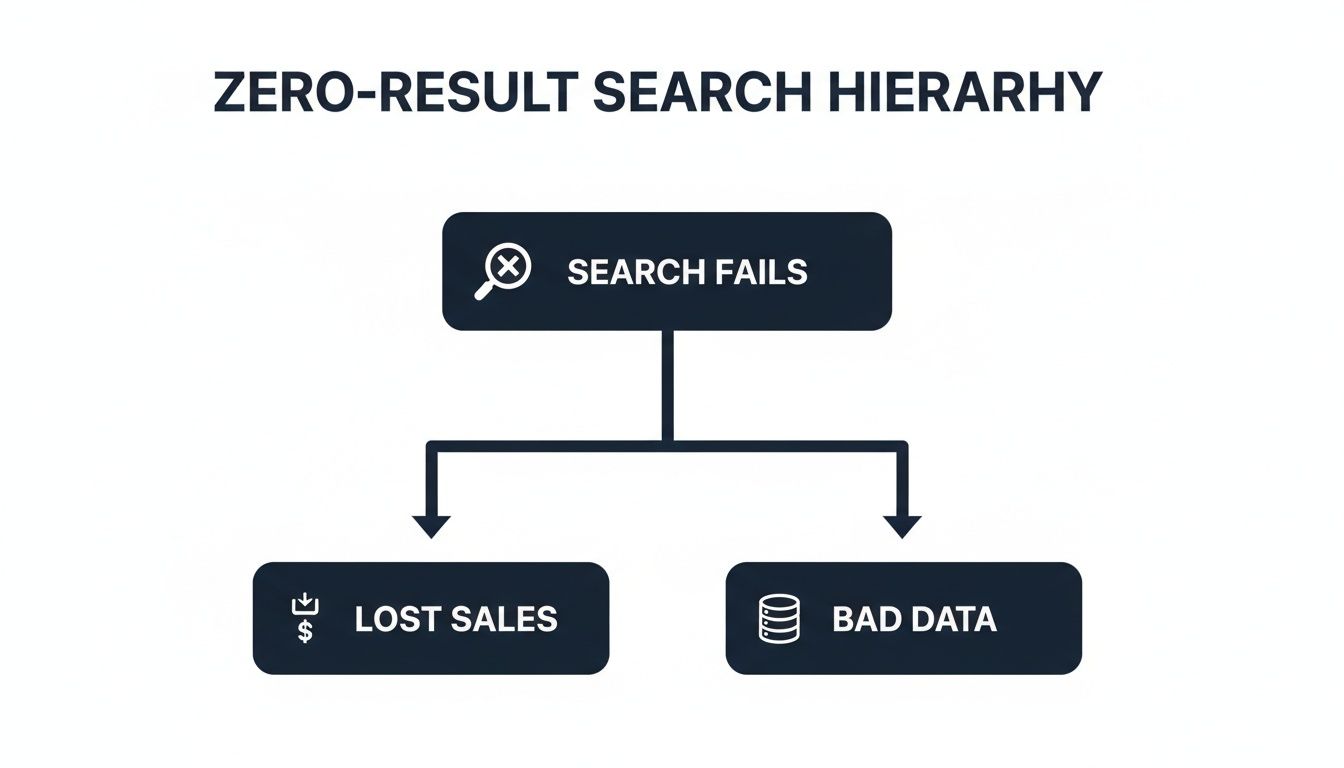
Every search dead-end is a direct path to a lost sale. More importantly, it is a glaring sign of underlying data deficiencies that are weakening your entire digital presence.
Analysing Your Search Logs for Actionable Insights
Your first step is to filter your search logs for queries that returned zero or minimal results. But do not just look at the raw numbers; segment them by frequency. A term searched hundreds of times that leads to a dead end is a far more urgent problem than some obscure, one-off query.
Look for patterns that reveal specific weaknesses:
- Synonyms and Regional Terms: Are customers searching for "runners" while all your products are tagged as "sneakers"? Or "lounge" instead of "sofa"? These vocabulary mismatches are low-hanging fruit.
- Common Misspellings: Simple typos can completely derail a purchase. Your system needs to be smart enough to connect "Nkie" with "Nike" or correct Australian English spellings like 'colour' and 'jewellery'.
- Attribute-Based Searches: Queries like "waterproof jacket" or "vegan leather bag" are pure, high-intent searches. If they lead to a blank page, it is a clear sign your product data enrichment strategy is not capturing the attributes customers actually care about.
The table below breaks down some of the most common reasons customers hit a 'no results' page.
Common Causes of Zero-Result Searches
| Cause of Failure | Customer Search Example | Underlying Data Problem |
|---|---|---|
| Synonym Mismatch | "trackies" | Product data only uses "tracksuit pants" or "joggers". |
| Spelling Errors | "joolry" or "jewlery" | Search engine lacks robust spell-correction for regional terms. |
| Missing Attributes | "gluten-free pasta" | The 'gluten-free' attribute is not a searchable field in the product data. |
| Regional Language | "thongs" (for flip-flops) | The site uses "flip-flops", a term less common in Australia. |
| Pluralisation Issues | "mouse" vs "mice" | The search algorithm does not recognise singular/plural equivalents. |
| Brand Variations | "Dr Marten" | The product is listed only as "Dr. Martens" with the period. |
These examples highlight the gap between how real people search and how product data is often structured. It is a gap you need to close.
By systematically analysing these logs, you are not just finding errors; you are mapping your customers' true search intent. This process exposes the language they use, the features they value, and the exact points where your current setup fails them.
To really dig into where your search is failing, the best AI search monitoring tools can provide the deep insights needed to pinpoint these blind spots. This kind of analysis is crucial for building a complete picture of your search performance. You can also see how these insights connect to broader business goals in our guide on leveraging data analytics for superior digital shelf performance.
Beyond Logs: Identifying Deeper Data Gaps
While logs tell you what failed, you need to investigate why. This is where the limitations of manual fixes become painfully obvious. A temporary synonym list will not solve the core issue if your supplier feeds are thin on detail to begin with.
Manually fixing thousands of SKU-level data gaps is an impossible task for any retail team. This diagnostic process should highlight the urgent need for SEO at scale. It builds an undeniable business case for shifting from reactive, manual adjustments to proactive, automated solutions.
The goal is to move from a system that requires customers to know your specific terminology to one that understands theirs. This requires a foundation of rich, structured data that can only be built efficiently through AI workflow automation.
Once you have a clear diagnosis of your search blind spots, you can begin the work of transforming your product catalogue from a liability into your most powerful discovery asset. This prepares your brand not just for today's customers, but for the future of agentic search and AI shopping.
The Real Problem: Generic Supplier Content
For many retailers, the reason zero-result searches keep happening can be traced back to a single, pervasive issue: generic supplier content. Relying on basic, often duplicated, product feeds from suppliers is a direct path to creating massive discovery gaps on your website. These feeds are built for logistics, not for customer engagement or searchability.
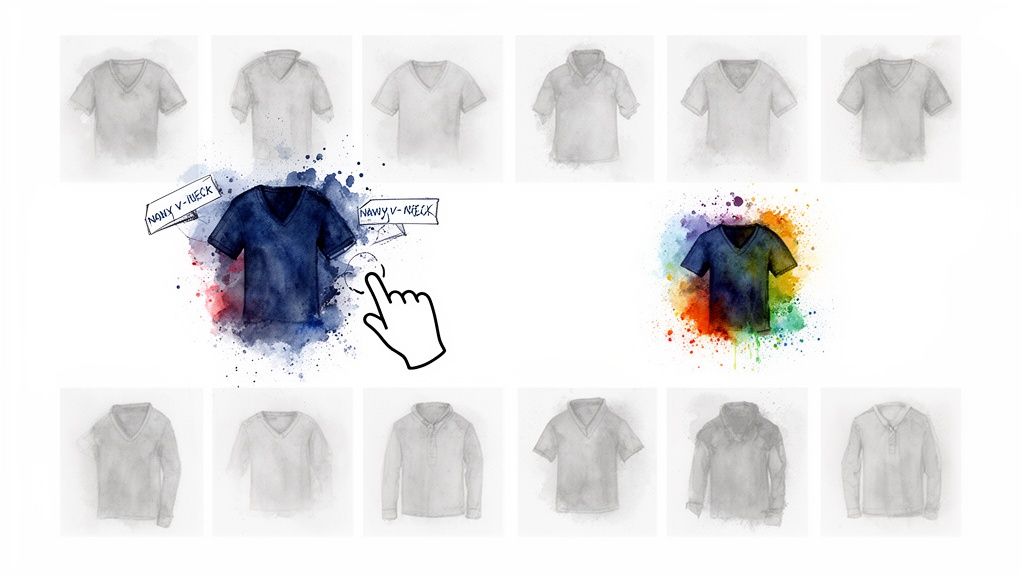
Supplier data is notoriously thin. It is almost always missing the rich, descriptive keywords, attributes, and synonyms that your customers actually use when they are looking for something. This creates a fundamental disconnect between your product catalogue and real-world search behaviour, leaving high-intent customers at a dead end.
The Vocabulary Gap Between Suppliers and Customers
Here is the thing: the language of a supplier is rarely the language of a customer. A supplier might list a shirt in their feed as ‘blue cotton tee’, a factual but sterile description.
But your customers search with far more nuance. They might look for a ‘navy v-neck t-shirt’, ‘cobalt crew neck top’, or even a ‘slim fit cotton tee’.
When your on-site search engine only has ‘blue cotton tee’ to work with, every one of those more specific queries returns a blank page. This is not a failure of your search technology; it is a failure of the data fuelling it. This problem is especially bad in categories like fashion and furniture, where visual and stylistic details are everything.
This reliance on basic feeds cripples your on-site discovery and has serious consequences for your external search performance. Search engines like Google penalise supplier content duplication, pushing your pages down in the rankings because they offer nothing unique compared to competitors using the exact same descriptions.
From Manual Data Entry to AI-Powered Enrichment
The solution is product data enrichment. This is a strategic process of transforming that generic supplier information into unique, structured, and highly optimised content that actually helps people find what they want.
This is where the shift from manual SEO to AI SEO becomes a competitive necessity. Manually rewriting thousands of product descriptions and adding detailed attributes is a bottleneck no retail team can afford.
Product data enrichment is no longer a 'nice-to-have'. It is the core engine for discoverability in modern retail. It is about building a data foundation that understands customer intent and is prepared for the future of agentic commerce.
AI-powered content workflows can achieve this at a scale and speed that is simply impossible for human teams alone. These systems automate the heavy lifting, freeing up your team to focus on strategy and quality. You can explore a deeper analysis of this challenge by reading our guide on why supplier data is holding back retail performance.
How AI Closes the Content Gaps at Scale
Adopting an AI-powered retail transformation allows you to systematically fix the weaknesses inherent in supplier feeds. The technology is designed to think like a customer and enrich data accordingly, a crucial step in creating AI-compatible SEO content.
Here are a few key AI-driven enrichment tactics that make a real difference:
- AI Image Recognition and Tagging: This is critical for visual-heavy sectors like fashion and furniture. It can analyse a product image and automatically tag dozens of specific attributes like 'v-neck', 'slim fit', 'crew neck', 'floral pattern', or 'oak finish'. These tags become searchable terms that directly match customer queries.
- Automating Product Descriptions: Generative AI can create thousands of unique, SEO-friendly product descriptions in days. This not only solves the duplicate content SEO fix but also ensures your brand's voice is consistent across your entire catalogue.
- Building Synonym Libraries: AI can analyse search data to build extensive synonym lists, connecting terms like 'sofa' and 'lounge' or 'sneakers' and 'runners'. This ensures your products appear regardless of the terminology a customer uses.
By implementing these retail efficiency tools, you move from a reactive position of fixing search errors to proactively building a resilient, discoverable product catalogue. This does not just resolve today's zero-result searches; it prepares your digital shelf performance for the future of retail search, where structured data is everything.
Using AI Workflows to Build a Resilient Search
Diagnosing the problem is the first step, but taking action is what gets results. To permanently fix the issues causing zero-result searches, you have to move beyond manual, reactive tweaks and embrace a modern, AI-driven strategy. This is where the transition from manual SEO to AI SEO becomes a real competitive advantage.

The core challenge is scale. A human team simply cannot enrich and optimise a catalogue of 10,000+ SKUs with the speed and consistency needed today. AI workflow automation for retail is the only practical solution, letting you overhaul your entire product catalogue in days, not months. The goal is to build a resilient search experience that actually understands what your customers are looking for.
Automating Product Data Enrichment at Scale
The foundation of a search that works is rich, structured data. This means going far beyond the basic information your suppliers send over. AI-powered content workflows do the heavy lifting of product data enrichment, turning thin, generic information into a powerful asset for discovery.
Here are a few key strategies that can be automated:
- Synonym and Intent Mapping: AI models can analyse millions of search queries to build vast synonym libraries. This ensures that whether a customer searches for "trackies," "joggers," or "tracksuit pants," they find the right product every time. It is a simple fix that dramatically reduces search failures.
- Attribute Extraction: AI can read unstructured text in descriptions, or even analyse product images, to pull out and standardise crucial attributes. This is how you make previously unsearchable details like "machine washable" or "sustainably sourced" discoverable.
- Unique Content Generation: To tackle the duplicate content SEO fix, generative AI can produce thousands of unique, on-brand product descriptions. This boosts your SEO performance and makes sure your content is genuinely helpful.
This level of automation smashes the content bottlenecks that plague so many retail teams. It shifts your team's focus from mind-numbing data entry to strategic oversight and quality control, a perfect example of human + AI collaboration in SEO.
Leveraging AI Image Recognition for Visual Search
For categories like fashion, furniture, and electronics, visual details are everything. Customers do not just search for a "sofa"; they search for a "grey three-seater fabric sofa with wooden legs." Manually tagging every one of these visual attributes is impossible at scale.
This is where AI image recognition and tagging becomes a game-changer. The technology can analyse a product photo and automatically generate a list of highly specific, searchable tags.
For a fashion retailer, this means automatically identifying and tagging attributes like 'v-neck', 'puff sleeves', 'floral print', or 'midi length'. For a furniture store, it could be 'oak finish', 'tapered legs', or 'velvet upholstery'. Each tag is another potential pathway for a customer to discover your product.
This process directly tackles one of the biggest reasons why zero-result searches keep happening on ecommerce sites: the failure to capture the visual language customers actually use. By making visual attributes searchable, you unlock a massive segment of high-intent queries that were previously hitting a dead end.
Building a Future-Proof Search Foundation
Implementing these automated content workflows does more than just fix today's search problems. It gets your entire product catalogue ready for the future of retail search, including the rise of AI shopping assistants and agentic commerce. These new AI agents need deeply structured, attribute-rich data to work properly.
By investing in product feed optimisation and supplier feed enrichment now, you are building an AI-compatible content foundation. This ensures your products are not just visible on your own site but are also discoverable by next-generation search tools like Google's AI Overviews and Amazon Rufus. To get a deeper look at the technical side of things, discover how API-driven workflows are transforming retail data enrichment in our detailed guide.
This strategic shift empowers your business to achieve true SEO at scale. It transforms your product catalogue from a static list of items into a dynamic, intelligent system that actively connects customers with the products they want, no matter how they choose to search.
Preparing Your Catalogue for the Future of Search
Fixing your on-site search is not just about winning a few more sales today. It is about getting your business ready for the next big shift in retail: agentic commerce. The old rules of discovery are being torn up and rewritten by AI, and the way customers find products is changing for good.
AI assistants like Google's AI Overviews, ChatGPT, and Perplexity do not just scan for keywords anymore. They digest structured data to give people direct, conversational answers. This means the old game of keyword-stuffing is over. The new game is all about building a solid data foundation so these AI agents can actually understand what you are selling.
The New Reality of AI-Driven Search
This is not some far-off theory; it is happening right now. The introduction of AI Overviews in Google search results has absolutely hammered click-through rates for retailers and content sites across Australia.
When an AI Overview shows up, the top organic result sees its click-through rate plummet by an average of 34.5%. For informational searches, the kind people do when they are researching a purchase, the numbers are even worse. Some eCommerce sites have seen CTRs fall by as much as 76%. This is not a dip; it is a cliff.
The message is loud and clear. If your product catalogue is not built for AI agents, you are on the fast track to becoming invisible. These new AI shopping agents need deeply structured, attribute-rich product data to do their job, and they will simply ignore any products they cannot make sense of.
Building an AI-Compatible Content Foundation
Getting ready for this future means you need to stop thinking about manual SEO and start building an AI SEO strategy. Your goal is no longer just to rank on a page. It is to get your products picked and recommended by an AI.
This demands a fundamental change in how you handle your product information.
Here is what that looks like:
- Product Data Enrichment: This is about turning basic supplier feeds into detailed, structured content. You need to add every possible attribute, material, dimensions, compatibility, use-cases, you name it.
- SKU-Level SEO: Optimisation has to go deep. Every single product variation needs a unique, descriptive title, a compelling description that is not just copied from the supplier, and a full set of relevant tags.
- AI-Compatible Content: Structure is everything. Your content needs clear hierarchies and standardised attributes so AI models can easily parse it.
A huge part of preventing zero-result searches and staying visible is having effective product catalog management. It is the only way to ensure your data is clean, organised, and ready for both human shoppers and AI agents.
From Reactive Fixes to Proactive Strategy
By focusing on product data enrichment and AI workflow automation today, you are doing more than just improving your on-site search. You are building a critical asset for the future of retail. You are creating the kind of AI-compatible SEO content that the next generation of shopping assistants will favour.
This strategic shift positions your business for survival and growth in an increasingly automated retail world. It ensures that as search becomes more conversational and agentic, your products are not just listed, they are understood and recommended.
This move from keywords to a rich data framework is what next-gen retail SEO is all about. It is how you keep your digital shelf stocked and your sales chart pointing up. To get there, you first need to understand how to build a high-quality product feed for AI search, which is the technical backbone for this entire strategy. Investing in this foundation today is the only way to secure your visibility tomorrow.
Frequently Asked Questions
Got questions? We have got answers. Here are a few common queries we hear from retailers about tackling zero-result searches and what it really takes to fix them for good.
How Does AI Actually Help with Product Data Enrichment?
Think of AI as a force multiplier for your retail team. It automates the painful, time-consuming job of adding rich detail to your product data, doing it at a scale and speed humans simply cannot match. This directly hits the root causes of those frustrating "no results found" pages.
For example, AI image recognition can whip through thousands of product photos in minutes. If you are a fashion retailer, it will automatically spot and tag crucial attributes like 'v-neck', 'floral pattern', 'slim fit', or 'puffed sleeves'. For a furniture brand, it might tag 'oak finish' or 'tapered legs'. Every single one of these tags becomes a new search term that perfectly matches how your customers are looking for products.
On top of that, generative AI can write thousands of unique product descriptions, wiping out the supplier content duplication that is killing your SEO. It also builds out huge synonym libraries, so it knows that 'lounge' and 'sofa' mean the same thing. This ensures your products show up no matter what words a customer uses. This is what modern retail content automation is all about.
What Is the Difference Between AI SEO and Traditional SEO?
Traditional SEO is often a slow, manual game of whack-a-mole. It focuses on optimising a handful of high-priority pages with specific keywords, a process that just does not scale when you have a massive product catalogue. It is a strategy that is completely outmatched by the complexity of modern retail.
AI SEO, on the other hand, is about structuring your entire catalogue's data so it is perfectly understood by both human shoppers and the AI search agents that are coming to dominate discovery. Instead of just chasing keywords, it focuses on product data enrichment for thousands of SKUs at once. This means adding deep attributes, making every description unique, and getting your digital shelf ready for conversational queries.
The real shift is from manual tweaking to automated content workflows. AI SEO is built for the future of agentic commerce, where structured data, not just keywords, is what gets you seen. It is how you prepare your business for SEO for ChatGPT / Perplexity / Rufus and make sure your products are found by the next wave of AI shoppers.
How Quickly Can We See Results from Improving Our Product Data?
The great thing about enriching your product data is that you will often see an impact much faster than with traditional SEO campaigns. The speed depends on where you are looking, but you will notice improvements in two key areas.
- On-Site Search Performance: As soon as your own site’s search engine indexes the newly enriched data, you can see a major drop in zero-result queries within days. Customers will instantly start finding products that were invisible before, which means better engagement and higher conversion rates.
- External Search Engine Rankings: With platforms like Google, it takes a bit longer, but the results are more profound. As search engines crawl and re-index your newly unique and detailed content, you can usually measure a real impact on rankings and visibility within a few weeks to a couple of months. This lifts your entire digital shelf performance.
This quick feedback loop lets your team continuously refine your AI workflows for ecommerce and proves a clear return on investment.
Can This Process Fix Issues Caused by Supplier Content Duplication?
Absolutely. In fact, stamping out supplier content duplication is one of the biggest wins you will get from an AI-driven strategy. Relying on generic, copy-pasted descriptions from your suppliers is a massive own goal for SEO, as search engines actively penalise sites with unoriginal content.
Using AI agents for retail efficiency, you can rewrite thousands of those generic descriptions to create unique, compelling, on-brand content for every single SKU. This process can be done in days, directly fixing the duplication penalties and helping your site find its unique voice. A human-led AI content QA process ensures every piece of generated content meets your quality standards, giving you the perfect blend of automation and expert oversight.
You are essentially turning a major liability into a competitive edge, boosting your site's authority and search rankings at a scale that just was not possible before.
Ready to eliminate "no results found" for good? Optidan AI uses AI-powered content workflows to enrich your product data, fix search gaps, and prepare your catalogue for the future of agentic commerce. Learn how we help retailers achieve SEO at scale by visiting https://optidan.com.
