
When we talk about agentic AI in retail, we’re really talking about giving autonomous AI systems, or ‘agents’, the power to independently tackle complex jobs. This isn’t just about analytics; it’s about action. Think of them correcting thousands of duplicated supplier descriptions, optimising every product page on your site, and getting your entire catalogue ready for the new world of agentic search.
It’s a massive shift away from manual, repetitive processes to automated, goal-driven workflows. For Australian retailers, this is the key to finally achieving SEO at scale and seriously improving performance on the digital shelf. This guide explores how AI workflow automation for retail is the future of work for ambitious ecommerce teams.
The AI Revolution in Australian Retail
The retail industry is going through a huge change, moving past simple data analysis and into proactive, smart automation. The best way to think about Agentic AI isn’t as a single tool, but as a dedicated team of digital specialists working for you 24/7, driving retail efficiency tools forward.
You can assign each agent a specific goal. One might be tasked with rewriting 10,000 product descriptions to make them unique, while another focuses on optimising all the image metadata for your entire furniture collection. This is the future of work in retail, where human teams guide AI agents to execute at a massive scale.
Unlike older AI that would just analyse data and spit out a report, these agents take action. They don’t just find the problems; they solve them. For retail leaders and ecommerce managers, this AI-powered retail transformation is the answer to some of the most frustrating and persistent operational headaches.
Overcoming Core Retail Challenges
Managing enormous product catalogues, often pulled from multiple different suppliers, creates huge bottlenecks. We see the same challenges pop up time and time again:
- Correcting Duplicated Supplier Content: So many retailers are stuck using generic supplier descriptions. It’s bad for SEO rankings and it washes out your brand voice. Agentic AI workflows can rewrite all of this content at scale, ensuring every single product page is original. This is a critical fix for duplicate content SEO issues.
- Product Data Enrichment: Supplier feeds are often bare-bones. They lack the rich, structured detail you need for a great customer experience and strong SEO at the individual product level. AI agents for retail efficiency can take these basic feeds and turn them into fully optimised product content.
- Achieving SEO at Scale: Manually optimising thousands upon thousands of product pages is an impossible task for any human team. Agentic AI makes scalable SEO solutions a reality, handling everything from keyword research to metadata updates in a matter of days, not years.
Before we go further, it’s worth highlighting the fundamental differences between the AI systems most retailers are used to (like chatbots) and the agentic workflows we’re discussing now.
Comparing Traditional AI and Agentic AI in Retail
| Capability | Traditional AI (e.g., Chatbot) | Agentic AI (e.g., SEO Agent) |
|---|---|---|
| Primary Function | Responds to specific user queries. | Independently executes complex, multi-step tasks. |
| Scope | Limited to predefined scripts and knowledge bases. | Can plan, reason, and adapt to achieve a goal. |
| Action | Provides information or answers questions. | Takes direct action (e.g., rewrites content, updates SEO). |
| Autonomy | Requires human input to start and guide. | Operates autonomously once a goal is set. |
| Retail Impact | Improves customer service interactions. | Optimises entire operational processes like SEO or content. |
As you can see, we’re moving from a reactive model to a proactive one. Agentic AI doesn’t wait to be asked; it gets the job done.
This infographic helps visualise how these core concepts are powering the AI revolution in retail.
The image really brings home how AI is becoming the central nervous system for modern retail, connecting data, content, and the customer experience in a way that just wasn’t possible before.
Embracing the Future of Work and Commerce
This move towards agentic AI is also changing how retail teams operate. It’s all about human + AI collaboration. Your team sets the strategy and defines the goals, and the AI executes those plans with incredible speed and precision, showcasing AI workflows for ecommerce.
This model frees up your experts to focus on high-value strategic work instead of getting bogged down in repetitive content tasks. It creates a more efficient, creative, and ultimately more impactful work environment. These new online shopping innovations are completely redefining what’s possible for ecommerce growth.
And this isn’t some far-off future concept; it’s happening right now. Australian consumers are adopting agentic AI in their shopping habits at a blistering pace, with adoption jumping 119% as businesses integrate these autonomous systems.
A recent Salesforce report found that Australian shoppers who use AI agents report 64% higher customer satisfaction. This shows the real, tangible impact on the shopping journey. This new era of agentic commerce future is here, offering a direct solution to the retail inefficiencies that have held businesses back for years.
Moving From Manual SEO to Agentic Search Optimisation
For years, retail SEO has felt like a slow, manual grind. Teams spend endless hours trying to correct duplicated supplier content, enrich basic product data, and just keep up with Google’s ever-changing rules. It’s a reactive game that creates massive retail content bottlenecks, making it almost impossible to properly optimise an entire product catalogue.
The move from this old way of doing things to agentic search optimisation isn’t just a small step forward; it’s a fundamental change in strategy. We’re shifting from putting out fires to proactively building a high-performance, automated content system. This is the difference between traditional SEO teams and the next-gen SEO for retailers.
This isn’t about doing the old tasks a bit faster. It’s about unlocking capabilities that were completely out of reach before. AI-powered content workflows can finally take on the colossal task of true SKU-level SEO, turning every single product page into a powerful asset for your business.
Tackling Retail SEO Challenges at Unprecedented Scale
The core problem with traditional SEO has always been one of scale. A human team simply cannot write unique, optimised descriptions for 50,000 products. It’s not timely, and it’s certainly not cost-effective.
Agentic AI, however, is built for exactly this kind of challenge. It automates the most labour-intensive parts of retail SEO, delivering results that used to take years in a matter of days.
Here’s how automated content workflows solve the biggest headaches:
- Eliminating Supplier Content Duplication: AI agents can systematically rewrite every single generic supplier description. The result is unique, brand-aligned content that avoids SEO penalties for duplicate content and actually helps you stand out.
- Dynamic Product Data Enrichment: An agent can take a bare-bones supplier feed, often just a name, SKU, and price, and flesh it out with detailed attributes, technical specs, and benefits-driven copy. This improves both the user experience and your search visibility.
- Optimised at Scale: This is the real game-changer. AI workflows can process your entire catalogue, optimising titles, descriptions, and metadata for tens of thousands of pages at once. This ensures consistent quality and brand voice across your entire digital shelf.
By automating these foundational tasks, your team is freed from the repetitive grind. They can finally focus on higher-value strategy. This is the essence of human + AI collaboration in SEO, where technology provides the scale, and people provide the strategic direction.
AI Image Recognition and Metadata Optimisation
A critical, yet often overlooked, part of retail SEO is image optimisation. For sectors like fashion SEO optimisation or furniture SEO services, how your products look is everything. Visual search is a massive driver of traffic. But manually tagging thousands of product images with descriptive alt text and keywords is another one of those impossible tasks for human teams.
This is where AI image recognition becomes essential. An agentic workflow can analyse every product photo, automatically identifying key attributes. It can spot the V-neck on a dress, the velvet material of a sofa, or the screen size of a TV. This capability is critical for retailers.
This automated product image tagging process then generates highly specific, optimised alt text and metadata at scale. It’s a huge boost for your rankings in both traditional and visual search, and it also makes your website more accessible for all users. It ensures your products are discoverable, no matter how customers are searching. To see more on this, you can explore how AI SEO software is reshaping online retail.
Preparing for the Future of Agentic Shopping
Making the switch to agentic search optimisation isn’t just about improving your current Google rankings. It’s about getting your business ready for the future of retail search.
AI shopping assistants like Google’s AI Overviews, Perplexity, and Amazon’s Rufus are fundamentally changing how people discover and buy things. These AI agents don’t just crawl websites; they consume and synthesise structured data to give direct answers and recommendations. Optimising for these is now a core part of agentic shopping and the future of work.
By creating AI-compatible SEO content now, rich with structured data, unique descriptions, and detailed attributes, you’re making your products easily understood and preferred by these new systems. This proactive approach to generative AI SEO is crucial for staying visible on the digital shelf in the emerging world of agentic commerce. To truly modernise your entire approach, consider exploring how potent marketing automation strategies can streamline your broader efforts.
Achieving Product Data Mastery at Scale
Every ecommerce manager knows the pain of messy, incomplete, and inconsistent supplier data. It’s the constant bottleneck that stops you from growing, damages the customer experience, and holds back your digital shelf performance. Agentic AI for retail tackles this challenge head-on, acting as the ultimate product data enrichment engine.
It takes the chaos of multiple supplier feeds and turns it into a single source of truth, one that’s structured, optimised, and ready for any sales channel. This isn’t just about cleaning up data; it’s about transforming a liability into your most powerful SEO and sales asset. The process uses comprehensive retail content automation to systematically correct issues and build value at a speed no human team could ever match.
This lets retailers finally move past basic data management and into true product catalogue SEO.
From Duplication to Distinction
One of the biggest drags on retail SEO is supplier content duplication. When hundreds of retailers use the same generic descriptions, search engines see it all as low-value, repetitive content. That can seriously harm your rankings. An agentic AI workflow is designed to fix this for good.
By analysing a base supplier feed, AI agents can generate thousands of unique, on-brand, and compelling product descriptions. This automated approach solves the duplicate content SEO fix at its source, giving each product a distinct voice. This is how you achieve real SKU-level SEO and make sure every single page is helping your search visibility, not hurting it.
Standardising Attributes for Superior Discovery
Beyond descriptions, agentic AI is brilliant at standardising product attributes. Picture a supplier feed for electronics where one brand lists screen size in inches and another uses centimetres. An AI agent can automatically spot this, normalise it, and structure all the data into a consistent format.
This consistency is crucial for a few big reasons:
- Improved On-site Search: Customers can easily filter and find products when attributes like size, colour, and material are all standardised.
- Enhanced SEO: Structured data helps search engines understand your products, improving your chances of appearing in rich snippets and AI-driven search results.
- Better Digital Shelf Performance: A well-organised catalogue just looks more professional and trustworthy, which naturally leads to higher conversion rates.
Agentic AI’s ability to bring order to chaotic data is a game-changer. It creates the clean, structured foundation needed for advanced product feed optimisation and multi-channel product optimisation, ensuring a consistent and high-quality customer experience everywhere your products are listed.
Sector-Specific Enrichment in Action
The value of this detailed enrichment really comes to life in specific retail sectors where tiny, nuanced attributes are essential for discovery.
For fashion SEO optimisation, an AI agent can use image recognition to tag attributes like ‘V-neck’, ‘linen blend’, or ‘puffed sleeves’. In the highly competitive furniture SEO services space, it can identify materials like ‘solid oak’ or ‘bouclé fabric’ and styles like ‘mid-century modern’. And for electronics SEO optimisation, it can pull out and standardise technical specs like processor speed or battery life.
This level of detail makes your products far more discoverable to customers making very specific searches. It’s also a critical part of preparing for the future of agentic commerce, where AI shopping assistants will rely on rich, structured data to make recommendations. To see how this fits into a broader strategy, you can explore our detailed guide on comprehensive product data enrichment.
These AI-powered workflows are redefining more than just product pages. For instance, agentic AI is also transforming customer service in Australian retail by automating complex tasks like processing refunds and managing peak sales volumes autonomously across multiple platforms. This shift turns customer service from a cost centre into a source of major operational efficiency, as you can read more about in this deep dive into Australian retail automation.
Unlocking Value with AI Image Recognition
In retail, the first thing a customer sees is almost always an image. It’s their most important touchpoint with your product. Good photos sell, sure, but there’s a huge amount of hidden value locked inside them. Agentic AI taps into this value with sophisticated AI image recognition, turning your static pictures into a goldmine of structured data. This data then fuels better search performance and gives your customers a much better experience.
This is a genuine game-changer for categories where visual details are everything, like fashion, furniture or electronics. An agentic AI for retail system can automatically scan thousands of product images, pulling out and tagging attributes that a basic supplier feed would never dream of including. This whole process is fundamental to building a catalogue that’s ready for the next wave of visual and agentic search.
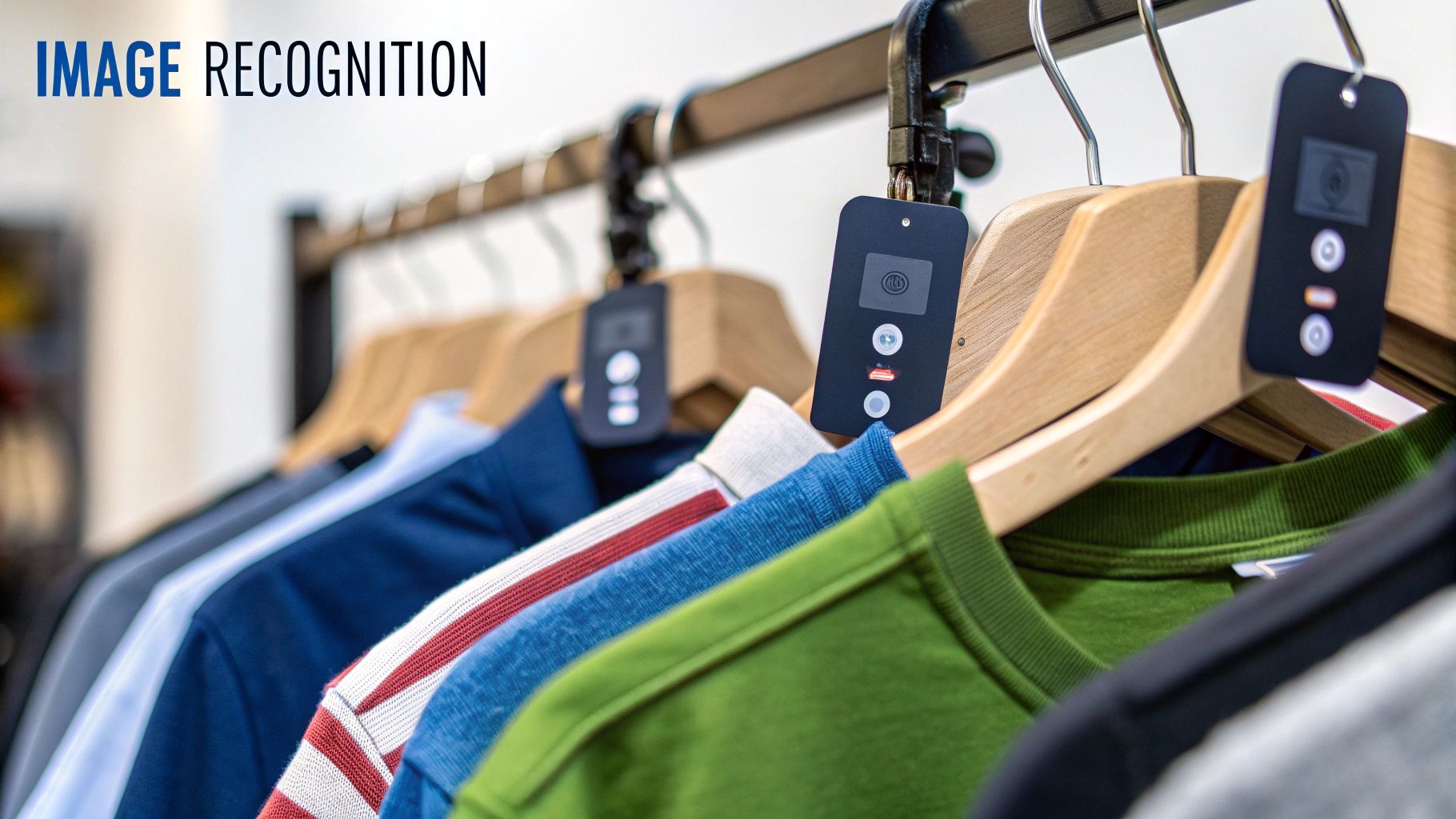
This isn’t just about making things tidy. This automated process enriches your product data on a granular level, opening up new ways for customers to find your products that simply don’t exist with manual methods.
From Pixels to Performance Data
Just think about how much information is packed into a single product photo. A person can instantly spot the neckline of a blouse, the fabric of a sofa, or the finish on a kitchen tap. Agentic AI gives your systems that same level of understanding, but it can do it for your entire catalogue in a matter of hours.
This automated product image tagging is crucial for a few key reasons:
- Better On-site Search: When a customer searches for a “V-neck linen top,” they actually find one. Why? Because the AI has already looked at the image, identified those exact features, and tagged the product accordingly.
- Improved Accessibility: It automatically creates descriptive alt text for every single image. This makes your site far more accessible for users with visual impairments and gives your overall SEO score a healthy boost.
- SKU-Level SEO: All this detailed metadata makes each product page more relevant in the eyes of search engines, helping you rank for those long-tail keywords that signal a customer is ready to buy.
Alt Tag Optimisation for Retail at Scale
Manually writing unique, descriptive, and keyword-rich alt text for tens of thousands of products is a classic bottleneck for any retailer. It’s one of those repetitive tasks that often gets pushed to the bottom of the list, yet it’s vital for both accessibility and image SEO for ecommerce. An AI-powered workflow automates this completely.
Instead of generic alt text like “blue dress,” an agentic AI system can generate “Blue V-neck midi dress with short puff sleeves in a linen blend.” This level of detail is precisely what search engines and AI shopping agents need to understand and rank your products effectively.
This automated metadata optimisation at scale ensures every single visual asset on your site is pulling its weight, directly contributing to your performance, improving rankings, and driving more qualified traffic.
A Game-Changer for Visual Categories
The impact of AI image recognition is most obvious in visually-driven sectors. Take the competitive world of fashion SEO optimisation. An AI agent can spot and tag attributes like sleeve length, fabric type, pattern, and style without breaking a sweat.
It’s the same story for furniture image tagging SEO. The AI can recognise materials like “solid oak,” “bouclé,” or “brushed brass,” alongside design styles such as “mid-century modern” or “industrial.” This deep product data enrichment gives customers the specific, structured information they need to find exactly what they’re looking for, which leads directly to higher conversion rates and a stronger position in the market.
Implementing Agentic AI Workflows in Your Business
Jumping into agentic AI for your retail business isn’t about flipping a switch and hoping for the best. Forget the massive, disruptive overhauls. A smarter way forward is a phased, strategic process that starts by targeting your biggest efficiency drains.
Think about it. Are you dealing with poor product feed optimisation? Widespread supplier content duplication? These are the perfect places to start. This practical approach lets you introduce powerful AI workflows for ecommerce that deliver real value straight away, without bringing your entire operation to a halt.
The trick is to begin with a clear, specific goal. Are you struggling to write unique descriptions for a 20,000-SKU catalogue? Is your team sinking hundreds of hours into manually tagging images for fashion SEO optimisation? Pinpointing these content bottlenecks is your first step. Once you know where the pain is, you can deploy targeted AI agents for retail efficiency to solve those specific problems at scale.
This is exactly where the human + AI collaboration in SEO model proves its worth. Your team sets the strategy and acts as the quality control, while the AI agents bring the speed and scale. It’s a partnership that creates a more agile, effective, and forward-thinking retail team.
A Phased Roadmap for Agentic AI Adoption
A smart implementation is all about building momentum and demonstrating value early. This phased roadmap is designed to do just that, de-risking the process while allowing your team to adapt and see wins at each stage.
A Phased Roadmap for Agentic AI Implementation
| Phase | Key Actions | Primary Goal |
|---|---|---|
| Phase 1: Audit & Identify | Analyse your existing product catalogue for major issues like duplicate content, missing attributes, and poor image metadata. | To create a data-backed business case by identifying the most significant content and SEO bottlenecks holding back performance. |
| Phase 2: Pilot Project | Select a specific category or brand (e.g., 1,000 products) for an initial run. Deploy an AI agent to fix duplication and enrich product data. | To prove the concept, measure the immediate uplift in digital shelf performance, and refine the workflow for a larger rollout. |
| Phase 3: Scale & Automate | Apply the refined automated content workflows across your entire product catalogue. Integrate the process with your existing PIM or ecommerce platform. | To achieve true SEO at scale, ensuring every product page is fully optimised, unique, and contributing to growth. |
| Phase 4: Monitor & Refine | Continuously monitor performance metrics, track rankings, and use insights to fine-tune the AI agents’ goals for ongoing improvement. | To establish a system of continuous optimisation that keeps your catalogue competitive and ready for the future of retail search. |
Following a structure like this allows you to prove ROI quickly. It builds internal confidence and gets everyone on board for a full-scale, AI-powered retail transformation.
Choosing the Right AI SEO Services
Be warned, not all AI solutions are created equal, especially when it comes to the messy reality of retail. When you’re looking for a platform or service for ecommerce SEO automation, it’s crucial to find one built specifically for the unique challenges of product catalogues.
Your ideal partner should offer much more than just basic text generation. You need a complete solution for product data enrichment, correcting rampant duplicate content, and optimising all your metadata.
The right platform acts as a central intelligence hub for your content. It should seamlessly integrate with your existing systems and provide the tools for your team to oversee the AI’s work, ensuring quality and brand alignment remain paramount.
For any retailer managing a huge range of products, the ability to deliver content at scale is non-negotiable. This is where specialised platforms truly shine, turning a task that was once impossible into a streamlined, automated process.
The Australian retail AI market is exploding for a reason, with revenue projected to jump from $310.9 million to nearly $2 billion by 2030. This growth is being driven by this exact shift. With 77% of ANZ retailers convinced AI agents will be essential to stay competitive, the time to invest is now. You can discover more insights about the booming Australian retail AI market and its expected impact.
Preparing for the Future of Agentic Commerce
Moving towards agentic AI for retail is more than just a quick fix for content bottlenecks; it’s a strategic play to future-proof your entire business. We’re standing on the edge of Agentic Commerce, a new era where autonomous AI agents won’t just be optimising content. Soon, they’ll be managing customer interactions, running marketing campaigns, and making data-driven decisions all on their own.
Bringing these technologies into your workflow now isn’t just about becoming more efficient. It’s about laying the groundwork for the next generation of search and online shopping. You’re getting your catalogue ready for a world where AI agents are the primary shoppers.
Embracing the AI-Powered Retail Transformation
The shift from manual work to AI-driven workflows fundamentally changes how retail teams operate. The idea of human + AI collaboration in SEO becomes the new centre of gravity. Your team sets the strategy and ensures quality, while AI agents handle the sheer scale of the execution.
This model helps your business become more agile and responsive. The core benefits we’ve talked about aren’t separate perks; they’re all connected parts of a bigger transformation:
- Achieving SEO at Scale: Getting tens of thousands of product pages optimised stops being a headache and becomes a manageable, automated process.
- Unique Content Creation: Getting rid of supplier content duplication protects your brand and gives your SEO performance a serious boost.
- Enhanced Digital Shelf Performance: Rich, structured data means better visibility, higher rankings, and more conversions.
Securing a Lasting Competitive Edge
The future of retail search will belong to AI assistants that need high-quality, structured data to make their recommendations. By putting agentic search optimisation in place now, you’re making your products more visible and appealing to these new gatekeepers.
This is the very core of the future of agentic commerce. The businesses building AI-compatible content today will have a massive head start tomorrow. They will be the first choice for AI shopping agents, locking in a prime position on the digital shelf as it evolves.
This was never about replacing human experts, but about amplifying their impact. It’s about giving your team the tools to focus on high-value strategy while AI takes care of the repetitive, large-scale work. As AI becomes more deeply woven into every part of retail, from supply chain to customer service, businesses that don’t adapt will be left behind. Embracing this shift is the clearest path to securing a real competitive edge in a market that’s changing by the day.
Common Questions About Agentic AI
If you’re a retail or ecommerce manager, you probably have a few practical questions about how Agentic AI actually works. Let’s get straight to the point and tackle the most common ones.
How Is Agentic AI Different from Standard AI Tools?
The big difference comes down to one word: action.
Your standard AI tools, think analytics dashboards or chatbots, are reactive. They’re great at analysing data you feed them or answering direct questions. An agentic AI for retail, on the other hand, is proactive. You don’t give it a task; you give it a goal.
For example, you could tell it, “eliminate all duplicated supplier content across the site.” The agent then figures out the necessary steps, plans the workflow, and executes it from start to finish. It’s the difference between an assistant who hands you a report listing problems and one who just goes and corrects them for you.
To get a better grip on the technology behind this, it’s worth exploring what AI agents are and how they work. It really clarifies the leap from simple automation to genuinely goal-driven AI.
What Is the Biggest Benefit for My Ecommerce Business?
Without a doubt, it’s the ability to achieve SEO at scale.
For years, retailers have known they should optimise their entire product catalogue, but the sheer manual effort made it impossible. Agentic AI completely shatters that barrier. It can optimise tens of thousands of SKUs in a matter of days.
This finally solves massive, long-standing issues like supplier content duplication and poor product data. The result is a direct, measurable boost to your digital shelf performance and your visibility in search.
Will This Technology Replace My Current SEO Team?
No, but it will absolutely empower them. The future is all about human + AI collaboration in SEO.
Agentic AI is built to handle the soul-crushing, repetitive work that ties up your human experts, like rewriting thousands of similar product descriptions or generating alt text for every single image.
This frees your team to focus on what they do best: high-level strategy, creative campaign ideas, deep competitive analysis, and quality assurance. Their work becomes far more strategic and valuable. Think of it as a tool for massive efficiency, not a replacement.
If you’re working with an external team, it’s a good idea to review some key AI questions to ask your SEO agency to make sure they’re ready for this shift.
How Does Agentic AI Prepare Us for the Future of Search?
The way people discover products is fundamentally changing. AI-powered assistants like ChatGPT, Perplexity, and Amazon’s own Rufus are becoming the new starting point for shoppers.
These systems don’t crawl websites like Google. Instead, they rely on highly structured, detailed, and unique product data to find and recommend products.
By using agentic AI to enrich your product feeds and create AI-compatible SEO content today, you’re future-proofing your business. You’re making sure your products can be easily understood and recommended by these new AI gatekeepers, which is the very core of the future of agentic commerce.
