

For Australian retail leaders, true ecommerce conversion rate optimisation is not about tinkering with A/B tests anymore. It is about a fundamental shift, moving away from manual guesswork and towards scalable, AI-driven systems built for the future of agentic search and AI shopping.
Rethinking CRO for the Age of AI and Automation
The old playbook for conversion rate optimisation usually revolved around isolated tweaks. Change a button colour here, rewrite a headline there. While those small changes have their place, they completely miss the bigger picture and the foundational issues holding back modern retailers: messy product data, duplicated supplier content, and clunky, inefficient workflows.
The real challenge today is optimising your entire digital shelf not just for human shoppers, but for the AI agents that are increasingly guiding their buying decisions.
This means moving from manual SEO to AI SEO, where success hinges on having structured, unique, and trustworthy content across thousands of SKUs. The goal is to build a powerful content ecosystem that boosts your digital shelf performance now and sets you up for the fast-approaching world of agentic commerce.
Getting this right involves a few key shifts:
- Product Data Enrichment: It is time to turn raw, inconsistent supplier feeds into structured, optimised product content that answers every possible customer question.
- Correcting Duplicated Supplier Content: Using generic supplier descriptions is a fast track to getting penalised. The only way to create a unique brand voice across your whole catalogue is with AI workflow automation.
- Optimised at Scale: You need automated content workflows that can refresh and optimise 10,000+ product pages in days, not years. This is how you solve retail’s biggest content bottlenecks for good.
This diagram shows exactly what that evolution looks like, from simple tweaks to the kind of sophisticated, AI-powered optimisation that defines modern CRO.
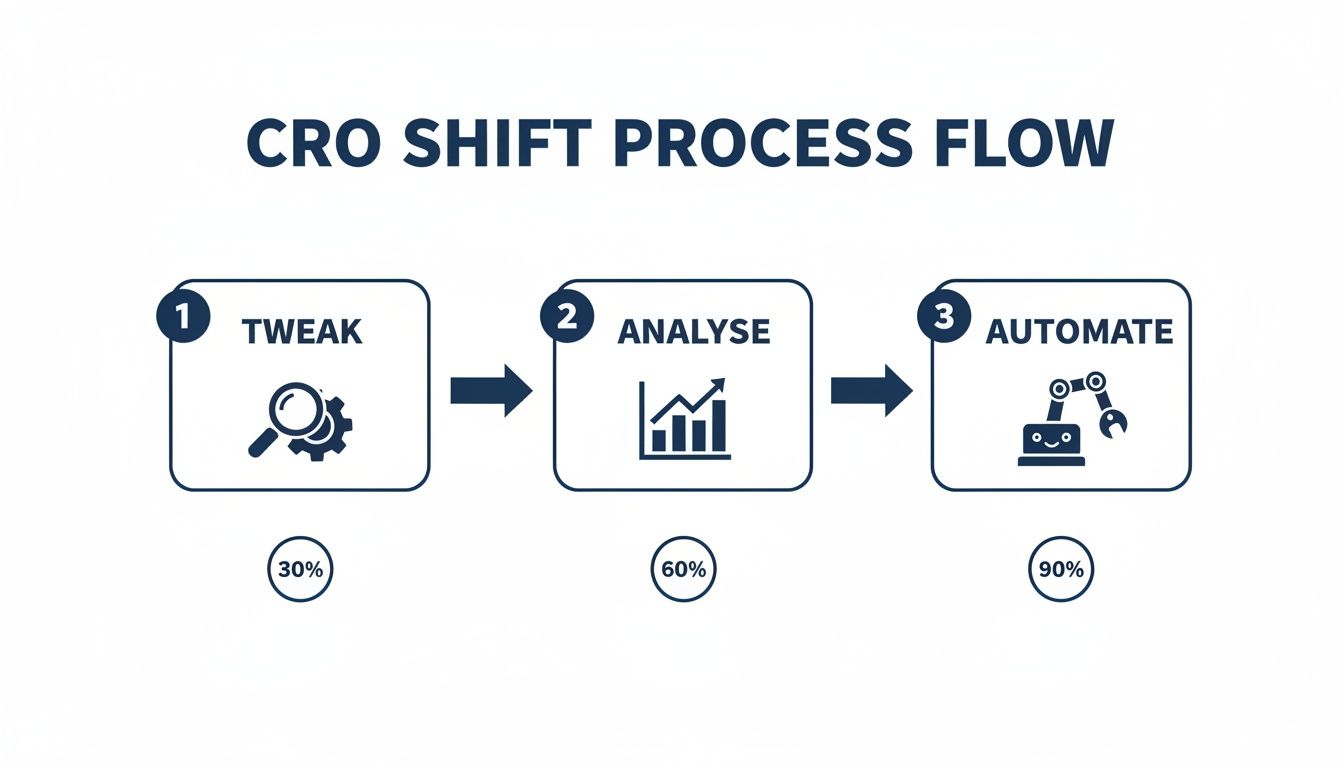
As the visual makes clear, real progress in ecommerce CRO happens when you move past surface-level changes and fully embrace automation.
To understand why this new framework is so critical, let's look at the difference between the old way of doing things and the modern, AI-led approach.
| Focus Area | Traditional Tactic | Modern AI-Led Approach |
|---|---|---|
| Testing | A/B testing minor UX changes (e.g., button colours). | Correcting foundational content & data issues across the catalogue. |
| Content | Manually writing copy for a few key landing pages. | Automating product descriptions for 10,000+ SKUs at scale. |
| SEO | On-page optimisation based on keywords and backlinks. | Building structured data ready for AI agents and agentic search. |
| Workflow | Manual briefs, tickets, and slow review cycles. | Continuous, automated content workflows that run in the background. |
| Goal | Incremental lifts on specific pages. | Systemic improvement of the entire digital shelf performance. |
This is not just a minor update to the old CRO playbook; it’s a complete rewrite. The focus has shifted from small, isolated wins to building a scalable, intelligent content system that drives performance everywhere.
Why a New Approach Is Critical for Australian Retailers
Local performance data really drives home the need for this strategic shift. The average ecommerce conversion rate in Australia recently hit a sobering 1.78%. That’s the lowest point in over a year and it’s slipped below the global average.
This figure comes after three straight quarterly drops, painting a clear picture of a tough market where tiny gains just will not cut it anymore.
In this environment, the retailers who win will be those who embrace retail content automation and scalable SEO solutions. It's about building an operational advantage through efficiency, preparing for the future of work in retail where human and AI collaboration drives growth.
For a deeper dive into the foundational strategies that make this work, check out this ultimate guide to ecommerce conversion rate optimization. It lays out a modern framework that pulls together AI SEO, deep product data enrichment, and automated workflows to deliver results you can actually measure.
Finding the Real Conversion Bottlenecks in Your Data
Before you can fix anything, you have to know what is broken. Real ecommerce conversion optimisation does not start with guesswork or chasing the latest trends. It starts with a deep, honest look at your own data to find exactly where your funnel is leaking.
Surface-level metrics like bounce rate are fine for a quick glance, but the gold is buried deeper. The real insights live at the SKU and category level, showing you the exact friction points that are quietly costing you sales every day.
The mission here is to move past generic analytics and pinpoint specific, actionable problems. Are shoppers bailing from a particular product category? Is one of your filters sending people straight for the exit? Answering these questions connects user behaviour directly to your content and on-site experience, which is where meaningful improvements happen.

Moving Beyond Surface Metrics
Too many ecommerce managers get fixated on the sitewide conversion rate, but that high-level number hides the real story. The truth is often buried in segmented data, where you can isolate how different customer groups, traffic sources, and product lines are actually performing. This is the first real step in building a CRO strategy that works.
For example, a high exit rate on a key category page might look like a UX problem on the surface. But dig deeper, and it’s often a direct symptom of poor product data enrichment or rampant duplicated supplier content. When customers land on a page and see the same generic, unhelpful descriptions copied across dozens of products, their confidence evaporates. They leave.
This is where AI workflow automation for retail is not just a nice-to-have; it's essential. It gives you the power to fix these content quality issues at a scale manual teams could never dream of matching.
Setting Up Custom Segments for Deeper Insights
To get to the root of your conversion problems, you need to analyse user behaviour with surgical precision. The key is setting up custom segments in your analytics platform.
Here are a few high-impact segments I always start with:
- By Product Category: Compare the conversion funnels for your top categories side-by-side. If your electronics section is crushing it but homewares is lagging, you might have issues with product imagery, descriptions, or pricing in the underperforming category. This is where furniture SEO services or electronics SEO optimisation at a content level becomes critical.
- By Traffic Source: Map out the journey of users from different channels. Are visitors from your paid social campaigns behaving differently than your organic search traffic? A big mismatch probably means your ad creative is setting an expectation that the landing page is not meeting.
- By New vs Returning Visitors: See how first-time shoppers interact with your site compared to loyal customers. If new visitors are dropping off in droves, it could signal a lack of trust signals or a navigation structure that’s just plain confusing.
By isolating these specific user journeys, you stop asking, "Why is our conversion rate low?" and start asking, "Why are first-time mobile visitors from Google abandoning our fashion category pages?" The second question is infinitely more powerful because it points directly to a solvable problem.
Identifying Checkout and SKU-Level Issues
The final yards of the customer journey are often the leakiest. Analysing your checkout funnel is absolutely non-negotiable. Pinpoint the exact step where users abandon their carts, is it at shipping calculation, account creation, or payment? Each drop-off point reveals a different type of friction you need to smooth out.
But do not stop at the checkout. Go deeper, all the way down to the individual SKU.
A specific product page getting tons of traffic but a dismal add-to-cart rate is a massive red flag. This almost always points to on-page content issues that can be fixed with AI-powered content workflows, such as:
- Poor Quality Images: Using AI image recognition and tagging can quickly identify products with blurry, non-compliant, or just plain bad photos.
- Thin or Duplicated Descriptions: Automating product descriptions ensures every single SKU gets unique, compelling copy that answers customer questions and is optimised for agentic search.
- Missing Product Attributes: Product data enrichment fills in all the crucial gaps, giving shoppers (and AI agents) the detailed specs they need to feel confident enough to buy.
By leveraging data analytics for superior digital shelf performance, you can draw a straight line from these on-page content weaknesses to your conversion metrics. This data-backed approach transforms optimisation from a series of random tests into a focused strategy, getting your entire product catalogue ready for the future of agentic commerce.
Optimising Your Digital Shelf with AI-Powered Content
Your product catalogue should not just be a list of items. It needs to be your hardest-working, highest-converting asset. The real magic is not just a good photo leading to a sale; it's the deep, enriched product data that fuels sustained growth in both conversions and search visibility.
The goal here is to build a digital shelf that works equally well for human shoppers and the AI agents that are increasingly guiding them. This means moving past the grind of manual content creation and embracing AI workflow automation for retail. We are talking about a system that takes generic supplier feeds and transforms them into unique, structured, and compelling product content that performs at scale.

From Supplier Feeds to Optimised Experiences
Let’s start with a common bottleneck for retailers: generic supplier content. If you are using the same product descriptions, specs, and images as dozens of your competitors, you are on a fast track to SEO penalties and, frankly, a boring customer experience that tanks conversions.
Correcting duplicated supplier content across thousands of SKUs used to be a massive headache, often taking months or even years of painstaking work. Today, AI-powered workflows can get it done in a matter of days. This shift from manual SEO to AI SEO is non-negotiable for any retailer serious about their digital shelf. If you want to go deeper on this, check out our guide on what the digital shelf means for retailers.
This is not a single-step fix. It involves layering several optimisations:
- Product Data Enrichment: This is where you turn basic supplier feeds into rich, structured data. It’s about standardising attributes, filling in the blanks on specs, and making sure every single product has a complete, accurate profile.
- Automating Product Descriptions: Generative AI can write unique, on-brand product narratives for every SKU in your catalogue. These descriptions highlight key benefits and weave in strategic keywords for both traditional search engines and the new wave of agentic search.
- Human-Led AI Content QA: Automation gives you the scale, but human oversight guarantees the quality and brand voice. This human + AI collaboration in SEO keeps your content trustworthy and authentic.
The Power of Visuals in an AI-Driven World
In categories like fashion, furniture, or electronics, the images do most of the heavy lifting. But their value goes way beyond just looking good. AI image recognition and tagging is now a crucial part of ecommerce content optimisation, getting your catalogue ready for the future of visual search.
This tech automatically looks at your product images and generates detailed, descriptive tags and alt text. A generic tag like "blue dress" becomes "navy blue A-line midi dress with short sleeves and a V-neck." That level of detail is pure gold for image SEO for ecommerce, helping your products show up more often in image searches and improving accessibility. This is especially true for fashion product image SEO.
But it’s more than just an SEO boost. This detailed tagging creates structured data that AI shopping agents can use to make incredibly specific recommendations. This directly strengthens your SKU-level SEO and your overall search visibility.
Preparing for Agentic Commerce at Scale
The Australian ecommerce market is incredibly competitive. Recent data shows that while order volume jumped 23.8% year-over-year, the top 5% of brands drove a staggering 45.4% of that growth. This tells us we are in a market where elite optimisation separates the leaders from the rest of the pack. Shoppers are clicking less but converting with much higher intent.
To get into that top tier, retailers have to adopt scalable SEO solutions. The future of retail search is agentic, which means AI agents will be vetting your product data for accuracy, uniqueness, and completeness before they even think about recommending it to a user.
Your digital shelf is no longer just a storefront; it’s a database that’s constantly being judged by machines. AI-powered content workflows are the only practical way to ensure your entire catalogue is optimised, structured, and ready for this shift. It is how you stop chasing clicks and start becoming a trusted source for AI-driven recommendations.
For a deeper dive into refining your online presence and boosting conversion through effective landing pages, consider these essential landing page optimization best practices. Building a powerful digital shelf means optimising every touchpoint, from the initial ad click to the final product detail page.
Designing a Frictionless Checkout Experience for Aussies
You can have the best product content in the world, even fine-tuned by sophisticated AI, but it’s completely wasted if your checkout process is a clunky, frustrating mess. This is it, the final, make-or-break stage of the customer journey where high purchase intent either converts into a sale or becomes just another abandoned cart statistic.
For Australian retailers, designing a frictionless checkout is not a "nice-to-have"; it's a non-negotiable part of modern ecommerce conversion rate optimisation.
The whole point is to build a seamless, trustworthy path to purchase. It needs to reinforce the quality and confidence you worked so hard to establish on your product pages. That means systematically removing every single point of friction, from confusing forms to surprise shipping costs. You want the momentum a shopper has built up to carry them straight through to payment.

Key Pillars of a High-Converting Checkout
A truly optimised checkout is not about one single tweak. It’s a combination of speed, clarity, and trust. It respects the customer's time and kills any last-minute doubts that could derail the sale. For Australian ecommerce managers, the focus should land on a few high-impact areas that directly address what local shoppers now expect.
- Payment Flexibility: Do not just offer credit cards. Integrating services like Afterpay, Zip, and PayPal is now standard practice in Australia. This simple move caters to different buying habits and can slash payment-related abandonments.
- Simplified Form Fields: Every extra field you ask a customer to fill out is another reason for them to give up and leave. Keep your forms brutally minimal, use autofill wherever you can, and be transparent about why you need each piece of information.
- Flawless Mobile Experience: With a massive chunk of traffic coming from smartphones, your checkout absolutely must be designed for thumbs, not a mouse. Think big buttons, simple layouts, and text that’s easy to read on a small screen.
The Australian Context: Delivery and Returns
In the Aussie market, two things have a massive impact on the checkout experience: delivery info and returns policies. Any ambiguity here is a conversion killer. Shoppers want to know exactly when their order will arrive and how much it’s going to cost before they commit.
In fact, free delivery is still the number one driver for 66.50% of Australian online shoppers. That single factor can make or break a sale, especially as local online turnover hits billions every month. So, be upfront. Show all shipping costs and estimated delivery times early in the process, do not save it for a nasty surprise on the final payment screen.
A clear, fair, and easy-to-find returns policy is one of the most powerful trust signals you can have. It removes the perceived risk of buying online, giving customers the confidence to click "buy now" because they know there's a safety net.
To help you nail this part of the journey, here’s a quick checklist of high-impact optimisations we see work time and time again.
High-Impact Checkout Optimisation Checklist
This table breaks down some of the most effective changes you can make to your checkout process to reduce friction and bring down those cart abandonment rates.
| Optimisation Area | Key Action | Expected Impact on CRO |
|---|---|---|
| Guest Checkout | Offer a prominent guest checkout option. | Reduces friction for new customers and speeds up the process, significantly lowering abandonment. |
| Progress Indicator | Display a visual progress bar (e.g., Step 1 of 3). | Manages expectations and reduces user anxiety, making the process feel shorter and more controlled. |
| Payment Options | Integrate local favourites like Afterpay & Zip. | Caters to local preferences, increases trust, and can lift Average Order Value (AOV). |
| Shipping Transparency | Show shipping costs and ETAs on the cart page. | Eliminates surprise costs, a top reason for cart abandonment, and builds trust early. |
| Mobile Form Fields | Use autofill, address lookup, and large tap targets. | Improves mobile UX dramatically, making it faster and less error-prone for users on the go. |
| Trust Signals | Display security badges (SSL, payment logos) clearly. | Reassures customers their data is safe, reducing security-related hesitations. |
| Returns Policy Link | Add a clear link to your returns policy. | Removes purchase risk and builds confidence, acting as a final reassurance before payment. |
Focusing on these areas creates a checkout flow that feels effortless and secure, directly encouraging more shoppers to complete their purchase.
Using Automation to Recover Lost Sales
Even with a perfectly tuned checkout, some cart abandonment is just inevitable. This is where automated content workflows come in, turning a lost opportunity into a recovered sale. By setting up a smart sequence of personalised, timely emails, you can gently nudge shoppers to come back and finish what they started.
These are not your generic, one-size-fits-all reminders. Modern retail efficiency tools let you tailor the messaging based on the specific products in the cart, the customer's history, and other behavioural cues. This level of personalisation makes the communication feel helpful, not pushy, and dramatically improves recovery rates.
The checkout is the final hurdle in your digital marketing funnel, and getting it right is about more than just UX tweaks. It is a strategic process of building trust, providing total clarity, and using smart automation to give every potential sale the best possible chance of converting. This holistic approach is what separates the average retailers from the leaders.
Building a Culture of Continuous AI-Powered Optimisation
True ecommerce conversion rate optimisation is not a one-off project with a neat finish line. It’s a complete shift in how your team operates, moving from putting out fires to a proactive, continuous cycle of improvement, often supercharged by AI.
This is where you build a real competitive moat. You are creating a system that learns, adapts, and gets smarter over time.
Building this kind of culture means weaving optimisation into every part of the business, from merchandising right through to marketing. It’s all about creating smart feedback loops where an insight from one area automatically triggers an improvement in another.
For instance, seeing high exit rates on a category page should not just lead to a UX meeting. It should kickstart an automated content workflow to fix what’s really broken, like lazy, duplicated supplier content or thin product descriptions that just are not cutting it for shoppers.
This is the engine that drives sustainable growth. It ensures your digital shelf performance is constantly getting better, keeping you ahead of the competition and in line with what both human shoppers and AI agents expect.
Prioritising Your Optimisation Efforts
With a seemingly endless list of things to test and improve, the biggest hurdle is often just knowing where to start. A genuine culture of optimisation does not rely on guesswork; it uses a clear method to prioritise what gets worked on, based on real commercial impact.
The trick is to balance the potential win with the resources needed to get it done.
A simple but powerful way to do this is to score your ideas against two factors:
- Potential Impact: How big could the conversion lift be if this actually works? Fine-tuning your checkout flow will almost always pack a bigger punch than changing a button colour on a page nobody visits.
- Ease of Implementation: How much time, money, and technical effort will this take? Using AI agents for retail efficiency to rewrite 5,000 product descriptions might be surprisingly straightforward, whereas a full platform migration is a massive undertaking.
By plotting your ideas on a simple matrix, you can instantly spot the low-hanging fruit (high impact, low effort) and build a logical roadmap. This data-first approach takes the guesswork out of the equation and keeps your team focused on what delivers the most value.
The goal is to get into a rhythm of testing and learning. By consistently knocking out high-impact, low-effort optimisations, you build momentum. This generates the data you need to justify the bigger, more resource-heavy projects down the track. That is the heart of an agile, performance-driven culture.
Measuring What Matters for Agentic Commerce
A culture of constant improvement runs on data. But you have to track the right things, especially as we head into the future of agentic commerce. While the overall conversion rate is still the north star, a new set of KPIs is emerging that really shows if you’re ready for AI-driven retail.
These metrics look beyond basic transactions to measure the health of your content itself:
- Content Uniqueness Score: What percentage of your product catalogue has unique, non-duplicated content? This is a mission-critical metric for both traditional SEO and agentic search optimisation.
- Product Data Completeness: How many of your SKUs have all their attributes filled out? This directly impacts how well an AI shopping agent can find and recommend your products.
- Image Tagging Coverage: What percentage of your product images have descriptive, AI-generated alt text? This is absolutely vital for fashion SEO optimisation and other visual-heavy categories.
Keeping an eye on these KPIs gives you a clear picture of your shift from manual SEO to AI SEO. It moves the focus from short-term tactics to building a long-term, defensible asset: a high-quality, structured, and machine-readable product catalogue.
This does not just improve your conversion rates today. It prepares your business for the future of retail search, where AI agents are the new gatekeepers. You can dive deeper into blending human expertise with automation in our article on human-in-the-loop automation. This strategic mix is the secret to building retail operations that are scalable, efficient, and intelligent.
Frequently Asked Questions
We often get asked about the practical side of shifting to a more advanced, AI-powered approach for ecommerce conversion optimisation. Here are some of the most common questions we hear from retail leaders and ecommerce managers.
How Does AI SEO Differ From Traditional SEO for Ecommerce CRO?
For years, traditional SEO has been all about keywords and backlinks. The goal was simple: appeal to human searchers on Google. AI SEO is a different beast entirely. It goes deeper, focusing on things like data structure, content uniqueness across your entire product catalogue, and entity-level information.
The real goal here is to make your products ‘machine-readable’. You want AI agents, like the ones powering ChatGPT or Google's AI Overviews, to see your store as a trusted, authoritative source.
For your conversion rate, this is a massive shift. An AI agent is far more likely to recommend one of your products if it can instantly verify all its attributes, check its quality signals, and confirm availability. This is where large-scale product data enrichment and systematically correcting supplier content duplication come into play, they are no longer just nice-to-haves, they are core pillars of modern retail.
What Is the First Step to Correcting Duplicated Supplier Content at Scale?
The first move, and easily the most important, is to run a comprehensive content audit. You need to understand the true scale of the problem before you can fix it. This means using specialised tools to crawl your website and cross-reference your product descriptions against a huge database of common supplier feeds.
Once you have that bird's-eye view, your duplication percentage, you can start prioritising. We always recommend starting with your highest-traffic or highest-value product categories.
From there, you can bring in an AI-powered content workflow. These systems use retail content automation to generate unique, on-brand descriptions for thousands of SKUs at a speed that humans just cannot match. The key is to wrap this in a human-led AI content QA process to make sure the quality and brand voice are spot on.
Can Small UX Changes Really Impact Our Conversion Rate?
Absolutely. It is easy to get caught up in the big picture of foundational content optimisation, which prepares your digital shelf for the future. But small, sharp UX changes can deliver an immediate and sometimes surprising lift in conversions. Think of them as the final nudge a customer needs to click "buy now."
For a retailer in the Australian market, this could be as simple as:
- Making sure a "Free & Fast Delivery" banner is impossible to miss.
- Integrating popular Buy Now, Pay Later options like Afterpay or Zip right where people can see them.
- Cutting down a clunky three-page checkout into a single, streamlined page.
- Ensuring the "Add to Cart" button is always visible on mobile, no matter how far someone scrolls.
These are not massive overhauls. They are targeted tweaks that reduce friction and build trust at the most critical moment in the journey, and they have a direct impact on your bottom line.
How Do We Measure the ROI of Investing in Product Data Enrichment?
Measuring the return from enriching your product data means looking beyond the final sale. You need to track a few key performance indicators.
First, keep a close eye on your organic search rankings and traffic for long-tail, product-specific keywords. This is a direct result of creating unique, detailed content at the individual SKU level. Second, track the conversion rate on the actual product pages you have enriched; you should see a clear lift when you compare them to your non-enriched pages.
Third, dig into your on-page engagement metrics. Are people spending more time on the page? Is the bounce rate dropping? Finally, for channels like Google Shopping, better product feeds lead to higher Quality Scores and a lower cost-per-click. That is a clear financial return you can see almost immediately.
For a deeper dive on this, feel free to check out our Agentic AI SEO Content Optimisation FAQs.
At Optidan AI, we help retailers get their product catalogues ready for the future of agentic commerce. Our platform optimises the critical decision layer where AI systems evaluate your data quality and content uniqueness, which in turn drives better performance on the digital shelf. Find out how we can help you build a scalable, AI-ready content strategy at https://optidan.com.
