


When we talk about the digital shelf for retailers, we’re referring to every single online touchpoint where a customer might discover, research, or buy your products. It’s a much bigger world than just your website. It includes search engine results, your marketplace listings, social media channels, and even how AI shopping agents like Amazon's Rufus find and understand your brand. This guide is for retail leaders and ecommerce managers focused on achieving scalable SEO and future-proofing their strategy for the age of AI.
What Is the Digital Shelf in Australian Retail

Think of your digital shelf as the modern-day version of your physical store shelf. In a bricks-and-mortar shop, you control where products go, how they’re priced, and what promotions you run. Online, that control is scattered across countless platforms, and each one has its own rules and algorithms. This is the core challenge for Australian retail leaders: keeping your brand consistent, visible, and accurate across a sprawling, fragmented digital storefront.
The real problem comes down to scale and complexity. Manually managing thousands of SKUs across dozens of channels is a logistical nightmare that almost always leads to inconsistent product information, poor search rankings, and, ultimately, lost sales. This is where an AI-driven strategy, focused on AI workflow automation for retail, stops being a 'nice-to-have' and becomes essential for survival.
Why Every Online Touchpoint Matters
The customer journey is no longer a straight line. A shopper might see your product on Instagram, search for it on Google, compare prices on a marketplace, and finally ask an AI assistant for recommendations. Every one of these interactions is a part of your digital shelf.
To manage this effectively, retail teams must move away from manual updates and embrace automated, intelligent workflows. A modern strategy must solve a few key challenges with retail efficiency tools:
- Correcting Duplicated Supplier Content: Using generic supplier descriptions is an SEO killer. It creates duplication penalties that hurt your rankings and prevents you from building a unique brand voice.
- Product Data Enrichment: Raw supplier feeds need to be transformed into optimised, structured product content that is loaded with the right keywords and compelling details, preparing it for both human shoppers and AI agents.
- Optimised at Scale: Retailers with tens of thousands of products need a way to manage their SEO quickly and efficiently, capable of optimising 10k+ pages in days. It’s about shifting from manual SEO to AI SEO.
The future of retail search is here. Agentic search optimisation ensures your products are not just visible to human shoppers but also discoverable and preferred by AI agents, shaping the agentic commerce future.
This sprawling digital presence has become the main battleground. The Australian market for retail display technologies is growing fast, with projections showing a leap from $408 million USD in 2023 to $644 million by 2029. Fuelling this growth are technologies like AI-driven optimisation, which shows just how much the industry is moving toward smarter, more efficient digital strategies.
In the end, mastering your digital shelf means you have to stop just putting out fires. It demands proactive, AI-powered content workflows that ensure every product is perfectly represented, everywhere it appears. To get a handle on the metrics that define success, check out our guide on improving your digital shelf performance. This is how you build a resilient, high-performing online presence that’s ready for the future of retail.
The Pillars of a High-Performing Digital Shelf

A high-performing digital shelf doesn't just happen. It's built with a clear strategy, focusing on four interconnected pillars that work together. Getting these right is the key to better search visibility, higher conversions, and building a brand that actually stands out.
Think of it like building a house, where each pillar is a cornerstone. If one is weak, the whole structure suffers, leading to poor rankings and lost sales. The real challenge isn't just knowing what these pillars are; it's optimising them consistently across thousands of products. This is a task that's nearly impossible without smart workflow automation.
Product Content That Converts
Your product content is the absolute foundation of your digital shelf. This is so much more than just a list of specs. It’s your number one tool for persuading customers and getting found on Google and by AI agents.
One of the biggest mistakes we see is retailers just copying and pasting supplier descriptions. This generic supplier content duplication often leads to search engine penalties and makes your brand sound just like everyone else. To win, you need unique, compelling product descriptions written for both people and search algorithms. This means turning raw supplier data into rich, structured content.
This process is called product data enrichment, and it’s about creating a catalogue that's not just accurate, but engaging and ready for the future of agentic search. Your product information should be treated as a living ecosystem, not just static data. You can dive deeper into this idea and learn how to build a living product data ecosystem.
Digital Assets That Captivate
Words can only do so much. High-quality images and videos are what bring your products to life, creating an emotional connection that text alone can't. In categories like fashion, furniture, or electronics, the right visuals are often the final push a customer needs to click "buy".
This is where AI image recognition and tagging delivers a serious competitive advantage. Instead of someone manually tagging thousands of photos with attributes like "V-neck," "oak finish," or "USB-C port," AI does it in a fraction of the time with pinpoint accuracy. This automated metadata makes your products far more discoverable in both text and visual searches, boosting your SKU-level SEO. This is a critical component of retail content automation, especially for fashion product image SEO and furniture image tagging SEO.
Availability and Fulfilment Clarity
There’s nothing worse than a customer finding the perfect product, only to see it's out of stock. It's a guaranteed lost sale and a surefire way to create a bad experience. That’s why clear, accurate information on availability and delivery options is non-negotiable.
Optimising this pillar is all about connecting your inventory systems to your ecommerce platforms for real-time updates. This transparency builds trust, manages expectations, and has a direct impact on reducing cart abandonment.
Social Proof That Builds Trust
In ecommerce, trust is everything. Customer ratings and reviews act as powerful social proof, telling new shoppers that your product is worth their money. A steady stream of recent, positive reviews can give your products a huge boost in visibility and click-through rates, both on your site and in marketplaces.
But managing customer feedback is an ongoing job. AI-powered sentiment analysis helps you spot trends, fix common problems, and find valuable insights for product development, all at scale. When all four of these pillars work in sync, you start the process of winning the digital shelf share of visibility, which is the ultimate goal.
Optimising these four pillars manually across a large catalogue is a monumental task, prone to errors and inconsistencies. Below is a breakdown of how AI-driven platforms turn these challenges into scalable opportunities for growth.
Core Components of the Digital Shelf and Their Impact
| Component | Manual Challenge | AI-Powered Solution |
|---|---|---|
| Product Content | Writing unique, SEO-friendly descriptions for thousands of SKUs is slow, expensive, and difficult to scale, leading to content bottlenecks. | Generates unique, optimised content in minutes using AI agents, turning generic supplier data into rich, conversion-focused listings and fixing duplicate content SEO issues. |
| Digital Assets | Manually tagging images with relevant attributes is tedious, inconsistent, and often incomplete, hurting image SEO for ecommerce. | Automatically analyses images using AI image recognition to apply accurate, detailed tags, improving discoverability in visual search at scale. |
| Availability | Syncing inventory data across multiple channels in real-time is complex and prone to latency issues, causing customer friction. | Integrates with inventory systems to provide instant, accurate stock levels, reducing overselling and improving the customer experience. |
| Ratings & Reviews | Sifting through thousands of reviews to identify key trends and customer issues is a massive time sink. | Uses sentiment analysis to instantly surface actionable insights, track brand perception, and identify product improvements, driving efficiency. |
By shifting from manual workflows to AI-powered optimisation, retailers can manage their digital shelf more effectively, ensuring every product has the best possible chance to be discovered and purchased.
The Shift from Manual SEO to AI-Powered Search
Winning on the digital shelf used to be a simple game of search. For years, retailers played by the old rules, relying on traditional SEO, a slow, manual slog of keyword research, content tweaks, and technical fixes. While it worked for a time, that approach is now a massive bottleneck, completely outpaced by the speed and scale of modern e-commerce.
Think about it. The old model had teams drowning in spreadsheets for weeks, manually automating product descriptions one by one. That workflow completely falls apart when you’re managing a catalogue of 10,000+ SKUs. What you end up with is patchy optimisation, a snail-like response to market trends, and a heavy reliance on generic supplier content that actually tanks your search rankings through duplication penalties.
The Rise of AI SEO and Agentic Search
The game has changed. We're moving from clunky, manual SEO to AI SEO, a fundamental shift powered by automation and intelligence. This next-gen SEO for retailers automates the most gruelling parts of optimisation, letting retail teams graduate from tedious execution to strategic oversight. It’s all about achieving SEO at scale without ever sacrificing quality or your brand’s voice.
At the heart of this shift is the rise of agentic search. Customers are not just typing keywords into Google anymore. They're asking AI assistants like ChatGPT, Perplexity, and Amazon's Rufus for product recommendations. These AI agents don't just scan for keywords; they understand context, compare features, and read structured data to find the best possible answer.
For your products to be recommended by these new gatekeepers, your digital shelf must be built with AI-compatible SEO content. This means moving beyond simple keywords to rich, structured product data that AI can easily parse and trust, preparing you for the future of agentic commerce.
Solving Retail’s Biggest Content Challenges
AI-powered content workflows hit the most painful problems ecommerce managers face head-on. By automating product descriptions, retailers can finally kill the pervasive issue of duplicated supplier content. Instead of bland, uninspired copy, AI can generate thousands of unique, optimised product descriptions in a matter of days.
This is the future of work in retail, where human + AI collaboration in SEO becomes the new standard. Your team sets the strategy, defines the brand voice, and gives the final sign-off, while AI agents for retail efficiency handle the repetitive, high-volume grunt work.
- Supplier Feed Enrichment: AI workflows take raw, messy supplier feeds and transform them into perfectly structured, SEO-ready content.
- Unique Content at Scale: This eliminates the risk of duplicate content SEO fix by creating distinct, on-brand descriptions for every single SKU.
- Speed and Efficiency: What once took months of manual labour can now be done in days, reducing retail content bottlenecks and freeing up your team for high-value strategic work.
This transition is getting a serious push from changing shopping habits in Australia. Recent data shows that 42% of Australian shoppers are omnichannel, blending physical and digital channels on their path to purchase. This makes a consistent, optimised presence everywhere non-negotiable, a goal that’s only really achievable with AI. You can find more on this in KPMG's 2024 report on seamless commerce.
Ultimately, leaning into AI is no longer a choice. For ambitious retailers looking to own their categories, from fashion SEO optimisation to complex electronics catalogues, AI-powered search is the only way forward at scale. It’s a move toward smarter, faster, and far more effective retail content automation. For a deeper dive, learn more about the role of artificial intelligence in e-commerce.
How to Master Product Data Enrichment at Scale
Your product data is the engine driving your entire digital shelf. If that engine is running on low-quality, unoptimised fuel, even your best products will stall before they ever get seen. Mastering product data enrichment is about building a system to turn raw, messy supplier feeds into a powerful, SEO-rich product catalogue that gets you found and converts shoppers. This is not a one-time clean-up; it’s a core operational process that needs to be fast, efficient, and ready to scale.
For far too long, retailers have been stuck in a painful cycle of manual updates, creating a huge content bottleneck. The old way involves teams spending weeks, sometimes months, fixing errors and trying to put a fresh coat of paint on generic supplier copy. This is not just inefficient, it's a direct threat to your digital shelf performance, leaving you wide open to competitors who are moving much faster. The goal is to build a system that can achieve true SKU-level SEO across every single item you sell.
From Supplier Feed Chaos to Catalogue Clarity
It all starts with the raw material: your supplier feeds. Let's be honest, they’re often a mess, being incomplete, inconsistent, and filled with generic descriptions that do more harm than good. Using this duplicated supplier content across your site is one of the fastest ways to get hit with SEO penalties and wash out your brand's unique voice.
The answer lies in creating automated content workflows. These systems are designed to ingest that raw data, then use AI to clean, structure, and enrich it before it ever sees the light of day. This is what modern retail efficiency looks like, shifting from a reactive, manual slog to a proactive, automated powerhouse.
- Correcting Duplication: AI-powered systems can instantly spot and rewrite duplicated descriptions, making sure every product page is 100% unique. This is absolutely critical for avoiding SEO penalties and building your site's authority.
- Building a Unique Voice: These workflows can be trained on your brand’s specific style guide, ensuring all automating product descriptions sound exactly like you.
- Achieving SEO at Scale: For a retailer with tens of thousands of SKUs, this is the only realistic way to launch fully optimised pages in a matter of days, not months.
The core idea behind enrichment is simple: stop treating your product data like a static file you upload once. Instead, see it as a strategic asset that you continuously improve. This mindset is fundamental to building an AI-compatible foundation for agentic search and the future of retail.
AI Image Recognition: The Visual Data Powerhouse
In visual-heavy categories like fashion, furniture, or electronics, the product images are just as important as the words. AI image recognition and tagging is a massive leap forward for retail SEO automation, turning your product photos into a goldmine of structured data that search engines absolutely love.
For instance, an AI can look at a photo of a dress and automatically generate tags like "V-neck," "A-line silhouette," "floral print," and "midi length." This kind of detailed metadata optimisation at scale helps your products show up in those hyper-specific, long-tail searches that signal a strong intent to buy. A big part of making this work involves streamlining your Digital Asset Management workflow to handle all this new, valuable data efficiently.
The Real-World Impact on Retail Efficiency
Picture a fashion retailer getting a new collection of 5,000 items. The old way? A content team would spend weeks manually writing unique descriptions, optimising alt tags, and tagging every attribute. The launch gets delayed, and sales are lost. With an AI-powered content workflow, that entire process can be done in under 48 hours.
This level of retail efficiency completely changes the game for an ecommerce operation. It frees up your team from mind-numbing, repetitive work so they can focus on what humans do best: high-level strategy, campaign planning, and creative direction. The ability to manage product feed optimisation with smart automation is not just a nice-to-have; it's a massive competitive advantage. To see how the nuts and bolts of this work, you can learn more about how API-driven workflows are transforming retail data enrichment. This move toward human + AI collaboration in SEO is defining what it means to be a modern retailer.
Putting Your AI Strategy into Action
Moving from theory to a real-world plan is where you actually start winning on the digital shelf. An effective AI strategy is not just about buying new software. It’s about completely rethinking your workflows to build a smarter, faster, and more scalable retail operation.
This is where the idea of AI workflow automation for retail stops being a buzzword and becomes a repeatable process that delivers real results.
At its core, this new model is all about changing how your team works. Instead of getting stuck in the weeds writing endless product descriptions or manually tagging images, your people become strategic directors. They’re the ones guiding the AI, defining the brand voice, and giving the final sign-off.
This is what human + AI collaboration in SEO actually looks like in practice. It frees up your team to focus on high-value strategy while the AI agents do all the heavy lifting. Suddenly, the content bottlenecks that have held back retailers for years transform into a serious competitive edge.
The Automated Content Workflow Blueprint
Building out a system for scalable SEO solutions follows a pretty clear path. Think of it as an assembly line designed for speed and quality, one that can turn messy supplier data into a fully optimised product catalogue in days, not months. The whole process is systematic, ensuring every one of your thousands of SKUs meets the same high standard.
Here’s how that workflow usually breaks down:
- Ingest Raw Supplier Feeds: It all starts by pulling in your raw supplier data, including product names, specs, dimensions, descriptions, and images. It doesn’t matter how messy or inconsistent it is; the system takes it all.
- AI Cleansing and Structuring: Next, the AI agents get to work. They clean up the data by standardising terms (like changing "navy blue" and "dark blue" to just "navy"), filling in any missing attributes, and organising everything into a clean, uniform format.
- Enrichment and Optimisation: This is where the real value gets added. Based on your brand guidelines and SEO strategy, the system generates unique, engaging product descriptions. At the same time, AI image recognition scans your product photos to automatically create rich alt tags and metadata, perfect for furniture image tagging SEO or fashion product image SEO.
- Human-Led Quality Assurance: Before a single word goes live, your team steps in for a final review. This human-led AI content QA step is crucial. It ensures the content is not just optimised for search engines but also perfectly captures your brand’s voice.
- Push to Live Channels: Once it gets the green light, the fully optimised content is pushed directly to your ecommerce site, marketplaces, and other channels. It’s ready to start bringing in traffic and sales immediately.
This flow shows exactly how that raw data gets transformed into a high-performing product catalogue that’s ready for anything.
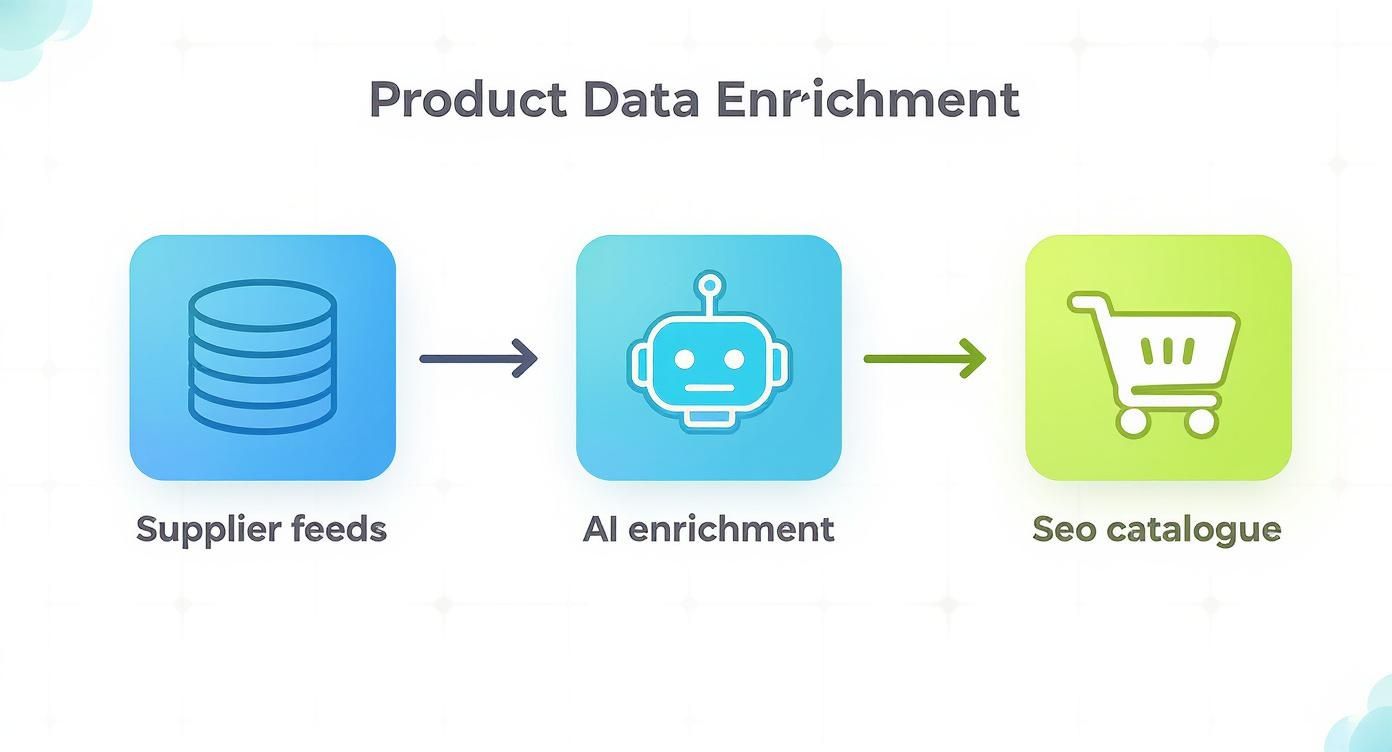
This automated process takes what was once a slow, manual, and error-prone job and turns it into a streamlined system that builds a rock-solid foundation for your digital shelf.
Embracing the Future of Retail Work
Adopting these AI workflows for ecommerce is how you get ready for the future of work in retail. It’s about creating a business that’s more agile, more data-driven, and more strategic.
When you automate the repetitive work involved in optimising product feeds efficiently, you free up your most valuable asset, your people, to focus on the things that actually drive growth.
This is what AI-powered retail transformation looks like on the ground. It’s not about replacing people. It’s about giving them superpowers, letting them achieve more with less effort. For any retail leader or ecommerce manager, this framework offers a clear path to achieving SEO at scale, finally solving the headache of supplier content duplication, and building a digital shelf that’s prepared for the next wave of agentic commerce.
Measuring the Performance of Your Digital Shelf
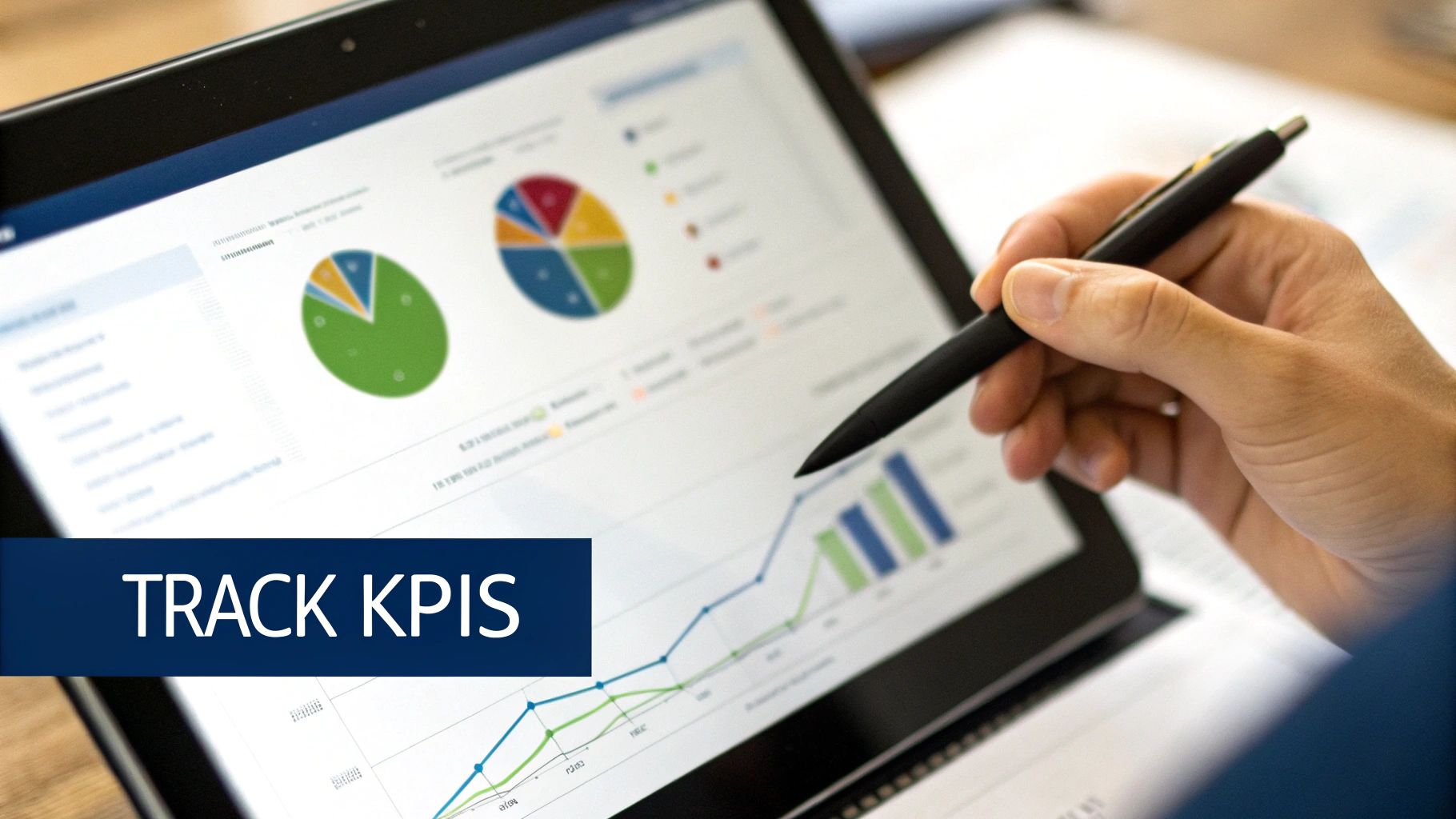
If you can’t prove the return on your digital shelf strategy, you can’t justify the investment. It’s that simple. This means getting past vanity metrics like clicks and impressions and focusing on the Key Performance Indicators (KPIs) that connect your AI-powered content workflows directly to business growth. Executives want to see results, not just activity.
A solid performance dashboard is your best friend here. It’s what turns complex data from retail SEO automation into a clear story about how your digital shelf is winning market share, boosting product visibility, and making the register ring. This is how you change the conversation from cost to genuine value.
Key Metrics for Executive Dashboards
Surface-level data won’t cut it. Your reporting needs to zero in on the metrics that prove your competitive edge and the operational wins you’re getting from AI workflows for ecommerce. These are the KPIs that give a complete picture of your digital shelf performance.
- Share of Search: This is not just about traffic; it's about dominance. It measures how visible your brand is for critical product terms compared to your direct competitors, giving you a real-time pulse on market share.
- Content Health Score: Think of this as a report card for your entire product catalogue. It scores every listing on things like uniqueness, completeness, and SEO quality, proving the real-world impact of product data enrichment.
- Ranking Improvements: Track your keyword positions across your most valuable product categories. This is where you show how fixing problems like supplier content duplication makes a direct, measurable difference to discoverability.
The goal is to tie every action back to an outcome. When you can show that lifting a Content Health Score by 15% resulted in a tangible increase in organic traffic and sales, you’ve built an undeniable case for continued investment in scalable SEO.
This data-first mindset is becoming non-negotiable as the retail world shifts. Here in Australia, retail media networks are completely reshaping the digital shelf, with 77% of advertisers already juggling three or more networks. As this channel explodes, the demand for clear, unified measurement is only going to grow, making robust KPI tracking absolutely essential. You can get more insights on the state of Australian retail media networks on IAB Australia.
Building Your Performance Framework
Tracking these advanced metrics does more than just report on the past; it shows how your team is getting ready for the future of work in retail, where data analysis is king. It puts a spotlight on the power of human + AI collaboration in SEO, proving your investment is delivering a clear competitive advantage.
Ultimately, a well-built performance dashboard gives you undeniable proof of ROI. It validates your strategy, showcases the efficiency of AI-powered systems, and secures the budget you need to keep winning. To dive deeper into this, learn more about leveraging data analytics for superior digital shelf performance.
Got Questions About the Digital Shelf? We've Got Answers.
We’ve covered the strategy, the core pillars, and the workflows you need to get your digital shelf in order. Now, let’s tackle the most common questions we hear from ecommerce managers and retail leaders who are ready to put these ideas into action.
What Is the First Practical Step to Improve My Digital Shelf?
The single most impactful thing you can do first is a full-blown audit of your product data. You can't optimise what you don't understand, so you need a crystal-clear picture of where you’re starting from. This means digging into your current product catalogue and flagging issues like supplier content duplication, missing product attributes, and inconsistent branding across the board.
This initial audit does more than just find problems, it builds the business case for bringing in AI-powered content workflows. It shows you exactly how big the content bottleneck is and puts a number on the risk, giving you a solid baseline to measure the success of any new retail efficiency tools you bring on board.
How Does AI SEO Maintain My Unique Brand Voice?
This is a big one, and rightly so. The answer comes down to human + AI collaboration in SEO. A smart AI SEO platform is not some black box spitting out generic text; it's a tool you guide with your own strategy. You start by setting up custom style guides, defining your specific tone of voice, and feeding it a list of brand-approved terms.
From there, the AI uses these guardrails to generate content that sounds like you. But the most important part is the human-led AI content QA step, which ensures every single description is checked and signed off by your team before it ever sees the light of day. This blend of AI agents for retail efficiency and human oversight gives you both massive scale and rock-solid brand integrity.
Can This Strategy Realistically Handle 50,000+ SKUs?
Absolutely. In fact, this is exactly where AI-driven scalable SEO solutions leave manual methods in the dust. Trying to manage a catalogue that size by hand is a recipe for failure, but automated content workflows are built for this kind of scale. The system can pull in massive product feeds efficiently, enrich all the data, and generate unique, optimised content for over 10,000 pages in just days, not years.
This level of SEO at scale for retailers is the whole point of using AI. It turns a massive, complex catalogue from a headache into your greatest asset, getting you ready for the future of agentic commerce and AI-powered retail. It makes sure every single product is pulling its weight and contributing to your digital shelf performance.
Ready to move from manual bottlenecks to scalable success? Optidan AI delivers the AI-powered content workflows and retail efficiency tools you need to get your entire digital shelf optimised, turning your product catalogue into your most powerful asset. Discover how we can transform your ecommerce strategy today.
