

Human-in-the-Loop (HITL) automation is a strategic partnership. It combines the raw speed of AI with the nuanced, real-world expertise of your retail team. For retailers, this is the key to finally breaking through content bottlenecks and turning slow, manual processes into a scalable workflow that can dominate the digital shelf.
This approach means you can optimise thousands of product pages in days, not months.
The Human and AI Partnership Unlocking Retail Growth
Imagine trying to write unique, compelling descriptions for 10,000 new products that have just landed from a supplier. Doing it manually is a non-starter. It’s an impossible task that creates a massive content backlog, directly hurting your performance on the digital shelf.
This is exactly where Human-in-the-Loop automation comes in, providing the scalable SEO solution modern retail demands.

This approach lets AI agents handle the heavy lifting, all the repetitive, high-volume tasks impossible to perform manually at scale. The system can ingest raw product feeds straight from your suppliers and immediately kick off product data enrichment. This automated content workflow is a core component of AI SEO, turning basic supplier feeds into optimised, structured product content.
It’s the shift from manual SEO to AI SEO, where technology corrects duplicated supplier content and drafts thousands of optimised product pages, making your brand ready for the future of retail search, including agentic search.
Empowering Your Team, Not Replacing It
Let's be clear: the core of this strategy is about human and AI collaboration. AI agents are phenomenal at speed and scale, but they lack the strategic oversight and brand intuition that your experienced team brings to the table.
The future of work in retail isn't about setting and forgetting full automation, it’s about augmentation.
Human-in-the-Loop isn't about replacing people but empowering them. It transforms the role of an SEO or content manager from a manual creator into a strategic editor, quality controller, and campaign driver, showcasing the power of human + AI collaboration in SEO.
This model frees your marketing and SEO experts from the grind, allowing them to focus on what they do best: refining brand voice, ensuring content quality, and driving high-level strategy. This balance is critical for any retailer looking to achieve genuine SEO at scale while maintaining a unique identity. For a deeper dive, check out our guide on balancing AI automation and brand voice in retail content.
The economic impact of this partnership is massive. A 2023 report from the Technology Council of Australia projected that rapid GenAI adoption could add $115 billion annually to the economy by 2030, mostly through productivity gains and quality improvements.
For ecommerce managers, this translates directly: AI agents draft keyword-rich product pages in a fraction of the time, but human oversight ensures the final output is plagiarism-free and perfectly brand-aligned. This AI workflow automation is the only practical way to achieve the retail efficiency needed to compete today.
Manual SEO vs Human-in-the-Loop AI SEO
To see the difference in action, let's compare the old way of doing things with a modern HITL approach. The table below breaks down how each process handles key retail content tasks, highlighting the strategic advantage of AI SEO vs traditional SEO teams.
| Metric | Manual SEO Process | Human-in-the-Loop AI SEO |
|---|---|---|
| Content Creation Speed | Months to optimise a large catalogue. | Days to draft and optimise thousands of pages. |
| Scalability | Limited by team size and budget. | Nearly infinite scalability with consistent quality. |
| Handling Supplier Feeds | Manual copy-pasting and rewriting. | Automated ingestion, enrichment, and rewriting. |
| Brand Consistency | Varies by writer and over time. | Enforced consistently across every single page. |
| Team Focus | Manual writing, editing, and uploading. | Strategic review, quality assurance, and campaign planning. |
| Cost Per Page | High, due to intensive labour. | Significantly lower, driven by tech efficiency. |
| Data Gaps | Often missed or ignored due to workload. | Automatically identified and filled at scale. |
The contrast is stark. While manual processes keep your team bogged down in repetitive work, a Human-in-the-Loop system turns them into strategic operators, driving real growth instead of just trying to keep up.
Why Traditional Content Workflows Are Failing Modern Retailers
For so many Australian retailers, the content creation process is fundamentally broken. Relying on outdated, manual workflows to wrangle huge product catalogues from supplier feeds creates crippling retail content bottlenecks. These logjams don't just slow you down, they directly hammer your digital shelf performance and your bottom line.
The whole model is just too slow, too expensive, and simply can't keep up with the pace of modern retail.
The pain points are probably all too familiar. You’re wrestling with duplicated supplier content that practically invites SEO penalties. You're dealing with a painfully slow pace of product data enrichment, which means new SKUs are stuck in the warehouse instead of in front of customers. And you're trying to maintain a consistent brand voice when multiple people are writing at scale, which is next to impossible.
This old way of doing things heaps an enormous administrative burden on your team, pulling their focus away from high-value strategic work and bogging them down in tedious, repetitive tasks. This is exactly where AI-powered retail transformation becomes essential, using retail efficiency tools to automate product descriptions and build a more agile operation.
The High Cost of Manual Inefficiency
Picture a fashion retailer getting 5,000 new SKUs for the upcoming season. Manually creating unique, keyword-optimised descriptions, titles, and metadata for every single item is a logistical nightmare. This process often drags on for weeks, sometimes even months, leading to massive opportunity costs.
The key challenges are clear:
- Supplier Content Duplication: Using generic supplier descriptions across your site is a huge red flag for search engines. It leads to poor rankings and makes you invisible to potential buyers, requiring a duplicate content SEO fix at scale.
- Time-to-Market Delays: The slow grind of manual content creation means new products are sitting on shelves, invisible to customers, while your team is desperately trying to catch up.
- Inconsistent Quality: Trying to maintain a consistent brand voice and quality standard is almost impossible with multiple writers. The result is a fragmented and confusing customer experience.
- Scalability Barriers: You can't grow your catalogue or react to market trends when your content workflow is limited by human bandwidth. It's a hard ceiling on growth.
This manual approach is a major bottleneck. It’s a reactive system stuck in a market that demands proactive, scalable SEO solutions just to stay competitive, let alone prepare for the future of agentic commerce.
The limitations of these legacy processes scream for a new approach. Retailers need AI workflow automation that can handle immense volume without sacrificing the quality and uniqueness that actually drive performance on the digital shelf. Moving from manual updates to autonomous workflows isn't just an option anymore, it's a necessity for survival. To see what this looks like in practice, you can explore how to start automating retail at scale.
How Human-in-the-Loop Automation Actually Works in Retail
Let's pull back the curtain on how this strategy works in the organised chaos of a modern retail business. It’s a surprisingly straightforward process that takes messy, raw data and turns it into a high-performing digital shelf. The secret is a workflow that puts your team exactly where they add the most value.
It all starts with your raw supplier product feeds. We all know what these look like: messy, incomplete, and often riddled with duplicated content. They're a terrible foundation for building quality product pages.
This is where the first stage of automation kicks in. An AI agent takes this raw data and immediately gets to work on product data enrichment. It’s the heavy lifting, the stuff no human team can do at scale. The AI structures information, uses AI image recognition to add detailed product image tagging like 'v-neck', 'floral print', or 'chrome finish', and drafts thousands of keyword-optimised product descriptions and metadata. It’s a content workflow moving at a pace that would be impossible for a manual team.
The Human Touchpoint: Where Strategy Takes Over
And here it is, the moment the ‘human-in-the-loop’ becomes essential. Once the AI has done its initial sweep, all that enriched content is routed to your expert team for review, refinement, and final approval.
Their role completely changes. They're no longer bogged down in tedious data entry, they're providing high-value strategic oversight. This human-led QA step ensures a few critical things happen:
- Brand Alignment: Your team makes sure every single description hits the right notes, matching your brand guidelines and capturing the unique voice your customers expect.
- Audience Nuance: They refine the content to connect with the specific quirks and preferences of your target audience, something AI can still struggle with on its own.
- Campaign Goals: The final content is double-checked to ensure it supports current marketing campaigns and broader SEO goals.
This collaborative model is a perfect example of human + AI collaboration in SEO. To see how this fits into the bigger picture of operational efficiency, it’s worth looking at these diverse business process automation examples. By structuring work this way, you’re not just automating tasks, you’re building an incredibly efficient system. For a deeper dive, our article on the real driver of AI ROI for retailers explains how crucial workflow design really is.
Getting Your Team Ready for an AI-Powered Future
This approach doesn't just improve your content, it fundamentally transforms roles and prepares your team for what's next in retail. It lines up perfectly with broader workforce trends here in Australia, where projections show 43% of tasks could be automated by 2027. But this isn't about replacing jobs, it's about augmenting human productivity.
For ecommerce businesses where scalable SEO is non-negotiable, keeping people in the loop is the only way to maintain quality and strategic direction.
This workflow transforms team members from data entry clerks into strategic editors and brand guardians. They are no longer bogged down by repetitive tasks but are empowered to apply their expertise where it matters most, ensuring every product page is ready for agentic search and traditional SEO alike.
This is how you tackle duplicate content head-on, enrich product data at a massive scale, and get your catalogue ready for the next generation of retail search, including AI agents for retail efficiency like Rufus and Perplexity.
Key Business Outcomes from a HITL Strategy
Bringing a Human-in-the-Loop model into your operations isn't just about efficiency, it delivers real, measurable results that directly impact your bottom line and set your retail business up for the future. This approach shifts your team's focus from drowning in reactive, manual work to driving proactive, scalable growth. These aren't just theoretical benefits, they're practical advantages that give you a serious competitive edge.
The first and most immediate win is achieving true SEO at scale. A HITL workflow lets you enrich and optimise over 10,000 product pages in just days, a massive task that would normally tie up your team for months. That incredible speed is what unlocks the next major outcome.
Enhanced Digital Shelf Performance
With all that freshly optimised content going live so quickly, your brand's digital shelf performance gets a serious boost. This means better search rankings, more visibility for your entire product range, and, ultimately, higher conversion rates. By consistently pushing out high-quality, unique product descriptions, you build authority with search engines and earn trust with your customers.
This diagram breaks down the core Human-in-the-Loop automation process, showing how it moves from initial data to human-led quality control.
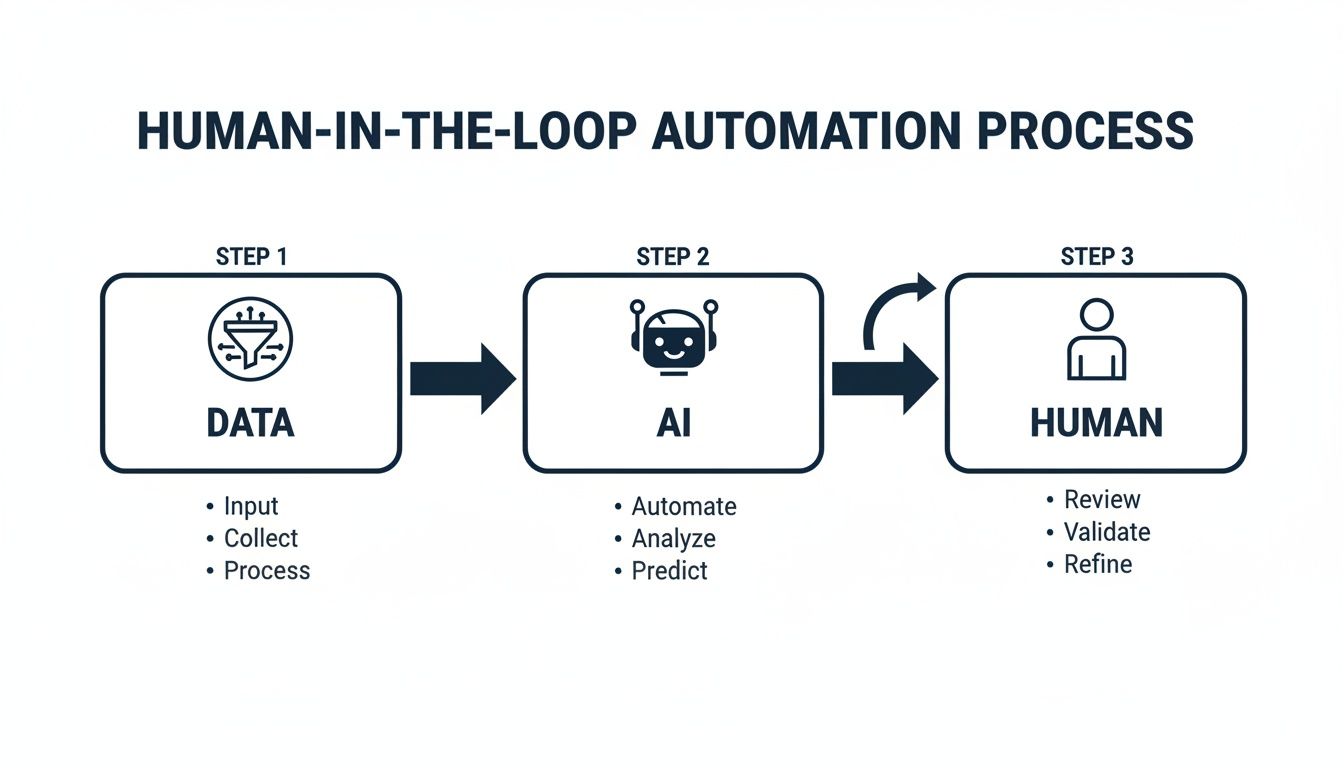
You can see how the AI does the heavy lifting with data processing, but the human expert provides that crucial final sign-off, guaranteeing both speed and quality.
Overcoming Content Duplication and Future-Proofing for AI Search
One of the biggest headaches for retailers is supplier content duplication. A HITL system tackles this head-on by generating unique descriptions for every single SKU. This completely removes the risk of SEO penalties and keeps your brand voice consistent across your entire digital storefront.
Even better, putting this AI workflow in place gets your business ready for the rise of agentic search optimisation. As AI agents like ChatGPT, Perplexity, and Rufus become the go-to for product discovery, having structured, AI-compatible SEO content is no longer optional, it's essential.
Here’s what this approach delivers:
- Massive Efficiency Gains: Automating the first pass on content creation frees up countless hours for your team, a key benefit of retail content automation.
- Improved Content Quality: Human oversight ensures every piece of AI-generated content is accurate, on-brand, and genuinely helpful to your customers.
- Enhanced Customer Experience: Rich, detailed, and unique product information helps shoppers make better buying decisions. When done right, a solid strategy can even help you increase customer lifetime value by building real brand loyalty.
By embracing Human-in-the-Loop automation, you’re not just optimising product pages, you’re building a resilient, scalable content engine that is ready for the future of agentic commerce and AI-driven retail.
Human-in-the-Loop Automation in Action Across Australian Retail
So, what does Human-in-the-Loop (HITL) automation actually look like on the ground? Let's move from theory to practice and explore how it’s being applied across different Australian retail sectors. This isn't some rigid, one-size-fits-all solution, it’s a flexible framework that drives both efficiency and quality, whether you’re selling dresses or dishwashers.
The core idea is always the same: let AI agents handle the repetitive, heavy lifting, and then bring in human expertise for the final, strategic polish. This powerful combination is unlocking scalable SEO that just wasn't possible before.
Vertical-Specific Applications
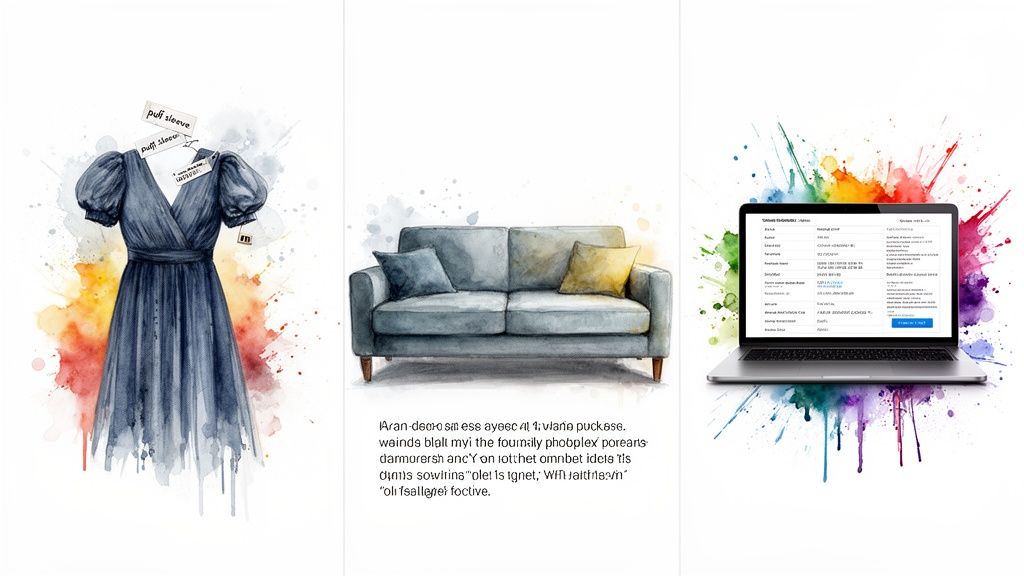
Think about a major Australian retailer’s fashion SEO optimisation strategy. They could use AI image recognition to tag product images with incredible detail, automatically identifying attributes like 'puff sleeve', 'A-line cut', or 'midi-length'. This granular data is gold. It powers faceted search filters and helps capture valuable long-tail keyword traffic, giving their digital shelf performance a serious boost through superior alt tag optimisation for retail.
Now, picture a furniture SEO services provider. Their challenge is turning dry supplier specs into rich, engaging descriptions that actually help someone imagine a sofa in their living room. An AI workflow can draft compelling stories for thousands of products, transforming a simple list of dimensions into content that answers customer questions before they're even asked. Human editors then step in to make sure the brand's tone of voice is perfect.
It’s a similar story for electronics SEO optimisation, which often means wrangling complex technical data from multiple supplier feeds. A HITL workflow automates product feed optimisation, ensuring consistency and accuracy across thousands of SKUs while cleaning up duplicated content from suppliers.
These automated content workflows show how human-led AI governance makes technology a powerful and adaptable tool for any retail sector, from beauty & cosmetics to grocery and pharmacy ecommerce SEO.
A Model for Scalable Governance
This model of human-led automation isn’t just for retail, it’s already proven in some of Australia’s largest operations. Take Services Australia, which uses a human-in-the-loop approach to process massive volumes of repetitive tasks, freeing up its staff to focus on complex human needs.
In 2023-24 alone, the agency processed a staggering 468.5 million claims and handled 1.1 billion online interactions. For ecommerce retailers using platforms like Optidan AI, this scale is relatable. It shows how AI-generated SEO content can be reviewed by humans across thousands of pages, ensuring brand consistency without the bottlenecks.
In a climate where 88% of public sector agencies report skills shortages in digital and data, HITL models bridge critical gaps and build trust in automation. You can see how they approach it in their Automation and AI Strategy here.
Your Roadmap to Implementing HITL
So, you're ready to move on from manual SEO and build a smarter, AI-powered workflow? Good. Let's walk through the practical steps to make that transition smooth and successful. The goal here isn't just to add technology, it’s to build a system that delivers scalable results and frees up your team to focus on what matters.
First things first: you need to audit your current content processes. Take a hard look at where the real bottlenecks are. Is it the painfully slow process of product data enrichment from supplier feeds? Or maybe it’s the constant battle to find and fix duplicated content across thousands of SKUs.
You can't measure improvement if you don't know your starting point, so get clear on your biggest pain points.
From there, you can start looking for an AI platform that actually fits your retail needs. You’ll want to look for specific capabilities like ecommerce content optimisation, AI image recognition, and genuinely automated content workflows. Don't try to boil the ocean and overhaul everything at once.
Launching Your Pilot Project
The best way to get started is with a focused pilot project. This is all about demonstrating immediate value and getting your team on board.
Pick a single, manageable product category, maybe fashion or furniture, and apply the Human-in-the-Loop model. This lets you dial in your automated content workflows in a controlled environment before rolling them out everywhere.
If you need a more structured way to approach this, you can find some helpful guidance in our ecommerce action plan templates.
It's absolutely critical to establish clear quality assurance guidelines for your human reviewers. Define exactly what "good" looks like. Arm your generative AI for retail teams with the right retail efficiency tools they need to do their job well. Remember, they are the guardians of your brand voice and the key to making this human-AI collaboration actually work.
Finally, you need to define what success looks like. Your key performance indicators should be clear and measurable. Think about tracking things like:
- The time-to-market for new products.
- Tangible improvements in search rankings and digital shelf performance.
- Noticeable increases in conversion rates at the individual SKU level.
Bringing HITL automation into your business is much more than a simple process change. It's a strategic move that builds a more efficient, competitive, and future-ready retail operation, one that's fully prepared for what’s coming next with agentic commerce.
Still Have Questions?
It's natural to have questions when you’re thinking about bringing a new workflow into your business. Here are a few of the most common ones we hear from retail leaders and ecommerce managers looking at Human-in-the-Loop automation.
Will Human-in-the-Loop AI Replace My Content Team?
No, absolutely not. This is a common concern, but the goal here is to augment your retail team, not replace them. Think of it as giving them a massive upgrade in capability.
The AI agents handle the repetitive, high-volume grunt work, like drafting thousands of product descriptions from raw supplier data. This frees up your human experts to focus on what they do best: high-value strategic work, refining brand voice, and ensuring the final output is top-notch. Their roles evolve from manual writers to strategic editors and quality guardians, making them far more effective.
How Does This Approach Handle Supplier Content Duplication?
This is one of the biggest strengths of the HITL model. The AI is specifically trained to take duplicated supplier content from your product feeds and completely rewrite it, creating unique, SEO-friendly descriptions for every single SKU.
But the process doesn’t stop there. The human-led AI content QA step is critical. Your team then reviews and refines this content, making sure it’s not just unique but also compelling and perfectly aligned with your brand’s voice. This entire workflow solves the duplicate content SEO fix at scale, a huge, ongoing headache for most retailers.
How Quickly Can We See Results from an AI SEO Workflow?
The speed to market is a massive advantage. While traditional SEO can take months to show any real impact, an AI-powered content workflow lets you enrich and optimise tens of thousands of product pages in a matter of days.
You can expect to see initial improvements in indexing and search visibility very soon after the new content goes live. The more significant gains in rankings and organic traffic usually follow within a few weeks, as search engines crawl and re-evaluate your newly optimised, high-quality digital shelf.
Ready to finally break through your content bottlenecks and achieve real SEO scale? Optidan AI turns your raw supplier feeds into thousands of optimised, brand-aligned product pages in days. Discover how our human-in-the-loop automation can elevate your digital shelf performance.
