
An enterprise SEO optimisation company is built to solve one core problem: delivering technically complex search strategies for businesses with thousands, or even millions, of web pages. Unlike a standard agency, their entire model revolves around scalable SEO solutions designed to wrangle enormous product catalogues and get retailers ready for the future of AI-driven commerce.
Why Traditional SEO Fails in Modern Retail
Let's be blunt: the old retail SEO playbook is broken. For years, the game was about ranking a handful of high-volume keywords. That strategy is now completely misaligned with the realities of modern ecommerce.
The real challenge for today’s retail leaders isn’t just about getting seen on Google. It’s about preparing your entire product catalogue for discovery by AI agents and the new shopping platforms they power. This is the future of work in retail, shifting focus from manual tasks to strategic oversight of AI workflows.
Traditional SEO methods, which are often manual and painfully slow, just can't keep up. When you're dealing with thousands of SKUs, a manual approach creates massive retail content bottlenecks. Trying to optimise product descriptions, fix systemic supplier content duplication, and enrich product data one by one becomes an impossible task for human teams alone. This is where AI-powered retail transformation becomes essential.
The Shift from Manual SEO to AI SEO Workflows
For an enterprise retailer, the difference between a legacy SEO approach and a modern one is night and day. The move from manual SEO to AI SEO isn't just an upgrade, it's a fundamental change in operational strategy.
Imagine trying to manually write unique descriptions for a new season's collection of 5,000 fashion items. It's a hugely resource-intensive project that could drag on for months, leaving you wide open to duplicate content issues and missed sales. This is a common scenario where the limits of conventional SEO become painfully clear. It’s also a key reason why many large retailers struggle with their on-site search functionality, as we explore in our guide on why on-site search fails for large retailers.
An enterprise SEO optimisation company built for the AI era swaps this manual grind for automated content workflows. These systems can ingest messy supplier feeds, pinpoint and fix duplication penalties, and generate optimised product content at a scale that was previously unimaginable, turning 10k+ pages around in days.
The new benchmark for success isn't just ranking higher. It's achieving SKU-level SEO readiness across your entire digital shelf. This means every single product page is uniquely described, correctly categorised, and structured for both human shoppers and AI shopping agents like Rufus or Perplexity.
Investing in Future-Proof Retail Search Visibility
This strategic shift is clearly reflected in market trends. Australian enterprise SEO spending is projected to hit $1.5 billion in 2025, a jump that highlights the growing urgency for more sophisticated, scalable SEO solutions.
For large retailers, this investment isn't just about gaining a competitive edge. It's about future-proofing their entire business for the rise of agentic commerce and the future of retail search. To dig deeper into this trend, you can read the full research on local SEO statistics in Australia.
Choosing the right partner is the critical first step in moving away from slow, manual processes and embracing an AI-led SEO strategy that delivers real commercial results and improves your digital shelf performance.
Evaluating Core Capabilities for AI-Powered Retail SEO
Choosing the right enterprise SEO partner isn't what it used to be. The old metrics and capabilities just don't cut it anymore. If you're a retail leader, your focus needs to shift towards finding a partner who can handle the sheer scale and complexity of a modern digital shelf, and get it ready for the fast-approaching future of agentic commerce.
This means you need to look past the surface-level keyword reports and really dig into three non-negotiable pillars of AI-powered retail SEO. Getting these right is the difference between just treading water and building a real competitive edge for the new era of search.
Product Data and Feed Mastery
Let's be clear: the entire foundation of modern retail SEO is built on clean, structured product data. Any potential partner has to prove they can take messy, inconsistent supplier feeds and turn them into a strategic asset. This is exactly where most generalist agencies fall over.
A true enterprise SEO optimisation company lives and breathes product data enrichment. They should be able to show you proven AI workflows that can:
- Correct and standardise mismatched product attributes from dozens of different suppliers.
- Automate the creation of unique, SEO-friendly product titles and descriptions that actually convert.
- Enrich every product with the critical tags and metadata that make your entire catalogue machine-readable for AI agents.
This isn't a manual "fix-it" job; it's a core competency driven by sophisticated retail content automation. It’s how you transform a chaotic supplier feed into structured, optimised content that's ready to perform across every channel. This is the core of optimising product feeds efficiently.
The process below shows exactly where outdated, manual SEO approaches break down in a retail environment.
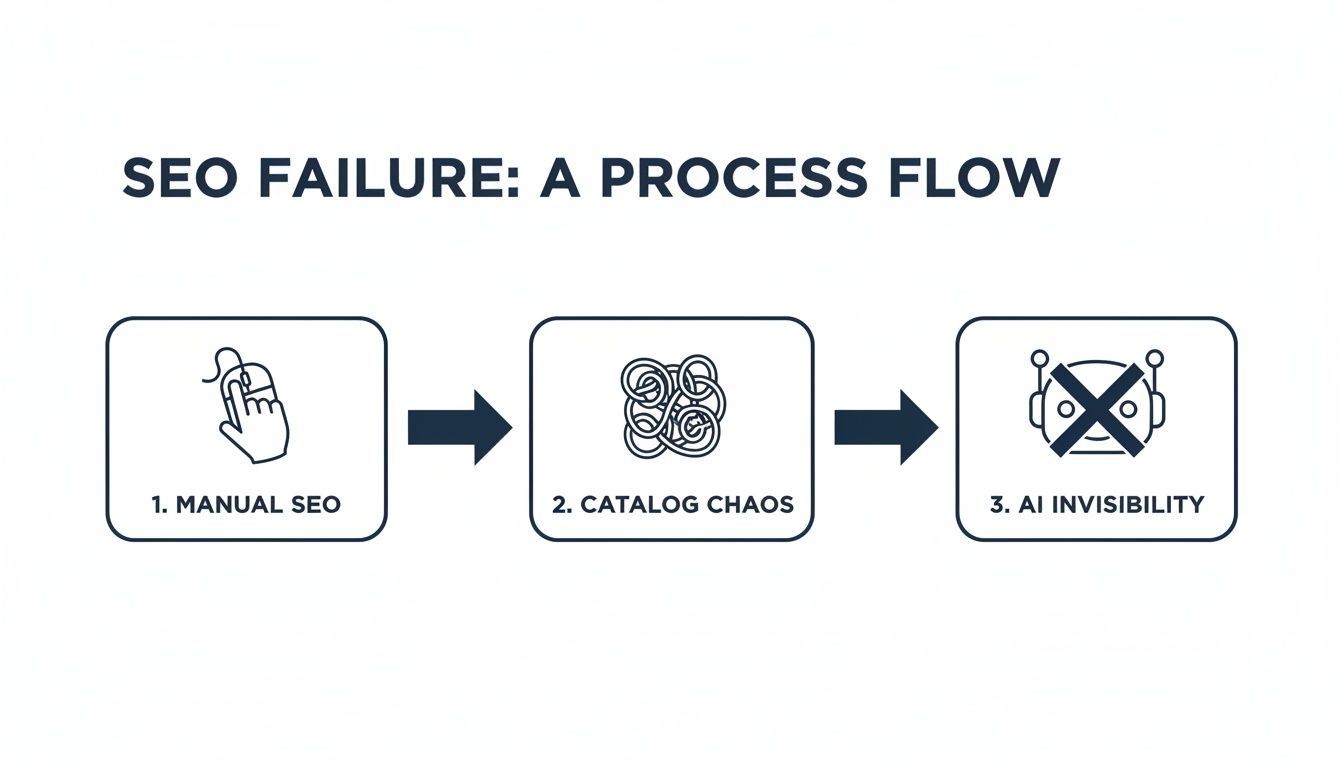
As you can see, relying on manual processes inevitably leads to catalogue chaos. From there, it's a short step to becoming completely invisible to the AI agents that are already starting to shape how people discover and buy products.
Scalable Content Workflows and Duplication Correction
For any retailer managing thousands, or tens of thousands, of SKUs, supplier content duplication is the silent killer of your organic performance. A top-tier enterprise SEO optimisation company must have a bulletproof solution for fixing this problem at scale.
Their platform needs to be able to audit your entire catalogue, pinpoint every piece of duplicate or thin content, and deploy automated content workflows to generate unique, high-quality product descriptions. The two keywords here are quality and speed. The right partner can revitalise over 10,000 pages in a few days, not drag it out over months. That’s the kind of agility you need in fast-moving sectors like fashion SEO optimisation or electronics SEO optimisation.
The real acid test is their approach to quality control. You need to ask potential partners how they run a human-led AI content QA process. This combination of human oversight and AI power is what ensures the content isn't just unique, but also on-brand, accurate, and genuinely helpful to your customers.
Agentic Search Readiness
The final, and arguably most critical, capability is agentic search optimisation. This is the forward-looking piece that gets your business ready for the next wave of commerce. It’s all about structuring your product information so that AI agents like ChatGPT, Perplexity, and Amazon's Rufus can easily find, understand, and recommend your products to shoppers. This is SEO for AI agents.
And it goes way beyond just text. A sophisticated partner will be using AI image recognition and tagging to enrich your visual assets, making them discoverable through visual search, something that's absolutely vital for fashion and furniture retailers. If a potential partner understands emerging concepts like Generative Engine Optimization (GEO), it's a strong signal they're ready for what's coming next.
A quick look at the outsourcing trend in Australia really drives this home. With 75% of large enterprises now outsourcing SEO tasks, the real challenge isn't finding an agency, but finding one with deep retail knowledge. Most generalists simply don't have the specialised skills to manage complex product feeds, leading to wasted investment, even with retainers costing $5,000 to $10,000 a month.
These numbers show exactly why retailers need partners with scalable, AI-driven platforms. Outsourcing alone doesn't solve the operational headaches of large-scale ecommerce. A partner with these core capabilities isn't just another SEO provider; they are a critical part of your future-proof AI-powered content infrastructure.
Key Questions to Ask Your Next SEO Partner
Choosing an enterprise SEO company isn't about finding another vendor. It's about securing a strategic partner who gets the future of retail and can actually navigate it. A standard agency pitch just won’t cut it anymore.
You need to ask the tough questions, the kind that slice through marketing fluff and get to the heart of their capabilities, especially with AI-powered, scalable SEO. Forget generic queries about keyword research or link building. That’s yesterday’s game. Your questions have to reflect the messy, complex reality of large-scale ecommerce.
Let's talk about massive product catalogues, inconsistent supplier data, and the fast-approaching world of agentic search. That’s where the real conversation begins.
Can They Actually Handle Your Scale?
First things first, you need to probe their core competency: turning your biggest content headaches into strategic advantages. Don't just ask if they can handle large websites. Make them prove it with real-world retail examples.
Here are a few sharp questions to get you started:
- Supplier Content Duplication: "Walk me through a specific case where you delivered a duplicate content SEO fix for a retailer with over 10,000 SKUs. What happened to their digital shelf performance afterwards?"
- Product Data Enrichment: "How does your platform take messy, unstructured product data from multiple supplier feeds and turn it into clean, enriched content? I want to see the automated workflow for this."
- Unique Product Descriptions: "What’s your real-world methodology for automating product descriptions that are unique, on-brand, and SEO-optimised in days, not months?"
These questions force potential partners to step away from theory and show you their practical retail SEO automation chops. Their answers will tell you everything you need to know about whether they have the tech and workflows to deliver SEO at scale, or if they’re still stuck in a manual, one-page-at-a-time mindset.
The right partner sees your product feed not as a problem to be managed, but as a strategic asset waiting to be optimised. They should be talking fluently about SKU-level SEO and automated content workflows.
Before you commit, it's a good idea to formalise your evaluation. A scorecard helps remove subjectivity and allows you to compare partners on a like-for-like basis.
Vendor Evaluation Scorecard
Here’s a sample scorecard to help you objectively rate potential partners on the capabilities that truly matter for modern retail and AI-driven SEO.
| Evaluation Criteria | Vendor A Score (1-5) | Vendor B Score (1-5) | Notes |
|---|---|---|---|
| Proven Retail Experience (10k+ SKUs) | Did they provide specific case studies? | ||
| Automated Data Enrichment | Was their workflow truly automated or manual? | ||
| Scalable Content Generation | How fast can they realistically deploy content? | ||
| Agentic Search Strategy | Do they have a clear plan beyond Google? | ||
| AI Content QA Process | Is there a human-in-the-loop for quality? | ||
| Image SEO at Scale | Do they use AI for image optimisation? | ||
| Technical Integration & Onboarding | How seamlessly do they fit into our stack? | ||
| Reporting & KPI Alignment | Are their metrics tied to business outcomes? |
Using a scorecard like this ensures you're making a data-driven decision, not just going with the slickest presentation.
Are They Ready for Agentic Commerce?
Your next line of questioning has to look forward. The world of retail is changing, and AI agents are at the centre of it. An agency focused only on today’s Google algorithm is already obsolete. You need a partner who is actively preparing clients for agentic search optimisation.
It helps to understand the broader ecosystem of leading AI companies for business automation, as many of these technologies will eventually integrate into your partner’s tech stack. This context allows you to ask more pointed questions.
Try asking these:
- Image SEO for Ecommerce: "What's your strategy for optimising image metadata and alt tags at scale for a huge fashion or furniture catalogue? How are you using AI image recognition in that process?"
- AI Shopping SEO: "How are you preparing our product catalogue right now so it can be discovered, understood, and recommended by AI shopping agents like ChatGPT, Perplexity, and Rufus?"
- Human + AI Collaboration: "Describe your human-led AI content QA process. How do you guarantee brand voice and factual accuracy when using generative AI for retail teams?"
These questions aren't just about buzzwords; they test a partner’s grasp of the fundamental shift from traditional search to agentic commerce. A truly capable firm will have a clear, actionable strategy for making your products findable and desirable to AI agents.
If they can't answer confidently, they’re not ready to lead you into the future of agentic commerce. For more ideas, our guide on 10 AI questions to ask your SEO agency can help you build out a comprehensive evaluation framework.
Defining Success Metrics for the Modern Digital Shelf
Any good partnership hinges on clear, aligned goals. When you bring on an enterprise SEO optimisation company, you need to move beyond old-school vanity metrics like keyword rankings to justify the investment and show real, tangible business impact.
Success isn't about inching up one spot for a single keyword anymore. It's about making systemic improvements across your entire product catalogue that actually drive commercial results. Your key performance indicators (KPIs) should directly reflect the efficiency gains and revenue growth that AI-powered content workflows are designed to deliver.
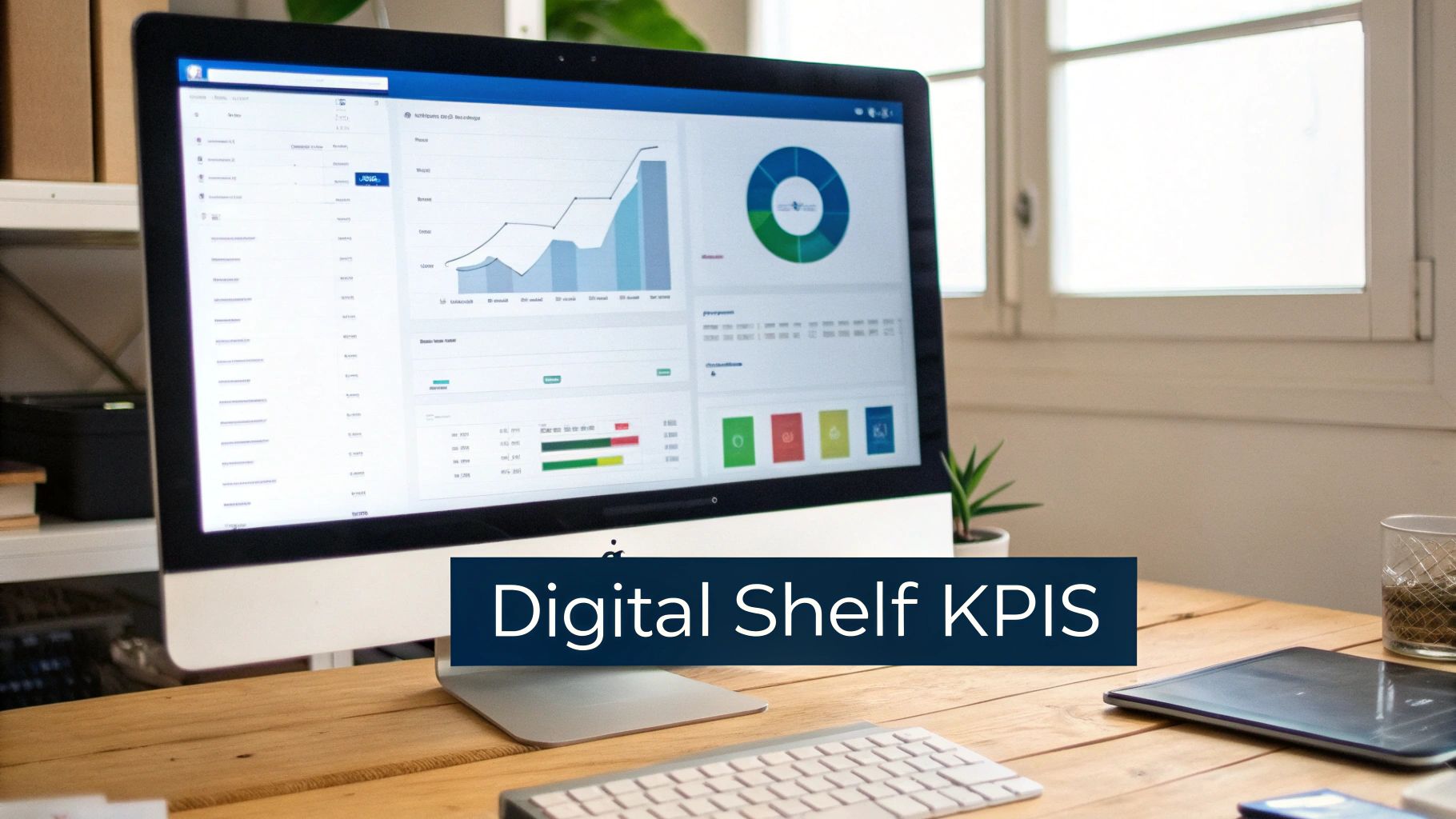
This means your reporting needs a serious upgrade. Ditch the static, backwards-looking SEO reports and build a dynamic dashboard that tracks the health and performance of your digital assets at scale.
Core Metrics for Retail SEO Automation
Your dashboard should tell a clear story of how AI-powered optimisation is solving your biggest retail headaches. Instead of getting bogged down in endless keyword data, you should be prioritising metrics that show genuine progress in content quality, organic visibility, and readiness for the new world of agentic search.
Here are the key operational KPIs you should be tracking:
- Content Uniqueness Percentage: What portion of your product catalogue now features unique, optimised descriptions? This is a direct measure of how well you're fixing supplier content duplication, a critical factor for both traditional SEO and future agentic search readiness. You should be aiming for over 95% uniqueness.
- Time to Market for New Products: How fast can you get a new product from a raw supplier feed to a fully optimised, live product page? This metric puts a number on the efficiency of your new automated content workflows and shows how you’re crushing content bottlenecks.
- Product Data Enrichment Score: You need a way to measure the completeness of your product data. Create a quality score that tracks attributes, tags, and optimised image metadata. This shows your progress in transforming basic feeds into the structured, machine-readable content that algorithms love.
These operational metrics are the canaries in the coal mine; they are the leading indicators of the commercial success that will follow. They prove you're putting the fundamental building blocks of a high-performing digital shelf in place.
When you focus on the percentage of your catalogue with unique descriptions, you're not just tracking an SEO metric. You're measuring your brand's ability to speak with a consistent, authoritative voice across thousands of touchpoints. That's crucial for building trust with both human customers and AI agents.
Translating Operational Wins to Commercial Outcomes
While operational metrics are your foundation, your leadership team wants to see the connection to the bottom line. So, the next layer of your dashboard needs to tie all this AI SEO work directly to tangible business results.
Make sure you’re measuring these essential commercial KPIs:
- Category-Level Organic Traffic Growth: Forget obsessing over individual keywords. Measure the lift in organic traffic to entire product categories. This demonstrates broader authority and shows you're gaining visibility where it really counts.
- Organic Conversion Rate by Product Type: Are the newly optimised product pages converting better than the old ones? This directly connects your content quality improvements to sales. It’s a simple question with a powerful answer.
- Digital Shelf Visibility Score: You need to know where you stand. Track your share of voice across key categories against your main competitors. This gives you a clear benchmark of your market position and the real-world impact of your SEO at scale.
Pulling these KPIs into a modern reporting dashboard gives you a powerful tool to communicate the value of your partnership. It completely changes the conversation from, "What are we ranking for?" to "How is our AI-powered retail transformation driving revenue and setting us up for the future of agentic commerce?"
If you want to go deeper, our guide on the top metrics to track for ecommerce success provides a comprehensive framework to get you started.
Integrating AI Workflows with Your Retail Team
Bringing a new enterprise SEO platform on board is much more of a change management initiative than a technical project. The real magic happens when their AI workflows genuinely connect with your existing teams, from merchandising and buying to marketing and IT. This was never about replacing human expertise. It's about amplifying it.
Making the leap from manual, tedious processes to an AI-powered retail operation needs a clear plan. It all starts with mapping out new processes, clarifying roles, and building a culture where human + AI collaboration in SEO is the norm. The key to getting buy-in is showing your team how automation frees them up from repetitive tasks, so they can finally focus on strategy, creativity, and the high-value analysis that actually moves the needle. Get this integration right, and you'll smash through content bottlenecks and get products to market faster than ever.
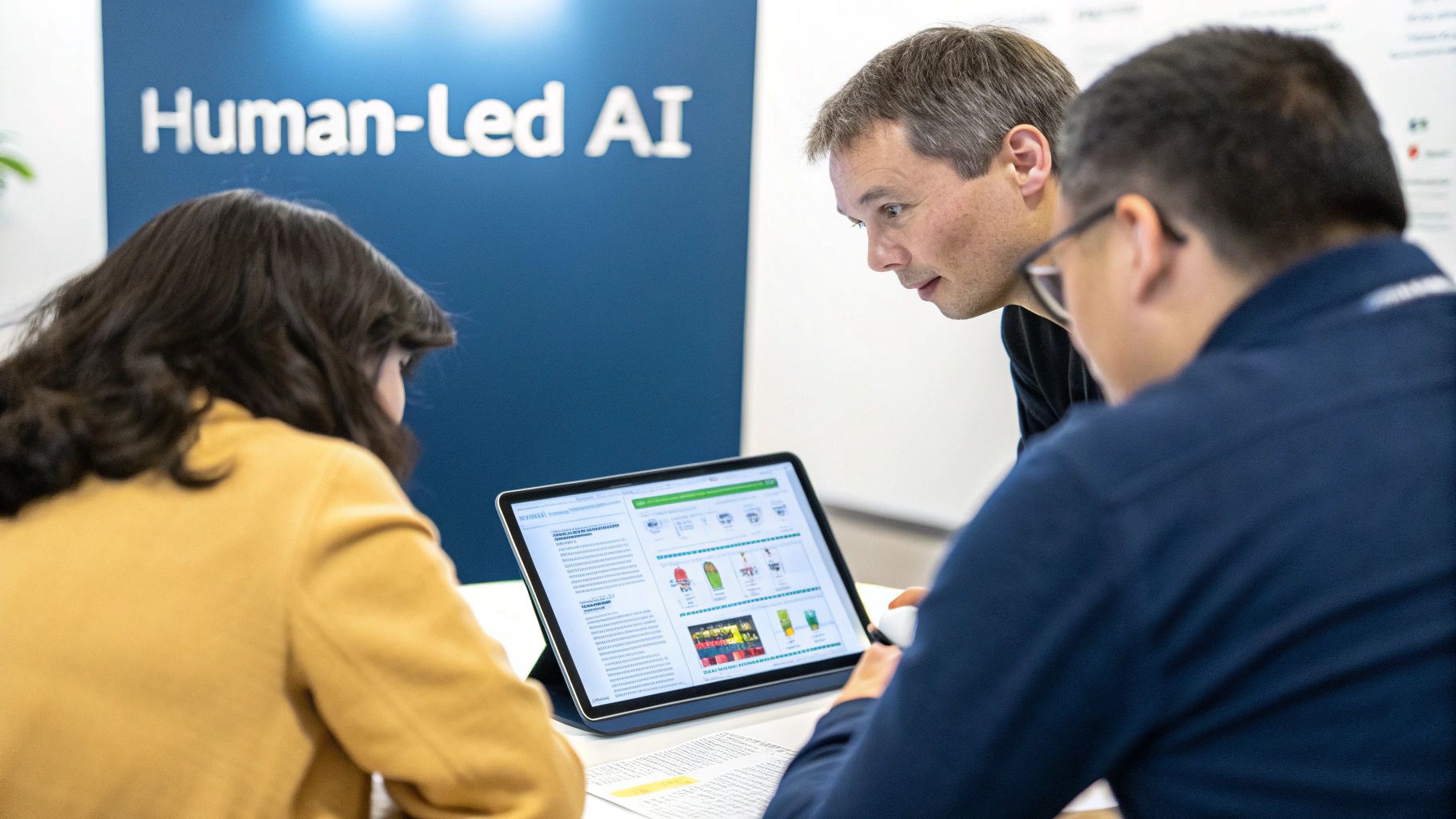
Building a Human-Led AI Quality Assurance Process
Without a doubt, the most important step is creating a solid human-led AI content QA process. AI is brilliant at generating thousands of unique product descriptions at scale, but your team’s deep brand knowledge and customer intuition are irreplaceable. This collaborative workflow is how you guarantee every piece of automated content is not just unique, but also accurate, on-brand, and genuinely helpful.
A good process usually looks something like this:
- Defining Brand Guardrails: Your team sets the rules of the game. They define the tone of voice, which product features to always highlight, and any forbidden terms. These guardrails steer the AI’s output.
- Sampling and Reviewing: Merchandisers or copywriters check a statistically significant sample of AI-generated content for quality and accuracy before anything goes live. It’s a simple but powerful checkpoint.
- Providing Feedback Loops: The partner’s platform must have a mechanism for your team to give feedback. This feedback should directly refine the AI models over time, making future content even better.
This human-in-the-loop system is crucial for building trust in the technology and ensuring the final output meets the high standards your customers expect. It’s the perfect blend of machine efficiency and human expertise.
Overcoming Internal Resistance and Data Silos
Let's be honest, introducing AI workflow automation for retail can sometimes stir up resistance. Teams might worry about their roles changing or feel protective of the old way of doing things. At the same time, data silos between departments like merchandising, IT, and marketing can stop the flow of information dead in its tracks, crippling any effort at effective product data enrichment.
The best way to tackle these hurdles is through open communication and focusing on shared goals. Frame the project around the clear benefits for everyone involved.
- For Merchandisers: Think faster time-to-market for new collections and far less time spent writing basic product details from scratch.
- For Marketers: Richer, more consistent content that boosts campaign performance and drives better organic visibility.
- For IT: A cleaner, more streamlined process for managing product feeds, which means less technical debt and fewer manual data headaches.
The goal is to demonstrate that AI is a powerful retail efficiency tool that empowers your team, not replaces them. It automates the tedious work of optimising product feeds, allowing your experts to focus on strategic decisions that drive growth in the new era of agentic commerce.
By creating this collaborative environment, you make sure the new capabilities are actually adopted and used effectively across the business. To see how this works in the real world, it’s worth exploring how the workflow is the real driver of AI ROI for retailers, which shows how connected systems produce tangible commercial results.
Common Pitfalls to Avoid When Picking Your Partner
Choosing the wrong enterprise SEO optimisation company can do more than just burn through your budget; it can set your entire retail strategy back by years. You need to look past the slick sales pitches and identify a partner with genuine, proven chops in the messy reality of modern retail search.
Making an informed decision means recognising the common traps that many ecommerce leaders fall into. Avoiding these missteps is critical to securing a partnership that prepares you for what’s next, like agentic commerce, not just today's Google rankings.
The Danger of the Generalist Agency
One of the most frequent mistakes is signing on with a 'generalist' agency. These firms might talk a good game about SEO, but they rarely have the deep, specific expertise required for large-scale retail. They simply aren’t equipped to handle the complexities of product feed optimisation or untangle systemic supplier content duplication across thousands of SKUs.
A generalist partner will almost always stumble when it comes to:
- Retail Content Automation: They often rely on manual processes that create huge content bottlenecks, crippling your speed to market for new collections or promotions.
- SKU-Level SEO: Their focus tends to drift to a few category pages, completely missing the massive commercial opportunity that lies in optimising every single product page.
- AI SEO Services: Their knowledge of agentic search is usually theoretical at best, leaving your catalogue invisible to the new wave of AI shopping agents.
Focusing on Cost Over Long-Term ROI
Another major pitfall is getting fixated on the upfront cost instead of the long-term return on investment that comes from automation. A lower monthly retainer might look tempting, but it often reflects a manual, labour-intensive approach that can’t deliver results at scale. It’s a classic false economy.
The right partner provides scalable SEO solutions that deliver compounding value over time. An investment in a platform that automates product data enrichment and generates unique, high-quality product descriptions pays for itself through greater efficiency, higher rankings, and better conversions. The conversation should be about total commercial impact, not just the monthly fee.
A true enterprise SEO optimisation company doesn't sell you hours; they sell you outcomes. Their value is measured in the percentage of your catalogue that becomes search-ready and how fast they can get it there.
Accepting Vague, Opaque Reporting
Finally, be wary of any potential partner that offers vague reporting or focuses on vanity metrics. If their success reports are all about a handful of keyword rankings without tying them to tangible business outcomes, it’s a massive red flag.
You need a partner who provides transparent reporting on the metrics that actually matter for retail: digital shelf performance, growth in category-level organic traffic, and conversion rates. Without that clarity, you have no real way of knowing if your investment is driving growth or just maintaining the status quo. This transparency is essential for proving the value of your AI-powered retail transformation.
Frequently Asked Questions
Bringing an enterprise SEO optimisation company on board is a major strategic move, especially as you look towards an AI-driven future for retail. Here are some of the most common questions we hear from ecommerce leaders navigating this decision.
How Is AI SEO Different from Traditional SEO for Retail?
The biggest difference is automation and scale. Think of it this way: traditional SEO often involves someone manually researching keywords and tweaking pages one by one. It just doesn't work for a catalogue with thousands of products.
AI SEO, on the other hand, uses automated workflows to solve massive, enterprise-level problems. We're talking about fixing supplier content duplication across 10,000+ SKUs, handling product data enrichment from messy feeds, and getting your entire catalogue ready for agentic search optimisation. It moves your team from doing the tedious manual work to providing strategic oversight, unlocking a level of efficiency that a human team could never match. This is the core difference between AI SEO vs traditional SEO teams.
Can We Use AI to Write All Our Product Descriptions?
You can, but it absolutely needs a human-led AI content QA process. Using generative AI in retail isn’t about replacing your team; it’s about making them far more effective.
An AI-powered platform can generate thousands of unique, SEO-friendly product descriptions in a matter of days. Your merchandising and marketing teams then step in to provide the essential brand guardrails and perform quality checks. They ensure every description is accurate, sounds like your brand, and is actually helpful to the customer. It’s the perfect blend of AI efficiency and human expertise.
What Is Agentic Search Optimisation and Why Does It Matter?
Agentic search optimisation is all about structuring your product data and content so AI agents, like ChatGPT, Perplexity, and Amazon's Rufus, can easily find, understand, and recommend your products. It’s a step beyond standard SEO.
This involves deep product data enrichment, implementing structured data correctly, and even using AI image recognition and tagging for visual categories like fashion or furniture. As more people start shopping this way, being visible to these AI agents will become non-negotiable for your digital shelf performance and future sales. Any enterprise SEO company you consider should have a crystal-clear strategy for this.
Ready to move from slow, manual SEO to a scalable, AI-powered strategy? Optidan AI provides the content automation and optimisation workflows built for large retailers preparing for the future of AI-led commerce. Transform your product catalogue today.
