

For Australian retail leaders, the gap between raw supplier data and actual search performance is a direct hit to the bottom line. Generic, duplicated, or just plain inaccurate product feeds are actively damaging your digital shelf, leading to terrible search rankings, wasted ad spend, and sales that simply walk out the door. This is a critical retail content bottleneck.
It's time to shift from slow, manual fixes to scalable, AI-powered content workflows that finally align your product data with what customers are actually searching for, preparing your business for the future of agentic commerce and AI-powered retail transformation.
The High Cost of Disconnected Data in Australian Retail

In the hyper-competitive Australian eCommerce market, the chasm between supplier feeds and real search performance is a massive commercial bottleneck. This is a core challenge for retail leaders and ecommerce managers seeking efficiency and automation.
Imagine a customer searching for a specific dress. They land on your product page, only to find the sizing information is wrong because it was pulled from a generic supplier feed. That single error doesn't just lose you a sale; it erodes trust and sends them straight to a competitor.
These data disconnects aren't minor glitches. They are systemic issues that systematically undermine your entire digital strategy, creating poor customer experiences, weakening your brand, and hitting your revenue where it hurts.
The Real-World Impact on Your Digital Shelf
The problems that spring from unoptimised supplier data are tangible and costly. When your feeds aren't enriched and aligned with how search engines actually work, you’ll inevitably run into critical challenges that degrade your digital shelf performance.
These issues show up in a few all-too-familiar ways:
- Poor Search Rankings: Generic product descriptions and titles just don't capture how real customers search, pushing your products down the results page where they'll never be seen. This highlights the gap between traditional SEO teams and AI SEO.
- Duplicate Content Penalties: Using the same supplier-provided content as dozens of your competitors is a red flag for search engines, which can penalise your site for duplication and crush your visibility. You can learn more about the hidden costs of duplicate content in our recent industry study.
- Wasted Ad Spend: Promoting products with the wrong stock levels or pricing doesn't just frustrate customers, it burns through your marketing budget with nothing to show for it.
- Low Conversion Rates: When product attributes like colour, material, or dimensions are missing or incorrect, shoppers simply don't have the confidence to click "buy". This is a direct failure of product feed optimisation.
To put this into perspective, we can map these common feed issues directly to their business impact.
Supplier Feed Disconnect vs Search Performance Impact
This table breaks down the direct consequences of common supplier data issues on key search and eCommerce metrics.
| Common Supplier Feed Issue | Impact on Search Performance | Resulting Business Problem |
|---|---|---|
| Generic, one-size-fits-all descriptions | Low organic rankings, poor click-through rates | Reduced organic traffic and lower brand visibility |
| Duplicated content across multiple retail sites | Search engine penalties, keyword cannibalisation | Severe drop in search visibility and authority |
| Missing or inaccurate product attributes | Poor filtering experience, high bounce rates | Lost sales and customer frustration |
| Outdated stock or pricing information | Negative user signals, wasted ad clicks | Damaged brand trust and inefficient marketing spend |
As you can see, what starts as a "simple" data issue quickly snowballs into a significant commercial problem, affecting everything from traffic to revenue.
In today's market, relying on raw supplier data is like entering a race with your shoelaces tied together. It slows you down, increases the risk of stumbling, and ensures you'll never reach your full potential.
The Growing Urgency for Australian Retailers
This challenge is especially pressing in Australia. While online retail sales have soared, performance metrics can be wildly volatile from one month to the next.
Recent data shows a 12% year-over-year growth in online sales, but those monthly fluctuations in traffic and revenue highlight just how performance-driven the market is. Misaligned supplier feeds are a direct cause of these dips, tanking everything from search visibility to conversion rates. With over 9.8 million Australian households now shopping online, retailers can no longer afford this data disconnect.
The only way forward is to move from tedious manual SEO adjustments to AI SEO and automated content workflows. By embracing product data enrichment and AI agents for retail efficiency, you can transform generic supplier feeds into optimised, unique, and compelling product content at scale. This isn't just about fixing today's problems; it's about preparing your business for the future of agentic commerce.
Auditing Your Supplier Feeds for SEO Gaps
Before you can fix the disconnect between your supplier data and what search engines want to see, you have to diagnose exactly where the problems are. A proper audit of your supplier feeds is the only place to start. This isn't just about spotting basic errors; it's about digging deep to find the specific weaknesses that are actively killing your search visibility. Think of it as creating a strategic baseline for your entire product data enrichment workflow.
The old-school method of manually spot-checking a few products just doesn’t cut it anymore. When you’re dealing with thousands, or even tens of thousands of SKUs, systemic issues are impossible to see with the naked eye. This is where AI SEO services are a game-changer, using AI workflow automation for retail to analyse entire product feeds at scale. They uncover the hidden patterns of duplicated supplier content, missing attributes, and unoptimised data that are holding you back.
Identifying Critical SEO Weaknesses at Scale
A truly effective audit zeroes in on the data points that have the biggest impact on your digital shelf performance and, increasingly, your readiness for agentic search optimisation. Forget just checking for completeness. You need to analyse the quality and uniqueness of the information each supplier sends over. This means hunting for recurring problems across your catalogue that are dragging down your rankings.
Your audit should prioritise flagging these common culprits:
- Supplier Content Duplication: This is about finding where the exact same product descriptions, specs, or even titles are being recycled across multiple suppliers and competitor sites. It's a massive red flag for SEO and a primary cause of duplicate content SEO fix issues that can get your pages suppressed.
- Missing Product Attributes: You need to spot the gaps in data that power your site’s faceted search and filters, things like colour, material, size, or technical specifications. For a fashion retailer, a missing 'material' field for hundreds of shirts isn't just bad data; it's a huge conversion blocker.
- Unoptimised Product Titles: Look for those generic, supplier-centric titles that completely miss customer search intent. A title like "HG-245B-BLK" from a feed is useless for SEO. It needs to be "Men's Black Leather Biker Jacket" to stand a chance.
- Inadequate Image Metadata: Check for missing or generic alt tags on your product images. Modern AI tools can flag these gaps instantly, which is critical for getting visibility in visual search, especially in categories like furniture and fashion where AI image recognition SEO is vital.
A comprehensive audit isn't about finding fault; it’s about finding opportunity. Every identified gap in your supplier feed is a chance to enrich, differentiate, and ultimately outperform your competitors on the digital shelf.
This foundational analysis is crucial. Gaining a deeper understanding of SEO audits and why your ecommerce store needs them will give you more context for building a solid strategy. To see how a thorough audit can pinpoint and resolve these exact issues, the Megagear audit case study is a great real-world example. By systematically uncovering these weaknesses first, you create a clear, actionable roadmap for turning raw supplier data into a powerful asset that drives search performance.
Building Your AI-Powered Data Enrichment Workflow
So, you've audited your supplier feeds and know exactly where the data gaps are. What's next? This isn't about slapping on a few manual fixes. It's time to build a smart, repeatable AI workflow that turns that raw, inconsistent supplier data into fully optimised, search-ready content for your digital shelf.
This is the leap from manual SEO to AI SEO, and it’s how you get ahead of retail content bottlenecks for good. Instead of your team burning weeks correcting titles or writing descriptions, you can set AI agents in ecommerce loose on these tasks. They'll get it done in days, freeing up your experts to focus on the high-level strategy and quality control that really matters. This is optimising product feeds efficiently.
The infographic below gives you a clear picture of those initial audit stages, the groundwork you need to lay before you can even think about hitting 'go' on an enrichment workflow.
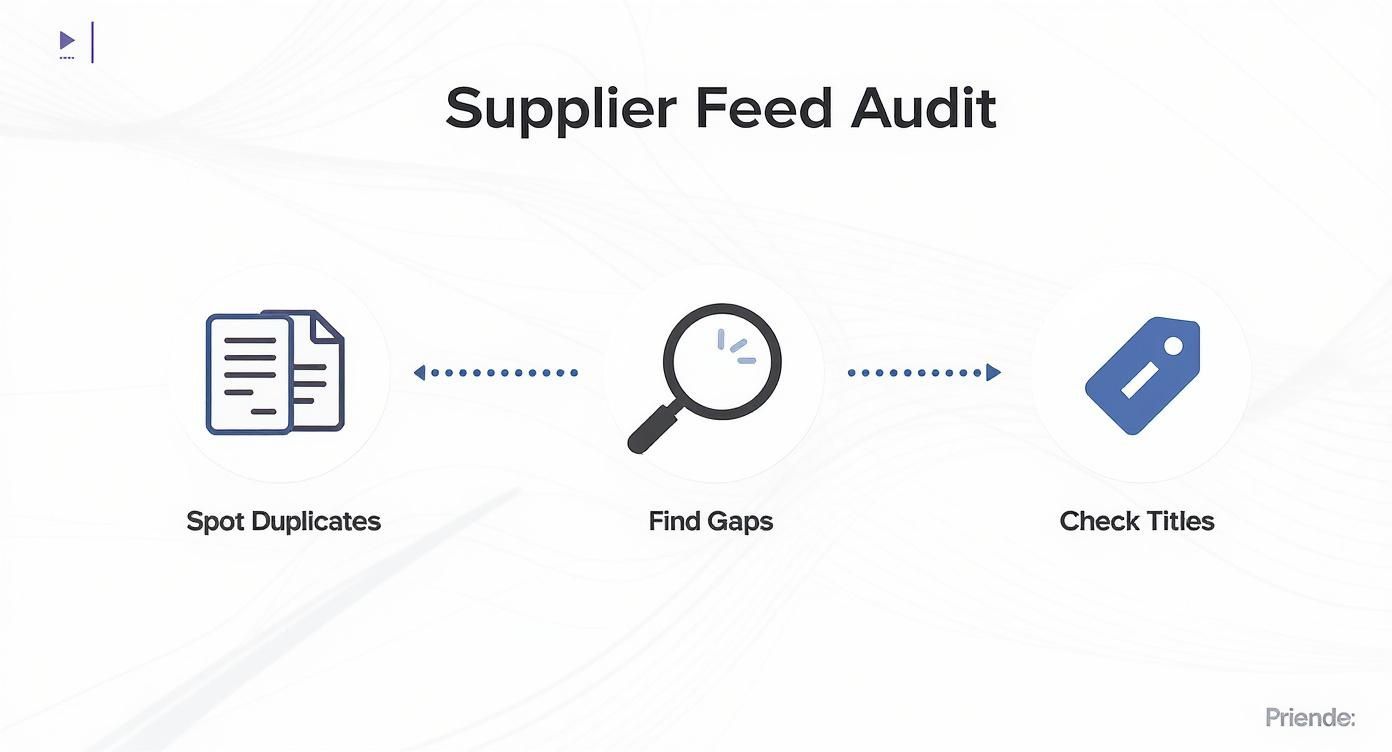
This process shows you how to systematically hunt down duplicates, find missing information, and check your titles. It’s the perfect setup for bringing in targeted AI to do the heavy lifting.
Automating Unique Content Creation
One of the biggest headaches for any retailer is supplier content duplication. Seriously, using the same generic descriptions as your competitors is a fast track to getting penalised by search engines. An AI-powered content workflow kills this problem by automating product descriptions at scale, generating unique, brand-aligned content.
And these systems do much more than just rephrase things. They're trained on your specific brand's tone of voice. They can weave in the right keywords and product attributes to create compelling copy that works for both your customers and AI agents like ChatGPT or Google's AI Overviews. This is absolutely fundamental to creating AI-compatible SEO content and getting ready for the future of retail search.
By automating product descriptions, you’re not just dodging penalties. You're building a distinct brand voice across thousands of SKUs, something that's pretty much impossible to do manually without a huge amount of time and money.
Leveraging AI for Image and Metadata Optimisation
If you're in a visually driven industry like fashion or furniture, your product images are just as crucial as the text. The problem is, supplier feeds often come with zero rich metadata needed for strong image SEO for ecommerce. This is exactly where AI image recognition and tagging become your secret weapon.
This technology can look at a product image and automatically generate descriptive alt tags and file names that actually help you rank. For instance, it can spot a "blue linen armchair with wooden legs," and tag it with all those attributes, boosting its visibility in visual search engines. This automated content workflow makes sure every single image is pulling its weight for your SEO. You can dive deeper into this by exploring our guide on the real driver of AI ROI for retailers.
This is especially critical in the Australian market. Here, the link between someone searching online and walking into a physical store is incredibly strong, a massive 46% of all searches in Australia have local intent.
When a potential customer is looking for a product nearby, your digital shelf better have accurate, real-time information. If your supplier feeds don't line up with your actual inventory and location data, you're not just losing a sale. You're damaging your local search reputation, which is tough to get back.
Mapping and Transforming Data for Digital Shelf Dominance

This is where the real work begins, turning your audit findings into an actionable game plan. We're talking about mapping, the crucial step of translating messy, inconsistent data fields from your suppliers into your own clean, optimised product schema. It’s all about creating one single source of truth that powers everything from your on-site filters to your listings across multiple channels.
The whole point is to build a master data template. This isn't just a spreadsheet; it's the blueprint that aligns every product with modern SEO practices and gets your catalogue ready for the future of agentic commerce. Without this step, any effort you put into enriching or optimising your data is like building a house on a shaky foundation.
Standardising Data with AI-Powered Logic
One of the most common headaches we see is inconsistent terminology. A supplier might send you a product labelled 'navy', while another calls it 'dark blue', and a third just uses 'blue'. To a customer using your website's filters, those are three entirely different colours. The result? A frustrating user experience and, almost certainly, a lost sale.
This is exactly where an AI-driven workflow becomes a game-changer. Instead of someone manually cleaning up these variations, AI models can instantly map them all to a single, consistent attribute. This normalisation process is absolutely fundamental to getting clean, filterable data that improves both the customer journey and your search relevance. This kind of systematic approach is a core part of effective product feed management, ensuring you have consistency no matter where the data comes from.
Mapping isn't just a technical task; it's a strategic one. You are defining the ideal data structure for every single product, making sure it has all the attributes needed to rank, convert, and satisfy both human shoppers and the AI shopping agents of tomorrow.
Enriching Sparse Feeds for SKU-Level SEO
Once your data is mapped and standardised, the next move is enrichment. It’s no secret that many supplier feeds are notoriously sparse, often missing the detailed specs that customers actually need to make a buying decision. This is where you graduate to true SKU-level SEO at scale.
Take an electronics retailer, for example. They might get a feed for a laptop that only lists the brand and model number. That’s not enough. An AI-powered workflow can automatically beef this up by:
- Pulling in technical specifications like RAM, storage type, screen resolution, and processor speed from a master database.
- Adding feature-benefit statements that explain why a certain processor is great for gaming or why a particular screen type is better for graphic design.
- Identifying compatible accessories to create valuable cross-selling opportunities right there on the product page.
It's the same story for a beauty brand needing beauty & cosmetics SEO. A basic supplier feed might just give you a product name and a shade. A smart enrichment workflow can automatically add the full ingredient list, flag if it's 'vegan' or 'cruelty-free', and specify its suitability for different skin types. These are the very details customers filter by, and adding them dramatically boosts your product’s visibility and digital shelf performance.
Adopting AI for these tasks creates a huge efficiency gap between you and competitors who are still stuck doing things the old way. The difference in speed, scale, and strategic focus is stark.
Traditional Manual SEO vs AI-Powered Workflow
| Task | Traditional SEO Team Approach | AI-Powered Workflow Approach |
|---|---|---|
| Data Standardisation | Manually correcting thousands of attribute variations in spreadsheets. Very slow and prone to human error. | AI models instantly recognise and map variations (e.g., 'navy', 'dark blue') to a single standard ('Blue'). |
| Product Enrichment | Junior team members manually research and add missing specs. Inconsistent and takes weeks for a single category. | Automatically pulls specs from databases, generates benefit statements, and identifies cross-sells in minutes. |
| Scaling Content | Optimises a handful of "hero" products, leaving the long-tail of the catalogue untouched and underperforming. | Applies high-quality enrichment across the entire catalogue of 10,000+ SKUs simultaneously, enabling SEO at scale for retailers. |
| Strategic Focus | Team spends 80% of their time on manual, repetitive data clean-up tasks. | Team spends 80% of their time on high-value strategy, analysis, and performance monitoring. |
| Speed to Market | New product launches are delayed by days or weeks waiting for manual data entry and optimisation. | New products are enriched and ready to go live within hours of receiving the supplier feed. |
Ultimately, an AI-powered workflow doesn't just make your team faster; it frees them from the grunt work of data entry and allows them to focus on what really moves the needle: strategy, performance, and growth.
Implementing Human-Led AI for Quality Assurance
While AI brings incredible scale to retail content automation, your team’s expertise is still your greatest asset. Moving from manual SEO to AI-driven workflows doesn't mean removing people from the equation. It simply reframes their role, from tedious content creation to strategic oversight.
This is where a human-led AI content QA process comes in. It's a "human-in-the-loop" model that perfectly balances speed with quality, creating a framework where your retail teams can review, refine, and perfect AI-generated content.
This ensures every single product description and attribute aligns perfectly with your brand’s unique voice and exacting standards. This is the future of work in retail: human + AI collaboration in SEO.
The Framework for Strategic Oversight
The goal isn't to manually check every piece of AI-generated content. That would completely defeat the purpose of optimised at scale. Instead, the focus is on building a smart, efficient quality assurance process that delivers maximum impact with minimal effort.
This really boils down to a few key activities:
- Systematic Spot-Checking: Regularly review a small, random sample of automated product descriptions to check for accuracy, tone, and keyword usage.
- Verifying Critical Data: Prioritise checks on high-impact data points. Think pricing, key specifications for electronics SEO optimisation, or material composition for fashion SEO optimisation.
- Validating AI Image Tags: For visual categories like furniture or beauty, have your team quickly verify that AI-generated image tags are contextually correct and relevant.
- Establishing Feedback Loops: Create a simple process for your team to flag any errors or awkward phrasing. This feedback is then used to retrain and continuously improve the AI models.
This quality assurance process transforms your team from content creators into strategic editors and AI trainers. They are no longer a bottleneck but the guiding intelligence that makes your automated content workflows smarter over time.
This strategic shift is essential in Australia’s booming but hyper-competitive eCommerce market. While the industry is seeing steady growth, new data shows the average basket size has dropped to a decade-low of just $95.
This tells us that while more people are shopping online, they are incredibly sensitive to price and product detail discrepancies. If the information in search doesn't perfectly match what's on your product page, they'll abandon their cart without a second thought. Precise data has become a critical factor for conversion. You can explore more insights into Australia's online shopping trends to see the full picture.
Building a Culture of Continuous Improvement
Adopting AI isn't a one-and-done setup; it's an ongoing process of refinement. By implementing a human-led QA workflow, you create a powerful cycle of improvement.
Every correction your team makes teaches the AI, reducing future errors and making the entire system more efficient over time. For practical guidance on structuring this review process, our guide on how to review writing effectively provides a solid foundation for your team.
This approach ensures your brand voice remains authentic and your product data stays accurate. It’s how you build the trust needed to improve digital shelf performance and thrive in the future of agentic commerce.
Got Questions? We've Got Answers.
Here are a few common questions we hear from retail leaders about connecting supplier feeds to actual search performance. We’ll get into the practical side of things, like how to get started, manage data from dozens of different suppliers, and figure out the real ROI of all this work.
How Quickly Can We See Results from AI Data Enrichment?
While some of the bigger SEO changes need time to bake in, the wins from product data enrichment can show up surprisingly fast. Most retailers see an initial lift in engagement, think better click-through rates and lower bounce rates, within a few weeks as product pages suddenly become far more relevant to what people are searching for.
But the real magic happens within two to three months. That's when you'll typically see significant jumps in organic rankings and traffic for those longer, more specific search terms. It’s a direct result of search engines crawling your newly optimised pages and recognising all that unique, structured content. The exact speed depends on your catalogue size and your site's current authority, but the impact on your digital shelf is direct and very measurable.
Does This Replace Our Existing SEO Team?
Absolutely not. It’s about making them more powerful. Moving from manual SEO to an AI-assisted workflow completely changes the game for your team, shifting their role from tedious data entry to high-level strategic oversight.
Imagine your team no longer spending 80% of their day fixing duplicated supplier content or writing alt tags one by one. Instead, they’re analysing performance, shaping brand strategy, and fine-tuning the AI models. This human + AI collaboration isn't just a trend; it's the future of retail work. Your team’s expertise becomes more valuable than ever because they’re the ones guiding the AI, making sure the final output is not just optimised, but also perfectly aligned with your brand’s voice and commercial goals. This is the core difference in the AI SEO vs traditional SEO debate.
Adopting AI for retail content isn't about cutting headcount. It's about amplifying your team's strategic impact by smashing the retail content bottlenecks that have been holding them back.
How Does AI Handle Data from Multiple, Messy Supplier Feeds?
This is where an AI-powered workflow really shines. The system is built to take in data from dozens of different supplier feeds, each with its own quirks, messy formatting, and inconsistent terms. Using a set of mapping and standardisation rules, the AI cleans it all up, normalising the inconsistent data into a single, pristine master template.
For example, it can automatically figure out that "Navy", "Dk. Blue", and "Midnight" all mean the same colour and map them correctly. This process of supplier feed enrichment ensures your customers get a consistent, accurate experience, no matter how chaotic the data is on the back end. It’s the only way to achieve true SKU-level SEO at scale.
What's the Real ROI on Automating Product Data?
The return on investment shows up in a few key areas, building a business case that’s hard to ignore.
- More Organic Revenue: By crushing duplicate content issues and optimising for those long-tail searches, you’ll see a significant boost in search visibility. That means more qualified traffic hitting your site and a direct lift in sales.
- Serious Operational Efficiency: Think about all the hours your team currently spends on manual content creation and data clean-up. Now, imagine that time is cut drastically. You can launch new products faster and redirect your team to focus on actual growth initiatives. These are tangible benefits of using retail efficiency tools.
- Better Conversion Rates: When product pages are enriched with detailed attributes and clear specs, shoppers have the confidence they need to hit "buy." This leads directly to higher conversion rates and a much stronger performance on the digital shelf.
- Getting Ready for Agentic Commerce: By creating structured, AI-friendly SEO content now, you’re preparing your entire catalogue for the next wave of AI shopping agents. It’s about securing a long-term competitive edge in a world where agentic search optimisation will be the norm.
Ultimately, the ROI isn’t just measured in cost savings. It’s about building a scalable, resilient, and high-performing ecommerce operation that’s ready for whatever the future of retail search throws at it.
Ready to eliminate data disconnects and unlock scalable growth? Optidan AI transforms your raw supplier feeds into thousands of SEO-ready product pages in days, not months. Discover how our AI-powered content workflows can elevate your digital shelf performance.
