


When we talk about reviewing writing these days, we're really talking about getting your content ready for agentic search. This is where AI assistants do the shopping for real customers. The old-school grammar check just doesn't cut it anymore. A modern review workflow for retail leaders is all about product data enrichment and structuring content so AI agents can understand it. It's less about proofreading and more about strategic positioning for your digital shelf.
Rethinking Your Content Review for an AI-First World
The days of just scanning for typos and checking keyword density are well and truly behind us. For any ecommerce manager, the content review process has become a huge part of AI SEO, and it has a direct impact on how well your products perform online. The aim isn't just to have readable content anymore; it’s to produce AI-compatible SEO content that generative AI agents, like Rufus or ChatGPT, can easily find, understand, and serve up to shoppers.
This means we need to move away from painstaking manual proofreading and embrace a human-led, AI-assisted quality assurance (QA) workflow. Instead of being a roadblock that slows everything down, this new approach transforms your review process into a high-speed engine for retail content automation. It’s the only practical way to turn raw supplier data feeds into thousands of unique, optimised product descriptions and achieve SEO at scale.
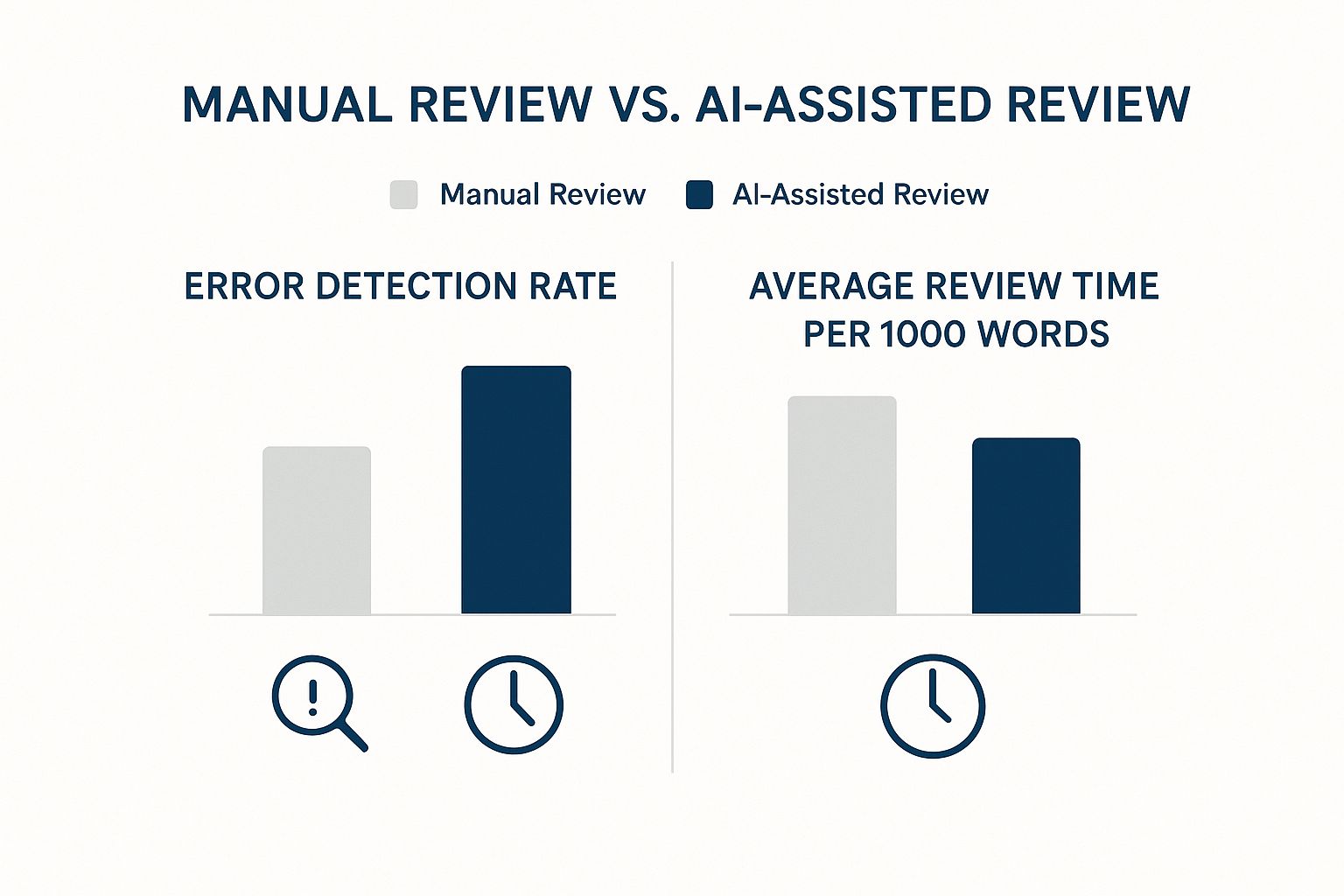
As you can see, AI-powered content workflows don't just speed things up; they’re also far better at catching errors. For the sheer scale of modern retail, they’ve become essential for efficiency and automation.
To show just how different these two approaches are, let's break down the old way versus the new. This table highlights the shift from outdated manual checks to the kind of efficient, AI-centric QA that modern ecommerce demands.
Traditional Review vs Modern AI-Assisted QA
| Review Aspect | Traditional Manual Review | AI-Assisted QA Framework |
|---|---|---|
| Pace & Scale | Slow, SKU-by-SKU process. A bottleneck for large catalogues. | Extremely fast. Capable of processing thousands of SKUs in minutes. |
| Primary Goal | Fix grammar, spelling, and basic keyword usage. | Enrich product data, ensure uniqueness, and structure for AI agents. |
| Error Detection | Dependent on human focus. Prone to fatigue and inconsistency. | Catches a wider range of issues, from duplicates to factual inaccuracies. |
| Role of Humans | Line-by-line editing and manual proofreading. | Strategic oversight, prompt engineering, and quality control. |
| Outcome | Readable, but often generic and not optimised for search. | Unique, optimised content ready for both human shoppers and AI. |
The takeaway is clear: clinging to manual-only reviews means falling behind. Adopting an AI-assisted framework is about working smarter, not harder, to keep your entire catalogue competitive.
Shifting from Manual Checks to Strategic QA
The future of work in retail is all about human and AI collaboration. Your team's time and expertise are far too valuable to be spent on line-by-line edits. Their real value lies in providing strategic direction for your AI agents. To get your review process up to speed, you'll want to explore some of the Best AI Writing Tools out there, as they are the foundation for building an effective retail content automation system.
A modern review process should be focused on these key areas:
- Fixing Duplicated Supplier Content: Your top priority should be finding and rewriting those generic manufacturer descriptions. This is crucial for developing a unique brand voice and avoiding any SEO penalties for duplicate content.
- Product Data Enrichment: This means turning a dry list of technical specs into compelling, structured benefits that resonate with customers and are easy for AI agents to parse.
- Preparing for Agentic Search: You need to structure your content to give direct answers to the very specific, long-tail questions that people will ask their AI shopping assistants.
By putting AI-powered content workflows in place, you can finally achieve optimisation at scale. This ensures your entire product catalogue is primed for the future of agentic commerce. The growing role of AI is what’s shaping all of these next-gen SEO strategies for retailers, and it pays to understand how it all connects.
Getting Your Content Ready for Agentic Search
The way we review content needs a fundamental shift. We have to start asking a new, critical question: Is this page built to satisfy an AI shopping agent? This is the new benchmark for what's known as agentic search optimisation. It’s less about how the page reads to a person and more about how it’s interpreted by a sophisticated algorithm.
Our focus has to zoom in from broad keywords to the nitty-gritty, structured, SKU-level details that AI agents rely on to make purchasing decisions.
This means your review process has to get ruthlessly specific. When you're assessing a piece of writing, you're not just checking for clarity anymore. You’re verifying that every single feature is explicitly tied to a tangible benefit for the customer. It's no longer enough to use generic descriptions pulled from a supplier's catalogue; that just lists specifications. Content that’s truly ready for the future of retail search explains why those specs actually matter.

Think about it this way. A standard description might just say "cotton-poly blend." An agentic-ready description, on the other hand, would say, "Made from a breathable cotton-poly blend to keep you cool during summer workouts." See the difference? That level of detail directly answers the kind of long-tail, conversational queries that will define agentic commerce.
A Practical Checklist for Your Agentic SEO Reviews
Your review workflow should become a quality control checkpoint for AI-readiness. The end goal here is to transform that basic supplier feed data into a rich, conversational asset that makes your product stand out on the digital shelf. For a deeper dive, check out our guide on agentic AI SEO content optimisation.
Here’s what you should be looking for:
- Benefit-First Language: Does the writing clearly spell out the positive outcome for the customer?
- Structured Data Points: Are key details like dimensions, materials, and compatibility laid out clearly so an AI can easily parse them?
- Answers Unspoken Questions: Does the description anticipate and answer the natural follow-up questions a real shopper would have?
- Unique Value: Is the content genuinely different from your competitors and the boilerplate supplier text?
By structuring your content as a series of clear answers, you are essentially pre-optimising it for the Q&A format favoured by AI shopping agents. This is a fundamental shift from writing for discovery to writing for direct response.
This methodical approach ensures every piece of content, whether you sell fashion, furniture, or electronics, is primed for the next wave of search. It’s all about building a foundation of scalable SEO solutions that work just as well for people as they do for the AI agents serving them.
Building a Workflow to Eliminate Duplicated Supplier Content
If you're relying on generic supplier descriptions for your product pages, you're essentially invisible on the digital shelf. It’s a massive red flag for search engines, telling them your content adds no real value and directly hurting your digital shelf performance. The first move for any retail leader is to build a solid system that finds and replaces this duplicated content across your entire site.
This isn't just about spot-checking a few pages here and there. I'm talking about an automated content workflow that can scan your whole catalogue. Modern retail efficiency tools can use AI to flag unoriginal text across thousands of SKUs in minutes. This gets your team out of the weeds of manual comparison and lets them focus on what they do best: rewriting with a unique brand voice.

Honestly, this is about more than just dodging SEO penalties; it's a core part of carving out a distinct brand identity. The problem of content originality is a serious one that goes well beyond search rankings. Think about it from a creator's perspective: the 2022 National Survey of Australian Book Authors revealed that over 25% of authors have to deal with copyright infringement. This forces a much closer look at protecting intellectual property, and you can read more about the findings from this author survey.
From Identification to Optimisation at Scale
Once your system has flagged the generic content, the real work begins. Your AI workflow automation needs to guide your team, or your AI agents, to turn that bland supplier data into product descriptions that actually sell.
Let’s say you’re a fashion retailer. Instead of "100% cotton t-shirt," your new description could talk about the fabric's soft feel against the skin or its ethically sourced origins. For an electronics store, it’s not just listing technical specs; it’s explaining how a faster processor delivers a lag-free gaming experience. You're translating features into tangible benefits.
The goal is to create a systematic, repeatable process where every product page becomes an asset, not a liability. This is the difference between simply managing a product feed and actively optimising it for conversions and agentic search.
Getting this methodical approach to correcting supplier content duplication right is non-negotiable if you want to achieve SEO at scale. By putting a smart workflow in place, you not only fix duplication issues and improve your rankings, but you also make sure your brand’s voice is the one customers hear. For a much deeper dive, check out our guide on avoiding supplier product feed duplication.
How to Review for Enriched Product Data and Engagement
A proper content review goes way beyond the usual technical SEO checks. You need to look for the human connection. Does your enriched product data actually tell a story that will engage a real person and encourage them to buy?
The real test is whether you've successfully turned a boring supplier feed into something compelling.
This means your review process has to critically examine if product features have been translated into genuine customer benefits. It’s not enough to just list specs; you have to show how those specs make the shopper's life better. This is a crucial part of product data enrichment and it has a direct impact on your digital shelf performance.
Think about the furniture industry. A review should check if a description goes beyond simply stating "solid oak frame." Does it talk about the frame's durability, making it perfect for a growing family? Or its timeless style that fits a modern living room?
It's the same for beauty and cosmetics. "Contains hyaluronic acid" is just a data point. An engaging description explains what that means for the customer: "deep, lasting hydration for a visibly plumper, glowing complexion."
From Data Points to Customer Connection
At its core, this part of the review is all about context and tone. You need to make sure the lifestyle context is woven seamlessly into the copy, making the product feel like a natural part of the customer's world. This is exactly where many automated content workflows need that final human check.
Your review should answer one simple question: Does this description make the customer feel something? Whether it’s excitement, confidence, or reassurance, emotion is what drives purchasing decisions long after the technical details are forgotten.
This is especially true when you consider your target audience. For instance, recent data on Australian book markets shows that readers aged 25 to 34 account for 21% of all purchases and often prefer digital formats. Knowing little details like this is key to reviewing content for maximum appeal. You can dig into these Australian reader statistics to see what I mean.
A sharp review process ensures your product descriptions do more than just show up in search results. They create a real connection that boosts conversions and builds brand loyalty. To help get this done at scale, our guide on the AI product description generator offers some practical tips for creating engaging copy more efficiently.
Weaving Image Metadata Reviews into Your Workflow
If you’re in a visually-driven industry like fashion, furniture, or electronics, your product images are doing just as much heavy lifting as your descriptions. This means your review process can't just stop at the text; it has to cover image metadata too. It's time to make alt tag optimisation for retail a core part of your quality assurance.
For far too long, alt text has been treated as a checkbox item, an afterthought tacked on at the end. But it's a critical piece of your digital shelf performance, directly impacting how your products surface in image searches on Google and other platforms. A solid review process ensures this metadata isn't just there, but is actively working for you.

This is where AI-powered content workflows really start to shine. Tools using AI image recognition SEO can whip up descriptive, keyword-rich alt text for thousands of product images in the time it takes to make a coffee. This solves the massive challenge of scale, but it doesn't mean you can set it and forget it. Human oversight is still the secret sauce.
How to Review AI-Generated Image Metadata
With AI handling the grunt work, your team’s role evolves from tedious data entry to high-level quality control. When you're reviewing AI-generated metadata, you're essentially checking for three key things:
- Is it accurate? Does the alt text genuinely describe what's in the picture? For a dress, this would mean specifying the colour, style, and any standout features like a "V-neck" or a "floral pattern". The AI might miss these nuances.
- Is it relevant to searchers? Does it use the kind of search terms a real customer would type in? Aim for "solid oak dining table for six people" instead of a generic "table".
- Does it sound like us? Even in a small snippet of metadata, your brand voice should be recognisable. A quick check ensures the tone aligns with the rest of your content.
Think of your image metadata as a silent salesperson. It needs to speak clearly to both search engines and visually impaired users, turning every single image into a hard-working SEO asset.
By building a simple framework for reviewing AI-generated metadata, you ensure your visual content actually gets found. This isn't just about ticking a box; it's a fundamental part of creating scalable SEO solutions that set your entire product catalogue up for visibility. It’s a smart move to future-proof your business as we move deeper into the world of agentic commerce.
Weaving AI and Human Expertise into a Scalable Content Workflow
Let's get one thing straight: bringing AI into your retail content process isn't about replacing your team. It's about making them more powerful. The real magic happens when you blend the sheer speed of automation with the sharp, strategic eye of your human experts.
This means setting up an automated content workflow where AI tackles the grunt work. Think of it as liberating your team from the tedious tasks so they can focus on what they do best: strategy, refinement, and creative direction.
This human + AI collaboration is how you finally break through retail content bottlenecks and start doing SEO at scale. It's the key to taking raw, messy supplier feeds and turning them into thousands of perfectly optimised product pages. The time savings are incredible; we've seen projects that used to drag on for months get done in a matter of minutes. In fact, you can see exactly how we did it in this breakdown of how OptiDan AI transformed content workflows from months to minutes.
Defining Who Does What in a Hybrid Workflow
In a well-oiled hybrid system, everyone knows their role. AI agents are the workhorses, chewing through the data-heavy, repetitive tasks. Your human team then steps in to provide the crucial final polish and strategic oversight.
Here’s what you should hand over to your AI agents for retail efficiency:
- First Drafts: Let the AI generate unique product descriptions directly from supplier data feeds.
- Spotting Duplicates: It can instantly flag generic, copy-pasted manufacturer descriptions across your entire catalogue.
- Keyword Weaving: AI is fantastic at integrating the right terms for agentic search optimisation.
- Image Metadata: Use AI image recognition to create a solid first pass of all your alt text.
This clear division of labour creates a fast, consistent process.
Your team's role evolves. They're no longer just writers; they become editors, strategists, and brand guardians. They're the ones doing the final quality check, ensuring everything aligns with your brand voice, is factually correct, and has that subtle human touch that builds real trust with customers.
This final, human-led AI content QA step is non-negotiable. It’s your guarantee that even with automation driving the process, every single piece of content reflects the high standards your brand is known for. To get this right, it’s worth diving deeper into what AI powered workflow automation can truly do for you. It's this synergy, this blend of human insight and machine efficiency, that will define the future of work in retail.
Common Questions Answered
When reviewing AI-written product descriptions, where should I focus my attention first?
Before you even think about grammar, there are two big things you need to nail down: factual accuracy and brand voice. It's surprisingly easy for an AI to misinterpret supplier data, so you absolutely have to verify every detail is correct.
Even more importantly, the description has to sound like it came from your brand. If it reads like a generic robot wrote it, you'll lose that crucial customer trust and brand consistency you've worked so hard to build.
We have thousands of products. How do we review everything without grinding to a halt?
This is where you need to work smarter, not harder. The trick is to set up a 'review by exception' system.
Instead of a human checking every single description, use your retail efficiency tools to automatically flag the potential duds. The software can hunt for duplicated supplier content, factual inconsistencies, or writing that just doesn't match your brand's voice. This frees up your team to apply their expertise only where it's genuinely needed, which is a massive win for optimising product feeds efficiently.
Is keyword stuffing still a thing with AI SEO?
Not in the old-school sense, but keywords are definitely still important. The game has changed, though.
Your review process should move beyond just checking for a primary keyword. Now, it's all about semantic relevance. You're looking for natural, conversational language and those longer, more specific phrases that people actually use when they're ready to buy. Does the content answer a real customer question? That's the new standard for SEO for AI agents.
Ready to turn your content review from a painful bottleneck into a serious growth driver? See how Optidan AI helps retailers master SEO at scale by visiting the Optidan website.
