

An Order Management System, or OMS, is the software platform that acts as the central nervous system for your entire retail operation. It’s the single source of truth that tracks every customer order from the moment they click ‘buy’, through to inventory allocation, warehouse fulfilment, final delivery, and even returns.
For any mid-to-large retailer in Australia, a modern OMS isn't just a nice-to-have, it's the engine that powers your operational efficiency and shapes the customer experience. This is the foundation for scalable SEO solutions and AI workflow automation.
Understanding the Role of an Order Management System
Think of your retail business as a complex road network. You have ecommerce sites, physical stores, warehouses, and shipping partners all needing to talk to each other instantly. The order management system is the intelligent traffic control centre directing every single vehicle, making sure each package gets to its destination without a hitch. For a more technical breakdown, you can find a precise definition of an Order Management System here.
Without this central hub, you're left managing chaos. Retail leaders trying to run things with spreadsheets and disconnected systems inevitably face costly errors, embarrassing stockouts, and unhappy customers.
The Shift From Operations Tool to Strategic Asset
Not long ago, an OMS was seen as a simple back-end tool for processing orders. Its job was to be accurate and reliable, and that was about it.
Today, its role has expanded far beyond logistics. A modern OMS is a critical strategic asset that directly impacts your digital shelf performance and readiness for the future of retail search. The real-time data flowing through your OMS, such as stock levels and fulfilment speeds, creates powerful 'availability signals' that are becoming increasingly important for:
- AI SEO: Search engines and new AI agents like Google’s AI Overviews and Amazon Rufus prioritise real-time product availability to give users answers they can trust. This is the core of agentic search optimisation.
- Agentic Commerce: As AI agents in ecommerce become more common, they will rely on clean, dependable data from your OMS to make buying decisions for consumers. This system provides the foundational data layer these agents require.
- Customer Experience: Nothing breaks brand trust faster than a customer buying something that turns out to be out of stock. An OMS prevents this by keeping your inventory synchronised across every sales channel.
Preparing for the Future of Work in Retail
A powerful OMS also helps solve the persistent content bottlenecks that slow retail teams down. Once you have a reliable source of inventory truth, you can confidently bring in AI workflow automation for retail for tasks like product data enrichment. You cannot effectively run automated content workflows or fix duplicated supplier content if you don’t know if the product is available to sell. This transition from manual SEO to AI SEO is a critical step in building retail efficiency tools for the future.
In essence, your OMS is no longer just about fulfilling orders. It's about ensuring your product information is trustworthy, accurate, and ready for an AI-driven future where visibility and selection happen long before a customer visits your website.
The Core Features of an AI-Ready OMS
Think of an effective order management system as less of a digital ledger and more of the operational heartbeat of your retail business. For Australian ecommerce managers trying to keep up with a booming market, the right OMS isn't just helpful, it's foundational, especially as we move towards AI-led commerce.
In Australia's fast-paced retail scene, a solid OMS is the only way to manage huge order volumes without chaos. The local spend shows just how critical these systems are, with Australia's piece of the Asia Pacific OMS market sitting at around $106 million. This isn't just about growth for growth's sake, it's driven by the need for real-time stock sync and omnichannel fulfilment. Retailers with modern systems are already seeing up to 25% faster order processing.
But an AI-ready OMS does more than just track packages. It provides the clean, reliable data that powers everything from AI SEO services to optimising product feeds efficiently.
Centralised Inventory Management
The absolute core of any decent OMS is a single, unified view of your inventory. I’m not just talking about what’s sitting in the main warehouse. I mean real-time visibility across every single channel: your physical stores, third-party logistics (3PL) partners, and online marketplaces.
This single source of truth is non-negotiable for agentic search optimisation. When AI agents for retail efficiency like ChatGPT or Amazon’s Rufus go looking for a product, their first question is "Is it available?". If your system feeds them conflicting or old information, they'll simply move on. Your products become invisible. This is where human + AI collaboration in SEO starts.
Intelligent Order Routing
Modern retail is a logistical puzzle. A customer in Perth is probably best served from a local store's backroom, while an order in Sydney might be faster coming from a central distribution hub. An intelligent OMS automates these decisions based on rules you set.
This isn’t just about being clever, it’s about efficiency and keeping customers happy. It lets you:
- Slash shipping costs by always picking the closest fulfilment location.
- Speed up delivery, which is a massive driver of customer loyalty.
- Balance stock levels across your entire network, preventing frustrating localised stockouts.
Seamless Returns and Reverse Logistics
The customer journey doesn't stop once the package arrives. A smooth, simple returns process is just as important. An AI-ready OMS manages reverse logistics with the same rigour as it does outbound orders, tracking returns and instantly updating inventory the moment an item is back in the system.
This doesn't just build trust with your customers. It gets returned stock back on the digital shelf and ready for resale as quickly as possible, protecting your margins.
An AI-ready OMS transforms operational data into a strategic asset. Its primary job is to create a reliable, real-time 'availability signal' that underpins every customer-facing promise and every AI-driven optimisation effort you undertake.
Integration and Data Accessibility
Finally, we get to what is arguably the most critical feature for the agentic commerce future: connectivity. Your OMS has to play well with others. It needs robust APIs to plug into your entire tech stack, from your eCommerce platform to your ERP.
This is especially true for integrating with product data enrichment tools. Your OMS provides the simple "yes, it's in stock" signal. That signal is the green light you need to confidently kick off large-scale retail content automation projects. This API-first thinking is how you connect your operational backend to your digital shelf, getting your entire business aligned for next-gen SEO. For a deeper dive, see how API-driven workflows are transforming retail data enrichment.
As retail leaders prepare for this shift, the very definition of a "good" OMS is changing. What was once about simple tracking and fulfilment is now about providing the clean, real-time data needed for AI-powered discovery.
| Essential OMS Features for AI-Led Commerce |
| :— | :— | :— |
| Feature | Traditional Functionality | AI-Ready Enhancement |
| Inventory Management | Periodic updates from warehouse stock counts. | Real-time, unified view across all channels (stores, 3PLs). |
| Order Routing | Basic rules, often manual (e.g., "always ship from main DC"). | Dynamic, automated routing based on cost, speed, and stock levels. |
| Data Accessibility | Limited to internal systems via batch exports or reports. | Open, robust APIs for seamless, real-time data exchange. |
| Returns Processing | Manual tracking of returned goods and delayed stock updates. | Automated reverse logistics with instant inventory updates. |
The takeaway is simple: an AI-ready OMS isn't just an upgrade, it's a fundamental shift. It turns your operational data into a powerful signal that ensures your products are visible, available, and ready for the next generation of commerce.
How an OMS Drives Digital Shelf Performance and AI SEO
Many retail leaders see their order management system as a back-office tool for tracking parcels. That’s a missed opportunity. For forward-thinking ecommerce managers, an OMS is a strategic asset with a direct, powerful impact on your front-end revenue, digital shelf performance, and readiness for the future of retail search.
The clean, real-time data from your OMS is what transforms your SEO from a slow, manual process into a scalable, AI-driven engine for growth.
Think of your product pages as promises you make to your customers. An OMS is the system that ensures you can actually keep them. It provides the core 'availability signals' that search engines and AI shopping agents now rely on to determine trust and relevance. Without this reliable data, even the most ambitious ecommerce content optimisation strategies will fall flat.
This link between back-end operations and front-end success is only getting stronger. In Australia, the supply chain management market, which is deeply tied to OMS platforms, hit USD 949.4 million in 2025 and is projected to rocket to USD 2,277.9 million by 2034. This growth isn't accidental, large enterprises, which make up 55% of this spend, are shoring up their operational backbones to power sophisticated omnichannel strategies.
The Foundation for High-Quality Content at Scale
One of the biggest headaches for large retailers is dealing with supplier content duplication. Raw product feeds are often generic, uninspired, and identical across dozens of competitor websites, creating a massive SEO problem. While AI workflow automation for retail can fix this by generating unique product descriptions SEO, it needs a reliable place to start.
An OMS provides that crucial first step. Before an AI agent can even think about enriching product data, it needs to know one simple thing: is the product actually available? The OMS gives a definitive yes or no, giving your content systems the green light to kick off product data enrichment with confidence and at scale. It's about optimising product feeds efficiently, not just processing them.
Your OMS is the ultimate source of truth for product availability. This signal is the bedrock upon which all your content quality and SEO efforts are built. It ensures your investment in creating unique product descriptions is focused only on items customers can actually buy.
This simple connection prevents a huge amount of wasted effort and resources, ensuring your retail content automation is focused squarely on SKUs that will generate revenue.
Winning in the Age of Agentic Search
The future of retail search is rapidly shifting towards agentic commerce. This is where AI agents like Google’s AI Overviews and Amazon Rufus make buying decisions for consumers. These agents value accuracy and trust above all else. They need real-time data on stock levels, fulfilment speeds, and availability to give users good answers.
Your OMS is the system that feeds this critical information directly to your digital storefront, and this data is quickly becoming a primary ranking factor for AI SEO.
- Trust Signals: Accurate stock information builds trust with both human shoppers and AI agents, slashing bounce rates from out-of-stock disappointments.
- Conversion Readiness: AI agents will always favour products they can confidently recommend for immediate purchase. Real-time availability is now a massive competitive edge.
- SKU-Level SEO: Precise inventory data enables granular SKU-level SEO, making sure specific product variations (like a size or colour) are shown accurately in search. AI image recognition SEO can further enhance this for fashion and furniture retailers.
On top of this, a well-implemented OMS is a powerful tool to improve ecommerce customer experience, driving higher customer satisfaction and repeat business.
When you start seeing your order management system as a core part of your marketing tech stack, you stop just managing logistics and start actively shaping how your products are discovered and sold. This strategic shift is essential for dominating the digital shelf today and preparing your business for the future of work in retail, where human and AI collaboration drives success.
You can learn more by reading our detailed guide on improving your digital shelf performance.
Choosing and Implementing the Right OMS
Picking and rolling out a new order management system is one of those big, foundational decisions that will define your operations for years. It’s not just about buying software, it's about laying a critical piece of your tech stack that will either set you up for success or hold you back from the future of work in retail.
The real goal here is to find a system that not only makes today’s operations smoother but also plugs straight into the AI-powered content workflows that are becoming essential. This isn't just about managing orders anymore. It's about getting your data ready for a world where AI agents in ecommerce make the buying decisions, and that requires absolute data integrity.
Key Evaluation Criteria for a Future-Ready OMS
When you’re looking at different vendors, it’s easy to get lost in feature lists. But the focus needs to be on whether their system can support a modern, AI-driven retail environment. Forget the basic order processing, you need to dig into the system’s architecture and its ability to grow with you. Any system that locks your data away in a silo is a major liability.
To make a choice that won't feel dated in a year, here are the areas to grill vendors on:
- API Capabilities: Does it have a robust, well-documented API? This is non-negotiable. It's how your OMS will talk to everything else, from your eCommerce platform to the AI tools handling product data enrichment and retail content automation.
- Scalability and Performance: Can the system handle your Black Friday traffic without breaking a sweat? Don't just take their word for it. Ask for real-world case studies and performance data from retailers your size. This is key for SEO at scale.
- Multi-Channel Support: It absolutely must give you a single, unified view of your inventory across every single channel, your physical stores, online marketplaces, and your own website. No exceptions.
- Support for Modern Fulfilment: Can it handle the complex logistics of today's retail? Think ship-from-store, click-and-collect, and intelligent routing across multiple warehouses. This flexibility is what allows you to get orders to customers faster and cheaper.
Choosing an OMS is less about the features it has today and more about the architecture it provides for tomorrow. A flexible, API-first system is the only way to ensure your operational core can keep pace with the rapid evolution of retail technology and agentic search optimisation.
This is why getting your operational data right is so important. Clean, accurate data flowing from your OMS is the fuel for AI-driven SEO, which directly impacts how you show up on the digital shelf.
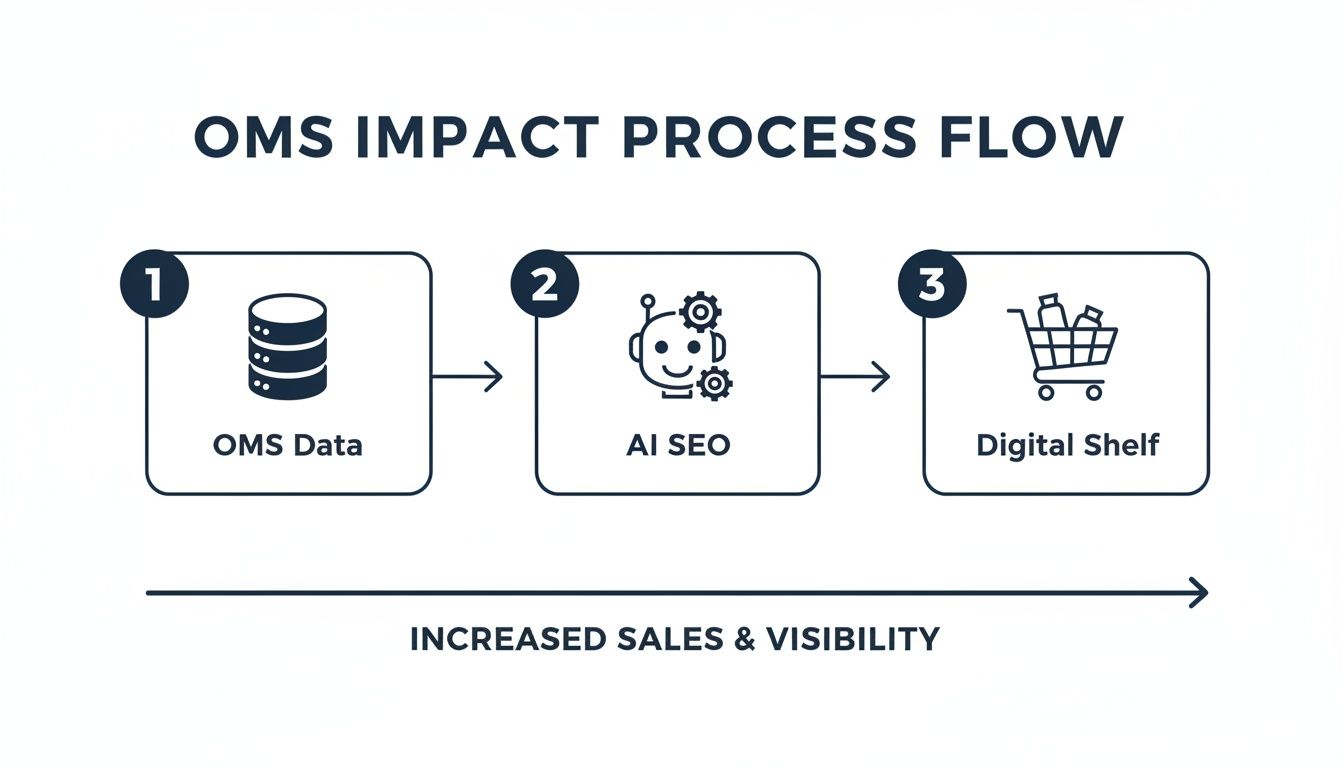
As you can see, solid operational data is the starting point. Without it, any effort to use AI to get more visibility and sales is built on a shaky foundation.
To help narrow down your options, we've put together a checklist of key questions to ask potential OMS providers. This isn't just a feature comparison, it's a way to gauge whether they're truly ready for the demands of modern, AI-driven retail.
OMS Vendor Evaluation Checklist
| Category | Evaluation Question |
|---|---|
| Integration & API | "Can you provide full documentation for your REST API? What are the rate limits?" |
| Scalability | "What is your average order processing time during peak periods for a retailer of our size?" |
| Inventory Management | "How does your system handle real-time inventory synchronisation across all channels?" |
| Fulfilment Logic | "Can we configure custom order routing rules based on stock location, shipping cost, and delivery speed?" |
| AI Readiness | "How does your architecture support exporting clean, structured data for external AI and analytics platforms?" |
| Support & Partnership | "What does your implementation support look like, and who will be our dedicated point of contact post-launch?" |
Think of this table as your guide during vendor demos. Their answers, or lack thereof, will tell you everything you need to know about their ability to be a long-term partner, not just a software supplier.
Navigating the Implementation Journey
Once you've picked a partner, the real work begins. Implementation is where even the best-laid plans can go wrong, but most pitfalls are completely avoidable with a bit of foresight. A successful launch comes down to solid planning, clear communication, and getting your team on board.
Common Implementation Pitfalls to Avoid:
- Inadequate Data Migration: Do not just copy and paste old, messy data into your shiny new system. That’s a recipe for disaster. This is your one chance to clean house, so take the time to scrub and structure your product and customer data before you move it.
- Poor Team Training: Your team needs to know more than just which buttons to click. They need to understand why this change is happening. Connect the dots for them, showing how the new OMS will lead to better AI workflows for ecommerce and make everyone's job easier.
- Lack of Stakeholder Buy-In: Everyone from the warehouse floor to the C-suite needs to be on board. If the people who will be using the system every day aren't invested, the project is doomed to fail.
- Insufficient Testing: Test everything. Then test it again. Run every possible scenario, order creation, inventory updates, returns, cancellations, in a staging environment before you even think about going live.
Getting an OMS implementation right is a massive step towards building the retail tech stack for an agentic future. It does more than just make you better at managing orders, it turns your operational data into a powerful asset for winning in a marketplace that's increasingly driven by AI.
Measuring the True ROI of Your OMS
Figuring out the real value of an order management system means looking beyond simple metrics like how fast you can process an order. For retail leaders today, the true return is measured by its direct impact on your digital shelf performance, customer happiness, and how ready you are for an AI-driven future. It's about connecting back-end efficiency to front-end revenue and brand strength.
A modern OMS is the operational bedrock for advanced strategies like AI SEO and retail content automation. By giving you a single source of truth for inventory, it enables AI-powered workflows that can confidently perform supplier feed enrichment or a duplicate content SEO fix, knowing it's all based on real, sellable stock. Getting this right is absolutely critical for winning in an era of agentic commerce.
Key Performance Indicators for a Modern OMS
To build a compelling business case, you need to focus on metrics that show tangible improvements across the entire customer journey. These KPIs prove how operational excellence translates directly into commercial success and gets your retail teams ready for AI efficiency.
- Reduction in Stock-Outs: Track how often customers see that dreaded "out of stock" message. Every time you prevent this, you're directly protecting a sale and building customer trust, both key signals for AI shopping SEO.
- Improved Order Accuracy Rate: Measure the drop in shipping mistakes, like sending the wrong item or quantity. Higher accuracy means lower return costs and happier, more loyal customers.
- Increased Perfect Order Percentage: This metric is a powerful one. It bundles on-time delivery, damage-free arrival, and order accuracy into a single score, giving you a clear indicator of your overall fulfilment quality.
- Lowered Cost-to-Serve: A smart OMS optimises shipping by routing orders from the most efficient location. This can dramatically cut down freight expenses and delivery times.
A high-performing OMS doesn't just process orders faster, it makes your entire retail operation smarter and more profitable. It turns operational data into a strategic asset that enhances your digital presence and prepares you for human + AI collaboration in SEO.
Linking OMS Performance to Digital Shelf Success
The link between operational efficiency and online visibility is becoming impossible to ignore. We're seeing this shift in the Australian market, while specific OMS data is scarce, the closely related POS market is on track to double to USD 1,258.11 million by 2030. This growth shows just how much integrated systems are changing the retail game.
Right now, Australian retailers are losing a staggering $1.2 billion each year from mismanaged orders. Yet, modern OMS-POS integrations have been shown to lift sales by 24% and slash returns by 15%, demonstrating a clear and compelling ROI.
This operational muscle directly flexes your digital shelf performance. Search engines and AI agents penalise brands that deliver a poor user experience, like promising products that aren't actually available. By ensuring your inventory data is rock-solid, your OMS improves key SEO signals, leading to better rankings, more traffic, and higher conversion rates. This is the foundation of agentic search optimisation, where trust and reliability are everything.
By tracking these advanced ROI indicators, you can clearly articulate the strategic value of your order management system. It shifts the conversation from a cost centre to a growth engine, proving that a well-implemented OMS is an essential investment for any retailer serious about competing in the future of AI-powered commerce. For a deeper dive, explore our guide on understanding the drivers of AI ROI for retailers.
Common Questions About Order Management Systems
Even with a clear plan, retail leaders often have a few lingering questions about putting an order management system to work. Let's tackle some of the most common ones and connect the dots between operational grunt work and digital shelf success.
How Long Does a New OMS Implementation Take?
The timeline really depends on the moving parts in your business, how complex your operations are, how many sales channels you’re juggling, and the size of your product catalogue. For a mid-to-large Australian retailer, you’re typically looking at a three to nine-month project.
This isn’t just a switch-flicking exercise. It involves picking the right vendor, carefully migrating all your data, integrating the OMS deep into your existing tech stack (like your eCommerce platform and ERP), and getting your team properly trained. A phased rollout is almost always the smartest way to go, as it minimises disruption and keeps things running smoothly.
Can an OMS Really Improve Our SEO Performance?
Absolutely. While an OMS isn't a traditional SEO tool, its impact on your digital shelf performance and readiness for AI SEO is massive. Modern search engines and the new AI shopping agents care more about user experience signals than almost anything else.
A solid OMS makes sure your product pages show accurate, real-time inventory. This simple act stops customers from getting frustrated by ordering something that’s out of stock, which in turn improves on-page engagement and lowers bounce rates. More importantly, this clean availability data is exactly what AI platforms need to create trusted, AI-compatible SEO content at scale, a must-have for ranking well in both old-school search and the new world of agentic search.
Think of an OMS as providing the foundational 'availability signal'. Search algorithms and AI agents need this signal to trust your product data. This trust is a powerful, if indirect, ranking factor that influences everything from your visibility to your conversion rates.
What Is the Difference Between an OMS and an ERP?
It's a common point of confusion because they can overlap, but an OMS and an Enterprise Resource Planning (ERP) system have very different day jobs in a retail business.
- An ERP is the big-picture system. It's designed to run the entire company, managing core functions like finance, HR, and manufacturing.
- An OMS is a specialist. It’s laser-focused on one thing: the complete lifecycle of a customer order, from the moment they click "buy" to the final delivery and any returns.
In a modern retail tech stack, the OMS is the expert that handles all the tiny, real-time details of getting orders out the door, and it plugs neatly into the central ERP system.
How Does an OMS Help With Challenging Supplier Data?
An OMS is a game-changer when you're wrestling with inconsistent supplier data. It becomes the central source of truth for inventory, pulling in feeds from all your different suppliers and creating a single, reliable view of stock levels across your entire network.
This is where it partners perfectly with AI-powered content workflows. The OMS provides the clean, real-time availability signal. An enrichment tool like Optidan AI then takes the raw, often duplicated product descriptions from your suppliers and uses that signal as a trigger. It transforms them into unique, brand-aligned, and SEO-optimised content ready for your digital shelf, correcting duplicated supplier content at scale.
Ready to turn your operational data into a strategic advantage? Optidan AI helps large retailers prepare for an AI-led future by transforming product feeds into high-quality, optimised content at scale. Learn how we get you ready for agentic commerce.
