


Product enrichment is the process of taking raw, basic product data from suppliers and transforming it into optimised, high-value content. Think of it as adding layers of detail, crafting unique descriptions, and organising everything into structured attributes.
It is the critical step that turns a generic, often duplicated, supplier feed into high-quality, SEO-ready content that helps you rank higher and convert more shoppers. It’s how you turn a simple product catalogue into your most powerful sales tool and prepare for the future of retail search.
From Nice-to-Have to Business Critical
For Australian retailers, the conversation around product enrichment has completely changed. It is no longer a ‘nice-to-have’, it is a core strategy for survival and growth in a seriously crowded market.
Every day, ecommerce leaders are stuck fixing duplicated supplier content that plagues thousands of SKUs. This is not just a minor headache; it is a problem that directly torpedoes your SEO performance and washes out your brand voice. We are not just talking about a content bottleneck here. It is a massive barrier holding you back from winning on the digital shelf. For a deeper look, check out our guide on why supplier data is holding back retail performance.
The challenge is twofold: you need to create unique, high-quality content at a massive scale, while also getting your catalogue ready for the next wave of AI-driven search.
The True Cost of Neglecting Your Product Data
Let's be blunt: poor product data costs you money. When customers cannot find the details they need, they lose confidence and head elsewhere. Search engines feel the same way, they struggle to understand and rank generic, thin content, which leaves you buried in the search results.
Here’s where it really hurts:
- Supplier Content Duplication: Using the same descriptions as every other retailer is a recipe for disaster. You blend into a sea of sameness, making it impossible to stand out, and you risk SEO penalties for duplicate content. This is why a core part of retail SEO automation is correcting duplicated supplier content.
- Agentic Search Readiness: The future of shopping is unfolding with AI agents like Google’s AI Overviews and Amazon's Rufus. These agentic commerce systems need deeply structured, highly detailed data to even consider recommending your products. Without it, your SKUs are effectively invisible to them, impacting your future digital shelf performance.
- Digital Shelf Performance: Rich, detailed data is the foundation of strong digital shelf performance. It leads to higher rankings, better click-through rates, and, most importantly, more conversions. It is the engine behind effective SKU-level SEO and a key driver of retail efficiency.
AI Automation as the Only Scalable Solution
Let's get real. Manually enriching a catalogue of 10,000+ products is just not going to happen. It is an impossible task for any human team. This is where AI-powered automation steps in and becomes absolutely essential. It is the only practical way for optimising product feeds efficiently and shifting from an old-school manual SEO model to a next-gen, AI-first approach. AI workflow automation for retail is the key to achieving SEO at scale.
For retailers in hyper-competitive spaces like fashion or electronics, this is not just about being more efficient; it is about staying in the game. Think about it: AI image recognition can automatically write optimised alt tags for thousands of product images, a crucial but impossible-to-manage task for fashion SEO optimisation.
This is especially true when you look at high-growth categories. In 2024, Australian online shoppers spent a staggering AU$9.66 billion on electronics, marking a 7.2% increase from the previous year. This boom shows just how vital detailed specs and unique content are in a category where customers do serious research before clicking "buy."
As this trend continues, having enriched, AI-compatible product content is what will separate the market leaders from everyone else. This AI-powered retail transformation highlights the future of work in retail, where human + AI collaboration in SEO becomes the new standard.
Before we move on, let's break down how a modern AI workflow stacks up against the old way of doing things. The difference is night and day, especially when you are dealing with thousands of products.
Manual vs AI-Powered Product Enrichment
| Attribute | Manual Enrichment Process | AI-Powered Enrichment |
|---|---|---|
| Speed | Extremely slow; weeks or months for large catalogues. | Extremely fast; thousands of SKUs processed in hours or days. |
| Scalability | Not scalable. Limited by team size and budget. | Highly scalable. Handles 100,000+ SKUs with ease. |
| Consistency | Inconsistent tone, style, and quality across different writers. | Consistent brand voice, tone, and structure across the entire catalogue. |
| Cost | Very high labour costs, especially for large volumes. | Significantly lower cost-per-product, freeing up human resources. |
| Data Gaps | Prone to human error, missed attributes, and incomplete data. | Automatically identifies and fills data gaps using AI models. |
| SEO Impact | Slow to implement changes, often missing keyword opportunities. | Rapidly deploys optimised content with targeted keywords for immediate impact. |
| Agentic Readiness | Not structured for AI agents; lacks the necessary depth and schema. | Built from the ground up to be machine-readable and ready for AI discovery. |
The takeaway here is pretty clear. While manual effort has its place for a handful of hero products, it completely falls apart at scale. To compete effectively today, an AI-powered approach is not just an advantage, it is a necessity for achieving scalable SEO solutions.
Turning Raw Supplier Data into an SEO Foundation
The path to a winning digital shelf always starts in the messy, chaotic world of supplier data feeds. If you are like most Aussie retailers, you know the drill: a jumble of inconsistent formats, missing attributes, and generic text. This mess is the single biggest bottleneck preventing any serious ecommerce content optimisation. The first, most critical job is to turn this raw material into a structured, SEO-ready asset, the bedrock for any scalable retail content automation.
This is not just about data cleanup; it’s about strategic product data enrichment. You have to pinpoint the data points that actually matter in your retail niche. For a fashion store, that means obsessing over attributes like material, fit, and occasion. For an electronics retailer, it’s about nailing technical specs like battery life, connectivity, and compatibility. Get this foundational work wrong, and you will be dealing with the consequences for months. We have seen it happen time and again, which is why we wrote a guide on fixing the data disconnect between supplier feeds and search performance.
This whole process is about turning a liability into your biggest asset.
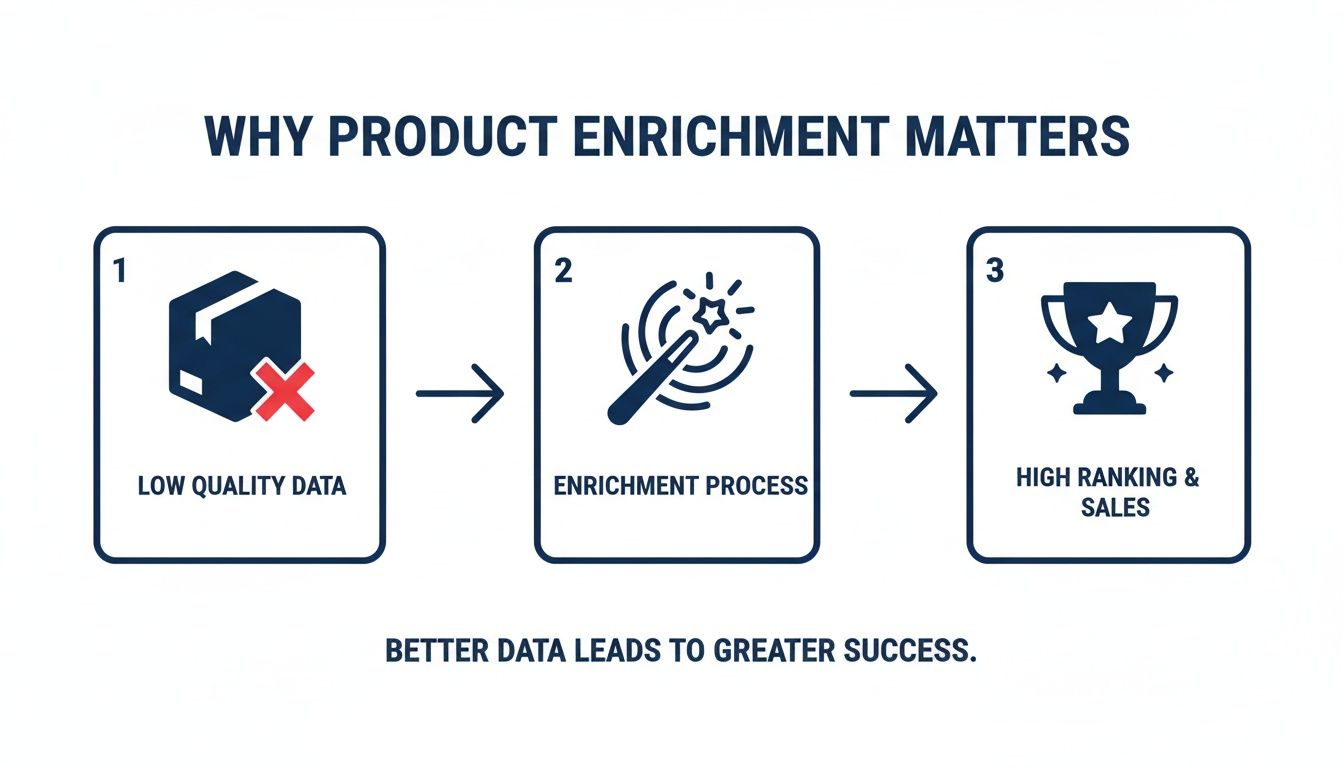
As you can see, enrichment is the bridge that turns raw supplier feeds into optimised product content that directly fuels search visibility and sales.
Building a Search-Centric Product Taxonomy
A solid product taxonomy is the skeleton of your entire product catalogue SEO strategy. Think of it as a classification system that organises your products logically, not just for your internal teams, but for search engines and the AI agents that are increasingly driving discovery. A great taxonomy mirrors exactly how your customers search.
No one just searches for a "sofa." They look for a "3-seater grey fabric sofa" or a "leather Chesterfield." Your taxonomy needs to be granular enough to capture these specific, high-intent searches. This structured approach is absolutely essential for agentic search, as AI shopping agents rely on this deep, organised data to understand and recommend your products.
Building this taxonomy is a crucial step in moving from manual, reactive SEO to a proactive, AI-driven strategy. It provides the logical framework needed for AI workflows to generate consistent, accurate, and highly relevant content at scale.
To really get this done right, a Product Information Management (PIM) system is a game-changer. These systems centralise and standardise all your product info, making the whole enrichment process far more manageable. If you are not familiar with them, this A Guide to Product Information Management Systems is a great place to start.
Standardising Data for AI-Powered Workflows
Once your taxonomy is in place, the next big hurdle is standardisation. Supplier feeds are notoriously all over the place. One might list dimensions as "H x W x D," another might spell them out, and a third might skip them entirely. Automated content workflows need consistency to work their magic, so standardising these attributes is not optional.
This means getting a few things right:
- Normalising Units: Make sure all measurements (cm, mm, kg, etc.) are consistent across your entire catalogue.
- Mapping Attributes: Align all the different supplier terms (e.g., "denim," "jean material") to your one standardised attribute ("Denim").
- Identifying Gaps: Systematically find missing data points that are critical for SEO and the customer experience. AI can even be trained to infer some of this, like using AI image recognition to tag a shirt's colour.
For instance, a furniture retailer might get feeds where wood type is listed as "Oak," "Oak Wood," or "Solid Oak." A simple standardisation rule maps all of these to a single, clean attribute: Material: Oak. This clean data is the fuel for automating thousands of product descriptions and metadata optimisations.
This meticulous prep work might seem like a heavy lift, but it’s the essential groundwork for achieving real retail efficiency. By creating a clean, structured, and comprehensive data foundation, you unleash the full potential of AI-powered content workflows. You turn what was once a messy data problem into a powerful strategic advantage.
Generating Unique Product Content at Scale
With your product data now structured and standardised, the real work begins. This is where we shift from just organising information to actually creating compelling, unique content for your entire catalogue. I’m talking about automating product descriptions and metadata for thousands of pages in a matter of days, not months. It’s the final nail in the coffin for that nagging duplicated supplier content problem.
The old way, relying on manual SEO and copywriting teams, just cannot keep up anymore. It’s a guaranteed retail content bottleneck that slows down growth and leaves your product pages wide open to SEO penalties. The future is about giving your expert team the leverage of AI, letting them focus on high-level strategy while the tech handles the grunt work.
From Standardised Data to Persuasive Copy
The heart of this entire process is developing dynamic content templates. Forget those rigid, fill-in-the-blank formulas you might be picturing. These are sophisticated instruction sets that guide the AI, blending your unique brand voice with proven SEO best practices.
Think of them as a creative brief for an AI copywriter. These templates tell the AI:
- Tone of Voice: Should the copy be playful, professional, or maybe a bit aspirational?
- Key Features to Highlight: What matters most for this product category? For a running shoe, it might be cushioning and support; for a sofa, it is all about the fabric and durability.
- Keyword Integration: How to naturally weave in the primary and long-tail keywords you have already researched.
- Structural Elements: The ground rules for creating snappy headlines, scannable bullet points, and well-structured paragraphs.
This approach ensures every product description is not only unique but also consistently on-brand and optimised for both real customers and the AI shopping agents they’re starting to use. It’s how you achieve true ecommerce content optimisation at a scale that was impossible just a few years ago.
Eradicating Supplier Content Duplication for Good
For years, duplicate content has been the silent killer of retail SEO. When hundreds of online stores use the exact same supplier-provided descriptions, search engines are faced with a sea of identical pages. They do not know who to rank, which often means nobody ranks well.
AI-powered content generation is the definitive duplicate content SEO fix. By taking the structured data for each product, the AI can rewrite and rephrase the information, creating a genuinely unique story for every single SKU in your catalogue.
This is not just about solving a technical SEO issue. It’s about finally carving out a distinct brand identity at the product level. You stop being just another reseller and become a trusted authority. To see exactly how this works, check out our guide on creating content at scale.
This shift is especially crucial as Australian ecommerce continues its rapid growth. By 2025, AI-driven product enrichment is set to redefine the local market, driving the kind of hyper-personalised experiences that build real customer loyalty. With the industry projected to hit $64.9 billion, AI retail efficiency tools are becoming essential for engaging Australia's 17.08 million monthly online shoppers, particularly in massive sectors like electronics (AU$9.66 billion) and fashion (AU$7.7 billion). You can discover more insights about Australia's ecommerce future on Pattern.com to get the full picture.
Automating Image SEO with AI Recognition
Product enrichment goes beyond just text. For retailers in highly visual categories like fashion, furniture, or beauty, image SEO for ecommerce is a massive, and often completely missed, opportunity. Let's be honest, manually writing descriptive alt tags for thousands of product images is an impossible task. But it is absolutely critical for accessibility and search visibility.
This is where AI image recognition and tagging comes in. These systems can analyse your product images at scale and automatically generate descriptive, keyword-rich alt tags.
Here’s what that looks like in practice:
- Fashion SEO Optimisation: An AI can spot a "blue long-sleeve cotton shirt" and generate the alt tag "Model wearing a blue long-sleeve cotton shirt," making it much more discoverable in image searches.
- Furniture Image Tagging SEO: For a couch, the AI can identify key attributes like "grey 3-seater fabric sofa with wooden legs," giving search engines vital context.
- Electronics SEO Optimisation: It can even recognise specific ports, screen sizes, and other visual features on a laptop or monitor.
By automating this part of metadata optimisation at scale, you turn every single image on your site into a hard-working SEO asset. You will drive more relevant traffic and get your site ready for a future where visual and agentic search play an even bigger role.
Integrating Human Expertise into AI Workflows
Automation gives you the speed and scale you need to compete, but it’s human expertise that ensures the final output is polished, on-brand, and actually drives sales. Bringing a human-in-the-loop (HITL) quality assurance (QA) process into your AI workflow automation for retail is not about slowing things down, it is about making your automation smarter.
This approach flips the script on your team's role. They are no longer manual content creators but strategic editors and brand guardians. The AI does the heavy lifting, flagging potential issues like factual slip-ups, awkward phrasing, or a tone that is just a bit off. This lets your experts focus their energy where it matters most, instead of drowning in thousands of perfectly fine product descriptions.

Establishing a Scalable QA Framework
An effective QA process does not create bottlenecks; it builds confidence. By setting clear standards and review protocols, you can trust your automated workflows while still maintaining control. The goal is not to check every single SKU, it is to strategically sample the AI's output.
Here’s what a practical framework looks like:
- Tiered Review Systems: High-value or hero products? They get a full manual review. Lower-priority items can be spot-checked.
- Confidence Scoring: The AI can be set up to assign a confidence score to its own output, automatically flagging descriptions that fall below a certain threshold for a human to look at.
- Feedback Loops: Every edit your team makes should be fed back into the AI model. This is crucial for refining its understanding of your brand voice and style guide over time.
This system ensures your human + AI collaboration is both efficient and impactful. For a global audience, it’s also key to think about how AI translation is balancing accuracy and style in AI translation so your enriched content feels authentic everywhere.
This is not about micromanaging an AI. It is about empowering your team with tools that amplify their expertise, allowing them to oversee a scalable content solution that would be impossible to manage manually.
The Role of Human Insight in AI-Powered Retail
Your team knows things an AI cannot. They understand the subtle nuances of your customer, the competitive landscape, and the emotional triggers that actually lead to a purchase. That expertise is vital for turning AI-generated content into something that truly connects with shoppers.
For example, an AI might generate a technically perfect description for a new sofa. But a human expert knows to add a line about how its compact size makes it perfect for apartment living, a key selling point for a huge customer segment. This is where human-led AI content QA turns good content into great content. Our guide on how to review writing effectively offers some practical tips for building this skill in your team.
This collaborative approach is exactly what you need to prepare for an agentic commerce future. AI agents in ecommerce will rely on content that is not just factually correct but also rich with context and genuinely persuasive. By weaving human expertise into your AI workflows, you ensure every piece of content meets the highest standards for your brand, your customers, and the future of retail search.
Deploying Enriched Content and Measuring Your ROI
Getting thousands of unique, optimised product pages generated is a huge win. But let’s be honest, the real value is not unlocked until that content goes live and you can actually prove it’s working. The final, critical steps are all about deployment and measurement, turning all that strategic effort into tangible business results.
Get Your Content Live, Fast
Efficient publishing is everything. Modern retail content platforms are not just for writing; they plug directly into major ecommerce systems like Shopify, BigCommerce, and Magento (Adobe Commerce).
This means you can push enriched descriptions, titles, and metadata to tens of thousands of SKUs automatically, without any manual copy-pasting. That seamless integration removes the final retail content bottleneck, making sure your speed to market is just as fast as your content creation.
Once your enriched content is live, your focus has to shift immediately to measurement. You need a data-driven approach to show the clear return on investment (ROI) from your AI SEO strategy. It’s time to move beyond vanity metrics and track the KPIs that tie your content directly to revenue. This is how you prove product enrichment is a powerful profit centre, not just another cost.
Setting Up Your Measurement Framework
To really understand the impact, you need a clear "before and after" picture. Benchmarking your performance before you deploy the new content gives you the baseline you need to quantify the uplift from all your product data enrichment efforts.
Your measurement framework should zero in on a few core areas of your digital shelf performance. These metrics tell the full story of how improved content is changing customer behaviour, from the moment they discover you all the way through to the final purchase. The goal is to connect the dots between content quality and commercial outcomes.
Start by tracking these essential KPIs:
- Organic Search Rankings: Keep an eye on the average position for your target keywords, both at the category and individual SKU level. Are your products climbing the search results for high-intent queries?
- Organic Click-Through Rate (CTR): A jump in CTR is often the first sign that your new titles and meta descriptions are grabbing searchers' attention and feel more relevant.
- Conversion Rate: This is the ultimate test. Does the richer, more persuasive on-page content convince a higher percentage of visitors to actually buy?
- Page-Level Engagement: Look at metrics like bounce rate and time on page. Good content should hold a visitor's attention longer and encourage them to explore more of your site.
Capturing this data is not just for reports; it’s about building a solid business case. When you can show that a 15% improvement in content quality led to a 5% increase in conversions, you have demonstrated a clear and powerful ROI that justifies further investment.
Tools and Workflows for Tracking ROI
Effective measurement requires the right tools and a disciplined process. Pulling in data from different sources is crucial for getting a complete view of your performance. Knowing how to connect those data points is what separates a good workflow from a great one. To see what this looks like in practice, check out our insights on how the right workflow is the real driver of AI ROI for retailers.
Here’s a quick look at the essential metrics you should be tracking, what they tell you, and the tools you can use to measure them.
Key Performance Indicators for Product Enrichment
| Metric | What It Measures | Example Tool |
|---|---|---|
| Keyword Rankings | Your store's visibility in search results for specific product and category terms. | Ahrefs, Semrush |
| Organic Traffic | The number of visitors arriving at your product pages from search engines. | Google Analytics 4 |
| Conversion Rate | The percentage of visitors who make a purchase after landing on a product page. | Google Analytics 4, Shopify Analytics |
| Return Rate | The percentage of products returned, indicating if descriptions set accurate expectations. | Your Ecommerce Platform |
| Customer Reviews | Qualitative feedback on product satisfaction and the accuracy of your descriptions. | Yotpo, Trustpilot |
By consistently monitoring these KPIs, you create a powerful feedback loop. The data gives you clear insights for ongoing optimisation, allowing you to tweak your content templates and AI workflows over time.
This data-first approach ensures your product enrichment strategy does not just give you an initial boost but becomes a sustainable engine for long-term growth.
Getting Your Store Ready for Agentic Commerce
The way your customers find and buy products is undergoing a fundamental shift. Your product enrichment strategy is no longer just about tweaking things for today's search engines; it’s about getting your catalogue ready for the inevitable rise of Agentic SEO. This is the next frontier of retail search, and it’s being driven by AI shopping assistants like Google's AI Overviews and Amazon's Rufus.
Think of these AI agents as the new gatekeepers of product discovery. They do not just skim for keywords. Instead, they dive deep into highly structured product data to make direct, confident recommendations to shoppers. All that detailed, attribute-rich, and unique content you’re creating through product enrichment? That’s the fuel they need. Without it, your products are at risk of becoming invisible in this new agentic shopping future.
Moving from Traditional SEO to AI-Ready Content
This all calls for a new way of thinking. It is time to move beyond old-school SEO tactics and start creating genuinely AI-compatible SEO content. Your product pages need to be structured not just for a human to read, but for a machine to understand. An AI agent needs to instantly grasp a product's material, its dimensions, what it’s compatible with, and who it’s for. Only then will it recommend your product over a competitor's.
This is exactly where a human-plus-AI approach gives you a massive strategic edge. You use AI to get the scale you need for your SEO efforts, while your team provides that final, critical layer of brand voice and quality assurance. The result is a catalogue that performs brilliantly in both worlds.
This is not just about making your workflow a bit more efficient. It is the core of how you future-proof your brand. It ensures your products are not only found by customers but are actively chosen and recommended by the AI agents that will soon guide their every purchase.
Taking a proactive approach to agentic search optimisation now is what will keep your brand competitive and visible, securing your spot on the digital shelf of tomorrow.
Got Questions? We've Got Answers
As more retailers start exploring retail content automation, a few key questions always pop up. Let's tackle them head-on, so you can see how this all works in practice and what it means for your business.
How Does Product Enrichment Solve Duplicated Supplier Content?
This is one of the biggest wins. Product enrichment takes the generic, copy-pasted text from your suppliers and completely transforms it.
Instead of publishing the same description that hundreds of other retailers are using, our AI-powered workflow ingests the basic product data, such as the SKU, title, and specs, and generates entirely new, unique content. We are talking brand-aligned descriptions, SEO-friendly titles, and sharp meta tags for every single product in your catalogue. This process effectively kills the supplier content duplication problem, helping you avoid SEO penalties and start ranking for a much wider array of keywords.
What Is Agentic SEO and Why Is It Important?
Think of Agentic SEO as optimising your product content for AI shopping assistants, not just for people browsing Google.
AI agents, like the ones powering Google's AI Overviews, need highly structured, detailed, and accurate data to make product recommendations. They do not just "read" your page; they analyse the underlying data. By enriching your products with a full suite of attributes and unique descriptions, you are essentially feeding these AI systems the exact information they need to understand and favour your products. Getting this right is becoming critical for future retail search visibility and sales.
Can AI Truly Handle Our Brand Voice at Scale?
Yes, absolutely, as long as it’s set up correctly. This is not about hitting a button and getting generic, robotic text. The real magic happens when we create detailed style guides and dynamic content templates that teach the AI your specific brand voice.
We define the tone, the personality, and even the words to avoid.
A human-led QA process then puts the finishing touches on the output, ensuring every piece of AI-generated content is a perfect match for your brand. This human + AI collaboration in SEO is what allows you to maintain brand consistency across thousands of products, something that’s just not possible to do manually.
Ready to leave manual SEO behind and build a scalable, AI-powered content engine? Optidan AI gives you the tools to transform your product catalogue, crush duplicate content, and get your store ready for the future of agentic commerce. See how we can help at https://optidan.com.
