

For Australian retail leaders, product page SEO is the core engine driving your digital shelf performance and revenue. It’s about optimising every last detail of a product's online footprint, from titles and descriptions to images and technical data, to make sure it ranks high in search results and is ready for the future of AI-powered shopping.
Honestly, it’s the most critical lever you can pull in a market where organic search is still king.
Why Your Product Pages Are Your Most Valuable Asset
In the hyper-competitive Australian eCommerce space, your product pages are not just digital catalogues anymore. They're your primary sales team, working 24/7. For retail leaders and eCommerce managers, mastering product page SEO is not some side project, it’s a strategic imperative. The simple truth is that most of your customers start their buying journey on a search engine, not your homepage.
The numbers don't lie. Organic search drives an incredible 53.3% of all traffic to Australian eCommerce sites, making it the single biggest channel for finding new customers. This stat alone shows how non-paid results blow paid ads and social media out of the water, making your product pages the ultimate traffic magnet.
The Shift from Manual Effort to AI-Powered Scale
Not long ago, optimising product pages was a painfully manual, time-sucking process. It created massive content bottlenecks. For any business with thousands of SKUs, the thought of writing unique, compelling content for every single one was just impossible. This usually led to lazy reliance on generic, duplicated supplier content, a surefire way to kill your search rankings and sound like everyone else.
That old model is completely broken. The future of work in retail demands a smarter, more efficient approach built on automation. This is where AI SEO and retail content automation change the game.
By moving from manual SEO to an AI-powered content workflow, retailers can finally kill off content duplication, enrich basic supplier feeds, and optimise tens of thousands of pages in days, not years. This is not just about moving faster, it's about gaining a serious competitive edge with SEO that can actually scale.
To better understand this shift, let's compare the old way with the new.
Manual SEO vs AI-Powered Product Page Optimisation
The move from traditional, labour-intensive SEO to modern, AI-driven workflows is a strategic game-changer. It is not just about speed, it is about unlocking scalability and performance that was previously out of reach for retailers with large catalogues.
| Factor | Traditional Manual SEO | AI-Powered SEO Workflow |
|---|---|---|
| Speed & Scale | Incredibly slow; a few hundred pages can take months. Unfeasible for large catalogues. | Extremely fast; thousands of pages can be optimised in days, not years. |
| Content Quality | Prone to human error, inconsistencies, and burnout. Often relies on generic templates. | Consistent, high-quality, and on-brand content generated at scale with human oversight. |
| Cost Efficiency | High labour costs tied to manual writing and editing. Poor ROI for large inventories. | Dramatically lower cost-per-page. Frees up human teams for strategic tasks. |
| Data Enrichment | Limited by manual data entry. Often misses key attributes and structured data. | Automatically enriches basic supplier feeds with detailed, structured, and SEO-friendly data. |
| Future-Readiness | Not equipped for the demands of agentic search or AI shopping agents. | Built to prepare product data for AI discovery platforms like Google AI Overviews and Rufus. |
This table highlights why the old approach is no longer sustainable. AI-powered workflows are not just an upgrade, they represent a fundamental change in how high-performing retail content is created and managed.
Preparing for the Future of Agentic Commerce
And the evolution does not stop there. The rise of agentic search optimisation means you need to get your product data ready for AI shopping agents like Google's AI Overviews and Amazon's Rufus. These AI assistants need structured, detailed, and unique product information to make recommendations. Pages with thin or duplicated supplier copy will simply be ignored.
This new approach makes a real difference in a few key areas:
- Product Data Enrichment: Turning basic supplier feeds into detailed, structured, and SEO-friendly content that AI agents can understand.
- Unique Content Creation: Using AI to rewrite duplicated descriptions at scale, carving out a distinct brand voice that stands out.
- Image Recognition & Tagging: Automatically generating descriptive alt tags for entire catalogues, a massive win for fashion and furniture SEO.
Ultimately, investing in product page SEO is about more than just rankings, it’s about future-proofing your business. To get the most from your online store, learning how to customize your WooCommerce product page for better content and design is a great place to start.
By embracing an AI-powered approach to retail, you can massively improve your digital shelf performance and build a foundation for real growth in the era of AI-driven commerce.
Building a Keyword Foundation for Every Product
Good keyword research for e-commerce is about way more than just picking one high-volume term and calling it a day. For retailers, the real goal is to build a detailed keyword strategy for every single product in your catalogue. This is how you capture shoppers at every stage of their journey, from vague ideas to purchase-ready searches. It's the absolute bedrock of solid product page SEO.
This is not about guesswork. It’s a data-driven process of mapping primary, secondary, and long-tail keywords to each product. You need to speak the exact language your customers are using, which is increasingly the same language AI agents use to search on their behalf.
Take a fashion SEO optimisation strategy for a "women's black linen blazer." A layered approach looks something like this:
- Primary Keyword: "black linen blazer" (this is your broad, high-volume term).
- Secondary Keywords: "women's tailored linen jacket" or "lightweight black blazer Australia" (these are more specific and show clearer intent).
- Long-Tail Keywords: "black linen blazer for office wear" or "best breathable blazer for summer" (these are super specific and signal someone is ready to buy).
This granular approach makes sure your product shows up whether someone is just browsing or has their credit card in hand.
From Manual Guesswork to AI-Powered Analysis
In the past, mapping keywords this deeply was a massive bottleneck. Can you imagine manually brainstorming hundreds of long-tail variations for a catalogue with 10,000+ products? It just wasn't possible.
This is where AI-driven content workflows give you a serious edge. Modern AI SEO services can sift through competitor product data at scale, spotting keyword gaps and opportunities your team would almost certainly miss. It’s not about replacing human strategy, it’s about arming it with the data to make smarter decisions, faster. This is the key to effective SKU-level SEO.
The infographic below really nails the shift from slow, manual SEO to a much more efficient, AI-powered model.
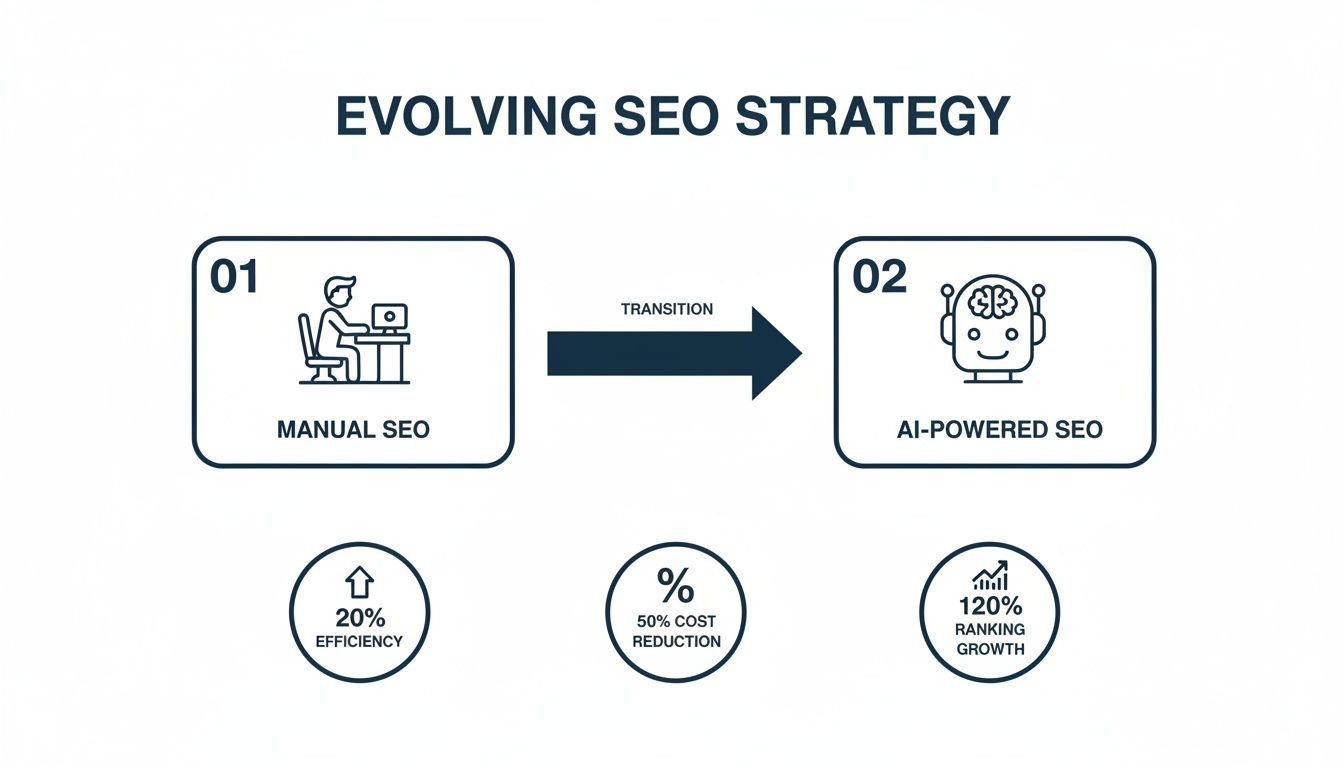
As you can see, AI-powered SEO doesn't just speed things up, it delivers better data insights, allowing retailers to scale their optimisation efforts in ways that were impossible before.
Preparing Keywords for Agentic Search
The future of retail search is conversational. AI shopping assistants like Google's AI Overviews and Amazon's Rufus don't just match keywords, they find answers to complex questions. Your keyword strategy needs to evolve for this new reality, which is the whole point of agentic search optimisation.
This means focusing on keywords that answer specific questions and sound like natural human language. If you're an electronics retailer, targeting "4K smart TV" is not enough anymore. An agentic-ready strategy would also include phrases like "best 65-inch TV for bright rooms" or "smart TV with Dolby Atmos and HDMI 2.1." These are the exact kinds of queries AI agents will use to find the perfect product for a shopper. If this is new territory, it's worth taking time to learn more about keyword research and its core principles.
A strong keyword foundation does more than just shape your product titles. It needs to inform every single element on the page, from the meta description and image alt tags right down to the technical schema markup. This creates a cohesive, highly relevant signal for both old-school search engines and new AI agents.
Nailing this foundation is the critical first step. A comprehensive guide on how to conduct keyword research for SEO can be a fantastic resource for getting your team up to speed. By embracing a scalable, AI-driven approach to your keyword strategy and product data, you can finally move past the old manual limitations and build a truly competitive digital shelf.
Turning Supplier Feeds Into Unique Selling Content

For most online retailers, the biggest thing holding back their SEO performance is a sea of generic, duplicated supplier descriptions. It’s a classic problem. If you’re managing thousands of SKUs, relying on the manufacturer’s content seems like the only option, but it’s a direct threat to your digital shelf performance.
When your product pages feature the exact same text as dozens of your competitors, search engines see it as low-value and repetitive. This directly tanks your ability to rank.
The old way of fixing this, manually rewriting every single description, is just too slow and expensive to be a real solution. But that does not mean you have to live with duplicate content. The real opportunity is moving from manual grunt work to smart, AI-powered content workflows that can transform basic supplier feeds into unique, optimised content at scale.
This is where strategic product data enrichment gives you a serious competitive edge. It’s all about taking that thin, generic supplier data and layering it with unique details, benefits, and keywords that actually connect with your customers and satisfy search algorithms. It’s how you build a distinct brand voice.
Crafting On-Page Elements That Convert
To really tackle the supplier content duplication problem, you need to nail the core on-page elements. Think of these as the building blocks of a product page that performs, structured for both human shoppers and the AI agents that are reshaping retail search.
- Compelling Product Titles: Don't just stop at the product name. A properly optimised title should include the primary keyword, the brand, and a key attribute. Something like, "Breville Barista Express Espresso Machine – Stainless Steel."
- Engaging Meta Descriptions: You get 160 characters to make your pitch in the search results. Make it unique and persuasive. Highlight a key benefit that makes someone want to click on your listing, not someone else’s.
- Benefit-Driven Descriptions: Stop listing features and start explaining how they help the customer. Instead of just saying "500-thread count cotton," frame it as "Experience hotel-quality luxury with our breathable, 500-thread count cotton sheets for a cooler night's sleep."
This is how you shift from simply listing a product to actively selling it. The goal is content that doesn’t just rank but also persuades.
From Logistical Headache to SEO Advantage
Automating this is the only way to unlock true scale. Modern AI SEO platforms can ingest your entire product feed, analyse the existing supplier content, and generate thousands of unique, on-brand descriptions in just a few days. This is not about replacing your team, it's about giving them retail efficiency tools to finally overcome the content creation bottleneck.
The core principle here is human-led AI content QA. While the heavy lifting of creation is automated, the final output is always checked to ensure it perfectly aligns with your brand’s tone and quality standards. This human + AI collaboration lets you achieve a level of consistency that was impossible before.
This approach is the answer to ecommerce content quality assurance for large catalogues. For retailers in visual sectors like fashion or home decor, this can even be combined with AI image recognition SEO to automatically tag product attributes, enriching your data even further.
Investing in your content like this pays off, big time. In fact, research shows that Australian eCommerce retailers with consistent, high-quality product page content see an incredible 326% boost in traffic.
By systematically turning generic data into rich, unique content, you’re doing more than just improving your product page SEO. You’re building a better customer experience, future-proofing your catalogue for the rise of agentic shopping, and creating a powerful engine for organic growth. If your team is stuck on this, exploring a specialised service for product feed enrichment can provide the framework to turn this challenge into a major win.
Winning with Visuals and Automated Metadata

In retail, customers buy with their eyes first. This makes your product imagery one of the most powerful, yet overlooked, assets for product page SEO. For most retailers, image optimisation is a slow, manual chore that’s often ignored, leaving huge performance gains on the table.
Beyond just looking good, every image on your site needs to be optimised for search engines and, increasingly, for AI agents. This is about more than just basic compression, it's about making your visuals discoverable through data.
For retailers in fashion, furniture, or electronics, the details in an image are what sell the product. Trying to manually describe these visual nuances across thousands of SKUs just is not a scalable SEO solution.
AI Image Recognition for Scalable SEO
This is where AI image recognition SEO creates a massive competitive advantage. Instead of a team manually writing alt tags, AI workflows can analyse your entire image catalogue, identifying and tagging key attributes automatically.
Think about a typical fashion SEO optimisation scenario. An AI can instantly recognise and tag attributes like:
- Garment Type: "midi dress," "blazer," "straight-leg jeans"
- Colour & Pattern: "navy blue," "pinstripe," "floral print"
- Material & Fabric: "100% linen," "cashmere blend," "satin finish"
- Style & Features: "v-neck," "puff sleeves," "single-breasted"
This automated product image tagging generates highly descriptive, keyword-rich alt tags for every single image. Not only does this improve accessibility, but it also massively boosts your visibility in image search, a critical channel for visual-led retail.
A furniture retailer could go from a generic alt tag like "brown sofa" to a fully optimised one like "mid-century modern 3-seater brown leather sofa with tapered wooden legs." The second version is exactly what a high-intent customer, or an AI shopping agent, is actually looking for.
Optimising Visual Assets Beyond Alt Tags
While alt tags are crucial, a complete visual SEO strategy involves several other technical elements that directly hit your page speed and rankings. We all know slow-loading pages are a conversion killer, especially on mobile.
Here’s a practical checklist for your visual assets:
- Descriptive File Names: Ditch generic names like
IMG_8432.jpg. Change them to something keyword-rich and descriptive, likewomens-black-linen-blazer-front.jpg. This gives search engines valuable context before they even process the image. - Next-Gen Formats: Use modern image formats like WebP or AVIF. They offer far better compression and quality compared to old-school JPEGs, which means faster load times without sacrificing visual appeal.
- Lossless Compression: This is non-negotiable. Use tools that compress your images to reduce file size while retaining quality. It's a foundational step for a fast, mobile-friendly user experience.
Getting these technicals right ensures your high-quality visuals actually enhance your product page SEO instead of dragging it down with slow performance.
Metadata Optimisation at Scale
Just as images need attention, so does the metadata for every single product page. Templated, repetitive meta titles and descriptions are a common curse for large retailers, leading to poor click-through rates and duplicate content signals.
Automated content workflows can fix this by generating unique, relevant, and keyword-aligned metadata for your entire product catalogue. These systems analyse product attributes from your feed to create compelling titles and descriptions that speak directly to what a user is searching for. To really get this right, you have to understand the connection between metadata and customer intent, as it's the key to writing copy that actually converts.
This metadata optimisation at scale helps you break free from the ineffective one-size-fits-all approach. By combining AI-driven visual tagging with automated metadata creation, you can ensure every single product page becomes a high-performing asset, ready to win on the digital shelf.
Mastering Technical SEO for Your Digital Shelf
Let's talk about the invisible architecture holding up your entire digital shelf: technical SEO. While your compelling descriptions and stunning images are what grab a shopper’s attention, it’s the tech framework underneath that ensures search engines can even find, understand, and rank your product pages in the first place.
Think of it like the foundation of a house. You can have the most beautiful interior design in the world, but if the foundation is cracked, everything built on top is at risk. For retailers, a weak technical setup can make even the best content and keyword strategies completely ineffective.
Using Product Schema to Get Seen
One of the most powerful tools in your technical SEO arsenal is Product Schema. This is basically a cheat sheet for search engines, a specific type of structured data that feeds them detailed product information in a language they can instantly process.
When you implement it correctly, you unlock those eye-catching rich snippets in search results, the ones with star ratings, pricing, and stock availability right there on the page.
But it’s not just about flashy search results anymore. This is now fundamental for the future of retail search. AI shopping agents, like Google's AI Overviews and Amazon's Rufus, depend on this structured data to pull crucial details about your products. If you don't have it, your products are essentially invisible to these powerful new discovery tools.
An effective Product Schema implementation acts as a detailed digital spec sheet for your products. It tells AI agents everything they need to know, from SKU and brand to price and review scores, making your catalogue ready for the agentic commerce future.
So, where do you start? Focus on the properties that deliver the most impact.
Essential Product Schema Properties for Retailers
This table breaks down the most critical Schema.org properties that every e-commerce manager should have dialled in on their product pages. Getting these right is non-negotiable for visibility.
| Schema Property | What It Does | SEO Impact |
|---|---|---|
name |
The official name of your product. | Core identifier for search engines and crucial for matching user queries. |
image |
A URL pointing to your main product image. | Enables your product to appear in visual search and rich snippets. |
description |
A concise summary of the product. | Provides context for search engines and can be used in search results. |
sku |
Your unique stock-keeping unit. | A critical identifier, especially for products with many variations. |
brand |
The brand or manufacturer of the product. | Helps with brand-specific searches and builds trust with consumers. |
offers |
Contains price, currency, and availability. | Powers the price and stock information seen directly in search results. |
aggregateRating |
A summary of customer reviews and ratings. | Generates the star ratings that dramatically boost click-through rates. |
Making sure these fields are filled out accurately is a massive step towards future-proofing your product listings for AI-driven search.
Solving Duplication with Canonical Tags
Here's a technical headache every retailer knows well: duplicate content from product variants. A single t-shirt available in ten colours and five sizes can spawn dozens of unique URLs, all with nearly identical content. This is a nightmare for SEO, as it confuses search engines and dilutes your ranking power across all those pages.
The fix is the canonical tag.
It’s just a small piece of code, but it’s incredibly important. It tells search engines which version of a page is the "master" copy that should be indexed. For that t-shirt, all the colour and size variations would point their canonical tag back to the main product page. This simple move consolidates all your ranking signals into one URL, fixing the supplier content duplication issue at a technical level.
This is a non-negotiable part of product page SEO for any retailer with a varied catalogue, from fashion to electronics.
Nail Your Mobile Speed (or Lose Sales)
Finally, never forget page speed. In an era where most online shopping happens on a mobile phone, a slow-loading product page is a guaranteed sale-killer. The data doesn't lie: a site that loads in one second can have a conversion rate five times higher than one that takes ten seconds.
Optimising your page speed means doing the basics right: compressing images, streamlining code, and ensuring your site has a responsive design that works flawlessly on any screen.
Regular audits are your best friend here. They help you spot and fix performance bottlenecks before they cost you customers and cash. If you’re not sure where to start, it helps to understand what’s involved in a comprehensive technical site audit for your eCommerce business.
Get these technical elements right, and you’re not just building a website, you're building a resilient, high-performing foundation that ensures your products are primed for success in an increasingly automated search world.
Got Questions About Product Page SEO? We've Got Answers.
Diving into the nitty-gritty of product page SEO can throw up a few questions, especially for Australian retail leaders managing huge product catalogues. Here are some straight answers to the queries we hear most often, cutting through the noise to focus on AI-driven strategy, scale, and getting that all-important competitive edge.
How Quickly Can We See Results from AI-Powered SEO?
While old-school SEO can feel like a waiting game, AI-powered content workflows get things moving much, much faster. The real difference is the speed of execution. Think about it: when you can rewrite and optimise 10,000+ product pages in a couple of days, search engines get a massive signal that your site's quality and relevance just got a serious upgrade.
You’ll often see a positive shift in keyword rankings and organic traffic within a few weeks of rolling out the new content. This speed is the core advantage of SEO at scale for retailers, it lets you jump on market trends and new product drops faster than you ever could manually.
Is It Risky to Use AI to Write Product Descriptions?
It's a fair question, but the risk is not in the AI itself, it's in using generic, unguided AI tools. A smart AI SEO strategy is not about just hitting 'generate' and hoping for the best. It’s about creating a human + AI collaboration in SEO, where AI does the heavy lifting based on your specific brand guidelines, keyword strategy, and tone of voice.
The best approach is a human-led AI content QA process. AI generates the unique descriptions first, instantly fixing the supplier content duplication problem. Then, your internal team or a specialist gives it a final polish, ensuring it hits your quality standards. You get the speed of automation with the nuance and expertise of a human touch.
How Does This Prepare Us for Agentic Search?
Agentic search is the next frontier, powered by AI assistants like Google's AI Overviews and Amazon's Rufus. These agents don't just look for keywords, they analyse structured data to find the best possible answer for a user. An AI-driven approach to product page SEO is not just helpful, it's essential for agentic search optimisation.
Here’s exactly how it gets you ready:
- Product Data Enrichment: AI workflows transform basic supplier feeds into richly detailed content, giving AI agents the specific attributes (like colour, material, or dimensions) they need to make a recommendation.
- Structured Data Implementation: By automating the creation of Product Schema, every page speaks the language of machines, clearly communicating its key details.
- Unique Content: Getting rid of duplicated content signals to AI agents that your pages offer unique value, making them a far more attractive source to pull from.
Can We Apply This to Our Product Images Too?
Absolutely. Visuals are a massive part of the customer journey, and AI image recognition SEO is a total game-changer, especially for industries like fashion, furniture, and electronics. Let's be honest, writing alt tags manually is a huge bottleneck that AI can completely eliminate.
An automated workflow can scan your entire image library and generate descriptive, keyword-rich alt tags for every single photo. This doesn't just improve accessibility, it gives your image search visibility a massive boost. For a fashion SEO optimisation strategy, this means every dress, shoe, and accessory can be automatically tagged with its style, fabric, and cut, creating thousands of new ways for customers to find you. This is a fundamental part of achieving superior digital shelf performance.
Ready to swap manual bottlenecks for scalable, AI-powered growth? Optidan AI turns your product feeds into high-performing, SEO-optimised content at a scale that was once impossible. See how we help retailers dominate the digital shelf by visiting https://optidan.com.
