


To win at Shopify SEO in 2025, Australian retailers need to stop thinking about slow, manual tweaks and start embracing AI-powered automation. The strategy that actually gets results today is built on a three-part system designed for scale and the future of search: AI content workflows, product data enrichment, and getting ready for agentic search.
This guide breaks down that exact playbook.
The New Playbook For Retail Search Dominance
The days of manually optimising metadata or writing product descriptions one by one are over. For Australian retailers on Shopify, dominating the digital shelf in 2025 is all about automation, data, and a serious focus on AI. Trying to keep up with a catalogue of thousands of SKUs using old methods creates massive content bottlenecks, slowing down product launches and killing your ability to react to the market.
This new playbook is about achieving SEO at scale. It’s a shift from being reactive to proactive, letting technology do the heavy lifting so your retail teams can focus on big-picture strategy and quality control. At its core, this means fundamentally changing how you manage content and data across your entire product catalogue, a clear move from manual SEO to AI SEO.
This diagram shows the three pillars that hold up a successful Shopify SEO strategy for 2025: AI Workflows, Data Enrichment, and Agentic Search readiness.
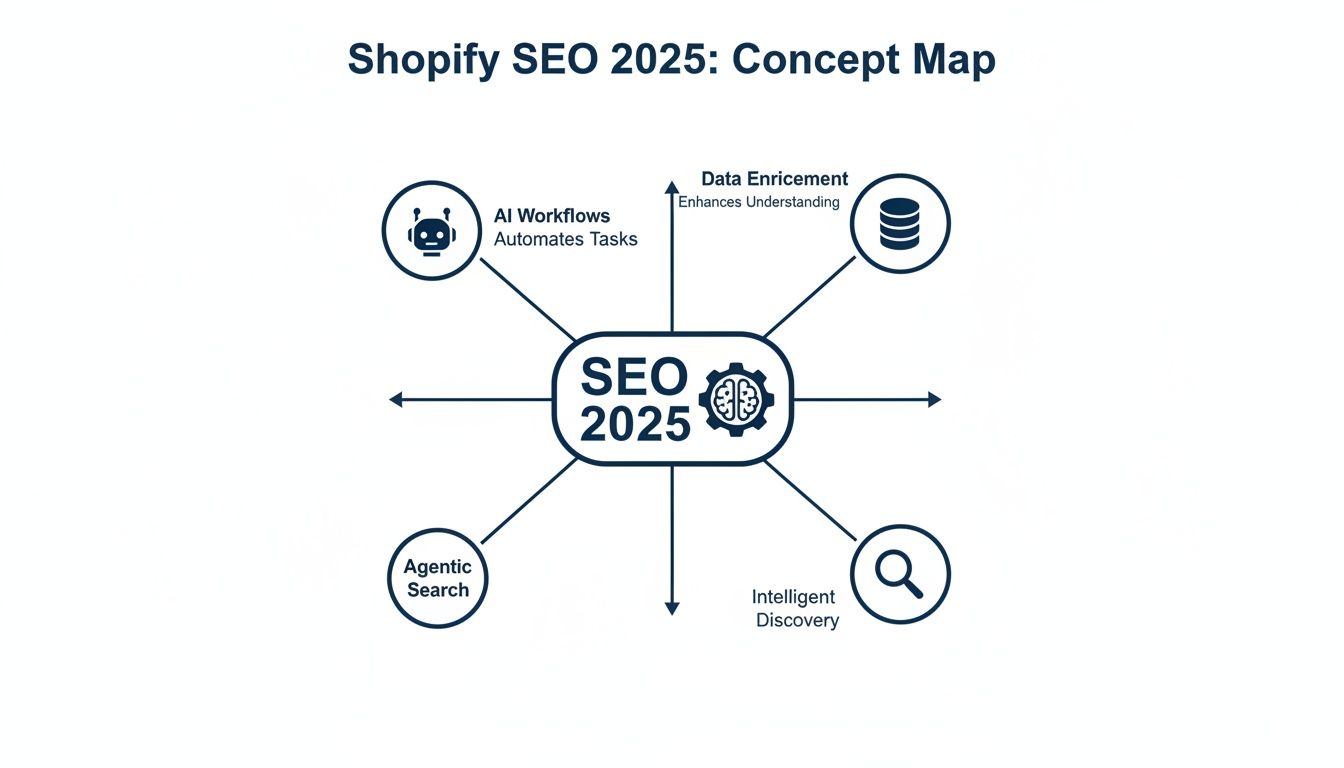
As you can see, these three pieces are completely interconnected. Together, they form a powerful system that delivers scalable SEO solutions and puts you miles ahead on the digital shelf.
Why This Shift Is Mission-Critical For Australian Retailers
The need to make this change is urgent, especially when you look at Shopify’s huge footprint in Australia. As of 2025, Shopify powers around 150,000 websites in the country. That number alone tells you how fierce the competition for online visibility has become.
With projections showing there will be 23.14 million Australian Shopify users by 2029, the cost of ignoring SEO is massive. We've seen retailers who get this right boost their conversion rates by up to 250%, a clear sign of the return on investment in retail efficiency tools.
The future of work in retail isn't about replacing people with AI, it's about amplifying human expertise with AI efficiency. This Human + AI collaboration in SEO lets teams smash through content bottlenecks and focus on the strategic growth that actually drives the business forward.
For any retailer serious about thriving, mastering the principles of AI Search Optimization in 2025 is non-negotiable. This isn't just about ranking on Google today. It's about preparing your store for the next wave of commerce, where AI agents in ecommerce discover and recommend products for shoppers automatically, defining the future of retail search.
Transitioning To AI-Powered Content Workflows
For years, retail SEO has been stuck in a painful, labour-intensive loop. Teams burn countless hours manually writing product descriptions, crafting metadata, and tweaking individual pages. This old-school approach is the single biggest bottleneck in retail, delaying product launches and killing any chance of reacting quickly to market trends.
The traditional model just can't keep up anymore. Imagine a new fashion season drops with 5,000 new SKUs. The old way means months of writing, reviewing, and uploading. By the time you're done, the trend might have already peaked. This slow, manual grind is a massive barrier to growth and the polar opposite of the agility modern ecommerce demands.
This is where AI-powered content workflows completely change the game. Instead of treating content as a series of one-off manual jobs, this new approach treats it as a scalable, automated system. It’s the critical leap from manual SEO to AI SEO, driven by AI workflow automation for retail.
Overcoming Common Retail Content Bottlenecks
The biggest hurdle for any growing retailer is scale. Manual content creation is the anchor holding that growth back, leading to a few critical issues that hit your revenue and digital shelf performance hard.
These bottlenecks almost always show up in the same ways:
- Delayed Product Launches: New stock sits in the warehouse for weeks or even months because product descriptions and SEO metadata aren't ready.
- Inconsistent Quality: When you're rushing to get products live, manual content creation leads to messy quality, a weak brand voice, and poor optimisation across your catalogue.
- Supplier Content Duplication: Teams often fall back on using generic supplier descriptions just to get products online, creating a huge duplicate content problem that tanks SEO performance.
Automated content workflows, powered by generative AI for retail teams, smash through these roadblocks. By plugging directly into your product information management (PIM) system or supplier feeds, AI agents for retail efficiency can generate fully optimised content for thousands of pages in days, not months.
This means you can launch products faster, keep your brand voice consistent, and make sure every single SKU is unique and search-ready from day one. To get this right, you need the proper foundations in place. You can learn more about what that looks like by reading about building AI-powered content infrastructure for enterprise retailers on our blog.
The New Standard for Retail Efficiency
Bringing in AI agents isn't just about moving faster, it’s about completely transforming your operational capacity. It’s a huge step forward in the future of work in retail, where humans and AI work together to achieve results that were previously impossible.
AI workflow automation for retail doesn't replace your talented ecommerce team. It supercharges them. It gets rid of the tedious, repetitive work, freeing them up to focus on high-impact strategy, creative campaigns, and human-led AI content QA.
This approach flips a major operational weakness into a powerful competitive edge. While your competitors are stuck in the manual grind, your team can focus on optimising campaigns, digging into performance data, and planning for growth. As you start adopting these systems, knowing how to scale your content marketing with AI workflows is essential for winning long-term market share. The future of agentic commerce will be won by the retailers who build these efficient, automated content workflows today.
Mastering Product Data Enrichment At Scale
The real foundation of a high-performing Shopify store isn’t a flashy theme or a clever marketing campaign, it’s the quality of its product data. Most retailers start with a raw, generic supplier feed, the same one shared with hundreds of other sellers. Using this content ‘as is’ on your site is one of the fastest ways to get lost in a sea of identical competitors and even risk penalties from search engines.
Mastering product data enrichment is all about transforming that basic supplier info into unique, structured, and highly optimised content for every single SKU. This isn't just about avoiding duplicate content penalties. It's about carving out a distinct brand voice and creating a far better customer experience on your digital shelf.

This process means systematically rewriting and beefing up every element of your product pages. We’re talking unique product descriptions SEO, titles optimised with real-world keywords, and metadata crafted to win clicks from the search results page. When you do this at scale, you unlock massive gains in digital shelf performance.
From Supplier Feed to Optimised Asset
The journey from a basic supplier feed to a fully optimised product page is a critical one. Simply copying and pasting what the manufacturer provides is a surefire way to get poor search visibility, thanks to supplier content duplication. Search engines are built to reward originality and push down sites that feature the exact same content found elsewhere.
An effective supplier feed enrichment workflow tackles this problem head-on. By using AI-powered retail tools, you can automate the creation of thousands of unique product pages, essentially automating product descriptions at scale. This isn't just about spinning text, it's about adding genuine value and context that helps a customer make a decision.
A proper enrichment process typically involves:
- Rewriting Descriptions: Creating unique, brand-aligned product descriptions that move beyond boring specs to tell a story and sell the benefits.
- Optimising Titles: Building SEO-friendly titles that include target keywords, brand names, and key attributes like colour or size for true SKU-level SEO.
- Enhancing Specifications: Turning dry bullet points into well-structured, easy-to-scan feature lists that answer customer questions.
- Implementing Schema: Adding structured data so search engines can easily understand product details like price, stock levels, and reviews.
This systematic approach is the only realistic way to achieve deep, product catalogue SEO across a large catalogue without burning out your team. It’s about building a scalable system that doesn't compromise on ecommerce content quality assurance.
The Power of AI Image Recognition in Retail
For retailers in visual-heavy sectors like fashion, furniture, or electronics, product images are just as important as the text. The problem is, standard supplier images often come with useless file names and no descriptive data. That's a huge missed opportunity for image SEO for ecommerce.
AI image recognition SEO fixes this by automatically analysing your product photos to identify and tag key visual attributes.
An AI model can look at a photo of a dress and instantly tag it with attributes like 'A-line silhouette', 'v-neck', 'floral print', and 'midi length'. These tags are then used to build highly descriptive alt text and enrich product data, improving search visibility for very specific, long-tail queries.
This tech is a game-changer for fashion SEO optimisation and furniture image tagging SEO. By automating alt tag optimisation for retail at scale, your entire visual catalogue becomes discoverable through image search, a channel you can't afford to ignore in these categories.
Improving Digital Shelf Performance with Structured Data
When you get right down to it, the goal of data enrichment is to improve your digital shelf performance. That means better rankings, more traffic, and higher conversions. One of the most powerful tools in your arsenal for this is structured data, also known as schema markup.
Structured data is essentially a "language" for search engines. It's a standardised format for giving Google explicit information about a page and its content. For a product page, this includes details like:
- Product Name
- Brand
- Price and Currency
- Availability (in stock, out of stock)
- Customer Reviews and Ratings
When you provide this data, search engines can show it directly in the search results as rich snippets. Seeing a five-star rating or a competitive price right there on the results page dramatically increases the chances someone will click on your link over a competitor's.
The impact of a well-executed enrichment strategy is clear and measurable. Retailers moving from basic supplier feeds to AI-enriched, structured content consistently see significant lifts across key metrics.
Product Data Enrichment Impact On SEO Metrics
| Metric | Before Enrichment (Baseline) | After AI-Powered Enrichment | Impact |
|---|---|---|---|
| Organic Click-Through Rate (CTR) | 1.8% | 4.2% | +133% |
| Average Keyword Ranking | Position 24 | Position 9 | +15 positions |
| Pages Indexed by Google | 65% | 98% | +51% |
| Conversion Rate from Organic | 1.2% | 2.1% | +75% |
| Bounce Rate | 55% | 41% | -25% |
These numbers show that optimising product feeds efficiently isn't just a "nice-to-have", it directly drives revenue and visibility.
On top of that, this level of detail is exactly what emerging AI shopping agents need to understand and recommend your products. If you're keen to explore the technical side of this, you can find a deeper dive into how API-driven workflows are transforming retail data enrichment on our blog. This is the future of retail search, and enriched, structured data is your ticket to compete.
Optimising Mobile Performance And Core Web Vitals
Technical excellence is the bedrock of any winning SEO strategy, particularly in the mobile-first Australian market. With user experience now a direct ranking factor, the speed and responsiveness of your Shopify store are no longer optional extras. They are fundamentals. For retail leaders, focusing on mobile isn't just a tech task, it's a core business priority that hits the bottom line.

The data doesn't lie. In 2025, mobile commerce completely dominates Australian Shopify retail. It accounts for 77% of all website traffic and 68% of purchases, generating an eye-watering AU$56.07 billion in late 2024. With nearly 150,000 Shopify stores in Australia all fighting for a market expected to hit 23.14 million users by 2029, retailers who ignore mobile SEO are actively leaving money on the table. You can dive deeper into Shopify's impact on retail at uptek.com.
Mastering Core Web Vitals in Shopify
Think of Google's Core Web Vitals (CWV) as its way of grading how enjoyable your site is to use. They’re a set of metrics that measure real-world user experience, specifically loading speed, interactivity, and visual stability. A bad score here can directly hurt your search rankings because Google wants to send its users to sites that offer a smooth, fast experience.
For Shopify retailers, getting these vitals right is critical:
- Largest Contentful Paint (LCP): This is all about speed. It measures how long it takes for the most important part of your page, usually a hero image or a big block of text, to show up. You're aiming for under 2.5 seconds.
- Interaction to Next Paint (INP): This one’s about responsiveness. INP checks how quickly your page reacts when someone clicks a button or opens a menu. A low score here means your site feels snappy, not sluggish.
- Cumulative Layout Shift (CLS): This measures visual stability. Have you ever tried to click something, only for an ad to load and push it down? That’s layout shift. A low CLS score means your page is stable and predictable.
Shopify’s infrastructure is built for speed, but that doesn't make you immune. Large images, clunky apps, and unoptimised code will always slow things down. The first step is to regularly run your store through Google's PageSpeed Insights to find out where the bottlenecks are.
Your store's technical health is the foundation upon which all other AI SEO and content efforts are built. A fast, stable, and mobile-friendly site ensures that your brilliant, AI-enriched product content actually gets seen by customers and indexed effectively by search engines.
Advanced Image Optimisation for Speed and Discovery
Images are often the number one culprit behind slow retail sites, especially in visual-heavy industries like fashion and furniture. But advanced image optimisation isn't just about speed, it's also about getting found in image search. This is where AI can be a massive help in achieving performance at scale.
AI image recognition SEO tools can automatically analyse your product photos to create descriptive file names and alt text. Instead of a generic IMG_8432.jpg, AI can rename a photo to womens-blue-floral-midi-dress.jpg and generate alt text like, "Woman wearing a blue floral print midi dress with a v-neck." This level of metadata optimisation at scale makes your entire visual catalogue understandable to search engines, driving traffic from very specific, long-tail image queries.
This automated approach to alt tag optimisation for retail ensures every single image contributes to your SEO without becoming a soul-crushing manual task. The best way to uncover these and other performance-related opportunities is with a comprehensive technical audit. You can explore what to expect from a a technical site audit for your ecommerce business in our detailed guide.
Preparing For Agentic Search And AI Shopping
So far, we’ve covered optimising for today's search. Now, it's time to look over the horizon at the next massive shift in retail: the rise of AI shopping agents.
Assistants like Google's AI Overviews, Perplexity, and Amazon's Rufus are completely changing how shoppers find and buy things. We're moving away from typing keywords into a search bar and towards conversational discovery. This new world is powered by agentic search, where AI agents do the heavy lifting for users, finding and recommending the best products on their behalf.
For retailers, this means the game is no longer just about hitting that number one spot. It's about being the product that an AI agent trusts enough to recommend. This isn't some far-off sci-fi scenario, it's happening right now. The future of agentic commerce will be won by retailers who build their digital shelf not just for human eyes, but for machine understanding.
This shift demands a whole new playbook for SEO, often called agentic SEO or AI SEO. It’s all about creating AI-compatible SEO content that’s deeply structured, contextually rich, and dead simple for AI models to understand and process, making your business ready for the agentic commerce future.
What Is AI-Compatible SEO Content?
Think of AI-compatible content as product data that’s so well-organised and descriptive that an AI can understand it as fluently as a human expert. It's like preparing a detailed briefing for a personal shopper, the more precise and thorough the information, the better their recommendation will be.
For instance, a standard product title might just be "Blue Sofa". An AI-compatible title, backed by structured data, would look more like "Coastal Hamptons Style 3-Seater Sofa in Navy Blue Linen-Blend Fabric with Oak Legs". That level of granular detail is exactly what an AI agent needs to make a confident choice when optimising for agentic search.
To get there, your content strategy needs to zero in on:
- Deeply Structured Data: This means using comprehensive schema markup for every single product, detailing everything from dimensions and materials to warranty info and shipping policies.
- Natural Language Descriptions: Write product descriptions that directly answer the questions your customers are asking, using their own language.
- Entity-Based Optimisation: Clearly define your products, brands, and their attributes as distinct "entities" that AI can easily connect and make sense of.
And what's the bedrock for all of this? The product data enrichment we talked about earlier. Without clean, unique, and highly detailed data for every SKU, AI agents will simply glide past your products and recommend a competitor's whose data is easier to parse.
Why Enriched Product Data Is Non-Negotiable
AI agents don’t "browse" your website like a human. They ingest and analyse its underlying data structure to find answers. If your product pages are built on generic supplier content, have missing attributes, or lack structured schema, you are effectively invisible to this new wave of AI shopping tools.
Agentic search runs on a simple principle: trust and clarity. An AI agent will only recommend products it can fully understand and verify. Rich, structured data is the currency of that trust.
This is where the future of work for retail teams becomes crystal clear. It's not about AI replacing ecommerce managers, but about fostering human + AI collaboration in SEO. Your team's role shifts from writing every description by hand to providing strategic oversight, managing the AI workflows for ecommerce that produce this deeply structured content at scale. They become the editors and strategists, ensuring the AI-generated output is brand-aligned and genuinely serves the customer.
This new dynamic allows your team's expertise and AI's efficiency to work in perfect harmony, turning what looks like a threat into a massive competitive advantage.
If you want to get a head start, our guide on preparing your product catalogue for agentic search offers a more detailed breakdown. By optimising for AI shopping today, you’re not just securing your position for the next quarter, but for the next evolution of retail.
Your Action Plan For Shopify SEO Dominance
Knowing what to do is one thing. Actually turning that knowledge into a concrete plan is where the real wins happen. This guide has laid out the critical shift from old-school, manual SEO to the new world of AI-powered automation. Now, it’s time to pull it all together into a clear, prioritised roadmap.
Think of this less as a checklist and more as a blueprint for building a scalable system for organic growth. The end goal is to create a digital shelf presence that’s not just dominant, but also efficient and ready for what’s coming next with agentic commerce.
Phase 1: Foundational Audit and Technical Excellence
Before you even think about scaling content, you have to get the basics right. Your technical foundation needs to be rock-solid. Why? Because even the most brilliant AI SEO strategy will fall flat on a slow, clunky, or broken site.
- Benchmark Core Web Vitals: First things first, head over to Google PageSpeed Insights and get a baseline for your LCP, INP, and CLS scores. Don't get overwhelmed, just focus on the big-ticket items it recommends, like image compression and reining in performance-hungry apps.
- Conduct a Crawlability Audit: Fire up a tool like Screaming Frog and let it crawl your site. Your mission is to make sure every single product and category page can actually be found and indexed by Google. Fix broken links and hunt down any orphan pages immediately.
- Review Mobile User Experience: This one’s simple: grab your phone (and a few others if you can) and walk through your key customer journeys. Is the navigation a nightmare? Is the checkout process smooth or a pain? Be honest and ruthless here.
Phase 2: Implement Automated Content Workflows
Once your foundations are solid, it's time to tackle the biggest bottleneck for most retailers: content. This phase is all about swapping out tedious manual effort for smart, scalable AI content workflows.
The first, non-negotiable step is to stop relying on generic supplier descriptions. An automated product data enrichment system is the only way to create unique, compelling descriptions and metadata when you have hundreds or thousands of SKUs. This directly tackles the problem of supplier content duplication, a massive red flag for search engines.
The real objective here is to build an automated engine. It should be able to take raw product feeds, chew them up, and spit out optimised, on-brand, and SEO-ready content for your entire catalogue. This system absolutely must include AI image recognition to handle alt tags and metadata automatically.
Phase 3: Future-Proof with Agentic Search Optimisation
With your technicals sorted and content flowing, the final phase is about skating to where the puck is going. Agentic search optimisation is about making sure your product catalogue isn't just visible to people, but also fully understandable to the AI shopping agents that are changing the game.
Your roadmap must include:
- Deep Schema Implementation: Go way beyond the basic product schema. You need to implement detailed structured data for everything, shipping policies, return information, product dimensions, materials, you name it.
- Establish Human-Led AI Content QA: AI is a powerful tool, not a replacement for your team. Set up a quality assurance process where your experts review and refine AI-generated content. This human + AI collaboration is the secret sauce to maintaining brand voice and accuracy.
- Develop a Measurement Framework: You can't improve what you don't measure. Track the right KPIs, like organic traffic to your newly enriched product pages, rankings for long-tail keywords, and, of course, conversion rates from organic search.
To help put all of this into practice, you can get started by using one of our proven SEO action plan templates to structure your initiatives.
Got Questions? We've Got Answers.
Here are a few common questions we hear from Australian retailers about Shopify SEO and getting ready for an AI-powered future.
How Can We Fix Duplicate Content From Supplier Feeds on Thousands of Products?
The only way to solve this at scale is with retail content automation. Instead of trying to manually rewrite thousands of pages, which is a losing battle, AI-powered platforms can take your raw supplier feeds and systematically rework every single product description, title, and spec to be unique.
This isn't just about avoiding SEO penalties for duplicate content, it's about creating a distinct brand voice. More importantly, it lets you process entire catalogues of 10,000+ products in a matter of days. A human team could never keep up. This is SEO at scale for retailers in action.
What Is Agentic SEO and Why Should I Care?
Think of Agentic SEO as optimising your store for AI shopping assistants. It’s about making your content easy for tools like Google's AI Overviews, ChatGPT, or Perplexity to understand and recommend. This is critical because the future of retail search is shifting fast towards these kinds of conversational, agent-driven experiences.
To get ready for this agentic commerce future, you need to focus on two things: deep product data enrichment and proper structured data (schema). This technical groundwork is what allows AI agents to accurately read your product details, pricing, and stock levels, making them far more likely to feature your products in their answers. It's how you future-proof your spot on the digital shelf.
Is It Safe to Use AI for Product Descriptions?
Yes, it's completely safe and incredibly effective, as long as you do it right. Google has been clear on this: they reward high-quality, helpful content, no matter how it’s made.
The trick is to use a Human-Led AI Content QA process. This model of human + AI collaboration lets AI agents do the heavy lifting of generating optimised content at scale, while your expert team steps in to review and refine it for brand voice, accuracy, and quality. You get the speed of automation with the strategic oversight of your experienced team. It’s the best of both worlds for your Shopify SEO.
Ready to clear your content bottlenecks and get your Shopify store ready for what's next in retail search? Optidan AI uses advanced AI workflows to create thousands of unique, optimised product pages in days. See how our AI-powered content platform can transform your performance on the digital shelf. Learn more at Optidan.com.
