

The simple reason supplier-led content breaks ecommerce discovery is that it creates a sea of generic, duplicated, and unoptimised product information across your site and the entire web. It’s a fast track to invisibility.
This approach damages your digital shelf performance, gets you filtered out by search engines for duplicate content, and completely fails to connect with discerning Australian shoppers. The result? Tanking conversion rates.
The Hidden Barrier Holding Your Ecommerce Growth Back

For years, just grabbing the product descriptions and images from your suppliers felt like an acceptable shortcut. It seemed efficient, a quick way to get thousands of SKUs live without bogging down your retail team.
But that common practice has quietly become the single biggest bottleneck holding back real ecommerce growth. What was once an efficiency play now actively sabotages your brand’s visibility and readiness for the future of work in retail. This shortcut makes you completely unprepared for the new era of agentic commerce. In this new world, unique, data-rich products are the price of entry. AI shopping agents and advanced search systems like Google's AI Overviews need structured, distinct information to recommend your products. Generic content just doesn't make the cut.
The Australian Market Demands a Better Approach
The Australian ecommerce market has hit a point where content quality is no longer a nice-to-have, it's a make-or-break factor for success. While the industry pulled in $64.9 billion in revenue and is projected to keep growing, a serious challenge is hiding in plain sight.
The average ecommerce conversion rate in Australia is stuck between 2% and 4%. That number is heavily weighed down by undifferentiated product experiences. You can dig into more data on Australian marketing performance to see just how intense the competitive pressure is.
This gap between attracting visitors and actually making sales points to the exact problem that AI-powered product data enrichment is built to solve. The real issue for many retailers is the hidden cost of relying on generic supplier data, and it’s a problem that demands a new strategy centred on AI workflow automation for retail.
Your supplier feeds are filled with generic descriptions, basic specifications, and low-quality images. While this gets a product live, it does nothing to help it get discovered, chosen, or purchased by either a human shopper or an AI agent.
Instead of being a foundation for growth, this supplier-led content creates a heap of problems that quietly sabotage your SEO at scale. These issues include:
- Duplicate Content Penalties: Search engines filter out pages with identical content, making your products effectively invisible in search results. Correcting duplicated supplier content is a critical first step.
- Brand Voice Dilution: Your unique brand identity gets lost in the noise when every product sounds exactly the same as your competitors'.
- Poor Customer Experience: Vague, unhelpful descriptions fail to answer basic customer questions, leading to higher bounce rates and abandoned carts.
- AI Incompatibility: Modern AI agents and agentic search platforms cannot effectively parse or recommend products that use generic, unstructured data. Your content is not AI-compatible.
The only way for Australian retailers to stand out in a crowded market is to turn this liability into an asset through AI-powered content workflows. Let's look at the direct contrast between the old way and the new.
Supplier-Led Content vs AI-Enriched Content
| Attribute | Supplier-Led Content (The Problem) | AI-Enriched Content (The Solution) |
|---|---|---|
| Uniqueness | Identical copy used by dozens of other retailers, causing duplicate content issues. | 100% unique, brand-aligned descriptions that stand out to search engines and shoppers. |
| Customer Focus | Basic specs and features, with no context for how the product solves a problem. | Answers real customer questions, highlights benefits, and builds buying confidence. |
| SEO Performance | Triggers search engine filters, resulting in poor rankings and low visibility. | Optimised for relevant keywords and search intent, leading to higher organic traffic. |
| Brand Voice | Generic and bland, completely disconnected from your brand's unique identity. | Consistent with your brand's tone of voice, building trust and recognition. |
| AI Readiness | Lacks the structured data and rich detail needed for agentic search optimisation. | Structured for AI discovery, making products visible in next-gen search platforms like ChatGPT and Perplexity. |
| Conversion Rate | Fails to persuade, leading to high bounce rates and low sales. | Engages shoppers and provides the information they need, directly improving conversions. |
The table makes it clear: sticking with supplier-led content isn't just inefficient, it's a strategic disadvantage. To compete effectively, retail leaders need to shift from simply listing products to truly presenting them in a way that resonates with both human shoppers and AI algorithms.
How Supplier Content Sabotages Your Digital Shelf

Relying on generic supplier feeds feels like a smart shortcut, but it is more than just a missed opportunity, it's an active drain on your bottom line. This common practice creates four distinct problems that methodically pull apart your digital shelf performance, leaving your products invisible and unsold.
Each of these issues feeds into the others, creating a massive barrier to growth that you can never fix with manual content tweaks. The damage spreads from SEO penalties to brand erosion, and the only way out is a strategic shift towards AI SEO and scalable SEO solutions.
The SEO Penalty Box
The most immediate hit comes from supplier content duplication. When you and dozens of other retailers are using the exact same product descriptions, titles, and metadata, you’re all telling Google the same thing: your pages offer zero unique value.
This does not always trigger a formal penalty. Instead, you get hit with content filtering, which is just as damaging. Search algorithms simply pick one version of the page to rank, and it’s often not yours, while the rest are filtered out of the results. Your products become invisible to shoppers who are actively looking for them.
Keyword cannibalisation also runs rampant. Multiple pages with nearly identical content end up competing against each other for the same search terms. This just confuses search engines and waters down your authority. It’s a classic reason why even well-known Australian electronics retailers find their products buried on page five of search results.
The Brand Voice Void
Your brand’s voice is one of your most valuable assets. It’s how you build trust, create loyalty, and stand out from the crowd. Supplier content completely wipes it out.
When you use generic, feature-focused copy, you're creating a sterile and forgettable shopping experience. There's no personality, no story, and nothing that connects the customer to what makes your brand special. For Australian fashion and beauty brands, where storytelling is everything, this is a fatal flaw.
When your product pages sound exactly like everyone else's, you aren’t giving customers a reason to buy from you. Price becomes the only differentiator, turning your products into commodities and eroding your profit margins.
Automating product descriptions with an AI workflow that understands and applies your unique brand voice is the only way to fix this at scale. It ensures every single SKU reflects your identity, building a consistent and trustworthy brand experience across your entire catalogue.
The Conversion Killer
Uninspired product content doesn’t just hurt your rankings; it actively kills conversions. Generic supplier descriptions are almost always dry, technical, and fail to answer the critical questions a customer has before they’re willing to click "buy".
They do not explain the benefits, address common concerns, or build any kind of emotional connection. This leads directly to high bounce rates and abandoned carts as shoppers leave your site to find the information they need somewhere else. To fix this, implementing a robust approach to product feed optimisation is critical for turning browsers into buyers. This is a core part of any good Amazon listing optimization strategy, and it’s just as vital for your own ecommerce site. Our own analysis confirms it: supplier product descriptions are costing retailers sales because they completely lack persuasive, customer-focused language.
The AI Invisibility Cloak
This is the big one for the future of retail search. Supplier-led content makes your products invisible to AI. The next wave of discovery isn’t about humans typing keywords into a search bar, it's about AI agents for retail efficiency making decisions for them.
These agents, from Google's AI Overviews to shopping assistants like Rufus, need clean, unique, and highly structured data to understand and recommend products. They will simply bypass unstructured, duplicated content because they cannot reliably determine its quality or authority.
This means if your catalogue is built on generic supplier feeds, you will be completely shut out of the coming era of agentic commerce. Getting ready for this future demands a move from manual SEO to an AI-powered retail transformation and scalable content workflows.
Auditing Your Catalogue for Damaging Duplication
The first step to clawing back your digital shelf performance is figuring out just how much supplier content is polluting your catalogue. Without a proper diagnosis, you’re flying blind, completely unaware of how this hidden problem is quietly killing your visibility and sales. The goal here is to stop guessing and start measuring.
To really get a grip on this, you need a rigorous auditing process. This is not about spot-checking a few product pages anymore. It’s about turning a frustrating manual headache into a data problem you can actually solve, paving the way for AI-powered workflows to fix it at scale.
Starting with a Technical SEO Crawl
Kick things off with a full site crawl. Using a standard tool like Screaming Frog or Ahrefs, you can get a bird's-eye view of your entire website and quickly flag the most obvious red flags.
This technical deep-dive lets you see just how widespread the duplication is across your most critical on-page elements. Think of it as creating a blueprint of your content problems.
- Duplicate Page Titles: This will tell you how many product pages are sharing the exact same generic title. For search engines, that's a massive signal that your content is just repetitive noise.
- Duplicate Meta Descriptions: You'll pinpoint all the identical meta descriptions that are crushing your click-through rates and telling Google to filter you out.
- Thin Content Pages: This will uncover all those product pages with next-to-no content, a classic sign of lazy supplier feeds that offer zero unique value.
This initial data gives you a high-level snapshot of just how cookie-cutter your product pages are. It’s the baseline evidence you need to justify digging deeper.
Analysing Performance Data for Hidden Clues
A technical crawl shows you what is duplicated, but your performance data shows you the commercial damage. This is where Google Search Console becomes your best friend, allowing you to connect the dots between poor content and poor organic visibility.
Look for product pages that get a lot of impressions but have shockingly low click-through rates. This is a classic symptom of generic, duplicated meta descriptions that are failing to convince anyone to click. Another dead giveaway is when your pages do not even rank for their own specific SKU or model number, a clear sign they're being filtered out in favour of a competitor using the exact same supplier copy.
A programmatic audit moves beyond manual checks, using AI-driven platforms to analyse thousands of SKUs in minutes. This generates a comprehensive duplication score, quantifying the exact percentage of your catalogue that is at risk of being filtered by search engines and ignored by AI agents.
The Shift to Programmatic Audits
Let's be realistic. For any retailer managing a catalogue with thousands, or even hundreds of thousands, of products, manual audits are a non-starter. They're just not possible. This is where you need to lean on AI workflow automation for retail.
Programmatic analysis puts the entire process on autopilot, delivering a level of insight that manual checks could never dream of.
These retail efficiency tools can:
- Ingest your entire product feed and compare every single description, title, and attribute across all your SKUs.
- Generate a clear duplication score, showing you exactly what percentage of your content is generic and at risk.
- Identify data gaps where critical information is missing from supplier feeds, which is the key to effective product feed enrichment.
This kind of data-driven approach gives retail leaders the concrete proof they need. It reframes the issue from a small creative task to what it really is: a large-scale data problem that demands a scalable SEO solution.
Shifting from Manual Fixes to AI SEO at Scale
Diagnosing the problem of supplier content duplication is one thing; fixing it is another beast entirely. The traditional approach of manually rewriting thousands of product descriptions is a costly and unsustainable content bottleneck for any serious retailer. It’s a strategy that guarantees you’ll fall further behind.
This is where the paradigm shifts from outdated manual SEO to modern AI SEO. The core of this transition is retail content automation, a strategic move that empowers your team to achieve more with less. Instead of treating each product page as a separate, manual task, this approach treats your entire catalogue as a single, dynamic asset. This strategic shift is about transforming messy supplier feeds from a liability into a high-performance asset. It empowers your retail team to optimise 10,000+ pages in days, not years, a scale that’s simply impossible with traditional methods.
The Limits of Manual SEO in Modern Retail
Manual SEO was fine when catalogues were smaller and competition was less fierce. Today, it’s a recipe for operational gridlock. The process of briefing copywriters, managing spreadsheets, and manually uploading content for thousands of SKUs is slow, prone to errors, and incredibly expensive.
Australian businesses are projected to spend $1.5 billion on SEO services, a figure that underscores the fierce competition for visibility. With desktop organic search commanding a 58.2% click-through rate, being present is non-negotiable. Yet, with 95 million blog posts published globally every month, generic, supplier-provided content becomes functionally invisible in the noise. For a deeper look into the Australian SEO landscape, you can explore more 2025 statistics and trends.
Manually rewriting product descriptions is like trying to empty the ocean with a bucket. You might make a tiny bit of progress, but you’ll never solve the underlying problem at the scale required to compete. The real challenge isn't creative, it's operational.
This is where the contrast between AI SEO vs Traditional SEO becomes stark. While traditional SEO teams are stuck in a cycle of endless manual updates, AI-driven systems are continuously optimising your entire digital shelf.
Embracing AI-Driven Product Data Enrichment
The solution lies in a smarter, automated approach. An AI-powered content workflow introduces speed and intelligence into your content operations, focusing on three core principles that directly address the weaknesses of supplier feeds.
- AI-Driven Product Data Enrichment: This is the foundational step. The system ingests raw supplier data and automatically enhances it. This includes correcting inconsistencies, filling in missing attributes, and structuring the information so it’s ready for both human shoppers and AI agents. For more detail, you can learn about the specifics of automated product data enrichment.
- Automated Unique Content Generation: Using this enriched data, AI can generate thousands of unique, brand-aligned product descriptions in minutes. These descriptions are not just keyword-optimised; they are crafted to reflect your brand’s voice and answer customer questions, directly boosting ecommerce content quality assurance.
- Scalable Metadata Optimisation: From page titles to alt tags for images, an automated workflow ensures every piece of metadata is optimised for discovery. This includes leveraging AI image recognition SEO to automatically tag product attributes in categories like fashion or furniture, creating thousands of new discovery pathways.
This shift represents a fundamental change in how retail teams work. It's about moving from manual execution to strategic oversight, a core principle of human + AI collaboration in SEO. Your team provides the brand direction and quality control, while the AI handles the immense scale and repetitive tasks. This is how you prepare for the future of work in retail and build a resilient content strategy for the agentic commerce era.
Building Your AI-Powered Content Workflow
To fix the damage from supplier-led content, you need to shift from a manual, reactive process to a proactive, automated one. Building an effective AI-powered content workflow is not about replacing your team. It's about giving them a system that can handle the sheer scale, speed, and complexity modern retail throws at them. It's how you turn messy supplier feeds into a genuine asset for discoverability.
A proven methodology breaks this down into four clear stages. Think of it as a roadmap, moving you from content chaos to an optimised, future-ready state where every product is primed for digital shelf performance.
The infographic below shows the fundamental shift from the old, slow way of doing things to a fast, scalable AI-powered model.
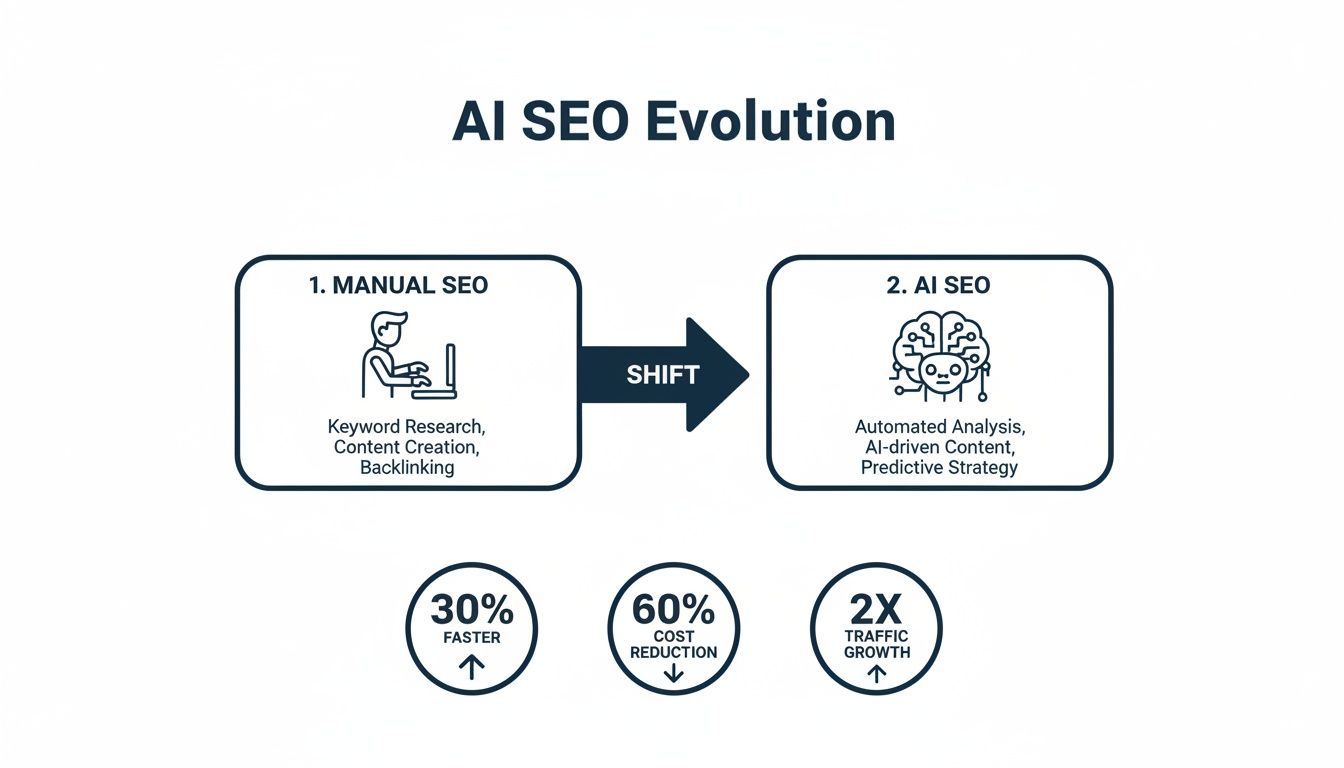
As you can see, AI SEO services compress tasks that used to take months into an automated workflow, letting retailers get results in days.
Stage 1: Ingest and Normalise
The first job in any sensible retail content automation strategy is to clean up the mess. Supplier feeds are notoriously all over the place, coming in different formats with inconsistent names and missing data. The "Ingest and Normalise" stage uses AI to pull all these different feeds into a single, structured source of truth you can actually rely on.
This process involves:
- Consolidating multiple supplier feeds into one master catalogue.
- Standardising product attributes (e.g., making sure "colour" is used every time, not "color" or "shade").
- Identifying and flagging critical data gaps that must be filled.
This is the foundational work. You cannot build a scalable SEO solution on bad data, so getting this right ensures everything that follows is built on a clean, accurate base.
Stage 2: Enrich and Optimise
Once your data is normalised, the real work begins. In the "Enrich and Optimise" stage, AI agents turn that basic product info into unique, compelling, and fully optimised content at a massive scale. This is where you tackle supplier content duplication head-on.
This stage is about far more than just rewriting text. It's a full-scale optimisation of every element on the product page, from the words a customer reads to the metadata that AI agents consume.
Key activities here include generating unique product descriptions SEO-optimised for your specific brand voice and target keywords. AI also uses image recognition and tagging to pull valuable details straight from product photos, a huge advantage for retailers in fashion, furniture, or electronics. This adds rich details suppliers often leave out, creating new ways for customers to find your products. Finally, it handles metadata optimisation at scale, making sure every title, alt tag, and structured data point is perfectly tuned for agentic search.
Stage 3: Human-Led QA and Refine
AI workflow automation for retail does not remove human expertise; it amplifies it. The "Human-Led QA and Refine" stage brings your team's strategic eye into the process, making sure the final output hits your brand and quality standards. This human + AI collaboration in SEO is what separates high-quality AI content from the generic, automated stuff.
Your team’s job shifts from the grind of manual writing to high-value quality control. They review batches of AI-optimised content, give feedback to sharpen the AI's grasp of your brand voice, and give the final sign-off. This creates a powerful feedback loop where the AI gets smarter and more aligned with your brand over time, guaranteeing long-term ecommerce content quality assurance.
Stage 4: Deploy and Monitor
The final stage is all about getting the optimised content live and tracking what happens next. A proper automated workflow should plug straight into your existing e-commerce platform, deploying thousands of updates without anyone having to lift a finger. This is vital for optimising product feeds efficiently and keeping your catalogue fresh.
After deployment, the system keeps an eye on digital shelf performance, tracking rankings, click-through rates, and conversions. This data feeds back into the system for ongoing tweaks, making sure your content strategy stays sharp as search algorithms and shopper habits change. It’s what gets you ready for the agentic commerce future, where continuous optimisation is simply the price of entry.
Preparing for the Future of Agentic Commerce
Leaning on supplier-provided content isn't just a bad habit anymore; in an era of AI-driven discovery, it's a dead-end strategy. Shifting to unique, structured, and optimised content isn't about chasing small SEO gains. It’s about being ready for the future of retail search.
The damage caused by duplicate content is well-documented, but the real story for Australian retail leaders is the opportunity that automated content workflows create. Moving past outdated manual processes to embrace scalable, AI-powered content workflows is now a commercial necessity. It’s how you secure your digital shelf, lift the customer experience, and guarantee your products are found, chosen, and recommended by the AI agents already reshaping how people shop.
The Agentic Commerce Imperative
Let's be blunt: manual SEO and content creation just cannot keep up. For retail teams stuck in an endless loop of writing and rewriting, an AI-powered platform offers a way out, providing retail efficiency tools that clear bottlenecks instead of creating new ones.
The future of retail discovery is happening now, and it’s being decided by algorithms that prioritise structured, unique, and trustworthy data. Supplier-led content fails on all three counts, making your catalogue invisible to the next generation of shoppers and the AI agents guiding them.
This isn't just about swapping manual SEO for AI SEO. It's about building a system that thinks at the SKU level, turning every single product into a performance asset, not a liability. From product data enrichment to image recognition and tagging, these automated systems do the heavy lifting, freeing your team to focus on bigger-picture strategy.
Your Next Step Towards AI Readiness
This isn't some far-off concept; it's happening right now. The foundation for success in the coming agentic commerce future is laid today by fixing the core problem of supplier content duplication.
Embracing AI workflow automation for retail gives you the power to correct these legacy issues at scale and build a resilient strategy for whatever comes next. To get a deeper understanding of this shift, explore our complete guide on Agentic AI and the future of retail discovery. This is your chance to lead the way in AI-powered retail transformation.
Frequently Asked Questions
How Can I Tell If My Site Is Impacted by Duplicate Content?
Google does not slap a big red penalty on your site for duplicate content. Instead, it just quietly filters it out of search results. This means your product pages effectively become invisible, which is the core reason supplier-led content breaks ecommerce discovery in the first place.
The tell-tale signs are usually a high number of indexed pages but disappointingly low organic traffic. You might also notice specific products aren't ranking, even for their own model numbers, or see warnings pop up in Google Search Console. The only way to know for sure is with a programmatic audit that sifts through your entire catalogue. This will show you the exact percentage of duplicated titles, descriptions, and metadata, giving you a crystal-clear picture of your risk.
Isn’t AI-Generated Content Also a Risk for SEO?
This is a common and understandable concern, but the risk isn't AI itself, it's badly managed AI. A strategic AI SEO platform does much more than just spit out text; it runs a complete content workflow. It starts by enriching your core product data, then uses your unique brand voice as a blueprint to create structured, highly optimised content.
The most important part? A human-led QA process is built right in. This ensures the final output is unique, perfectly aligned with your brand, and engineered for discoverability. It's the complete opposite of the generic, one-size-fits-all copy you get from supplier feeds.
How Can We Implement This Without Overwhelming Our Team?
That’s the exact problem AI workflow automation is built to solve. The old-school approach of manually rewriting thousands of product descriptions creates a massive resource bottleneck. It’s the very reason most retailers cannot achieve SEO at scale.
An AI-powered content platform takes the most time-consuming tasks, from cleaning up data to creating the content, and automates them. This approach to automating product descriptions frees your team from soul-destroying manual work. It elevates their roles to strategic oversight and quality control. You’re not adding headcount; you’re putting a system in place that creates efficiency and delivers scalable SEO solutions with the team you already have.
An AI-powered workflow is a force multiplier for your retail team. It handles the immense scale of product data enrichment and content generation, allowing your experts to focus on strategy and quality control, not manual data entry.
How Does Optimising for AI Agents Differ from Traditional SEO?
Traditional SEO has always been about keywords and backlinks to get a webpage ranking for a human searcher. Agentic SEO, or agentic search optimisation, is a different game entirely. It's about making your product data clean, machine-readable, and trustworthy.
AI agents in ecommerce, like shopping assistants on ChatGPT or Perplexity, need incredibly detailed and accurate data to make good recommendations. This means optimising for structured data (like schema), guaranteeing content uniqueness, and providing rich image metadata through AI image recognition SEO. You're shifting focus from just optimising a 'page' to optimising the underlying 'data' that describes your product for both humans and the machines shaping the future of retail search.
This readiness is non-negotiable for any retailer, whether you're in fashion SEO optimisation or a complex field like electronics SEO optimisation. The goal is to make your catalogue fully compatible with the next generation of product discovery.
Ready to fix the content bottlenecks holding your retail business back? Optidan AI transforms messy supplier feeds into a high-performance asset, preparing your digital shelf for the future of agentic commerce without adding operational complexity. Book a no-obligation discovery call to see how we can help you achieve SEO at scale.
