
Picture a personal shopper who doesn't just hear what you ask for, but actually understands what you mean. This is what's happening right now with agentic AI and the future of retail discovery. The simple search bar is quickly becoming a smart, conversational partner for your customers.
How Agentic AI Is Redefining the Customer Journey
The old customer journey was a straight line, a keyword search that led to a product page. That predictable path is being completely torn up and rebuilt.
AI agents like ChatGPT and Amazon's Rufus are now interpreting complex, intent-driven questions, not just basic keywords. This fundamentally changes how people find products. For Australian retailers, this isn't some far-off trend; it’s happening today and it demands your attention now.
We're seeing a massive shift from manual SEO to AI SEO. It’s about preparing for a world where your customers no longer type "men's running shoes". Instead, they’ll ask an AI agent, "Find me the best waterproof trail running shoes for the Blue Mountains, under $250, with good ankle support". Answering that kind of query requires a much deeper level of optimisation, one built on structured data and incredibly detailed product information. This is the new reality of AI-powered retail transformation.
The New Search Paradigm
Old-school SEO tactics, like stuffing keywords and chasing backlinks, are losing their punch. The future of retail search belongs to brands that can feed AI agents clear, accurate, and easy-to-digest information. This means getting strategic about:
- AI SEO: Optimising your content for AI agents that sit between you and your customer.
- Agentic Search Optimisation: Structuring your product data so it can directly answer complex, conversational questions.
- Digital Shelf Performance: Making sure your products are visible and chosen by AI, which is the new digital shelf.
This isn't a future prediction, it's already in motion. Recent data shows agentic AI use in Australian retail has shot up by about 50% in just three months. This explosion is driven by the one in three Australians who now regularly use AI assistants to find what they're looking for.
For retail leaders and ecommerce managers, the challenge is crystal clear. Your product catalogue must become a reliable, machine-readable knowledge base. If it isn't, your brand risks becoming invisible in this new world of agentic commerce.
This new ecosystem isn't something you can react to later. It's about proactively building a foundation of high-quality, unique content that positions your products as the perfect answer to a customer's real needs. You can learn more about how AI agents will find products in 2026 in our detailed guide on agentic commerce. The brands that move now will lock in their spot in the future of retail discovery.
Preparing Your Digital Shelf for AI Agents
To have any chance of winning in the age of agentic search, your product data has to be flawless. AI agents don't just browse, they analyse, compare, and make decisions based on the quality and structure of the information they find. Getting ready for this shift means turning your product catalogue from a simple list of items into a rich, machine-readable knowledge base that an AI can actually trust.
This isn't about tweaking a few keywords here and there. It's a fundamental move away from the slow, manual SEO tactics of the past and towards proactive, automated systems built for how people will find products tomorrow. The whole game hinges on making your digital shelf AI-compatible, ensuring every single one of your products is perfectly positioned to be found and recommended.
The way people search is already changing, moving from simple keywords to complex, conversational questions that an AI answers directly.
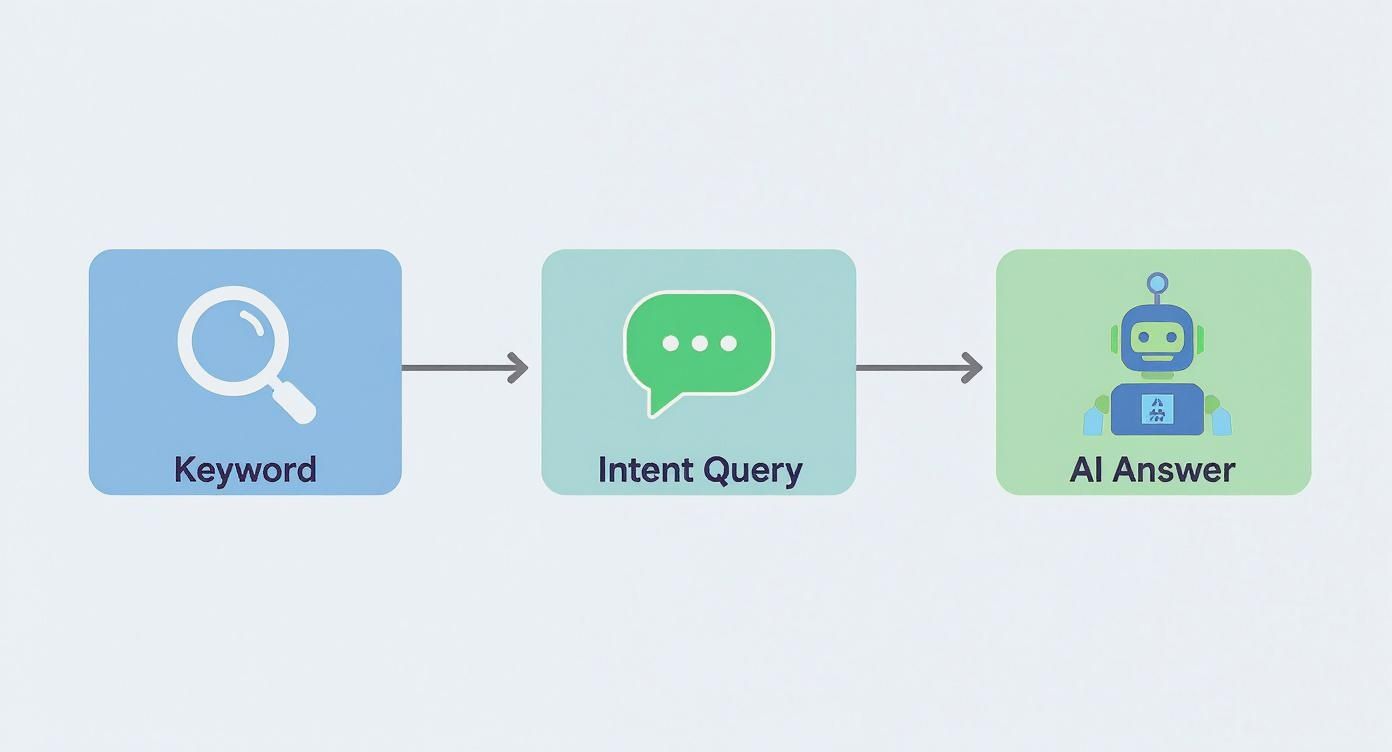
As you can see, the focus is no longer on ranking for a keyword. It's about becoming the most logical and complete answer to a detailed question a user poses to an AI.
The Foundation: Product Data Enrichment
The first and most critical step is solid product data enrichment. So many retailers just pull product information straight from supplier feeds, which are notoriously inconsistent, incomplete, or filled with generic, unhelpful descriptions. For an AI agent, this messy data is basically useless.
Product data enrichment is the process of transforming those raw supplier feeds into structured, optimised, and high-quality product content. It involves standardising attributes, filling in missing details, and making sure every field, from materials and dimensions to compatibility and use cases, is accurate. This is a core component of effective product feed optimisation.
Think of it as creating a perfect CV for each of your products. It's a CV that an AI can scan in seconds to decide if it’s the right fit for a customer's specific needs.
Eliminating Duplicated Supplier Content
One of the biggest roadblocks to being ready for agentic search is supplier content duplication. When hundreds or thousands of your product pages use the exact same descriptions provided by the manufacturer, search engines see it as low-quality, repetitive content. It’s a huge red flag.
This duplication doesn't just hurt your SEO, it stops you from building a unique brand voice. AI-powered workflows can finally fix this problem at scale by automatically rewriting and improving supplier content to create unique product descriptions for every single SKU. This is absolutely essential for building authority and making sure AI agents see your product pages as valuable, original sources of information. You can learn more by preparing your product catalogue for agentic search with our in-depth guide.
AI-Powered Workflows for Scale and Precision
Let's be realistic, manually optimising a catalogue of 10,000+ products is an impossible task. This is where AI workflow automation for retail becomes a non-negotiable. These automated systems can deliver scalable SEO solutions that were completely out of reach just a few years ago.
The shift from old-school, manual SEO to a modern, AI-ready approach is stark. Traditional methods are slow, inconsistent, and simply can't handle the scale required for today's massive ecommerce catalogues.
Transitioning From Traditional SEO to AI-Ready SEO
| SEO Element | Traditional Manual Approach | Modern Agentic AI Approach |
|---|---|---|
| Product Descriptions | Manually written one-by-one; often relies on generic supplier copy. | Automatically generated, unique descriptions for every SKU, optimised for intent. |
| Data Enrichment | Ad-hoc updates; missing or inconsistent attributes are common. | Systematic enrichment of all fields, ensuring data is complete and structured. |
| Content Uniqueness | High risk of duplicate content penalties from using supplier feeds. | Proactive de-duplication and rewriting to create original, authoritative content. |
| Metadata Optimisation | Manual title and meta description updates, often inconsistent. | Scalable optimisation across the entire catalogue for consistency and accuracy. |
| Image Tagging | Alt tags are often missing, generic, or manually entered. | AI image recognition automatically generates detailed, descriptive tags for visual search. |
| Scalability | Extremely limited. A team can only handle a few hundred pages a month. | Highly scalable. Can process and optimise tens of thousands of products in days. |
This table highlights the core difference: manual work is a bottleneck, while an AI-powered workflow creates a scalable, future-proof content system.
Key AI-driven capabilities include:
- Automating Product Descriptions: Generative AI can create thousands of unique, SEO-friendly descriptions in days, not months. This finally solves the retail content bottleneck and frees up your team for more strategic work.
- Image Recognition and Tagging: For sectors like fashion, furniture, or electronics, visual search is critical. AI image recognition can automatically scan product images and generate detailed alt tags like "black leather ankle boots with a block heel."
- Metadata Optimisation at Scale: AI agents can systematically review and optimise titles, meta descriptions, and other technical SEO elements across your entire catalogue, ensuring everything is consistent and accurate.
The goal is to create an automated content workflow where every new product added to your feed is instantly enriched, de-duplicated, and optimised. This is the essence of moving from traditional SEO teams to a future-focused, human + AI collaboration in SEO.
This structured, detailed, and unique content is exactly what AI agents need to confidently recommend your products. By investing in retail content automation and product feed optimisation, you're not just improving your current digital shelf performance, you are building a resilient foundation for the agentic commerce future.
The Power of AI Workflow Automation in Retail
For any large Australian retailer, content bottlenecks are a constant headache. They slow down growth and make it tough to react quickly to market changes. Imagine the grind of manually writing and optimising content for thousands of products, it's slow, expensive, and almost always inconsistent. This is where AI workflow automation in retail comes in, not just as a small improvement, but as a complete operational reset.
AI agents are built to handle the repetitive, soul-crushing tasks that tie up your talented teams. Think about launching a new season's collection. Instead of taking months, you could generate unique, SEO-ready product descriptions for 10,000+ items in just a few days. This is the new reality of retail content automation.
And it’s not just about speed. These workflows deliver scalable SEO solutions that were previously out of reach, making sure every single product page is perfectly tuned for the demands of agentic search. It turns a chaotic, unpredictable process into a reliable, high-performance content machine.
From Manual Bottlenecks to Automated Breakthroughs
We've all seen the traditional content process. Small teams chipping away at enormous product catalogues, leading to endless delays, patchy quality, and missed opportunities. AI-powered content workflows are designed to smash through these barriers.
Take metadata optimisation, for example. For a fashion retailer with thousands of products, manually optimising every image alt tag is a nightmare. But with AI image recognition, you can analyse thousands of product photos and automatically generate precise, descriptive tags like "women's high-waisted linen trousers in beige" with perfect consistency.
This is what optimising at scale truly means. It’s about building systems that can handle massive volume without ever compromising on quality. To see how this applies beyond content, you can explore the broader potential of workflow automation to streamline all sorts of retail operations.
Connecting Automation to Business Outcomes
The real beauty of these automated workflows is how directly they link to tangible business results. This isn't just tech for the sake of it, it's a strategic move with a clear and compelling return for ecommerce managers.
The benefits are immediate and easy to measure:
- Dramatically Improved Digital Shelf Performance: High-quality, unique content at a SKU-level is exactly what AI agents are looking for. Better data means better visibility in AI-driven search, which leads to better rankings and more sales.
- Faster Time-to-Market: Launching a new product line no longer has to be a six-month ordeal. Automated workflows get product pages optimised and live in a fraction of the time, letting you jump on trends well before your competitors.
- Significant Cost Savings: When you automate repetitive tasks, you free up your content and SEO teams to focus on strategy and high-value work. Those efficiency gains translate directly into lower operational costs and a much more effective team.
For retail leaders, moving from manual processes to AI workflows is a massive competitive advantage. It's about building an agile, efficient, and scalable content operation that's ready for the future of agentic commerce.
This shift isn't just about plugging in new tools. It's about completely rethinking how content gets created and managed across the entire business. As we dive into in our guide, retail workflow automation is the new competitive advantage for brands that want to lead the pack.
The Future of Work in Retail SEO
The rise of AI agents in ecommerce is changing the game for retail teams. But it's not about replacing people, it's about amplifying their expertise. SEO and content specialists can finally step away from mind-numbing data entry and into more strategic roles focused on quality control, creative direction, and performance analysis.
This human + AI collaboration in SEO ensures your brand's unique voice stays strong, even when you're producing content at an incredible scale. By embracing AI workflows for ecommerce, retailers can unlock new levels of efficiency, drive better performance on the digital shelf, and build a solid foundation for the next wave of retail discovery.
Human and AI Collaboration for Retail Teams
The rise of agentic AI in ecommerce isn't about replacing talented retail teams, it's about amplifying their capabilities. This shift reframes the entire conversation around the future of work in retail. It's time to move away from the fear of replacement and focus on a powerful human and AI collaboration model.
The goal here is simple: elevate your team from repetitive, manual tasks to strategic, high-value work. This is where you unlock real efficiency, combining human intellect with AI’s incredible speed to achieve results that were previously out of reach.

From Manual SEO to AI SEO Oversight
The old way of doing SEO is officially obsolete. Manually researching keywords, writing descriptions one by one, and painstakingly optimising individual pages just can't keep up. Not when your catalogue has tens of thousands of SKUs and new products are landing daily.
Moving from manual SEO to AI SEO redefines what it means to be a specialist. Instead of being bogged down in content creation, your team becomes content curators and strategists.
Their new responsibilities look something like this:
- AI Workflow Management: Designing and fine-tuning the automated workflows that handle product data enrichment and description generation at scale.
- Strategic Prompt Engineering: Crafting the precise instructions that guide AI agents to produce content that's not only SEO-friendly but also perfectly aligned with your brand’s voice.
- Performance Analysis: Focusing on high-level data to spot trends, measure the impact of AI-driven changes, and make smart, strategic adjustments.
This new model makes SEO scalable, turning an overwhelming task into a manageable and strategic operation.
The Critical Role of Human-Led AI Content QA
AI can generate content at lightning speed, but it can't replicate brand nuance or human empathy on its own. That requires expert guidance. This is where human-led AI content quality assurance (QA) becomes non-negotiable. It's the critical checkpoint that ensures every piece of AI-generated content meets your high standards for accuracy, tone, and brand consistency.
A "co-pilot model", where humans and AI work together, is the most effective approach. It balances the raw efficiency of AI with the strategic oversight and brand knowledge that only a human expert can provide.
Human oversight is the final, crucial step in any scalable content workflow. Your team’s role shifts to reviewing, refining, and approving AI-generated outputs. This process guarantees that while you’re optimising at scale, you never sacrifice the quality that defines your brand.
In fact, learning to successfully balance AI automation and brand voice is a skill that separates market leaders from the rest. For a deeper look, check out our guide on balancing AI automation and brand voice in retail content.
Empowering Retail Teams for the Future of Work
Adopting AI agents isn't about cutting headcount, it's about upskilling your team and making their work more meaningful. By automating the most repetitive parts of their jobs, you free them to focus on what humans do best: strategy, creativity, and customer understanding.
This empowers your team by:
- Reducing Content Bottlenecks: AI handles the volume, allowing your team to focus on strategic campaigns and high-priority product launches.
- Increasing Job Satisfaction: Moving from tedious data entry to high-impact strategic work makes roles far more engaging and rewarding.
- Driving Innovation: With more time for analysis and creative thinking, your team can experiment with new strategies to improve digital shelf performance.
This collaborative approach is the cornerstone of the future of work in retail. It builds a more agile, resilient, and effective team that can confidently navigate the evolving world of agentic commerce. The result is a workforce that isn’t just prepared for the future, but is actively shaping it.
Measuring Success in the Agentic Search Era
As retail shifts towards agentic AI, the old ways of measuring success are going out the window. Traditional metrics like keyword rankings just don’t cut it anymore. They can't possibly capture the full picture of your brand's performance in a world of conversational, intent-driven questions.
To prove your AI SEO strategy is actually working, you have to adopt new performance indicators that reflect how customers find products now. It’s no longer about being number one for a search term, it’s about becoming the trusted, authoritative answer that an AI agent serves up to a shopper with a specific need.
The rapid uptake of this technology in Australia makes this shift urgent. In the first half of the year alone, agentic AI use among Australian businesses jumped by 119%. With Australian shoppers using AI agents reporting 64% higher satisfaction, it’s crystal clear that getting seen on these platforms is a critical performance channel. You can find more insights about this rapid AI adoption in the Australian market.
Shifting from Rankings to Visibility in AI Answers
Your main goal now is to measure how often your brand shows up in AI-generated responses. Instead of tracking if you rank for "waterproof running jacket," you need to know if your product is the one recommended when a user asks an AI, "Find me a breathable, waterproof running jacket for Sydney's winter under $250."
To get this right, you need to start focusing on these new metrics:
- Share of AI Voice: Think of this as the new share of shelf. It measures how often your brand or products are mentioned in AI answers for your key product categories.
- Visibility in Conversational Queries: This involves tracking how well you perform against long, detailed questions that sound just like how real customers talk to AI agents.
- Attribution from AI-Driven Traffic: You need to analyse the conversion rates and revenue that come from users who click through from an AI recommendation. This is how you show the direct commercial impact of your work.
Learning how to properly measure marketing ROI is absolutely essential here, as AI gives you a much clearer line of sight into attribution and performance.
Connecting Data Enrichment to Performance Metrics
The quality of your product data is the fuel for these new metrics. AI agents need rich, structured, and unique content to trust your products enough to recommend them. This creates a direct, measurable link between your content efforts and your bottom line.
Every product attribute you enrich, every duplicate description you fix, and every image tag you optimise is a direct investment in your visibility within AI-generated answers. This is the new standard for measuring digital shelf performance.
When you use scalable SEO solutions like automated product description writing or AI image tagging, you can draw a straight line from that activity to a lift in your share of AI voice. It’s never been easier to justify the investment in smarter content workflows.
The Future of Digital Shelf Monitoring
Your digital shelf monitoring tools have to evolve. They need to stop just tracking keyword positions and start simulating conversational queries to report on your visibility inside platforms like ChatGPT, Perplexity, and Rufus.
This means looking for a new set of capabilities:
- AI Answer Tracking: Actively monitoring your brand’s presence in generative AI responses.
- SKU-Level Performance: Drilling down to see how individual products are performing in AI-driven recommendations.
- Competitor Benchmarking: Seeing how your share of AI voice compares to your competitors in real-time.
By focusing on these forward-looking KPIs, you can effectively measure and communicate the success of your AI SEO strategy. For retail leaders, understanding the top metrics to track for ecommerce success in 2024 provides a solid playbook for this new measurement landscape. It’s a proactive approach that ensures your brand stays visible, relevant, and profitable in the new era of agentic commerce.
Your Roadmap to Agentic Commerce Readiness
Jumping into agentic commerce doesn't mean you have to rip up your entire operation and start again. The smart way to get started is by taking small, deliberate steps. You want to kick off targeted projects that show real value before you even think about scaling things across the whole business. This is a practical roadmap, built from the core lessons of AI SEO, that will guide you from today's manual grind to an AI-powered retail future.
First things first, you need a brutally honest look at where you stand right now. The best place to start is with a deep audit of your product data. Your main goal here is to figure out just how much supplier content duplication you're dealing with. This one analysis will shine a light on the biggest gaps you need to fix before AI agents can even begin to work with your content.
Starting with a Pilot Project
Once you've got a clear picture of your data's health, pick one specific product category to use as a pilot. This lets you test the waters and fine-tune your strategy without betting the farm. The aim is simple: prove a clear return on investment that gets everyone excited about doing more.
Your pilot should zero in on two key areas:
- Product Data Enrichment: Start by enriching the products in your chosen category with unique, detailed attributes. It's about turning those thin supplier feeds into the kind of rich, structured content AI agents need to make a confident recommendation.
- Automated Content Workflows: Set up an AI workflow automation tool to generate unique product descriptions just for this category. This tackles the duplicate content problem head-on and shows off the power of optimising at scale.
This first phase is all about proving the concept works. Get this right, and you'll have a powerful internal case study showing how AI workflows for ecommerce can solve long-standing content headaches and lift your performance on the digital shelf.
Scaling and Integrating AI Workflows
With a successful pilot under your belt, it's time to take those automated content workflows and roll them out across your entire product catalogue. This is where you shift from a tactical fix to a strategic overhaul, weaving AI agents for retail efficiency right into the heart of your operations. This is a human + AI partnership, where your team provides the strategic direction and quality control.
The speed at which AI is being adopted in Australia shows just how urgent this is. Right now, 70% of small retail enterprises in Australia have already brought AI tools into their business, with another 13% planning to do the same within two years. This puts retail at the front of the pack for AI uptake, all driven by the clear benefits in customer service and personalisation. You can dig into more data on how Australian retailers are adapting to AI.
The future of agentic commerce will be defined by the retailers who act now. By building a foundation of clean, structured data and embracing scalable SEO solutions, you position your brand for market leadership in the next era of retail discovery.
Making these changes isn't just an operational upgrade, it's a powerful move to set yourself apart from the competition. The agentic shopping future is already here, and getting ready for it is your ticket to not just taking part, but leading the way.
Got Questions? We've Got Answers
Stepping into the world of agentic AI can feel like a big leap. It’s natural to have questions. Here are some straight answers to the most common queries we hear from retail leaders getting ready for this shift.
What Is Agentic AI in a Retail Context?
Think of Agentic AI as a hyper-intelligent personal shopper for every single one of your customers. It’s a system smart enough to understand complex, conversational questions and then go to work, completing multiple steps to find the perfect product.
It’s the difference between a basic keyword search and a real conversation. For example, instead of a customer just typing "running jacket," they can ask, "find me a breathable, waterproof running jacket for Sydney's winter that costs less than $250." The agent gets the context, understands the intent, and comes back with specific, genuinely helpful options. It's a discovery process that actually feels personal.
What's the First Step to Prepare for Agentic Search?
Before you do anything else, you need to get your product data in order. A full audit and cleanup is the single most important first step. Why? Because these AI agents rely entirely on clean, structured, and detailed information to do their job and trust what your brand is offering.
Start by getting rid of the low-hanging fruit, like all that duplicated content from supplier feeds that’s holding you back. From there, your focus should be on turning thin, boring product descriptions into unique, helpful content. Make sure every technical spec is accurate and formatted the same way across your entire catalogue. This isn't just busy work, it's the foundation of any solid AI SEO strategy.
How Is Agentic SEO Different from Traditional SEO?
Traditional SEO is all about picking the right keywords to show up in search results. Agentic SEO, or Agentic Search Optimisation, is a whole different ball game. Your new focus is on making your product information so clear and logical that an AI agent can understand it perfectly.
This means you’re prioritising structured data, contextual relevance, and rock-solid accuracy over just stuffing in keywords. You need to stop asking, "what keywords do people search for?" and start asking, "what questions will customers ask an AI, and is my product data good enough to give them the best answer?". The goal is to create rich, unique content right down to the SKU-level, content an AI can parse, trust, and recommend with confidence.
Ready to get your retail business ready for the age of agentic commerce? Optidan AI gives you the AI-powered content workflows you need to enrich product data, wipe out duplicate content, and build scalable SEO solutions. Discover how our platform can transform your digital shelf performance.
