


Retail workflow automation isn't some niche tech anymore, it's fast becoming the new baseline for competitive advantage. Think of it as the engine that powers operations optimised at scale, tying inventory, marketing, and SEO into one seamless system. It's what gets your business ready for the future of agentic search and AI shopping.
The Hidden Engine Driving Modern Retail Success
Behind every successful Australian retailer, there's a powerful and often invisible operational engine. In the past, this engine ran on pure manual effort. Teams would spend endless hours painstakingly updating product descriptions, tagging images by hand, and wrestling with messy supplier data feeds.
Today, that engine is being rebuilt with AI workflow automation for retail, and it’s creating a massive gap between the market leaders and everyone else.
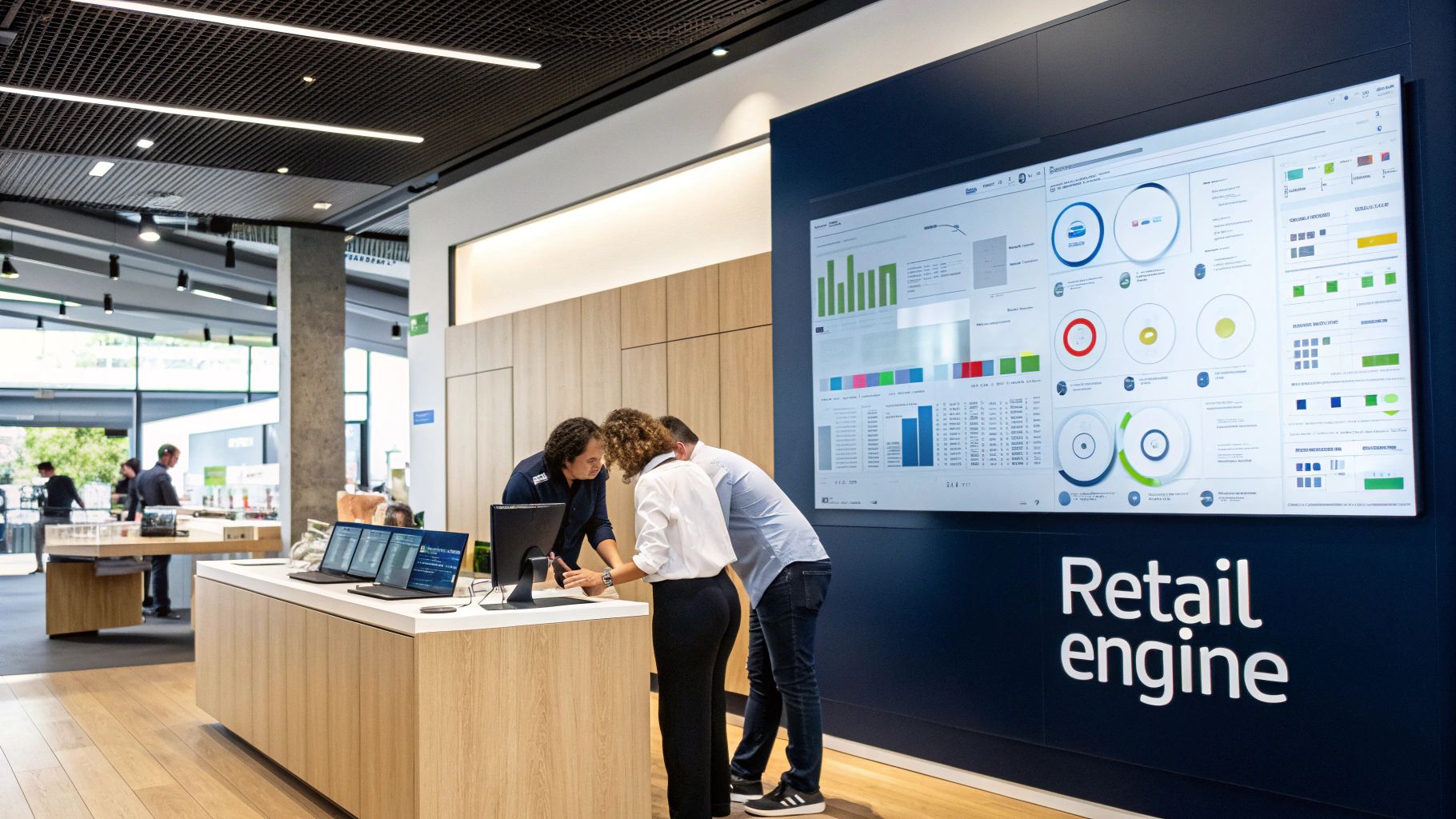
This shift is no longer a choice, it's a necessity. Retail leaders and ecommerce managers are under immense pressure to manage huge product catalogues, often with thousands of SKUs, while also optimising every single page for a new era of search. We're talking about AI agents like Google's AI Overviews and Amazon's Rufus, where structured, unique, and high-quality data is the price of entry for digital shelf performance.
From Manual Grind to Strategic Advantage
Real retail workflow automation is about so much more than just ticking off tasks. It's a strategic pivot from manual SEO to AI SEO, designed to smash the content bottlenecks that hold back growth. Instead of seeing automation as a threat, the sharpest teams view it as a force multiplier. It frees up their skilled people from repetitive work so they can focus on what really matters: strategy, creativity, and growth.
This transition is all about building intelligent systems that can:
- Ingest and structure data: Automatically handle product data enrichment, turning chaotic supplier feeds into clean, optimised content ready to perform.
- Create unique content at scale: Fix duplicated supplier content to sidestep SEO penalties and build a distinct brand voice across thousands of products.
- Optimise visual assets: Use AI to recognise and tag images for entire catalogues, an absolute must for verticals like fashion SEO or furniture SEO.
The business case for this change is crystal clear. To see how these principles apply more broadly, it's worth understanding the fundamentals of marketing workflow automation, which shares a similar DNA.
Comparing Manual vs Automated Retail Workflows
To really grasp the shift, it helps to see the old way next to the new way. The difference isn't just about speed, it's about moving from reactive, labour-intensive tasks to proactive, strategic operations that create a real competitive edge.
| Operational Area | The Old Manual Workflow | The New Automated Advantage |
|---|---|---|
| Product Data | Manual entry, copy-pasting from messy supplier sheets. | Automated ingestion, cleaning, and structuring of data feeds. |
| Content Creation | Teams write descriptions one by one, often using supplier copy. | AI generates unique, brand-aligned content for thousands of SKUs. |
| Image Tagging | Someone manually adds alt text and tags to each image. | AI instantly tags entire catalogues for better searchability. |
| SEO | Slow, page-by-page optimisation with inconsistent results. | Sitewide optimisation rules applied instantly for consistency. |
| Time to Market | New products take days or weeks to get online. | New products are live and optimised in hours, not days. |
This table shows it's a complete operational overhaul. Automation doesn't just do the old tasks faster, it unlocks entirely new capabilities that were impossible before.
The Momentum Is Building in Australian Retail
This isn't some far-off trend, it's happening right now. Retail workflow automation has become a defining advantage for Aussie businesses. The market hit USD 548.8 million in 2024 and is projected to explode to USD 1.41 billion by 2033. This growth is being fuelled by rising operational costs and the rapid uptake of AI-powered systems.
By reframing automation as a strategic amplifier, you empower your team to focus on what humans do best: innovation, brand building, and customer strategy. The machine handles the scale, while your people drive the growth.
This pivot is about more than just efficiency. It’s about building a resilient, future-ready retail operation that can compete in an agentic commerce world. The systems you build today will absolutely determine your visibility and success tomorrow. To go deeper, check out how the right framework is the real driver of AI ROI for retailers.
Winning the AI-Powered Digital Shelf
The retail battleground has shifted online for good, and the digital shelf is where you win or lose. Yesterday’s SEO playbook, built on manual keyword research and slow content updates, is no match for today’s market. We're now in the era of agentic search optimisation, where AI shopping assistants like Amazon's Rufus and Google's AI Overviews call the shots. This demands a completely new approach.
This is where retail workflow automation becomes your most critical advantage. It’s not about tweaking a few product pages anymore. It’s about achieving flawless SKU-level SEO across your entire catalogue, a task that’s flat-out impossible to do manually at scale. Winning now means optimising thousands of pages in days, not the months or years it takes a traditional SEO team.
From Supplier Feeds to Search Supremacy
One of the biggest hurdles every retailer faces is the raw, messy data coming straight from suppliers. These feeds are often incomplete, inconsistent, and duplicated across dozens of other retail websites. That’s a huge red flag for search engines and a recipe for SEO penalties.
Automated workflows tackle this challenge head-on, turning that chaotic supplier data into a powerful asset. This product data enrichment process is the foundation for building a strong AI SEO strategy. To get a better sense of how this works, see how API-driven workflows are transforming retail data enrichment and the mechanics behind it.
Here’s how AI agents turn raw data into optimised content that wins:
- Fixing Duplicated Supplier Content: AI can rewrite thousands of generic manufacturer descriptions, creating unique, on-brand content that search engines love to rank.
- Structuring Unstructured Data: Workflows automatically standardise attributes, fill in the blanks, and make sure every product detail is correctly categorised.
- Optimising at Scale: This isn’t a one-and-done fix. It’s a continuous system that keeps your entire product catalogue pristine and primed for peak digital shelf performance.
To truly compete, retailers need a comprehensive digital shelf strategy that bakes in both optimisation and ongoing management.
The New Imperative: Visual Search Optimisation
For retailers in visual-heavy sectors like fashion, furniture, or electronics, product images are just as critical as the text. But manually tagging every single image with descriptive alt text? That’s a classic content bottleneck that kills any hope of scaling. This is another area where retail content automation gives you an edge no one can match.
Modern AI image recognition and tagging can analyse an entire library of product images in minutes, automatically generating keyword-rich, descriptive alt tags. An automated workflow can identify attributes like "long-sleeve linen shirt" for fashion SEO or "walnut mid-century modern coffee table" for furniture SEO, making your products discoverable in a whole new way.
This metadata optimisation at scale ensures every single product image is actively working to boost your SEO performance, a goal that's simply out of reach with manual effort.
The AI adoption rate in local retail shows just how vital this has become. As of 2025, over 91% of retailers in Australia and New Zealand are investing in generative AI. This rapid uptake, which includes over 45% of retail SMEs, is set to grow the Australian AI in retail market from $310.9 million in 2024 to nearly $2 billion by 2030.
The future of retail search isn't about being found by keywords alone. It’s about being understood by AI agents. That requires structured, unique, and deeply enriched product data, delivered at a scale only automation can achieve.
Ultimately, mastering the AI-powered digital shelf means moving from manual, reactive SEO tasks to a proactive, automated system. It's the difference between struggling to keep up and setting the pace for the rest of the market.
The Three Pillars of Retail Automation
A solid retail workflow automation strategy isn’t just one big system. It's actually built on three separate but connected pillars that work together to completely overhaul your digital shelf performance. Getting your head around these pillars gives you a clear roadmap for ditching manual, soul-destroying tasks in favour of scalable, AI-driven workflows that give you a serious competitive edge.
This workflow shows how AI automation links your high-level digital shelf strategy with the nitty-gritty of SKU-level optimisation.
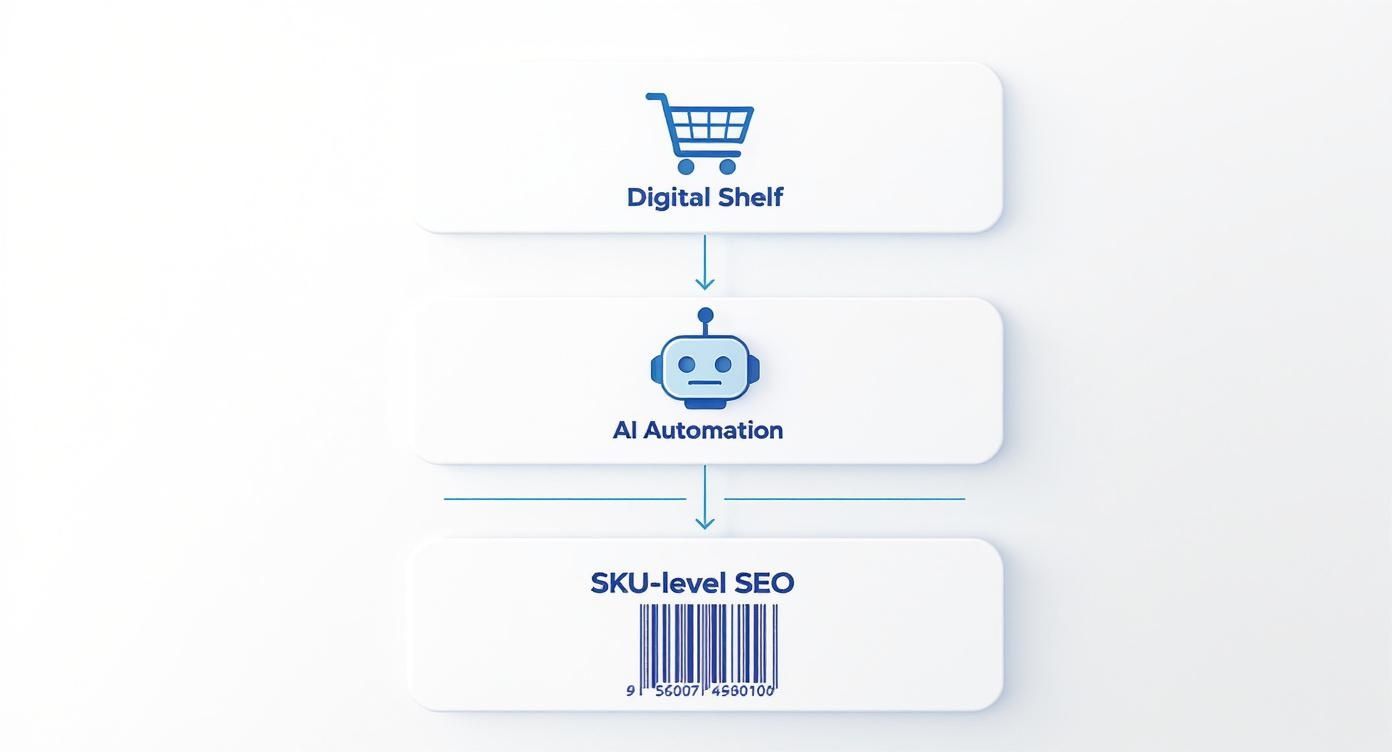
The diagram makes it clear: to dominate the digital shelf, you need AI automation to handle optimisation at the individual product level. This creates a direct line between your strategy and the results you see.
Pillar 1: Product Data Enrichment
The first and most important pillar is product data enrichment. Every retailer knows the headache of getting inconsistent, messy, and incomplete data feeds from suppliers. This raw data is a liability, holding back your SEO and giving your customers a poor experience.
Think of an automated content workflow as a refinery. AI agents take these chaotic feeds and methodically clean, structure, and enrich them.
- Standardising Attributes: The system automatically fixes typos, standardises units of measurement, and makes sure all product attributes (like colour, size, and material) are consistent across your entire catalogue.
- Filling in the Gaps: AI can spot missing information and use existing data or even external sources to complete product specs, building a full profile for every single SKU.
- Optimising for Search: The workflow enriches the data with relevant keywords, prepping it for agentic search optimisation. This ensures your products are ready to be found by AI shopping agents as well as traditional search engines.
This pillar turns your product data from a weakness into your greatest asset for product catalogue SEO.
Pillar 2: Duplicate Content Resolution
The second pillar tackles one of the most stubborn problems in ecommerce: supplier content duplication. Using the same generic product descriptions as hundreds of your competitors is a surefire way to get penalised by search engines and just blend into the noise.
Retail content automation solves this by creating unique product descriptions SEO-ready, and doing it at scale. This is where Generative AI for retail teams really comes into its own.
AI agents can take a single set of product attributes and generate hundreds of unique, on-brand descriptions. This process eliminates the risk of duplicate content penalties while establishing a consistent and persuasive brand voice across your entire inventory.
For instance, an electronics retailer with 50 similar TV models can use AI to generate distinct descriptions for each one, highlighting the subtle differences in their features. This not only creates a better user experience but also gives search engines unique content to index and rank, giving your retail search visibility a massive boost. A human-led AI content QA process ensures quality is kept high across thousands of SKUs.
Pillar 3: Scalable Image and Metadata Optimisation
The third pillar is all about your visual assets, which are absolutely critical for engagement and discoverability, especially in categories like fashion, furniture, and beauty. Image SEO for ecommerce has always been a painfully manual job, but AI completely changes the game.
Through AI image recognition and tagging, automated workflows can analyse thousands of product photos in minutes, identifying key attributes and generating optimised metadata.
This process includes:
- Automated Alt Tag Generation: AI writes descriptive, keyword-rich alt tags for every image. This improves accessibility and gives crucial context to search engines. For a fashion retailer, this means automatically tagging an image as a "blue floral print midi dress with puff sleeves", a level of detail that’s impossible to do manually at scale.
- Product Image Tagging: The system can identify and tag specific features within an image, making products searchable by their visual characteristics. This is vital for furniture image tagging SEO, where customers might search for a "dark wood Scandinavian-style dining table."
- Metadata Optimisation at Scale: This goes beyond images to all metadata, ensuring titles, descriptions, and tags are consistently optimised across every single channel.
Together, these three pillars create a powerful, automated engine for achieving SEO at scale. It allows retailers to optimise 10,000+ pages in just days and lock in a dominant position on the digital shelf.
How Automation Impacts Different Retail Verticals
To see how this works in the real world, let's look at how these core automation pillars deliver tangible benefits across different retail sectors. This helps leaders from various industries see the direct application to their own business.
| Retail Vertical | Key Automation Pillar | Primary Competitive Advantage |
|---|---|---|
| Fashion & Apparel | Duplicate Content Resolution | Unique, brand-aligned descriptions for thousands of similar SKUs, avoiding SEO penalties. |
| Electronics | Product Data Enrichment | Consistent and accurate technical specs, improving filterability and reducing returns. |
| Home & Furniture | Image & Metadata Optimisation | Visually searchable products (e.g., "oak wood coffee table"), boosting discovery. |
| Health & Beauty | Product Data Enrichment | Accurate ingredient lists and standardised attributes, building trust and aiding search. |
| Grocery & FMCG | Duplicate Content Resolution | Differentiated product stories for common CPG items, capturing niche search traffic. |
As you can see, the principles are the same, but the impact is tailored to the specific challenges and opportunities within each vertical. Automation isn't a one-size-fits-all solution; it's a flexible framework that adapts to drive results where they matter most.
How Automation Solves Real-World Retail Problems
Theory is one thing, but the real power of retail workflow automation shows up when it fixes the frustrating, day-to-day problems holding your business back. Let’s get practical and look at a few scenarios where automated workflows deliver a clear competitive edge by smashing through common content bottlenecks.
These aren't futuristic concepts. They're real-world applications driving results for retailers right now, from better search rankings to higher conversion rates.

Scenario 1: The Fashion Retailer Drowning in Visuals
A popular Australian fashion brand is juggling over 5,000 SKUs, each with a handful of images. Their small e-commerce team spends hundreds of hours manually writing alt text and tagging products with basic attributes like "dress" or "shorts."
As a result, their fashion SEO optimisation is weak and inconsistent. Customers can't find what they want using specific searches like "long-sleeve floral dress" or "high-waisted linen shorts." This is a classic content bottleneck, the sheer scale of the task makes manual work impossible, leaving a huge amount of SEO value on the table.
The Automated Solution:
By plugging in an AI image recognition and tagging workflow, the retailer can process its entire image catalogue in a matter of hours, not months. The system automatically analyses every photo, generating detailed, descriptive alt tags and product tags from visual cues.
- Before: Generic alt text like "woman in dress."
- After: "Woman wearing a blue floral print midi dress with puff sleeves."
This automated alt tag optimisation for retail instantly makes their products more discoverable in both traditional and visual search. It also gets them ready for an agentic commerce future, where AI shopping agents will depend on this kind of rich metadata to find the perfect item for a user.
Scenario 2: The Furniture Retailer Battling Duplication
A furniture retailer gets product feeds for hundreds of similar-looking sofas from the same supplier. Under pressure to get products live, the team just copies and pastes the manufacturer's generic descriptions.
This creates massive supplier content duplication issues, torpedoing their search rankings and stripping away their unique brand voice. They’ve become invisible on the digital shelf because their content is identical to dozens of their competitors.
The core problem isn't laziness, it's a lack of scale. No manual team can write hundreds of unique descriptions for nearly identical products without falling hopelessly behind. This is where AI workflow automation creates an unassailable advantage.
The Automated Solution:
An automated content workflow powered by generative AI solves this problem completely. The system takes basic product attributes, dimensions, material, colour, and spins them into hundreds of unique, SEO-rich descriptions.
- Attribute Set: Sofa, 3-seater, grey fabric, oak legs.
- AI-Generated Variations: One description might focus on the "mid-century modern aesthetic," while another highlights its "family-friendly durable fabric."
This approach to automating product descriptions ensures every page is unique, wiping out duplication penalties and boosting furniture SEO services. A human-led QA step keeps everything on-brand, perfectly blending AI efficiency with human oversight.
Scenario 3: The Electronics Retailer Juggling Marketplaces
An electronics retailer sells on its own website, Amazon, and eBay. Each channel demands different formats for product titles, bullet points, and technical specs. Manually tweaking their product feed for each platform is a logistical nightmare, leading to inconsistent data and lost sales.
The Automated Solution:
A smart product feed optimisation workflow centralises all their product data. From this single source of truth, AI agents for retail efficiency automatically reformat and rewrite content for each specific channel in real-time.
This multi-channel product optimisation ensures every listing is perfectly tailored to the platform it's on, pushing visibility and sales to their maximum potential. For retailers looking to build a truly agile data strategy, it's worth exploring how to build a living product data ecosystem that can power workflows just like this.
These examples show that retail workflow automation isn't just about speed. It’s about doing things that were previously impossible, unlocking new levels of performance and creating a competitive edge that lasts.
Building Your Human and AI Collaboration
Whenever AI workflow automation for retail comes up, there’s always one big question in the room: will it replace jobs? The reality is much more interesting. The future isn't about replacing talented people, it's about building powerful collaborations between them and their AI counterparts.
This changes what roles look like inside ecommerce teams. AI agents are built to do the heavy lifting, the repetitive, large-scale tasks that need speed and precision. Think automating product descriptions for thousands of SKUs or rolling out metadata optimisation at scale. This is what frees your team from the content bottlenecks that have been holding back growth for years.
Instead of being stuck in manual data entry, your ecommerce managers are elevated. Their work becomes centred on strategy, creative direction, and quality control. They become the conductors of the automation orchestra, making sure every single output is perfectly in tune with your brand.
Redefining Roles in the Age of AI
This move towards human + AI collaboration in SEO doesn't just make your team more efficient, it makes their roles more dynamic and valuable. Their focus shifts from tedious execution to high-impact strategic oversight, which is a far better use of their experience.
This new structure looks something like this:
- AI Agents for Repetitive Tasks: These handle the scalable SEO work, like optimising product feeds and fixing duplicated supplier content across your entire catalogue.
- Human Teams for Strategic Oversight: This is where your team shines, focusing on brand voice consistency, creative campaigns, and performing human-led AI content QA to ensure everything is excellent.
This isn’t just about getting more done. It also boosts job satisfaction by letting your team focus on the creative, engaging work they were hired to do in the first place.
Choosing the Right Automation Partner
For retail leaders, picking the right partner for this journey is everything. You're looking for a solution that does more than just raw automation. You need a platform that gets the nuances of retail and is designed for a human + AI collaboration model from day one.
A key thing to look for is a partner that offers both massive scale and a solid framework for human-led quality assurance. This means you can optimise 10k+ pages in days without ever losing the human touch that actually defines your brand. In this new era of agentic commerce, your team’s expertise in guiding the AI is what creates a real competitive advantage. You can dig deeper by reading our guide on balancing AI automation and brand voice in retail content.
This shift is already happening fast. Small retail businesses in Australia are quickly bringing AI-driven workflows into their operations. In fact, 70% are already using AI tools, with another 13% planning to adopt them soon. That’s 83% of small retailers embracing this change, using AI mainly to improve customer service, personalise marketing, and make faster decisions. To see the bigger picture, you can discover more insights about how Aussie retailers are adapting to AI.
The future of work in retail isn't about human vs. machine. It's about empowering your best people with the best tools, creating a synergy where AI handles the scale and your team drives the strategy and brand identity.
Ultimately, this collaborative approach is the key to unlocking the true potential of retail workflow automation. It transforms your operations from a cost centre into a strategic growth engine, getting you perfectly positioned for the future of retail search and AI-powered commerce.
Your Path to a Lasting Competitive Advantage
The shift from manual SEO to AI SEO isn't just on the horizon, it’s the new standard for retail leaders who want to win. We've talked a lot about how retail workflow automation is more than just a task manager, it's the engine that powers your competitive edge. It's the only real way to achieve true SEO at scale, getting you ready for agentic search and the future of retail search.
For retailers who want to do more than just survive, sticking with manual content processes is a dead end. The way forward is crystal clear: adopting AI-powered content workflows is non-negotiable for anyone serious about dominating a crowded market.
From Bottlenecks to Breakthroughs
Every ecommerce manager knows the pain of content bottlenecks. It’s the slow grind of fixing duplicated supplier content, the monumental task of product data enrichment across thousands of SKUs, or the tedious process of image optimisation, one by one. These manual hurdles don’t just drain resources, they actively hold back your growth.
These are the exact problems that scalable SEO solutions were designed to solve.
By automating these processes, you completely change the game for your digital shelf performance. Imagine optimising 10,000+ pages in days, not months. This isn't a fantasy, it's the new benchmark for ecommerce SEO automation and the key to unlocking consistent visibility and sales.
The question for retail leaders is no longer if they should adopt automation, but how quickly they can integrate it to get ahead. Proactive adoption today will define the market leaders of tomorrow.
Charting Your Course with AI
Your journey into AI-powered retail transformation starts with a hard look at your current operational pains. Where are your teams burning the most time on repetitive, low-impact work? Pinpointing these areas is the first step in building a business case for automation. The goal isn't to replace your team but to create a powerful human + AI collaboration in SEO, where the tech handles the scale, and your people drive the strategy.
Exploring how automation can boost your operations is a crucial next step. To learn more, see our detailed guide on improving your retail operational efficiency.
The future of agentic commerce will be led by businesses that are agile, data-driven, and relentlessly optimised. By bringing AI agents for retail efficiency into your workflow, you’re not just fixing today’s problems. You’re building a resilient, adaptable foundation for whatever comes next. The time to act is now.
Frequently Asked Questions
When you're looking at a big shift like workflow automation, it’s natural to have questions. Here are some of the most common ones we hear from retail leaders and ecommerce managers, along with straight-up answers.
How Quickly Can I See Results From Automation?
The impact can be almost immediate, especially with content. If you're tackling tasks like cleaning up duplicated supplier content or enriching product data, you can see thousands of pages fixed in just a few days. Manually, that’s a job that would take months.
A recent study even found that 54% of businesses get a return on their automation investment within the first year.
While the content gets deployed fast, improvements to your digital shelf performance and SEO rankings will build over the following weeks. Search engines need time to crawl and re-index your newly optimised pages. But that initial speed is a massive competitive advantage.
Will AI Automation Replace My Ecommerce Team?
No, that’s not the goal. This is all about human + AI collaboration.
AI workflow automation is built to take on the repetitive, high-volume tasks that clog up your team’s pipeline. Think of optimising thousands of product feeds or handling SKU-level SEO across an entire catalogue. It’s work that no human team can do efficiently at scale.
This frees up your talented people to focus on high-value work, the stuff that really moves the needle. They can focus on brand voice, creative strategy, and providing that crucial human oversight for the AI-generated content. It’s about giving your team a tool that makes them strategic overseers, not manual workers.
Can Automation Truly Capture Our Unique Brand Voice?
Absolutely, as long as it’s set up correctly. Good AI-powered content workflows aren’t about pumping out generic, robotic text. The best systems are trained specifically on your brand guidelines, your most successful content, and what you know about your customers.
AI agents can then generate unique product descriptions that feel like they came directly from your team. This is a core part of the Generative AI for retail teams approach, the system provides the scale, and your team provides the final creative stamp of approval.
Is This Only For Large Retailers With Big Budgets?
Not anymore. While the big players definitely benefit, automation now offers huge advantages for businesses of all sizes. Thanks to cloud-based platforms and scalable tools, powerful retail automation is more accessible than ever.
For a smaller retailer, automating product descriptions or image tagging can completely level the playing field. It allows you to compete on the digital shelf without needing a massive content team. The trick is to start small: find your biggest content bottleneck and apply a focused, automated solution to get a fast and measurable return.
Ready to clear those content bottlenecks and build a real competitive advantage? Optidan AI delivers the scalable SEO solutions you need to optimise thousands of product pages and own the digital shelf. Discover how our AI-powered retail transformation can work for you.
