
AI-generated text is simply content created by artificial intelligence. Think of large language models as highly advanced apprentices that can produce human-like writing.
For Australian retailers, this isn't just a fancy new tool. It's a practical way to turn raw, boring supplier data into unique, SEO-ready product descriptions and marketing copy. Doing this at scale is the key to improving digital shelf performance and climbing up the search rankings.
The New Reality of Australian Retail
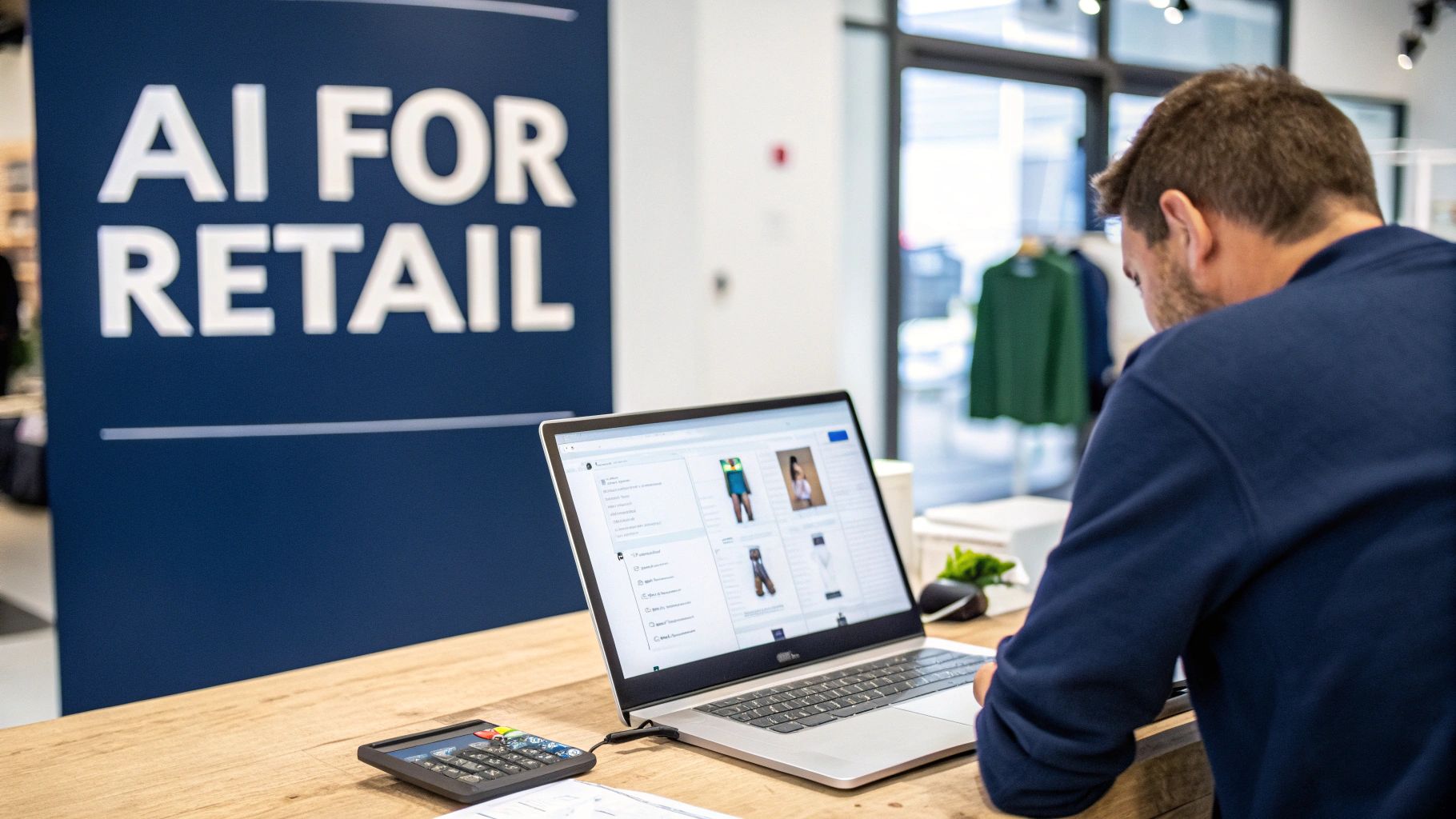
For retail leaders and eCommerce managers across Australia, the conversation around AI has moved from "what if" to "right now." The old manual ways of creating content just can't keep up anymore.
Trying to manage massive product catalogues with thousands of SKUs creates huge retail content bottlenecks. It slows down your time-to-market and stalls growth. The real question is: how can you possibly create unique, compelling, and optimised content for every single product without hiring an army of writers?
This is where AI-generated text becomes a central part of any modern retail strategy. It offers a way out of the grind of manual SEO and content creation, moving businesses toward automated content workflows that deliver both speed and quality. This is the essence of retail efficiency and automation.
Addressing Core eCommerce Challenges
The pressure to perform on the digital shelf has never been higher. Retailers are constantly fighting common issues that chip away at their bottom line. AI offers concrete solutions to these nagging problems.
- Correcting Duplicated Supplier Content: Using the generic descriptions from suppliers is a fast track to getting penalised by search engines. AI can rewrite thousands of these, creating unique product descriptions that establish your brand voice and boost your search rankings, fixing the duplicate content SEO problem.
- Enabling Product Data Enrichment: Basic supplier feeds just don't have the detail needed to convince a customer to buy. AI workflows can enrich this data, turning a few bullet points into structured, benefit-driven content that answers customer questions and fuels your SKU-level SEO.
- Image Recognition & Tagging at Scale: For businesses in fashion or furniture, image SEO is non-negotiable. AI image recognition can automatically write descriptive alt tags and metadata for your entire visual catalogue, making your products discoverable through visual search.
The shift to AI in Australia is happening fast. Recent data shows generative AI has sparked a 77% increase in content output for Australian businesses, and conversions from AI-optimised marketing have jumped by 47%. This isn't just hype; it's having a real commercial impact. You can find more insights in these Australian AI writing statistics.
Ultimately, this guide is about putting AI to work. We’ll dig into how to build scalable SEO solutions and get ready for the future of agentic search, helping you move from manual headaches to AI-powered growth.
Moving from Manual Efforts to AI SEO
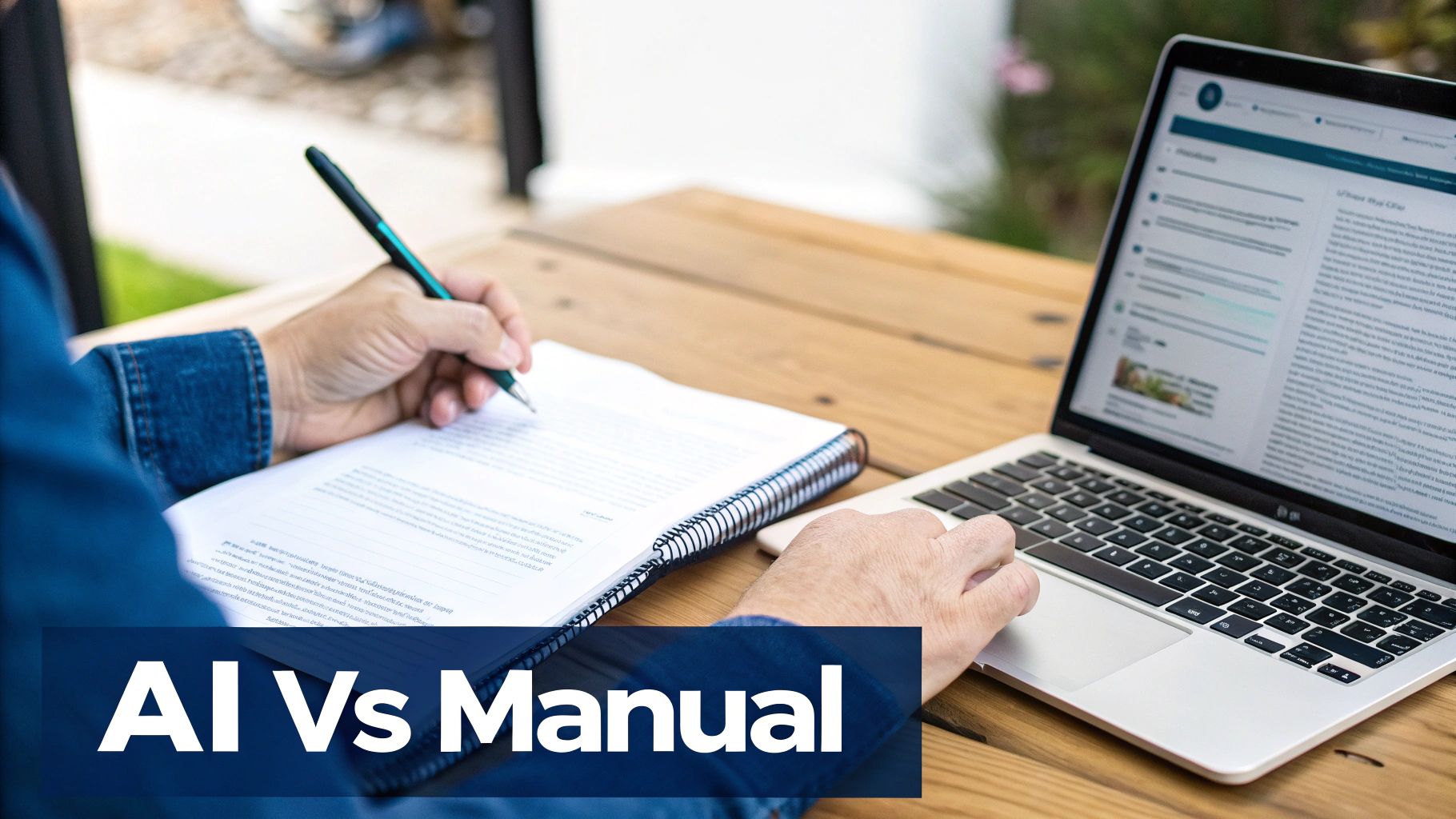
For years, retail SEO has felt like handcrafting every single item in a massive warehouse. It’s a detailed, labour-intensive, and painfully slow process that’s impossible to scale across thousands of products. Every product description, meta title, and alt tag had to be written one by one, a content bottleneck that held back growth for any retailer with a large catalogue.
This old-school model is cracking under the pressure of modern eCommerce. The sheer volume of SKUs, the constant demand for fresh content, and the high cost of manual work make it totally unsustainable. It’s the reason so many stores suffer from widespread supplier content duplication, which kills search rankings, and incomplete product data, which tanks conversion rates.
The move to AI SEO isn’t just an upgrade; it’s a complete rethink of how retail content gets made and managed. Think of it as shifting from a craftsman’s workshop to a fully automated production line. This is the only realistic way to achieve SKU-level optimisation at scale.
The Limitations of Traditional Retail SEO
Manual SEO forces retail teams into a constant game of catch-up. The effort needed to optimise even a fraction of a large product catalogue is immense. This leads to massive delays in getting products to market and leaves a lot of revenue on the table.
Here’s where it really breaks down:
- Inability to Scale: It’s logistically impossible for a human team to write unique, optimised descriptions for 10,000+ products in any reasonable timeframe. This creates a permanent content backlog.
- Pervasive Duplication: Faced with impossible deadlines, teams often fall back on generic supplier feeds. The result? Duplicate content penalties that suppress performance on the digital shelf.
- High Operational Costs: The time and people required for manual content creation are a huge operational expense that delivers slow, incremental returns at best.
This shift away from manual processes fundamentally requires a move towards sophisticated data-driven marketing strategies that prioritise profit and efficiency over outdated, labour-intensive tactics.
Introducing AI as the Scalable Solution
AI SEO flips these limitations on their head, turning them into opportunities. By putting AI-powered content workflows in place, retailers can execute complex optimisation tasks across their entire catalogue in days, not months or years. This is the heart of true retail efficiency and the key to preparing for the future of work in retail.
With an AI-driven approach, you can automate critical jobs that were previously impossible at scale. This includes deep product data enrichment, where basic supplier info is transformed into rich, structured content. It also opens the door to automated image recognition and tagging, making sure every product image is optimised for visual search. To see what’s possible, take a look at how retailers are harnessing artificial intelligence in e-commerce.
This transition is a strategic pivot. It moves your team from being bogged down in repetitive writing to overseeing a powerful retail content automation engine. This shift is essential for building a foundation for agentic commerce, where AI agents for retail efficiency will rely on perfectly structured data to make buying decisions. Optimising at scale is no longer a competitive advantage, it's a requirement for survival and growth.
Solving Core Retail Challenges with AI Workflows
For Australian retail leaders, the daily grind is a relentless juggling act. You're managing tens of thousands of SKUs, fighting for a sliver of visibility on a crowded digital shelf, and battling constant operational pressures. AI-powered content workflows aren't some futuristic dream; they're the practical solution to these headaches, turning manual bottlenecks into automated advantages.
This is about applying AI generated text to solve real, tangible business problems right now. By automating critical content tasks, retailers can finally get the scale they need to compete and win online. The true value isn't just in the AI itself, but in building efficient systems. As we've covered before, the right workflow is the real driver of AI ROI for retailers.
To see just how big the difference is, let's compare the old way of doing things with an AI-powered approach.
Manual vs AI-Powered Retail Content Workflows
The table below breaks down the time and effort required for common content tasks. It's a clear picture of the efficiency gains you can expect when moving from slow, manual processes to an automated AI workflow.
| Retail Task | Traditional Manual Approach (Per 1000 SKUs) | AI-Powered Automation Approach (Per 1000 SKUs) |
|---|---|---|
| Product Description Writing | 80-120 hours of writer/editor time | 1-2 hours of setup & review |
| SEO Keyword Integration | 20-30 hours of research & manual input | < 1 hour of automated integration |
| Image Alt Text Tagging | 15-25 hours of manual tagging | < 1 hour of automated recognition & tagging |
| Data Enrichment (Specs to Benefits) | 30-40 hours of research & creative writing | 1-2 hours of automated expansion & review |
As you can see, the time savings are massive. This isn't just about going faster; it's about freeing up your team to focus on strategy and growth instead of getting bogged down in repetitive tasks.
Fixing Duplicated Supplier Content
One of the most damaging issues in eCommerce is leaning on generic supplier content. When hundreds of retailers use the exact same product descriptions, search engines flag it as low-value, duplicate content. That can absolutely torpedo your SEO performance. But who has the time to manually rewrite thousands of these descriptions? It's an impossible task for most in-house teams.
This is where an AI workflow delivers an immediate win. An automated system can pull in your entire product feed and rewrite every single description, tailored to your brand voice and SEO strategy.
- Unique Product Descriptions SEO: The AI generates fresh, original content for each SKU, wiping out the duplicate content penalty.
- Brand Voice Alignment: The system is tuned to your specific tone, keeping everything consistent across your catalogue.
- Scalable SEO Solutions: A job that would take a team months to finish can now be done in a matter of days. Your product pages are optimised and ready to rank, fast.
Enabling Deep Product Data Enrichment
Let's be honest, basic supplier feeds are pretty thin. A simple product title and a few bullet points just aren't enough to convince a customer to buy or to perform well in search, especially as we head into an agentic commerce future. Product data enrichment is how you turn that sparse data into comprehensive, structured content that actually sells.
AI agents can look at raw data, like material composition or tech specs, and expand it into benefit-driven stories. This process is the key to dominating the digital shelf. For example, in electronics SEO optimisation, an AI can take a list of processor speeds and memory sizes and turn it into a compelling narrative about seamless multitasking and incredible gaming performance.
This systematic approach completely changes your SEO game. You move from a page-level focus to a SKU-level powerhouse. By enriching the data for every single product, you create thousands of highly relevant, long-tail search opportunities that a traditional SEO team could never hope to capture.
Automating Image Recognition and Tagging
For retailers in visual categories like fashion, furniture, or beauty, image optimisation is a huge, and often ignored, part of SEO. Every single product image needs descriptive alt text so search engines can understand it and to meet accessibility standards. Manually writing alt tags for a catalogue of 20,000 images? That's a monumental job.
AI image recognition SEO is the answer. The technology can literally "see" and interpret your images, automatically generating accurate, descriptive tags at a massive scale.
- Fashion SEO Optimisation: AI can spot attributes like "long-sleeve linen shirt," "V-neck," and "button-down front" to create detailed alt text.
- Furniture Image Tagging SEO: For a sofa, it might generate tags like "grey three-seater fabric sofa with wooden legs" and "modern living room furniture."
This automated workflow doesn't just boost your visual search visibility; it dramatically improves the user experience for visually impaired shoppers. It's a perfect example of how AI workflows for eCommerce deliver both efficiency and a better customer journey, making sure every part of your product page is working to drive growth.
How to Optimise 10,000 Product Pages at Scale
Let’s be honest. The real test for any retail tech isn’t what it can do for one product, but what it can do for your entire catalogue. Manually optimising 10,000, 20,000, or even more product pages is a non-starter. It’s simply not a viable business strategy.
This is where a systematic, AI-powered content workflow shifts from a "nice-to-have" to a core operational necessity. It’s how you achieve genuine content at scale. An effective system for eCommerce SEO automation isn’t just about speed; it's about building a repeatable, predictable process for excellence.
It takes the chaotic, time-sucking task of content creation and turns it into a streamlined production line. The result? Consistent, high-quality results across every single SKU. This is the leap from old-school manual SEO to a future-focused AI model.
The Automated Content Workflow Blueprint
Think of an automated content workflow as an end-to-end system designed for retail content automation. It breaks down the monumental task of catalogue optimisation into a series of manageable, automated steps, each one building on the last. This ensures every piece of content is not only generated efficiently but is also enriched, quality-checked, and perfectly aligned with your brand and SEO goals.
The journey from raw supplier data to a fully optimised product page follows a clear path, tackling critical retail challenges like duplicate content, poor data quality, and messy image management in a single, cohesive process.
The infographic below gives a simplified view of this journey, showing how raw, duplicated content is transformed through data enrichment and image tagging.
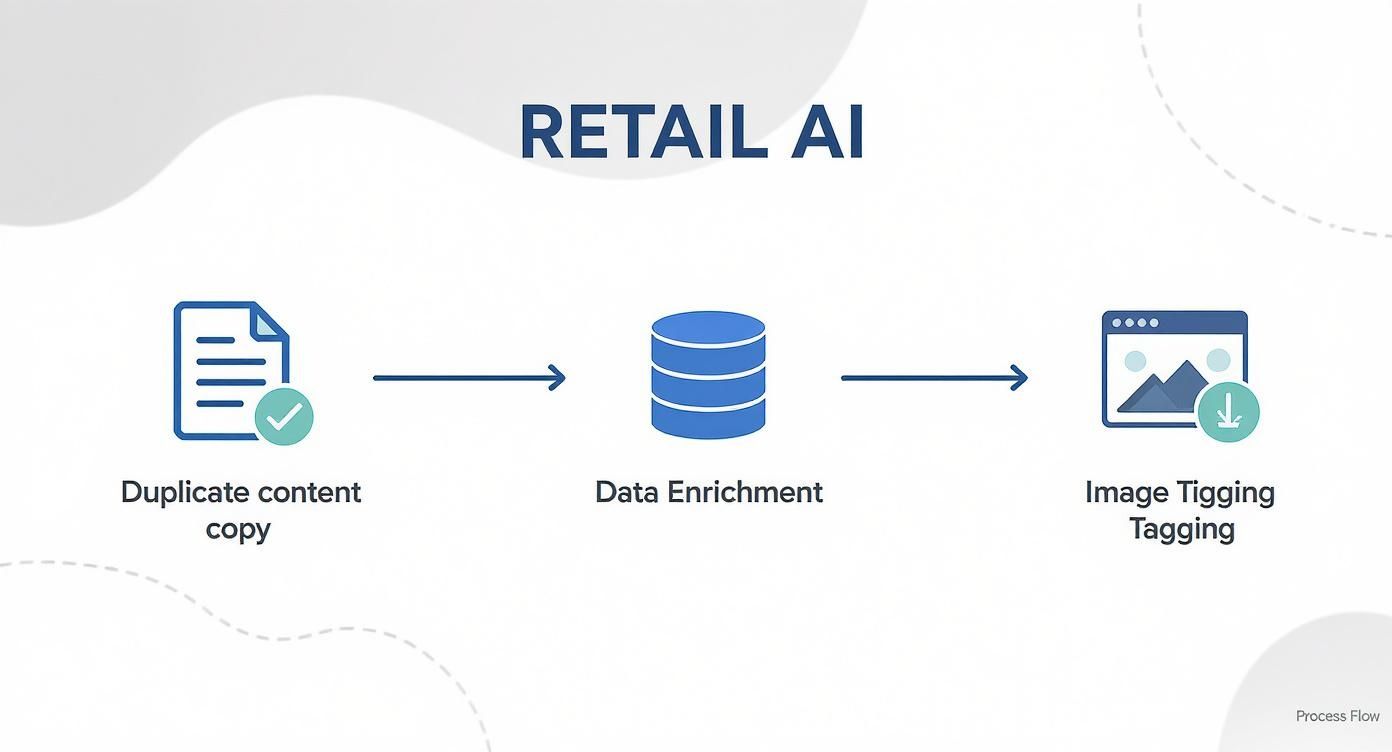
This visual shows the key stages in turning basic supplier feeds into powerful, SEO-ready assets for your digital shelf. It’s the only way to tackle supplier content duplication head-on and enrich your entire catalogue for superior digital shelf performance. By structuring the process this way, you can achieve a level of SKU-level SEO that’s impossible to reach by hand.
From Data Ingestion to Final Deployment
Executing this at scale requires a clear, step-by-step methodology managed by sophisticated AI agents for retail efficiency. Each stage is configured to meet your specific business rules, from brand voice to technical SEO requirements.
-
Initial Data Ingestion: The process kicks off by pulling in your entire product catalogue, including raw supplier feeds, existing product data, and all your image assets. This creates a single source of truth for all the optimisation work that follows.
-
Product Data Enrichment: This is where the magic happens. The system analyses the raw data and uses AI to expand on it. For an electronics retailer, it might turn a simple "16GB RAM" spec into a compelling benefit: "Experience seamless multitasking and lightning-fast performance, perfect for high-end gaming and professional creative work." This is the key to optimising product feeds efficiently.
-
Content Generation and Optimisation: With this enriched data as fuel, AI generated text models create unique product descriptions, meta titles, and other essential copy. This stage bakes in keyword strategies for verticals like fashion SEO optimisation or furniture SEO services, making sure every page is targeting the right search queries from the get-go.
-
Image Recognition and Tagging: At the same time, an AI image recognition SEO module gets to work on all your product images. It automatically generates descriptive alt text (like "Women's black leather ankle boots with side zipper") and relevant tags. This is a massive, often-overlooked step for alt tag optimisation for retail.
-
Human-Led Quality Assurance (QA): Before a single thing goes live, the generated content is reviewed by your team. This human + AI collaboration in SEO is non-negotiable. It ensures brand voice is spot on, facts are accurate, and everything aligns with your strategy. It’s not about rewriting; it’s about refining and approving the AI's work to guarantee high eCommerce content quality assurance.
-
Final Deployment: Once approved, the fully optimised content is automatically pushed back into your PIM or eCommerce platform, updating thousands of pages seamlessly.
This structured workflow is the engine of next-gen SEO for retailers. It smashes through content bottlenecks, delivering the speed, scale, and quality you need to compete and win.
Preparing for the Next Frontier of Agentic Search
The shift from manual SEO to AI-powered workflows is more than a simple efficiency upgrade. It’s a strategic necessity to get ready for the biggest shake-up in online search since the smartphone. We’re stepping into the era of agentic commerce, where AI agents will become the main way people discover and buy products.
This new reality demands a fundamental change in how retailers think about their online presence. Your future customers won’t be scrolling through endless pages of search results. Instead, they'll hand off their shopping lists to AI agents like Google's AI Overviews, Amazon's Rufus, and those built into platforms like ChatGPT and Perplexity.
This is the start of a massive transformation, one that will redefine the future of work in retail and demand an entirely new approach to SEO for AI agents.
Understanding Agentic Search Optimisation
Agentic Search Optimisation (Agentic SEO) is all about structuring and enriching your product data so AI agents can easily understand, trust, and recommend your products. Unlike traditional SEO, which is built around human search habits, agentic SEO is laser-focused on meeting the data needs of machines.
These AI shopping agents don't "browse" your website like a person does. They parse its underlying data, hunting for highly structured, detailed, and accurate information to make buying decisions on behalf of their users.
The ai generated text and enriched product data you create today is the foundational layer for being discoverable in this new search paradigm. Without it, your products will be invisible to the next generation of digital shoppers.
For a deeper look into the mechanics, our guide on preparing your product catalogue for agentic search breaks down the specific data structures and enrichment strategies you'll need. This AI-compatible SEO content is no longer a best practice, it’s a critical investment in future-proofing your business.
Why Structured Data Is the Key to Future Visibility
In the agentic shopping and the future of work, the quality of your product data is your most important asset. AI agents are built for precision. They need clear, machine-readable information to work properly.
Think about what an SEO for AI agents strategy needs to cover:
- Deep Product Data Enrichment: An agent needs more than just a title and a price. It needs every single specification, from the dimensions and materials of a couch to the processing speeds and port types for a laptop.
- SKU-Level SEO: Optimisation has to be granular. Every product variation, every size, every colour, needs its own complete set of enriched data. This ensures the agent can find the exact item a user is asking for.
- Clear, Factual Content: The AI will always prioritise accuracy. Your content must be fact-based and free from fluffy marketing jargon, allowing the agent to confidently compare your products against competitors.
This new ecosystem represents a monumental shift. To get a sense of the profound changes on the horizon, you can explore insights into the next frontier of agentic AI and how it will reshape digital interactions.
For retailers, this means the human + AI collaboration in SEO becomes vital. Your team's role shifts from writing content page by page to designing and managing the automated workflows that feed these agents. This strategic pivot ensures your brand isn't just a participant in the future of retail search, it's positioned to lead it.
Combining AI Automation with Human Expertise
Let's be clear: bringing AI into your content workflow isn't a 'set and forget' deal. While AI generated text delivers incredible speed and scale, its real value is unlocked when you pair it with your team's know-how. This is what we call Human + AI Collaboration in SEO. The goal isn't to replace your expert retail teams, it's to supercharge them.
Think of AI as the ultimate workhorse. It automates the repetitive, high-volume tasks that clog up your content pipeline. This frees your people to focus on what they do best: high-value strategic work like refining brand voice, shaping your overarching SEO strategy, and triple-checking factual accuracy. You get the best of both worlds, machine speed and human brilliance.
The Critical Role of Human-Led Quality Assurance
The single biggest risk in automating retail content is pushing out low-quality, off-brand, or just plain wrong information at scale. A robust, human-led AI content QA process is the non-negotiable safety net that stops this from happening. It’s what ensures every piece of content strengthens your brand and boosts your performance on the digital shelf.
An effective QA workflow means having your experts review and refine the AI's output before it ever sees the light of day. This step is absolutely crucial for protecting your unique brand identity and keeping customer trust. To dig deeper into striking this essential balance, check out our guide on balancing AI automation and brand voice in retail content.
This human oversight also acts as a critical line of defence. The same AI that powers retail efficiency can be used for malicious purposes. Australia, for instance, has seen a jaw-dropping 479.3% surge in phishing content, much of it crafted by AI to be frighteningly convincing. In 2023, Scamwatch logged about 109,000 phishing reports that led to AU$26.1 million in losses, showing just how much of a double-edged sword AI can be. You can find more insights on these AI-driven cybersecurity risks in Australia.
Building Reliable Retail Content Systems
A successful AI rollout is about building reliable, repeatable systems, not just cranking out one-off pieces of content. This systematic approach turns your content operations from a manual, reactive chore into a predictable, strategic asset for your business.
A solid system should be designed to:
- Ensure Brand Consistency: Your human team sets the guardrails for tone, style, and voice. The AI then executes flawlessly at scale across thousands of product pages.
- Validate Factual Accuracy: Experts must verify technical specs and product details, especially in tricky categories like electronics SEO optimisation or pharmacy eCommerce SEO.
- Align with Strategic Goals: Human strategists ensure the AI's output directly supports your bigger business goals, whether that's climbing search rankings or driving more sales.
By combining the speed of AI agents with the strategic direction of human experts, you build an automated content workflow that delivers both quality and scale. It's how you future-proof your business for whatever comes next in commerce.
Frequently Asked Questions
We get a lot of questions from retail leaders and eCommerce managers trying to figure out how AI-generated text fits into their world. Here are some of the most common ones.
How Does AI-Generated Text Actually Connect to Our PIM or CMS?
Great question. Modern AI content platforms aren't standalone tools; they're designed to plug directly into your existing setup. They use APIs to create a two-way street with your Product Information Management (PIM), CMS, or eCommerce platform like Shopify or BigCommerce.
The workflow is pretty slick. The AI pulls your raw product data, works its magic to enrich and generate new content, and then pushes the optimised pages straight back into your system. This means you can update thousands of product pages automatically, cutting out the mind-numbing manual work and streamlining your entire content process.
Will AI Replace Our In-House Content and SEO Teams?
No, the goal here is to supercharge your team, not replace it. Think of AI as a tool that handles the repetitive, soul-crushing tasks that create bottlenecks, like writing unique descriptions for 20,000 different SKUs.
This frees up your in-house experts to do what they do best: think strategically. They get to define the AI's brand voice, build out the overarching SEO strategy, analyse what's working, and oversee quality control. It shifts their role from content creators to content architects.
This human-AI partnership is where the real magic happens.
How Do We Make Sure the AI Content Doesn't Sound Like a Robot and Matches Our Brand Voice?
This is probably the most important piece of the puzzle. A good AI content process always starts with a deep dive into your brand. We're talking style guides, target audience personas, and even examples of your best-performing content. All of this is used to train and fine-tune the AI.
The system then generates content that sticks to those rules. But the critical final step is the human-led QA process. Your team gets the final say, reviewing and tweaking the output to make sure every single word is perfectly on-brand before it goes live. This is how you get both scale and quality, without compromise.
Ready to swap manual bottlenecks for a scalable, AI-powered content workflow? See how Optidan AI can transform your product catalogue and get your business ready for the future of agentic commerce. Learn more at https://optidan.com.
