

For Australian retailers, the shift from managing ecommerce by hand to using intelligent automation isn’t on the horizon anymore. It’s here. AI Shopping Platforms are a fundamental change in how retail works. Think of them as the central nervous system for a modern online store, built for speed, scale, and staying relevant in a market that gets more complex by the day.
They are the essential retail efficiency tools for any business looking to seriously compete online.
Embracing the New Reality of AI Retail
For retail leaders and ecommerce managers, the term 'AI' can feel a bit broad and intimidating. The best way to think about an AI Shopping Platform is not as a single tool, but as an automated expert on your team who works around the clock. Its whole purpose is to smash through the costly, time-consuming retail content bottlenecks that stop your business from growing effectively.
This shift represents a move from manual SEO to AI SEO, using smart, automated content workflows. Instead of an ecommerce manager spending weeks trying to correct duplicated supplier content from messy feeds, the platform gets it done in days. This is the practical side of generative AI for retail teams, the part that directly improves your digital shelf performance and your bottom line through AI workflow automation for retail.
Why Adoption Is No Longer Optional
The pressure to adopt these platforms comes directly from a clear change in how people shop. Australians are quickly making AI part of their buying habits. Recent data shows that almost half of all Aussies have already used AI assistants for online shopping, and that number jumps to a massive 66% for consumers under 45.
This signals a powerful generational move toward AI-driven commerce. It means getting ready for "agentic search" isn't a future problem, it's a today problem. You can explore more on these evolving consumer trends and online shopping innovations.
What does this all mean? It means old-school SEO and manual content management are quickly becoming obsolete. To stay visible in the future of retail search, your product catalogue has to be optimised not just for people, but for the AI agents they’re using to find things. These platforms get your products ready for the future of agentic commerce.
An AI Shopping Platform isn't just about new tech; it's a strategic move away from the limits of manual work. It creates a human + AI collaboration in SEO where your team can finally focus on high-value strategy, while AI agents for retail efficiency handle the content and data optimisation at a scale you could never imagine before.
The Strategic Advantage of Automation
Let's cut to the chase. The core benefit here is achieving SEO at scale. If you’re a retailer with thousands of products, manually creating unique, optimised content for every single one is completely impossible. This is exactly where automated content workflows become a non-negotiable part of your strategy.
An AI platform can execute critical jobs with incredible speed and accuracy.
Here's a high-level look at how AI platforms stack up against the old way of doing things, highlighting the shift from traditional SEO teams to AI-powered retail transformation.
Traditional Ecommerce vs AI-Powered Platforms
This table shows the clear strategic shift from slow, manual processes to fast, automated, and intelligent systems.
| Capability | Traditional Ecommerce (Manual) | AI Shopping Platform (Automated) |
|---|---|---|
| Content Creation | Slow, inconsistent, impossible to scale | Unique, on-brand content generated in minutes |
| Data Enrichment | Relies on incomplete supplier feeds | Automatically enriches and structures product data |
| SEO Management | Focuses on a few "hero" products | Optimises the entire catalogue for visibility |
| Error Correction | Manual, time-consuming data cleanup | Identifies and fixes duplicates and errors instantly |
| Market Responsiveness | Weeks or months to adapt to trends | Adjusts to market changes in near real-time |
The takeaway is simple: manual methods can't keep up with the scale or speed required to win in today's market. AI platforms give you the operational horsepower to compete.
For example, an AI platform can handle jobs like:
- Product Data Enrichment: Instantly turning basic, boring supplier feeds into compelling, structured product content that sells. This is a core part of optimising product feeds efficiently.
- Correcting Duplicated Supplier Content: Fixing all that duplicated supplier content to avoid SEO penalties and build a strong, consistent brand voice.
- Image Recognition and Tagging: Automatically generating descriptive alt tags and metadata for entire fashion or furniture catalogues, giving your image SEO a massive boost without manual effort.
Ultimately, these platforms deliver the scalable SEO solutions you need to improve rankings, increase visibility, and drive sales across your entire product range. This is how you solidify your position in the agentic commerce future.
Moving From Manual SEO to Agentic Search Optimisation
The traditional playbook for getting seen online is officially broken. For years, retail SEO was all about chasing a handful of high-volume keywords, a slow, manual, and often reactive game. That’s simply not enough to compete anymore, not when AI agents are becoming the new front door to your store.
This is where the game changes. We're moving from manual SEO to Agentic Search Optimisation (ASO), a forward-thinking strategy built for how people will actually find products tomorrow. It's about getting your entire product catalogue ready for discovery not just by human shoppers, but by AI agents like ChatGPT, Perplexity, and Amazon's Rufus. Think of it as a fundamental upgrade from old-school SEO to modern AI SEO.
Why Legacy SEO Teams Can't Keep Up
The biggest hurdle for traditional SEO teams is scale. Try manually optimising thousands of SKUs, each with its own unique description, metadata, and image alt tags. It’s an impossible task. This creates a massive retail content bottleneck, leaving the vast majority of your products under-optimised and essentially invisible online.
This manual approach leads to some critical, yet common, problems:
- Widespread Supplier Content Duplication: Using generic supplier descriptions is a recipe for disaster. It creates duplicate content issues that can get you slapped with significant SEO penalties, which requires a duplicate content SEO fix.
- Inconsistent Brand Voice: When you’re scrambling to update pages one by one, maintaining a cohesive brand identity across thousands of products is incredibly difficult.
- Missed Ranking Opportunities: The "long tail" of search, those highly specific, conversational questions people ask, remains completely untapped because manual efforts can't possibly cover every product variation.
This is exactly why AI workflow automation is no longer a "nice-to-have." An AI SEO strategy blows past human limitations. It enables optimised at scale workflows that can process over 10k+ pages in days, not years. You can learn more about how agentic AI is changing the way retailers compete online and understand why this shift is so critical for survival.
The core difference between AI SEO vs Traditional SEO is the shift from a reactive, limited-scope approach to a proactive, comprehensive strategy. It's about making sure every single product in your catalogue is an asset that can be found by the next generation of shoppers and their AI assistants, preparing you for the future of agentic commerce.
Preparing Your Catalogue for AI Agents
Agentic search optimisation isn't just about tweaking keywords, it requires a whole new mindset. Your goal is to create AI-compatible SEO content. This means structuring your product data in a way that an AI can easily understand and interpret it. You're essentially feeding the AI agent the exact information it needs to confidently recommend your product to a user for AI shopping SEO.
This comes down to a deep focus on product data enrichment. Your content needs to be packed with attributes, features, benefits, and specifications, all written in natural, conversational language. This is what prepares your catalogue for the detailed, multi-step questions that define agentic commerce. To stay ahead, it's also essential to keep up with the best ChatGPT rank tracker tools on the market.
By adopting AI-powered content workflows, you transform your SEO from a defensive chore into a powerful offensive strategy, locking in your visibility for the future of retail.
Automating Product Data Enrichment at Scale
The biggest bottleneck holding back most retailers isn't ad spend or inventory, it's messy, inconsistent supplier data. If you’re an ecommerce manager, you know the grind. Manually cleaning up thousands of product feeds is a never-ending battle that kills progress and hurts your bottom line.
This is exactly where AI shopping platforms give you a serious edge. They turn that chaotic, time-consuming task into a powerful, automated workflow.
Think of these platforms as a high-tech data refinery. They take in raw, often duplicated, supplier content and systematically turn it into perfectly structured, unique, and optimised product information that's ready for any channel you sell on. This process of product data enrichment is the bedrock of modern retail success and is key to ecommerce content optimisation. If you want to go deeper, you can explore the importance of product data enrichment and see how it directly drives performance.
This automated approach also solves one of the biggest risks in ecommerce SEO, which is supplier content duplication. By rewriting and enhancing thousands of descriptions automatically, the system eliminates the threat of SEO penalties while building a strong, consistent brand voice across your entire catalogue. This is crucial for ecommerce content quality assurance.
From Raw Feeds to Retail-Ready Content
The journey from a basic supplier feed to a high-performing product page involves several layers of AI-driven optimisation. It's essentially a retail content automation engine built for both quality and speed, finally making SKU-level SEO achievable even for massive catalogues.
This isn't just a minor shift, it's a fundamental change in how retail operates. AI is reshaping the entire ecommerce landscape in Australia. A recent report from the National AI Centre found that 46% of Australian retail businesses are already using AI, building personalised experiences that were once unimaginable.
This infographic shows just how far we've come, moving from painstaking manual efforts toward a future driven by agentic search.
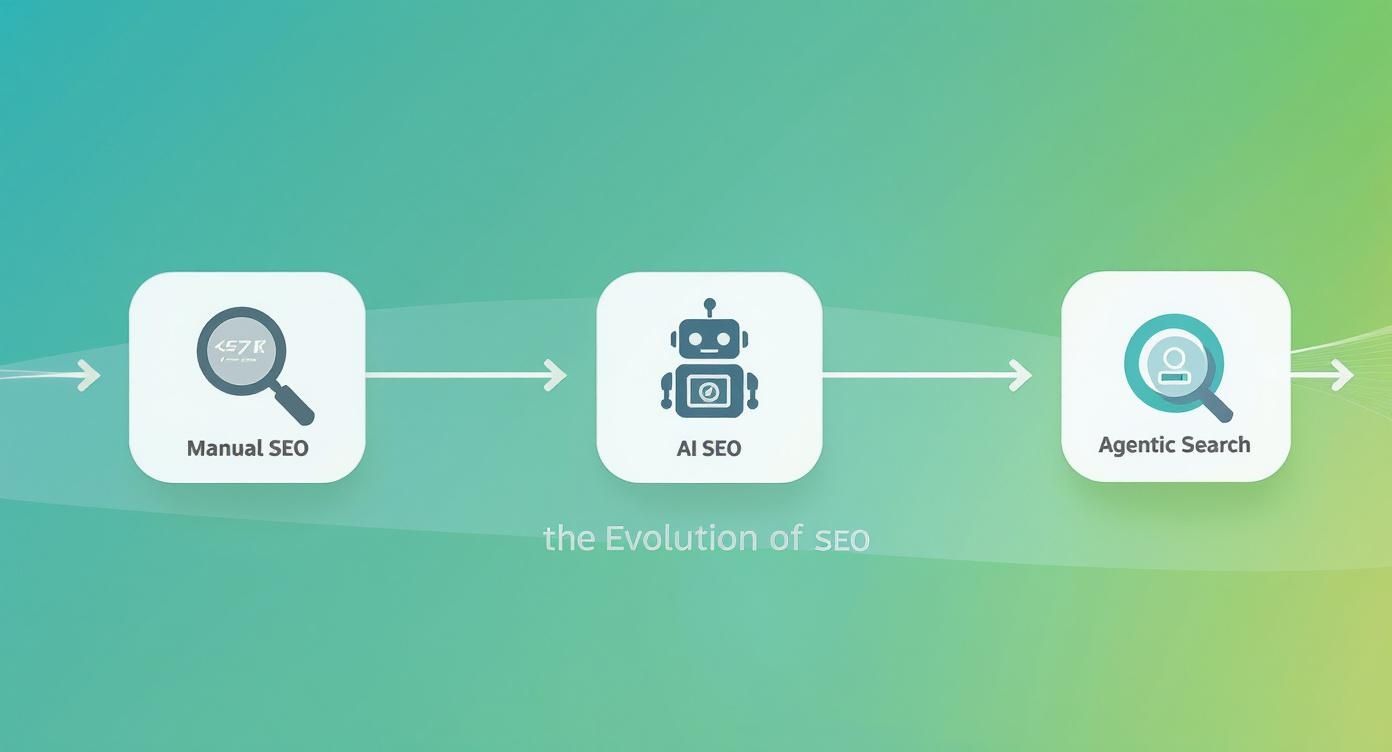
This progression from manual to agentic makes one thing clear: automation and intelligence are no longer optional if you want to stay competitive and improve your digital shelf performance.
Sector-Specific AI Optimisation
But AI's power isn't limited to just text. For industries where visuals are everything, it delivers a massive competitive advantage.
- Fashion and Furniture SEO: AI-powered image recognition and tagging can automatically analyse your product photos to create descriptive, keyword-rich alt tags. It can spot attributes like "linen," "oak finish," or "v-neck," boosting your visibility in image search without you lifting a finger. This is a critical part of fashion product image SEO and furniture image tagging SEO.
- Electronics SEO: For products with dense technical specs, the platform is a powerhouse for metadata optimisation at scale. It makes sure every single feature and technical detail is structured and optimised correctly, making your products easier to find and filter.
This is what we mean by SEO at scale for retailers. An AI-powered content workflow can process and optimise over 10k+ product pages in just a few days. A task of this size is simply impossible for a human team.
This level of efficiency ensures every single product in your catalogue is pulling its weight. The result is a digital shelf that's fully prepared for multi-channel product optimisation and the agentic commerce future that's already here.
Calculating the Strategic ROI of AI in Retail
For any retail leader, talk about new technology always circles back to one critical question: what’s the return on investment? Once you get past the flashy features, the real value of an AI Shopping Platform is its measurable impact on your bottom line. It's about connecting AI workflow automation for retail directly to profitability.
The ROI isn't just one number on a spreadsheet. It’s a collection of real-world outcomes that solve core business headaches.
It starts with smashing through retail content bottlenecks. By automating tedious jobs like automating product descriptions and enriching supplier feeds, you reclaim countless hours. Your team is freed up from repetitive manual work to focus on high-value strategy.
This newfound efficiency has a direct payoff, which is better performance on the digital shelf. When every single product is optimised with unique, high-quality content, your entire catalogue starts ranking better. You get more organic traffic and your retail search visibility climbs across every channel.
The Financial Case for AI Adoption
Investing in AI isn't a cost centre anymore, it's a fundamental requirement for growth. The Australian retail AI market is exploding, with revenues projected to jump from $310.9 million to a staggering $1.99 billion by 2030. This growth is being fuelled by advanced tech like agentic AI, which can operate on its own without needing a human to guide every step.
A recent report found that 77% of retailers in Australia and New Zealand now see AI agents in ecommerce as essential to staying competitive. On top of that, 74% are planning to increase their AI investments in the next year.
Investing in scalable SEO solutions isn't just about keeping up; it's about building a lasting competitive advantage. The ROI comes from higher conversion rates, lower operational costs, and the ability to outflank competitors who are still stuck doing things manually.
Measuring Long-Term Value and Efficiency
Beyond the immediate sales lift, the ROI of AI builds long-term resilience into your operations. Think about the cost of duplicate content penalties or the missed opportunity from thousands of under-optimised product pages. AI-powered content workflows eliminate these risks at scale, protecting your revenue and brand reputation.
When you're looking at the strategic ROI, it's important to see the whole picture. You can explore the broader implications of AI in ecommerce to get a sense of how deep this goes.
It shows that AI is not just another tool, it's becoming a central part of how retail will operate in the future. The choice is pretty clear: embrace an AI-powered retail transformation or get left behind. You can dig deeper into winning this new competitive race by reading about the new race for AI ROI.
How Human and AI Collaboration Redefines Retail Teams

The rise of AI in retail isn't about replacing your expert teams, it’s about making them better. For many ecommerce managers, a big concern is how these powerful new tools will affect job roles. The reality is, AI shopping platforms create a new, more effective dynamic of human + AI collaboration, moving the focus away from grunt work and toward genuine strategic oversight.
This shift is a huge step forward for the future of work in retail. AI is brilliant at handling repetitive, large-scale tasks that are simply impossible for human teams to manage efficiently. Just think about the challenge of writing unique, optimised content for a catalogue of 10,000 SKUs, or making sure every single product image has perfect alt tags for SEO. These are the content bottlenecks AI was born to solve.
Shifting Roles from Execution to Strategy
When AI handles the heavy lifting, the roles of your SEO, content, and merchandising specialists transform. Instead of being bogged down for weeks with data entry or manual content creation, they’re freed up to focus on what humans do best: strategy, creative direction, and quality assurance.
- Ecommerce Managers: You’re no longer a project manager for tedious tasks. Instead, you become a strategic leader who guides AI agents, analyses performance data, and makes the high-level decisions that actually drive growth.
- SEO Specialists: Forget manual keyword research for a handful of hero products. Now, you can oversee the AI SEO strategy for the entire catalogue, ensuring brand alignment and technical excellence across the board.
- Content Teams: The focus moves from churning out endless product descriptions to becoming brand guardians. Your team will refine AI-generated content through human-led AI content QA, develop creative campaigns, and ensure a consistent tone of voice that resonates with customers.
This model unlocks a level of retail teams and AI efficiency that was previously out of reach. Your team provides the critical oversight and creative input, while AI agents execute with speed and precision. It’s a powerful, scalable partnership.
The core of this new dynamic is simple: let AI handle the repetitive work so your talented people can focus on the strategic work. This partnership is the key to unlocking scalable SEO solutions and achieving superior digital shelf performance.
A New Model for Retail Productivity
This collaborative approach is a direct answer to the challenges of SEO at scale. For example, an AI platform can take messy supplier feeds, correct duplicated content, and generate thousands of unique product pages in just a few days. The ecommerce manager’s role then becomes one of quality control, reviewing the output and providing feedback to fine-tune the AI's performance.
This is the future of retail search in action. It's a system where AI workflows for ecommerce are managed and directed by human expertise. This creates a more agile, impactful, and ultimately more strategic workforce, ready for the challenges of agentic shopping and the future of work.
Your Questions About AI Shopping Platforms Answered
As retail leaders start to wrap their heads around intelligent automation, some very practical questions always come up. Here are direct, clear answers to the most common queries we hear, helping you navigate the shift to AI-powered retail with confidence.
What Is Agentic SEO and Why Is It Critical Now?
Think of Agentic SEO as optimising your website for AI assistants like ChatGPT, Perplexity, or Amazon's new Rufus, not just for people typing into Google. It’s become critical because shoppers are increasingly using these AI agents to discover products and get buying advice.
Traditional SEO was all about keywords. Agentic SEO, on the other hand, is built on structured data, conversational language, and really rich product details. This approach, also known as agentic search optimisation, helps AI agents properly understand your products and recommend them accurately. If your catalogue isn't ready for this new kind of search with AI-compatible SEO content, you'll be invisible to a huge, and fast-growing, group of shoppers.
For a deeper look, you can find answers to other questions in our guide to Agentic AI SEO content optimisation FAQs.
How Do AI Platforms Fix Duplicate Supplier Content?
This is a big one. Supplier content duplication is a major red flag for search engines and can get you penalised. AI shopping platforms tackle this head-on by using generative AI to automatically rewrite and enrich product information at a massive scale. The AI figures out a product's key features, injects your brand’s unique voice, and spits out thousands of unique product descriptions SEO-friendly and ready to go.
This automated workflow doesn't just solve the duplication problem, it dramatically lifts the quality of your content. It means every single product page can rank on its own merits, strengthening your digital shelf and clearing a massive bottleneck that holds back most retail content teams.
You can think of the AI's core job here as transformation. It takes that generic, low-value supplier data and turns it into a unique, high-performing asset for your brand. Suddenly, every single SKU is pulling its weight in your SEO strategy.
Will My Ecommerce Team Need Extensive Retraining to Use an AI Platform?
Not at all. Modern AI platforms are designed to enhance your team's existing skills, not make them redundant. The whole point is to shift your team away from tedious, manual work and toward high-level strategy and oversight. It’s about creating a powerful human + AI collaboration.
The platform takes care of the repetitive tasks that eat up your team's time, freeing them up to focus on what humans do best: strategy, analysis, and quality control. Most platform providers also offer plenty of training and support to make sure the transition is smooth. It’s a move toward a much more efficient model where the AI handles the scale, and your team provides the critical human intelligence.
Ready to eliminate content bottlenecks and prepare your retail business for the future of agentic commerce? Discover how Optidan AI can automate your product data enrichment and scale your SEO efforts. Visit Optidan to learn more.
