

Think of brand positioning as staking your claim on a unique piece of real estate in your customer’s mind. It's the art of defining what your brand stands for, moving beyond just price to build the kind of loyalty that lasts. For Australian retailers, this isn't a luxury; it’s essential for survival.
Why Brand Positioning Is Your Strongest Retail Asset
In a retail world flooded with duplicated supplier content, strong brand positioning has gone from a "nice-to-have" to a core business necessity. It’s the foundational strategy that separates market leaders from the crowd, making sure customers choose you not just for what you sell, but for what you represent. This is a critical first step in the journey from manual SEO to AI SEO.
This isn’t about a clever tagline or a memorable logo. True brand positioning is about owning a distinct concept in the consumer's mind. It's the reason a customer instantly thinks of your furniture brand when they hear "sustainable design," or your fashion label when they want "bold, expressive style." This mental real estate is your most valuable asset, directly influencing your digital shelf performance.
The Foundation of Digital Shelf Performance
A clear brand position acts as a guiding star for every single marketing and operational decision you make. It dictates everything from your product descriptions and image metadata to your customer service approach. When you get it right, it solves several huge challenges for modern ecommerce managers:
- Correcting Duplicated Supplier Content: Instead of relying on generic product feeds that make you sound exactly like your competitors, a strong position guides the creation of unique, brand-aligned content. This is where AI-powered product data enrichment becomes critical, transforming basic supplier info into a compelling story that reflects your unique value and building a unique voice.
- Building a Defensible Market Position: It lets you compete on something other than price. When you’re positioned as the expert in a niche or the leader in quality, you’re far less vulnerable to price wars and can command healthier margins, reducing retail content bottlenecks.
- Improving SEO at Scale: A consistent brand voice makes your content more authoritative and recognisable to both customers and search engines. This is essential for improving digital shelf performance and getting ready for the future of agentic search, where AI agents will rely on clear, structured data and AI-compatible SEO content to make recommendations.
The Commercial Impact in Australian Retail
The link between strong positioning and commercial success isn't just theory, it's proven. In Australia, a clear brand identity is directly tied to significant brand value growth. For example, recent industry analysis shows retail is the nation's most valuable sector, contributing AU$47 billion to the economy.
Woolworths, which has consistently positioned itself around freshness and value, was named Australia's most valuable brand for the fourth year in a row. Its value grew 18% to AU$16.2 billion, proving that a well-defined position translates directly into tangible financial gains and market leadership. You can see more insights in the Brand Finance Australia 100 2023 report.
Ultimately, a robust positioning strategy is the first step in moving from manual, reactive marketing to automated, strategic growth. It provides the framework needed for AI SEO and retail content automation to deliver real results. You can explore our guide to developing a powerful branding strategy framework to begin building your foundation.
How to Develop Your Brand Positioning Strategy
Alright, let's move from theory to action. Developing your brand positioning strategy is all about building a practical framework that carves out your brand’s unique identity in the market. For busy retail leaders and ecommerce managers, this process can be broken down into clear, manageable steps. It’s a strategic exercise that goes far beyond surface-level demographics to define what makes your brand genuinely different.
The end goal is to create a powerful positioning statement. Think of this statement as a north star for all your marketing, content, and product decisions. It ensures every part of your business tells a single, compelling story. This alignment is critical for achieving standout digital shelf performance with scalable SEO solutions.
The visual below maps out the core process flow, zeroing in on the key stages: understanding your audience, sizing up the competition, and nailing your value proposition.
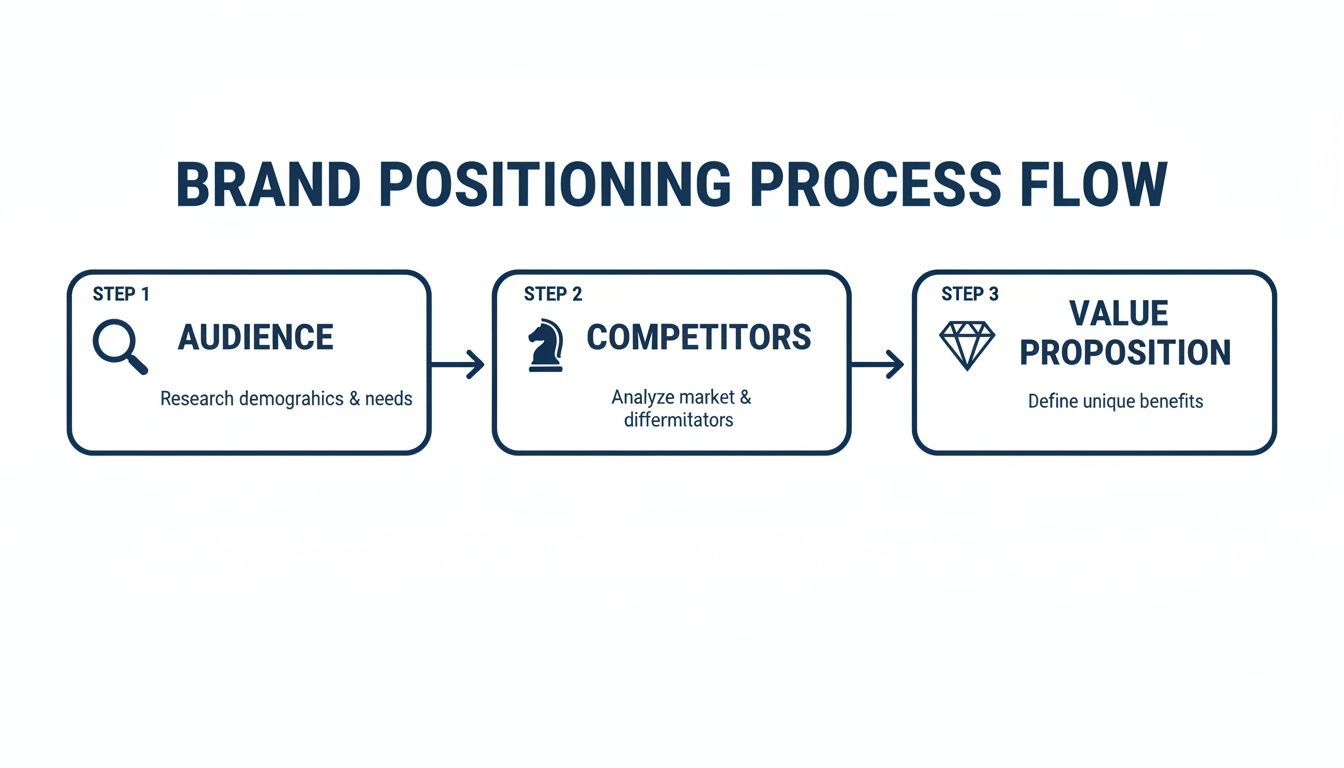
As you can see, a winning strategy always starts with a deep dive into your customers and competitors before you can even begin to articulate what makes you unique.
Step 1: Identify Your Target Audience
First things first, you need to define exactly who you're talking to. This is much deeper than basic demographics like age or location. You have to get inside their heads to understand their motivations, their pain points, and what they truly value when shopping in your category, whether that's fashion, furniture, or electronics.
To get there, start asking the right questions:
- What specific problems are they trying to solve with products like yours?
- What are their core values, and how do those values shape their buying decisions?
- Where do they hunt for information before making a purchase? (Think social media, blogs, or even AI agents.)
- What kind of brand experience are they actually looking for?
Getting this right is the bedrock of effective positioning. It ensures your message doesn't just reach them, but resonates on a level that builds real loyalty.
Step 2: Analyse Your Competitors
Next up, you need to map out the competitive landscape to find the gaps. Your brand can't be unique in a vacuum; its differentiation is always relative to the other players in the market. The mission here is to understand how your competitors position themselves so you can find a space that you can own completely.
Start by identifying both direct and indirect competitors. Then, dissect their messaging, brand voice, and perceived strengths and weaknesses. This analysis is where you'll uncover opportunities where customer needs are being underserved, allowing you to carve out a distinct and defensible spot in the market.
A common mistake is defining your brand based on what you think is unique. True differentiation comes from identifying what your customers perceive as unique and valuable compared to the alternatives.
Step 3: Pinpoint Your Unique Value Proposition
With a clear picture of your audience and the competitive field, the final step is to articulate what makes you different and, frankly, better. This is your unique value proposition (UVP). It’s the promise you make to your customers, one that you can deliver and that no one else can.
Your UVP should be a concise statement that answers three fundamental questions:
- Who is your customer? (Your specific target audience)
- What problem do you solve for them? (The core need you address)
- Why are you the best choice? (Your key differentiator)
This whole process culminates in crafting a positioning statement, which is an internal document that solidifies your brand's place in the market. While it's closely related to your company's core principles, it's distinct. You can dive deeper into this in our guide to writing a powerful brand mission statement.
For some inspiration, checking out powerful brand positioning statement examples can provide valuable insights. Ultimately, this defined position will steer every AI-powered content workflow and product data enrichment initiative you run, ensuring your brand story is told consistently and at scale.
Bringing Your Brand to Life with Scalable SEO Content
A brilliant brand positioning strategy is useless if it never reaches your customers. For Australian retailers, the real work begins after the strategy is defined. The challenge isn't just knowing your brand; it's translating that identity into compelling, unique content across tens of thousands of product pages. This is where the big-picture concept of positioning crashes into the day-to-day reality of ecommerce.
The biggest hurdle? A heavy reliance on generic supplier content. Using the same descriptions as dozens of your competitors instantly washes away any unique positioning you've built. It creates a sea of sameness that confuses customers and, worse, attracts search engine penalties for duplicate content. This retail content bottleneck is actively undermining your brand’s voice and digital shelf performance.
This is precisely where the jump from manual SEO to AI SEO becomes non-negotiable. It's simply not feasible for human teams to manually rewrite thousands of product descriptions. AI-powered content workflows offer a way to scale, turning a slow, resource-heavy job into an efficient, automated process that can optimise 10,000+ pages in days.
Overcoming Supplier Content Duplication at Scale
For retailers, especially in fast-moving sectors like electronics or fashion, supplier feeds are a double-edged sword. They give you the essential product data, but they often come bundled with bland, uninspired descriptions that have zero brand personality. Fixing this supplier content duplication is one of the fastest ways to improve your digital shelf performance.
AI-driven retail content automation tools can tackle this problem systemically. These platforms take the raw product data from supplier feeds and use it as a starting point to generate unique, brand-aligned content.
Here’s how it works:
- Product Data Enrichment: The AI analyses basic data like specs, materials, and dimensions. It then enriches this with descriptive language that actually reflects your brand's positioning, think "rugged and durable" for outdoor gear or "sleek and minimalist" for modern furniture.
- Unique Product Descriptions SEO: Instead of one generic description, AI workflows can produce multiple unique variants. This ensures every single product page is original, which directly addresses duplicate content issues and boosts your SKU-level SEO.
- Automating Product Descriptions: The system can generate optimised content for 10,000+ pages in a matter of days. That’s a scale that traditional content teams just can't match, representing a leap forward in retail efficiency tools.
This isn't just about dodging penalties. It's about seizing control of your brand's story on the digital shelf. Every unique description is a fresh opportunity to reinforce what you stand for and connect with your ideal customer.
Building a Foundation for Agentic Search
Moving towards AI SEO and automated content isn't just about solving today's headaches; it's about getting ready for the future of retail search. The rapid rise of AI shopping agents like ChatGPT, Perplexity, and Amazon's Rufus signals a massive shift in how people will find and buy products. The future of work in retail is here.
These AI agents will rely on structured, unique, and authoritative data to make their recommendations. Retailers still running on generic, duplicated content will simply become invisible in this new era of agentic commerce. By investing in unique content and product feed optimisation right now, you're building an AI-compatible foundation that ensures your brand stays visible and relevant.
This shift marks a new phase of human + AI collaboration in SEO. Your team sets the strategy, the brand voice, the key selling points, the target audience, and AI agents execute that strategy with incredible speed and precision across your entire product catalogue. Understanding the principles of writing content for a website that clicks with both humans and AI is fast becoming a core skill for retail leaders. This strategic approach to SEO at scale turns your product pages from simple listings into powerful assets that actively build your brand, drive sales, and future-proof your business for the next wave of search.
Using Product Data to Strengthen Your Brand Identity
In ecommerce, your brand story isn't just told through clever ads or your homepage copy. It's built right into the details of every single product page. For your brand positioning in marketing to stick, it has to be woven into the fabric of your product data, from enriched descriptions all the way down to image metadata. These aren't just back-end tasks anymore; they're your front-line brand-building tools.
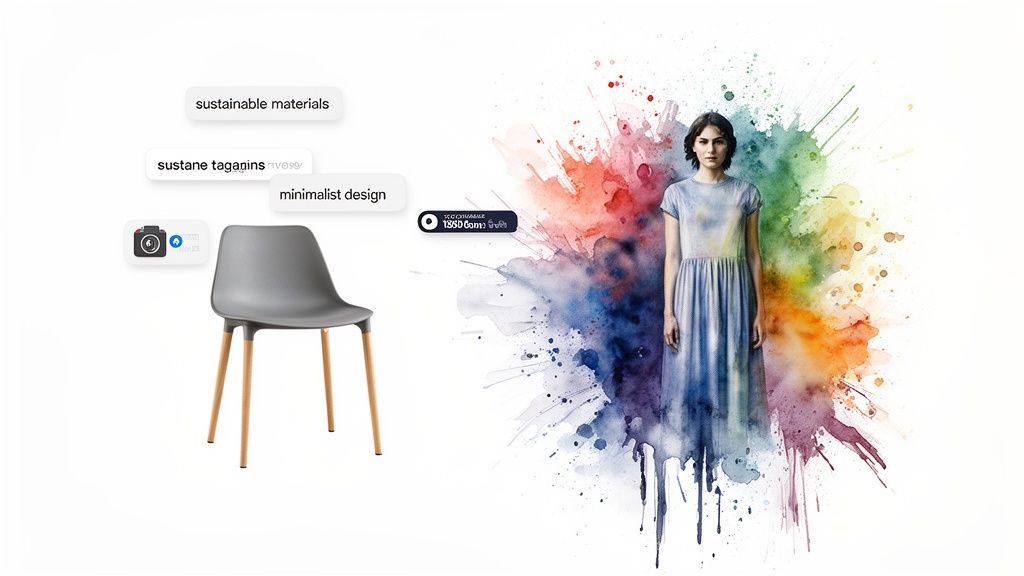
This is especially true for visual-heavy categories like fashion, furniture, and electronics. Here, customers shop with their eyes first, making image SEO for ecommerce a critical battleground. Being seen versus being invisible often comes down to the quality of your image data. This is where smart automation can give you a real edge, turning technical chores into powerful branding opportunities.
This shift matters because brands are now built online. In Australia, your digital shelf is everything. With 96% of Aussies online and 81% active on social media in 2023, this is where you have to win. The latest research shows that nearly one in three Australians now use social media to research brands, a figure that grew 7.3% in just one year. For a huge chunk of your audience, your product detail page is the first real handshake with your brand.
From Supplier Feeds to Brand Narratives
Turning a generic supplier feed into a compelling brand narrative is a journey paved with data enrichment. The first step is getting rid of supplier content duplication, but the real magic happens when you transform that basic data into a story that sells your brand, not just the item.
This is where an AI-powered content workflow really shines. It can systematically turn bland, generic feeds into rich, on-brand content. Imagine a retailer positioned around sustainability. The AI can instantly spot products made from recycled materials and automatically generate descriptions that champion their eco-friendly credentials. Suddenly, product feed optimisation goes from a tedious chore to powerful, automated storytelling. Of course, knowing how to write product descriptions that truly sell is the foundation for making this work.
AI Image Recognition and Automated Tagging
If you're managing a massive catalogue, manually tagging every single image with brand-aligned keywords is simply out of the question. It's an impossible task. This is where AI image recognition SEO steps in to provide a scalable fix. The technology scans your product images and automatically generates descriptive tags and alt text that reinforce what your brand stands for.
Think about how this plays out in different industries:
- Fashion SEO Optimisation: AI can identify and tag attributes like "bohemian style," "linen fabric," or "floral print," helping you rank for those specific long-tail searches that high-intent shoppers use.
- Furniture Image Tagging SEO: It can tag images with terms like "minimalist design," "solid oak construction," or "mid-century modern," embedding your brand’s aesthetic directly into your SKU-level SEO.
This kind of metadata optimisation at scale ensures every single image on your site is pulling its weight to strengthen your brand position. It boosts your image search visibility while consistently communicating your unique value, to both customers and the AI agents of tomorrow. By finally addressing the impact of supplier product feeds on brand voice, you can make sure every bit of data is working towards your strategic goals.
This structured, brand-rich data is exactly what emerging AI shopping SEO tools and agentic search platforms are built to find. By getting your product data in order today, you're not just improving your digital shelf performance right now; you’re future-proofing your brand for the agentic commerce future.
Measuring the Success of Your Brand Positioning Efforts
Let's be honest, "strong brand positioning" feels good, but it doesn't pay the bills. For retail leaders, that feeling needs to connect directly to the hard numbers that drive the business, especially your digital shelf performance. If you can't measure it, you can't prove its value.
Proving the return on your brand work isn't just a good idea; it's a priority. Australian marketers are already zeroed in on this, with a recent report showing 78% put the "growth agenda" at the very top of their list. That focus even beats out building a first-party data strategy or embedding brand purpose. You can get the full story in the 2023 Arktic Fox “Digital & Marketing in Focus” report.
The message is loud and clear: successful brand positioning in marketing has to be measured through a commercial lens.
Key Metrics for Tracking Positioning Impact
So, how do you connect your brand strategy to actual business outcomes? You need to watch a specific set of performance indicators. These are the metrics that show how your investment in AI-driven content and a unique brand voice is fuelling growth at a granular, product-by-product level.
Here’s what you should be tracking:
- Organic Search Rankings: Are you climbing the ranks for your strategic, brand-aligned keywords? Think terms like "sustainable kids' fashion" or "minimalist oak furniture." A steady climb here is a direct reflection of your brand's growing authority.
- Conversion Rate Uplift: This is a simple but powerful test. Compare the conversion rates on pages with your new, on-brand content against those still using generic supplier descriptions. A clear lift proves your positioning is hitting the mark with customers.
- Share of Voice (SOV): How often is your brand being mentioned online in key product categories compared to your competitors? Growing SOV is a strong signal of increasing market presence and better brand recall.
- SKU-Level SEO Performance: Don't just look at site-wide traffic. Dive deep into the traffic and sales for individual products that have undergone product data enrichment. This is where you prove the value of investing in quality content across your entire catalogue.
From Manual Guesswork to AI-Powered Proof
For years, trying to link brand initiatives to sales felt like guesswork. The shift from manual SEO to AI SEO changes the game entirely by making measurement faster, more accurate, and scalable across thousands of products. AI workflow automation for retail doesn't just create optimised content; it delivers the data you need to prove it works.
This isn't a small adjustment. It's a fundamental shift in how we execute and measure brand strategy. The AI SEO vs traditional SEO debate highlights that the old way of doing things simply can't keep up.
Traditional vs. AI-Powered Positioning Execution
| Task | Traditional SEO Team | AI SEO Automation |
|---|---|---|
| Content Rollout | Manually writes a few high-priority pages over weeks or months. | Generates 10,000+ unique, on-brand pages in a matter of days. |
| Performance Tracking | Relies on broad, site-wide analytics with a slow feedback loop. | Provides SKU-level data, enabling rapid A/B testing and optimisation. |
| Reporting ROI | Struggles to connect brand voice to specific sales uplifts. | Directly links content changes to conversion rates and keyword rankings. |
| Scalability | Content efforts are always limited by team size and budget constraints. | Offers scalable SEO solutions that grow with your product catalogue. |
By building dashboards that track these metrics, the link between brand and revenue becomes crystal clear. It's no longer a fuzzy concept but a measurable driver of growth.
This approach empowers you to show exactly how a strong brand identity, executed through AI-powered content workflows, directly fuels business growth and secures a genuine competitive edge in the market.
Future-Proofing Your Brand for Agentic Search
The way your customers find and buy products is about to fundamentally change. The rise of agentic search, powered by AI assistants like ChatGPT, Perplexity, and Amazon's new Rufus, means your brand's future visibility hinges entirely on the quality and structure of your product data today.
This shift from manual SEO to AI SEO isn't a far-off concept anymore. For every Australian retail leader, it's an immediate priority.
In this new era of agentic commerce, a strong, data-rich brand position is your most important asset. AI shopping agents won’t browse your website like a human does. Instead, they'll comb through structured product data, unique descriptions, and authoritative content to make direct, trusted recommendations.
Retailers still relying on generic, duplicated supplier content are at serious risk of becoming invisible. Imagine an AI agent comparing ten retailers selling the exact same TV. The brands with unique, enriched data and a clear position will be the ones it trusts. Those with thin, copied content? They'll just be filtered out of the conversation.
Preparing for AI-Compatible SEO
The strategic work you do now isn't just about chasing today's search rankings. It's about laying an AI-compatible foundation that prepares your brand for the future of retail search, which demands a completely new way of managing your product catalogue.
Key preparations include:
- Product Data Enrichment: Going beyond basic supplier feeds to create detailed, structured content that clearly shows off your brand's unique value.
- Unique Content Creation: Using AI-powered content workflows to wipe out duplication, making sure every single SKU has its own distinct, brand-aligned description and attributes.
- Metadata Optimisation at Scale: Using AI image recognition to generate descriptive, relevant tags and alt text, adding layers of context that AI agents can understand.
This isn't about replacing your team. It's about giving them superpowers. The future of work in retail is a human + AI collaboration. Your team sets the high-level strategy and brand direction, while AI agents for retail efficiency handle the grunt work at a scale that would be impossible for humans alone.
This strategic alignment ensures your brand's positioning is perfectly communicated to both human shoppers and their AI assistants, securing your digital shelf performance for years to come.
By adopting scalable SEO solutions now, you're not just optimising for today's search engines, you're actively building the retail tech stack for an agentic future. This forward-thinking approach to brand positioning in marketing turns your product data into your most powerful competitive edge, ensuring you don’t just survive the shift to AI shopping SEO, but lead it.
Frequently Asked Questions
Getting your head around brand positioning can feel like a tough gig, especially when retail tech seems to change every other day. Let’s break down some of the most common questions we hear from Aussie ecommerce managers and retail leaders.
What Is the Difference Between Branding and Brand Positioning?
Think of it this way: your branding is the whole toolkit, your logo, colours, the way you talk. It's the 'what'. Brand positioning, on the other hand, is the specific spot you’ve decided to own in your customer's mind, especially compared to everyone else selling similar stuff.
Positioning is the 'where'. It’s the strategy that tells you how to use your branding toolkit. A sharp position ensures every single thing you put out there, from a product description to an Instagram post, hammers home one clear, consistent message.
How Can Smaller Retailers Compete with Giants?
You can't outspend them, so you have to outsmart them. The secret is to find a niche and own it completely. Forget trying to be everything to everyone. Instead, focus on a specific customer group or a unique value that the big players are too slow or too broad to bother with.
This is where tools like AI SEO and retail content automation become your unfair advantage. They let smaller teams execute a super-targeted positioning strategy at scale, pumping out unique, optimised content for their entire catalogue without an army of writers. By dominating your corner of the market, you build a loyal following the big guys can't touch.
My Current Positioning Isn’t Working What’s the First Step?
If your positioning is falling flat, stop guessing and start diagnosing. The first move is always to go back to the data. Kick things off by digging into your digital shelf performance. Where are you bleeding? Which products and categories are invisible in organic search or failing to convert?
The biggest mistake we see is brands assuming everyone else sees them the way they see themselves. The market’s perception is the only one that matters. Customer surveys, competitor analysis, and keyword research will quickly show you the gap between where you think you are and where your customers actually place you.
Once that data is on the table, you'll see the disconnects. From there, you can start building a new position, one that's not just different, but genuinely matters to the people you want to sell to. It's a strategic move, not just a reaction.
Ready to fix your brand's digital shelf performance for good? Optidan AI gives retailers AI-powered content workflows to create thousands of unique, SEO-ready product pages at scale. We correct duplicated supplier content and get your brand ready for the new world of agentic search.
Find out how our scalable SEO solutions can sharpen your brand positioning by visiting https://optidan.com.
