

At its core, a brand mission statement is a short, sharp declaration of your company’s purpose. It answers three simple questions: what you do, who you do it for, and the value you bring to the table. Think of it as the strategic North Star for your entire retail operation.
Your Mission Statement in the Age of AI Search

The role of your brand mission statement has fundamentally changed. What was once a static paragraph on an 'About Us' page is now a critical asset for winning in the new era of AI SEO. For retail leaders and ecommerce managers, understanding this shift isn't just important, it's essential for protecting your digital shelf performance and future-proofing your brand.
Search is moving away from clunky keyword queries and towards fluid, conversational interactions. Your mission statement provides the foundational context that AI agents crave. Generative AI tools like ChatGPT, Perplexity, and Rufus aren’t just matching keywords, they're reasoning engines. They’re built to understand intent, purpose, and value, which is the very DNA of a strong mission statement. This readiness for agentic search is a core part of next-gen SEO for retailers.
Why Your Mission Is Now an SEO Signal
In the past, retail SEO was a game of keyword optimisation. Today, with the rise of agentic search optimisation, the game has changed. The new goal is to provide clear, unmistakable signals about your brand’s identity and what makes you different. Your mission statement is the strongest signal you have for achieving scalable SEO solutions.
It acts as a cheat sheet for AI agents, helping them quickly grasp:
- Your Brand's Purpose: Why do you exist beyond just moving boxes?
- Your Unique Value: What problem do you solve better than anyone else?
- Your Target Audience: Who are you here to serve?
This clarity is everything. When an AI agent assesses your website, it's looking for a coherent story. A well-crafted mission gives it the 'why' behind your 'what'. This allows AI to confidently recommend your brand for complex, high-intent queries that go far beyond a simple product search. This is how you prepare your brand for the future of retail search, where agentic shopping will be the norm.
From Manual Keywords to AI-Driven Context
This pivot from manual SEO to AI SEO marks a massive strategic shift. You’re no longer just optimising product pages; you’re optimising your entire brand narrative for machine comprehension. Your mission statement is the source code for that narrative, forming the foundation of your retail content automation strategy.
Your mission statement acts as the central thesis for your brand. Every piece of content, from product descriptions to blog posts, should support and reflect this core purpose, creating a unified signal for AI agents.
This is especially crucial for retailers battling supplier content duplication. A generic supplier feed offers zero unique context, making it impossible for an AI to tell your products apart from your competitors'. By grounding your content strategy in your mission, you can begin the process of product data enrichment at scale. You start turning duplicated, invisible content into unique, mission-aligned stories that build a distinct brand voice and boost your digital shelf performance. This shift to AI-powered content workflows is essential for reducing retail content bottlenecks.
To get a better handle on optimising your online presence in this new landscape, exploring the specific steps for AI Search Engine Optimization will ensure your mission hits the mark. When you turn your purpose into a measurable competitive advantage, you’re ready for a future dominated by AI-powered discovery.
How Your Mission Drives Growth in Australian Retail

A clearly defined brand mission statement isn’t just a feel-good phrase for your website’s ‘About Us’ page. It’s a powerful commercial asset, especially in the hyper-competitive Australian retail market. For retail leaders, a strong mission is your strategic compass. It shapes customer loyalty, simplifies day-to-day decisions, and even helps you attract top-tier talent.
More importantly, it’s the bridge connecting your brand’s purpose to real, measurable outcomes like higher conversion rates and stronger digital shelf performance.
Think of your mission as the starting point for your brand’s unique voice. This is absolutely critical for tackling the widespread problem of supplier content duplication. Your mission gives you the ‘why’ behind what you sell, letting you turn generic, copy-pasted product feeds into distinct stories that actually connect with savvy Australian shoppers.
Moving Beyond Generic Supplier Content
Let’s be blunt: relying on duplicated supplier descriptions is a fast track to poor search visibility and a watered-down brand. Your mission statement is the unique angle you need for effective product data enrichment. It becomes the filter for your content strategy, making sure every product description reflects your core values, whether that's sustainability, local craftsmanship, or cutting-edge tech. This is how you can scale SEO content for retail effectively.
This process is the bedrock of any solid retail SEO automation effort. By anchoring your content in a unique mission, you create a clear framework for AI workflow automation for retail. This is how you rewrite thousands of product descriptions at scale, ensuring each one is original, optimised for search, and perfectly aligned with your brand’s purpose. It’s the most effective way to solve the duplicate content penalty for good.
Connecting with the Australian Consumer
Today's Australian shoppers are smart. They look for authenticity and will quickly tune out brands that feel hollow or lack a clear purpose. A well-crafted mission statement helps you build a genuine connection that goes far deeper than just price tags and product features.
The data backs this up. A recent study revealed that a massive 88% of Australian consumers feel brand messaging often fails to align with their personal needs and values. On top of that, sustainability is a key deciding factor for 46% of Australians when they shop. It's a clear signal: brands need to move beyond product-centric slogans and adopt a purpose-driven model that communicates ethics and social impact.
A brand mission isn't just a marketing metric; it's a core driver of brand equity and financial performance. It informs every touchpoint, from your SEO strategy to your customer service, creating a consistent and trustworthy brand experience.
This alignment has a direct impact on your bottom line. When your mission is clear, decision-making across the business becomes simpler, from marketing campaigns to supply chain choices. Every action reinforces your brand's promise, and that consistency is what builds lasting customer trust.
Driving Tangible Business Outcomes
A strong brand mission is the foundation for scalable growth. It's the first and most important step in differentiating your brand in a crowded market and preparing for the future of work in retail, where human + AI collaboration in SEO is becoming the new standard.
This purpose-driven approach delivers several concrete benefits:
- Improved Customer Loyalty: A clear mission builds a deeper bond with customers who share your values, leading to better retention.
- Enhanced SEO Performance: Unique, mission-led content naturally improves your SKU-level SEO and helps you stand out in both traditional and AI-powered search results.
- Attraction of Top Talent: A strong sense of purpose makes your company a more attractive place to work, helping you build a team that is genuinely invested in your brand's success.
Ultimately, your brand mission statement is a strategic tool that powers SEO at scale for retailers. It allows you to shift from manual, reactive content fixes to proactive, automated workflows that build a stronger, more visible, and more profitable retail brand.
The Building Blocks of a Powerful Mission Statement
A powerful brand mission statement doesn’t just materialise out of thin air. It’s built from a few specific, intentional components that get to the heart of your brand’s identity. Forget abstract theories for a moment; what you need is a practical framework that helps you build a mission to guide everything from marketing right through to operations.
For any retail brand, this framework really boils down to three essential pillars: your purpose (the ‘why’), your value (the ‘what’), and your audience (the ‘who’). Nailing these is the first step in creating a consistent story that not only connects with people but also prepares your product catalogue for the future of AI-powered search and agentic commerce.
This simple hierarchy shows how these three pillars work together to form a solid foundation for your mission.
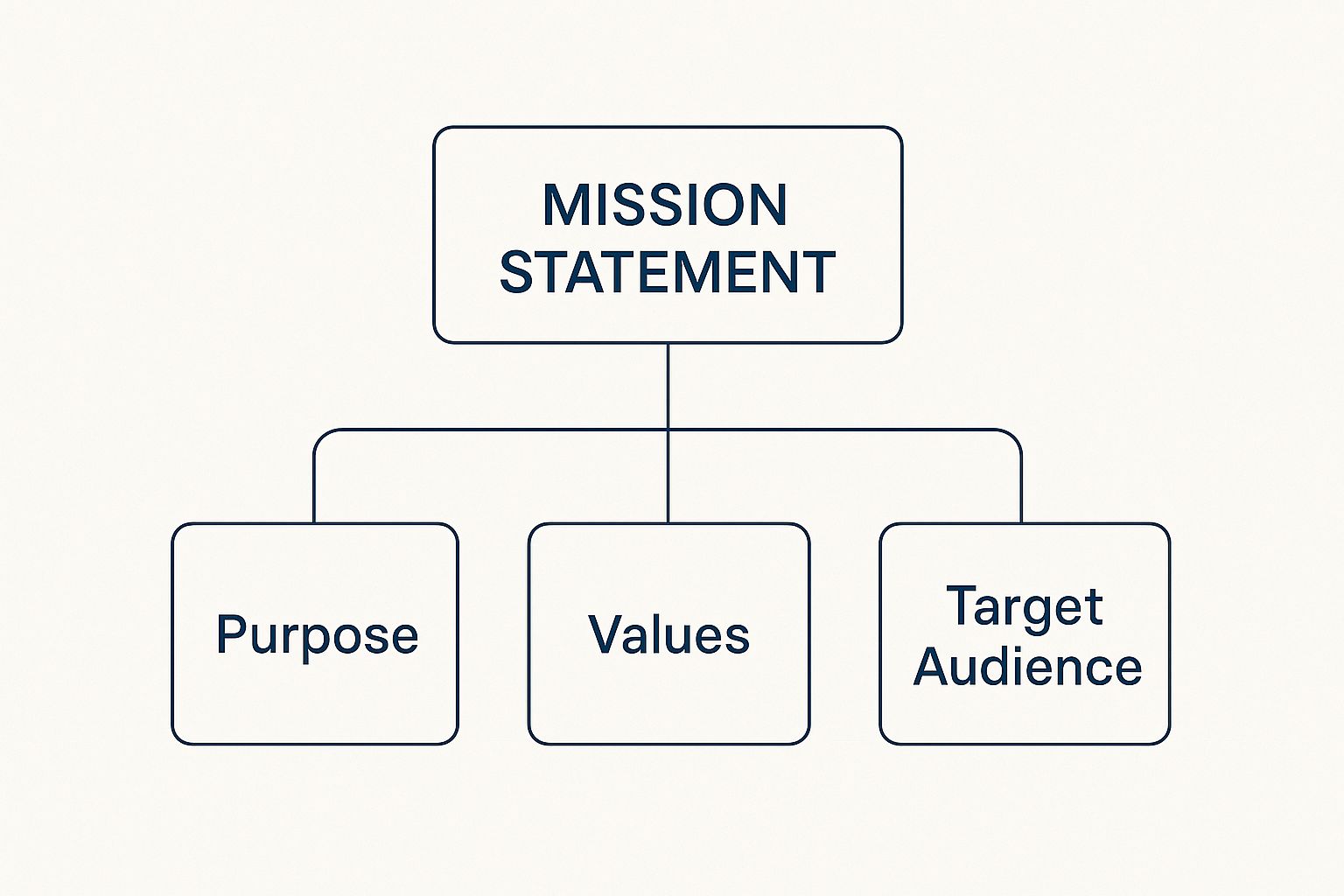
As you can see, they aren't just separate ideas. They’re interconnected pieces that, when combined, define what your brand truly stands for.
To break it down even further, here's a look at the core components every retail mission statement should have, along with the questions that get you to the right answers.
| Component | Guiding Question | Retail Application Example |
|---|---|---|
| Purpose (The Why) | Why does our business exist, beyond making money? | "To make sustainable style accessible to everyone." |
| Value (The What) | What tangible benefit or unique experience do we deliver? | "Delivering handcrafted, Australian-made furniture that lasts a lifetime." |
| Audience (The Who) | Who are we specifically here to serve? | "Creative professionals who demand performance and design." |
Getting clear on these three areas is the difference between a mission statement that gathers dust and one that actively drives your business forward.
Defining Your Core Purpose
Your purpose is the soul of your brand. It’s the real reason your company exists, beyond just turning a profit. Think of it this way: for an AI agent trying to understand your brand, your purpose is the main signal that sets you apart from a sea of competitors. It’s the ‘why’ behind every single product you sell.
To get to the heart of your purpose, sit down with your leadership team and ask these questions:
- What problem did we originally set out to solve?
- If we were gone tomorrow, what would our customers genuinely miss?
- What kind of impact do we want to have on our industry or community?
A fashion brand’s purpose, for instance, might be "to make sustainable style accessible to everyone," which is a world away from just "selling clothes." This kind of clarity is absolutely essential for feeding AI the right signals, giving it the context it needs to understand your product catalogue SEO.
Articulating Your Delivered Value
While purpose is your ‘why’, value is your ‘what’ and ‘how’. It’s the tangible, real-world benefit you provide to your customers. This piece of the puzzle has to be clear, compelling, and directly solve a problem or meet a desire for your target market. It’s what you do better than anyone else.
To pin down your value, consider these prompts:
- What unique experience or result do our products deliver?
- How do we make our customers' lives better, even in a small way?
- What are the core principles that guide how we choose our products and serve our customers?
A furniture retailer might define its value as "delivering handcrafted, Australian-made furniture that lasts a lifetime." This statement immediately tells you about quality, local craftsmanship, and durability. It’s this unique angle that helps you fix issues like supplier content duplication and gives you a strong story to work with when automating product descriptions.
Your brand's value proposition is the promise you make to your customers. A strong mission statement makes that promise clear, memorable, and consistent across every channel.
Identifying Your Target Audience
Finally, a mission statement has to speak to a specific audience. When you try to be everything to everyone, you end up with a bland, watered-down message that connects with no one. Clearly defining who you serve lets you tailor your language, your values, and the entire brand experience to them.
An electronics retailer might target "creative professionals who demand performance and design," which is far more focused than "people who need computers." This sharp focus is critical for agentic search optimisation, as AI agents will use this exact information to match your brand with shoppers who have high intent and are ready to buy.
Defining these three building blocks isn't just a branding exercise. It’s a strategic must-have for any modern retailer, forming the foundation for a strong brand voice and an effective SEO strategy. For expert help in crafting these foundational elements, professional brand strategy services can offer invaluable guidance. By clearly articulating your purpose, value, and audience, you create the essential data points that drive both customer loyalty and performance in an AI-driven world. If you want to dive deeper, you might be interested in developing a strong brand voice strategy for your Shopify store.
Activating Your Mission with an AI Content Strategy
A brand mission statement shouldn’t just be a nice-sounding line on your ‘About Us’ page. It needs to be an active tool that shapes how you do business. This is where your ‘why’ plugs directly into the ‘how’ of modern ecommerce, turning your core purpose into a content engine that can actually scale. With AI workflow automation for retail, you can finally translate your mission into unique, optimised content across thousands of product pages.
This is the bridge between a static mission and an active content strategy, and it’s the key to solving some of retail’s biggest headaches. It provides the framework to fix duplicated supplier content, build a unique brand voice, and lift the performance of your entire product catalogue. It’s all about making your mission do the heavy lifting for you.
And this is where the future of retail search is heading. By embedding your mission into your content, you’re creating AI-compatible SEO content that’s ready for today’s search engines and the next wave of agentic shopping.
From Supplier Feeds to Mission-Led Narratives
The first real step is to stop using raw, generic supplier data and start telling compelling brand stories. Your mission statement becomes the creative brief for this whole process. It guides the product data enrichment workflow, making sure every single product description, spec, and feature reinforces what makes your brand different.
An AI-powered content workflow can automate this entire transformation. You give the AI your brand mission, voice guidelines, and target audience, and it can generate thousands of unique product descriptions in days, not months. Here’s how automated content workflows function:
- Ingesting Supplier Feeds: The system pulls in the basic data like SKU, product name, and technical specs.
- Applying the Mission Filter: The AI looks at your mission to get a handle on your core values. Is it sustainability? Innovation? Quality craftsmanship?
- Generating Unique Narratives: It then rewrites those generic descriptions to reflect your mission. A simple jacket is no longer just "a waterproof outer layer." It becomes "your reliable companion for urban exploration, crafted from recycled materials to protect you and the planet."
- Optimising for Search: At the same time, the content is optimised for relevant keywords, boosting your SKU-level SEO and improving your overall digital shelf presence.
This approach finally solves the supplier content duplication problem that holds so many retailers back. Instead of getting penalised for generic content, you start building real brand equity with every product page you publish.
A brand mission statement gives AI the context it needs to act as your brand’s storyteller at scale. It transforms a workflow from simple data processing into a powerful tool for building a consistent and compelling brand narrative.
Optimising Visuals with AI Image Recognition
Your mission isn’t just about words; it should shape your visual strategy too. In categories like fashion SEO optimisation or furniture SEO services, the right image is everything. AI image recognition and tagging can bring your mission to life visually across your entire catalogue, ensuring even your metadata sings from the same hymn sheet.
Think about what that looks like in practice. An AI can scan thousands of product images and automatically write descriptive, mission-aligned alt tags. So instead of a generic "black dress," an AI guided by your mission might generate "a sustainably-made black cocktail dress for the modern minimalist." This kind of alt tag optimisation for retail is crucial.
This automated process creates consistency and gets your site ready for the future of agentic commerce. AI agents like Rufus and Perplexity depend on rich, structured data, both text and image metadata, to understand and recommend products. When you optimise at scale, you make sure your entire digital shelf is ready for both human shoppers and their AI agents. The mix of mission-aligned text and visually optimised metadata sends a powerful, unified signal that boosts visibility and conversions.
This is what next-gen SEO for retailers is all about. It’s a move away from manual, one-off updates to a complete, automated system where your brand mission guides every single piece of content. This strategic shift doesn't just clear retail content bottlenecks; it positions your brand for long-term success in an AI-driven market. To learn more about creating content that drives results, check out our insights on content marketing for ecommerce. By putting your purpose to work, you build a resilient and competitive brand that’s ready for the future of retail.
Real-World Examples from Leading Australian Brands
Theory is great, but seeing a powerful brand mission statement in the wild is where it all clicks. To really see what works, let’s look at how a couple of top-tier Australian brands use their mission to steer their business, win over customers, and drive real growth.
These companies prove a mission isn’t just a nice-sounding sentence for your website. It's a strategic asset. It shapes their marketing, defines the customer experience, and carves out a clear identity that cuts through the noise. When you break down their approach, you can draw a straight line from their purpose to their performance.
And the financial impact is huge. The 2025 Kantar BrandZ report revealed that the top 40 most valuable Aussie brands grew their combined value by 25% since 2023, hitting a massive US$156 billion. Who’s leading the pack? Brands like Commbank (valued at $31 billion) and Canva ($14.2 billion), both thriving because their missions are baked into everything they do. This isn't a coincidence. It shows the clear competitive edge Australian companies gain when they put a sharp, values-driven mission statement to work. You can check out more insights into Australia's most valuable brands on Kantar's website.
Commbank Building a Brighter Future
Commbank’s mission is simple: "to improve the financial wellbeing of our customers and communities." It's a masterclass in clarity and putting the customer first. It completely shifts the focus from just banking transactions to a bigger, more meaningful goal of creating a positive impact.
Let’s quickly pull it apart with our framework:
- Purpose (Why): To improve financial wellbeing.
- Value (What): Giving people the tools and support they need for better financial health.
- Audience (Who): Their customers and the wider Australian community.
You see this mission everywhere in their business. From budgeting tools inside their app to community grant programs, every single touchpoint connects back to this core idea. For any retail leader, this is a perfect example of how a service-focused mission can build incredible trust and set you apart in a ridiculously crowded market.
Canva Empowering the World to Design
Over at Canva, their mission is "to empower everyone in the world to design anything and publish anywhere." This statement nails the brand's entire vibe. It’s big, it’s for everyone, and it’s directly tied to what the product actually lets you do.
Canva’s success is built on a mission that is both a promise to its users and a guiding principle for its product development. It answers the 'why' with unwavering clarity.
This mission drives their whole content and SEO strategy. It’s the reason they have templates for literally everything you can think of, making sure their platform shows up for millions of specific search queries. Their mission has become a powerful engine for organic growth, perfectly positioning them for the future of retail search, where AI agents will look for brands that solve very specific problems for very specific people.
For retailers, the lesson here is critical. When you build a mission around empowering your audience, you create a solid foundation for a content strategy that can scale. It provides the context AI SEO needs and helps automate unique product descriptions that actually connect with your target market. These examples are proof that a well-crafted brand mission statement is the cornerstone of any brand that wants to be resilient, visible, and ultimately, profitable.
Frequently Asked Questions
Got questions? You're not alone. Figuring out how to connect a high-level idea like a brand mission statement to the nuts and bolts of your retail business can be tricky. Here are some of the most common questions we hear from retail leaders, especially when it comes to AI SEO and scaling up content.
How Does a Mission Statement Influence AI SEO?
Think of your mission statement as the strategic brief for modern AI SEO. It’s the foundation that search agents need to understand your brand. Traditional SEO was all about keywords, but agentic search optimisation is a whole different game. It’s about purpose, value, and audience.
AI agents like ChatGPT, Perplexity, and Google's AI Overviews don't just scan for words; they try to understand why you exist. Your mission gives them that context. It helps them confidently recommend your products for complex, intent-driven questions, which is exactly how you improve your digital shelf performance and get ready for the future of retail search.
This is also your secret weapon against supplier content duplication. By baking your mission into your product data enrichment process, you create unique, authoritative content that stands out from generic supplier feeds. AI agents can then prioritise your listings with confidence. For a deeper dive on this, check out our Agentic AI SEO content optimisation FAQs.
How Can I Activate My Mission Across 10,000 Product Pages?
Trying to manually weave your brand mission into thousands of product pages is a non-starter. It’s simply impossible. This is where AI workflow automation for retail becomes essential. The trick is to turn your mission from a big idea into a practical, repeatable guide for your content engine.
Here’s how a scalable SEO solution makes it happen:
- Feed the AI Your Mission: You give the system your mission statement, brand voice guidelines, and target customer profiles.
- Automate the Rewrite: The AI then gets to work, transforming thousands of generic supplier descriptions and injecting your unique value proposition into every single one.
- Enrich with Visuals: Using AI image recognition and tagging, the system creates mission-aligned alt text and metadata for all your product images, reinforcing your brand story.
This isn't just about speed, it's about achieving optimised at scale workflows that can refresh your entire catalogue in days, not years. It’s the only practical way to automate product descriptions while keeping quality and brand consistency locked in.
What’s the Difference Between a Mission and a Vision Statement?
People often mix these two up, but they serve very different roles. Getting the distinction right is key to creating both effectively.
-
A mission statement is about the here and now. It answers, "What do we do?", "Who are we doing it for?", and "What value do we bring today?". It’s grounded, practical, and action-oriented.
-
A vision statement is about the future. It answers, "What do we want to become?" or "What ultimate impact do we want to have?". It’s aspirational, inspirational, and forward-looking.
Think of it this way: Your mission is the road you’re on right now. Your vision is the destination you’re driving towards. You need both to know where you're going and how you'll get there.
For an ecommerce manager, the mission guides today's tasks like ecommerce content optimisation and product feed optimisation. The vision, on the other hand, inspires the long-term goals that drive market leadership and lasting brand impact.
How Do I Tailor My Mission for the Australian Market?
To create a mission that genuinely clicks with Aussie consumers, you have to go deeper than basic demographics. It's about understanding what truly motivates them.
For example, new research from the 2025 Aussie Futures Study by HAVAS Red Australia shows that a one-size-fits-all mission just won't cut it. They’ve identified distinct consumer groups like 'Aspiring Altruists' (driven by making the world better) and 'Progress Pioneers' (focused on self-improvement).
These insights prove that to succeed in Australia, your mission needs to speak to these different value systems. It has to feel authentic and relevant, showing a real commitment to what matters to them, whether that’s supporting local communities, sustainability, or personal growth. Your brand mission statement should reflect the specific values your target audience champions. That’s the key to building real loyalty in the Australian retail market.
