


Fixing your product content improves both your SEO and on-site search at the same time. It works by creating a single, authoritative source of data that powers every way a customer can find you.
This unified approach gets rid of the frustrating inconsistencies between how shoppers find your products on Google and how they search for them on your own website. For retail leaders and ecommerce managers, this means a much smoother customer journey, streamlined workflows, and better performance right across the digital shelf.
The Disconnected Discovery Problem in Australian Retail

Here is a scenario common among Australian retailers: their external SEO efforts and internal on-site search are completely disconnected. These two critical functions are almost always managed in separate silos, which leads to operational drag, wasted resources, and a jarring customer experience that absolutely kills revenue.
This separation creates a frustrating dead end for shoppers. Imagine a customer discovers one of your products on Google through a perfectly optimised search result. They click through, love what they see, but later cannot find it again using your site’s own search bar. Why? Because the internal system uses different keywords or lacks the same rich data that got them there in the first place.
This friction is a conversion killer and a major retail content bottleneck.
One Content Layer to Rule Them All
The fix is a shift in perspective, moving from manual SEO to AI SEO. Stop treating product content as a task for two separate teams. Instead, see it as the single, core asset that fuels every single customer touchpoint.
When you build one robust, enriched, and optimised layer of content through product data enrichment, the gains start to compound.
A unified strategy ensures the detailed attributes that help a product rank on Google, like material, dimensions, compatibility, and unique features, are the exact same attributes powering the filters and search results on your own site. This is the bedrock of modern digital shelf performance.
This is not just a small tweak, it is a move away from legacy retail thinking. Instead of optimising for siloed channels, you optimise the core data itself using retail content automation. The result is a consistent, high-fidelity experience that meets customer expectations everywhere they look.
This single source of truth becomes the engine for so much more:
- Better SEO visibility by using unique product descriptions that avoid the dreaded supplier content duplication penalties.
- Sharper on-site search relevance, which means fewer "no results found" pages and higher conversion rates. Our guide on why on-site search fails for large retailers dives deeper into this common problem.
- Agentic Search Optimisation, getting your entire catalogue ready for the future of AI agents like Google's AI Overviews and Amazon Rufus, which depend on structured, high-quality data to function.
To show the real-world impact of this shift, let's compare the two approaches. The siloed model creates friction and missed opportunities, while a unified strategy builds momentum across the board.
Siloed vs Unified Discovery Strategy
| Metric | Siloed Approach (Separate Teams) | Unified Approach (One Content Layer) |
|---|---|---|
| Customer Experience | Inconsistent and frustrating. Keywords that work on Google fail on-site. | Seamless and intuitive. Consistent terminology across all channels builds trust. |
| Conversion Rate | Lower. Shoppers abandon sessions after failed on-site searches. | Higher. Accurate results and filters lead customers directly to purchase. |
| Team Efficiency | Inefficient. Duplicated effort as SEO and eCommerce teams work separately. | Streamlined. One content update improves performance everywhere, saving time. |
| SEO Performance | Limited. On-site data does not support or align with external SEO goals. | Amplified. Rich, structured data boosts both organic rankings and internal relevance. |
| Future Readiness | Poor. Unprepared for AI agents that require structured, unified data. | Strong. Well-positioned for AI-powered discovery and agentic commerce. |
The difference is clear. A unified approach does not just fix problems, it turns your product content into a strategic asset that drives growth through scalable SEO solutions.
The Commercial Case for a Unified Approach
The benefits are not just theoretical, they show up on the bottom line. Australian ecommerce businesses that get strategic with their product content see remarkable growth. A solid grasp of effective e-commerce SEO best practices is the first step, but the real gains come from consistency.
Local data shows that businesses with consistent content strategies achieve 326% more traffic than those without. This is huge when you consider that organic search drives 53.3% of all traffic to ecommerce sites, making content a top-tier investment.
Adopting AI-powered content workflows finally makes this unification possible at scale. What was once a chronic retail bottleneck can now become your most powerful competitive advantage.
Auditing Your Product Content for Scale
Before you can start fixing your product content, you need to know exactly what is broken. A proper, comprehensive audit gives you that diagnosis. This goes way beyond simple keyword checks, it is about systematically finding the flaws that are killing your digital shelf performance.
This is not about spot-checking a few dozen pages. It is about analysing your entire product catalogue at scale to find the systemic problems. The whole point is to build a data-driven priority list that ties content fixes directly to commercial results, making sure your effort actually pays off.
For any retailer with thousands of SKUs, old-school manual audits are just not an option. They are painfully slow and eat up resources. Imagine manually checking every single product for thin content, duplicated supplier descriptions, or missing attributes. It would take months, maybe even years. By the time you finished, the data would already be stale.
Shifting from Manual Spot Checks to AI-Led Audits
This is exactly where AI SEO and automated workflows completely change the game. Instead of tying up your team sifting through endless spreadsheets, you can deploy AI agents to analyse your entire catalogue in a matter of days.
Let's take an Australian fashion retailer with 15,000 SKUs as an example. An AI agent can crawl every single product page and instantly flag every item missing critical attributes like 'material composition', 'sleeve length', or 'fit type'. These are the exact details that power the faceted navigation in your on-site search and get your products noticed in Google Shopping's filtered results.
An audit is not just about finding what is broken. It is about quantifying the opportunity cost. Identifying that 70% of your best-selling electronics are missing 'compatibility' data gives you a clear, high-value starting point for your optimisation efforts.
This move from manual grunt work to AI-powered analysis is a huge part of the future of work in retail. It gets your team out of the weeds of tedious data entry and puts them in a more strategic role, where they can focus on interpreting the audit's findings and shaping the retail content automation strategy.
Key Areas for Your Scaled Content Audit
A thorough, AI-driven audit needs to zero in on several critical areas that directly affect both ecommerce SEO and site search. Each one is a massive lever you can pull to improve how customers find your products and how likely they are to convert.
- Supplier Content Duplication: The audit absolutely must pinpoint every single instance where you have just copied and pasted generic descriptions from suppliers. This is a huge red flag for Google, and it is a wasted chance to build your own brand voice.
- Attribute Completeness: You need to systematically check for missing data points that are crucial for your vertical. For a furniture retailer, this might be 'dimensions' and 'assembly required'. For a pharmacy, it could be 'active ingredients'. This data is non-negotiable for both on-site filtering and agentic search optimisation.
- Content Thinness: The audit should identify product pages with descriptions that fall below a certain word count (say, less than 50 words). These pages offer very little value to search engines or customers and are often the first to get flagged as low-quality.
- Image Metadata Gaps: Use AI image recognition to scan all your product images. The audit should flag products with generic filenames like
IMG_1234.jpgor missing, useless alt tags. This is a fundamental piece of image SEO for ecommerce. - Internal Linking Structure: You need to analyse how your product pages are linked together. A good audit will reveal orphaned products that are incredibly difficult for both users and search crawlers to find, completely crippling their ability to rank.
By automating this analysis, you get a complete, 360-degree view of your content's health. This systematic approach lets you stop guessing what is wrong and start knowing exactly where the problems are, setting you up for targeted, effective fixes.
Transforming Supplier Feeds With AI-Powered Workflows
Once your audit reveals the gaps in your product content, you hit the hard part: fixing it. This is where most retailers get stuck, staring down a backlog of thousands of SKUs that need manual rewrites. It's a massive bottleneck.
The only way to move from diagnosis to deployment at scale is to use AI-powered content workflows. These systems are designed to take raw, generic supplier feeds and turn them into unique, brand-aligned, and SEO-optimised assets for your digital shelf.
This is not about replacing your team. It is about smart human and AI collaboration that finally solves the problem of scale. The AI handles the heavy lifting, the tedious enrichment and generation, freeing up your team to focus on strategic oversight and quality control. This is the key to achieving consistent, high-quality SKU-level SEO across your entire catalogue.
The process starts by pulling in the often messy and incomplete data suppliers send over. An automated workflow then systematically cleans it up, turning a basic product feed into a powerful engine for digital shelf performance.
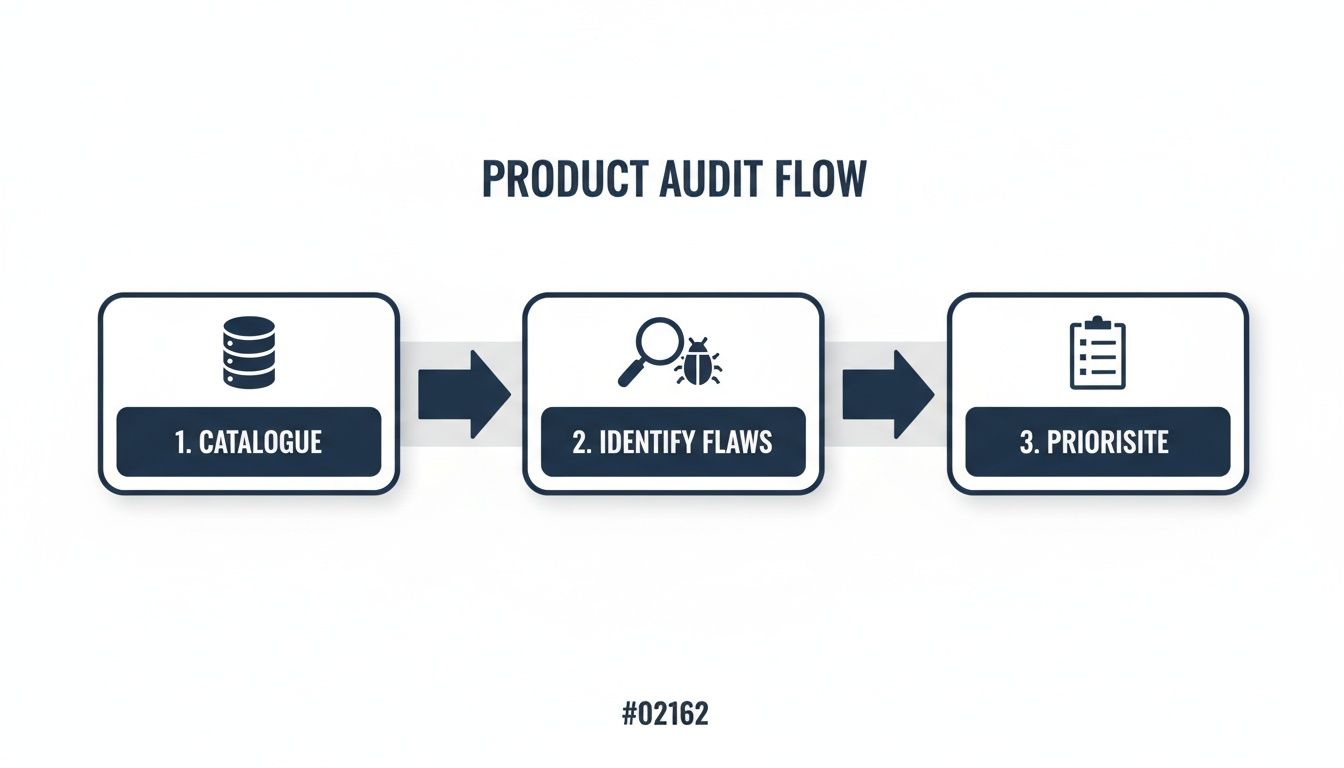
This simple framework helps us systematically find the flaws and prioritise what to fix before unleashing the AI agents to do their work.
Generating Unique Descriptions to Beat Duplication
One of the most common and damaging issues is supplier content duplication. Slapping the same generic description on your site as hundreds of other retailers is a guaranteed way to kill your SEO authority and create a forgettable customer experience.
AI workflows completely solve this problem. By feeding a generative AI model your brand’s style guide, tone of voice, and key selling points, it can rewrite thousands of descriptions in days. Every single one becomes distinct, on-brand, and properly optimised. This does not just fix duplicate content SEO issues, it injects your brand’s personality into every product you sell.
Take a furniture retailer, for example. A supplier's terse description like "Oak dining table, seats 6" can be transformed into a compelling story: "Gather your loved ones around our handcrafted solid oak dining table, designed in Australia to be the heart of your home for years to come. Comfortably seating six, its warm, natural finish brings a touch of timeless style to any meal."
Enriching Product Data With AI Image Recognition
For retailers in fashion, furniture, and electronics, a picture is worth a thousand data points. AI image recognition is a game-changer for modern product data enrichment, as it automatically analyses product photos to pull out valuable attributes that are almost always missing from supplier feeds.
This tech can:
- Identify visual attributes like colour, pattern, neckline, and sleeve length for powerful fashion SEO.
- Tag specific features such as material ('leather', 'velvet'), style ('mid-century modern', 'industrial'), and hardware details for furniture.
- Recognise components and port types for electronics, adding crucial compatibility data that customers need.
This automated product image tagging populates the structured data needed for both Google's advanced search filters and your own on-site faceted navigation, making your products much easier to find.
Structuring Data for Humans and AI Agents
The final piece of the puzzle is getting the structure right. Your newly enriched data needs to be easily understood by search engines, your on-site search platform, and the new wave of AI agents.
The move toward AI-powered search in Australia has completely changed the game. Data shows that 56% of Australian businesses now use AI-driven content tools that do more than just basic keyword research. This is critical, as platforms like Google’s Search Generative Experience rely on deep, structured data to build their summaries.
It is no surprise that Australian businesses investing in this level of content quality have reported 68% higher ROI on their content marketing and SEO efforts.
This means more than just filling in fields. It is about implementing schema markup for reviews, pricing, and availability, and making sure all attributes are formatted consistently. These API-driven workflows are transforming retail data enrichment, turning chaotic feeds into a clean source of truth that powers every discovery channel. By creating one optimisation layer that serves both SEO and site search, you build a solid foundation for whatever comes next in retail search.
Deploying Enriched Content for Maximum Impact

Creating high-quality, optimised product content is a huge achievement, but let's be honest, the job is only half done. That enriched data delivers zero value until it is pushed live and correctly deployed across your entire digital ecosystem.
A successful deployment is what turns all that hard work into tangible results, ensuring your new content boosts both ecommerce SEO and site search performance at the same time.
This is about much more than just hitting 'publish' in your Product Information Management (PIM) system. A strategic deployment means synchronising your new content with search engine crawlers and your internal search technology. It is how the same rich data that powers a Google rich snippet also fuels your on-site search filters, creating a powerful, unified discovery layer for your customers.
Think about it. When you add structured data for price, stock levels, and reviews, you are not just giving Google a clearer picture of your products. You are simultaneously feeding your on-site search engine the exact attributes it needs to power advanced filtering and sorting. The result is a much smoother, more intuitive user experience.
From PIM to Performance
The goal here is a seamless flow of data that improves discovery everywhere. Enriched attributes like 'material' for a fashion retailer or 'compatibility' for an electronics store are absolutely crucial. They create a vastly better on-site experience, allowing customers to drill down into their choices effectively and dramatically reducing bounce rates.
To get this right, your deployment workflow has to be methodical. This is a core part of our scalable SEO solutions, which are designed to roll out changes across thousands of pages without causing technical headaches or disrupting the customer journey.
The real win is when a single attribute update, like adding 'water-resistant' to a line of jackets, immediately improves your Google Shopping eligibility and adds a valuable new filter to your on-site search. That’s the power of a unified content layer.
This strategic approach to deployment marks the shift from tedious, page-by-page SEO to efficient, AI-powered content workflows. It ensures every dollar you invest in content enrichment pays dividends across all of your customer acquisition channels.
The Technical Deployment Checklist
To make sure your freshly enriched content gets indexed and used correctly by both Google and your internal search, a technical checklist is essential. Skipping these steps can mean your optimised content remains invisible, completely negating all your hard work.
Here are the critical actions your team needs to take:
-
Regenerate and Submit Sitemaps
As soon as a large-scale content update goes live, regenerate your XML sitemap. This is a direct signal to search engines like Google that a significant number of pages have changed and need to be re-crawled. Submitting the new sitemap via Google Search Console gets the ball rolling faster. -
Update Canonical Tags
If your enrichment process involved merging product pages or consolidating variants, it is vital to review and update your canonical tags. Make sure they point to the definitive version of each page to stop duplicate content issues from undermining your SEO efforts. -
Force Re-indexation of Key Pages
For your high-priority products or updated category pages, use the "Request Indexing" feature in Google Search Console. This prompts Google to crawl the pages sooner, getting your new content into the search results without delay. -
Synchronise with Your On-Site Search Engine
This is the step that directly impacts your on-site experience. Your internal search platform, whether it is a native solution or a third-party tool like Algolia or Klevu, needs to re-index your product catalogue. This action makes all the new attributes available for filtering, searching, and ranking within your site.
By treating deployment as a critical stage of the optimisation process, you complete the circuit. This ensures that a single content fix truly does improve SEO and on-site search at the same time. This strategy is also fundamental to understanding how better product content improves conversion without changing UX, as it focuses on enhancing the core data that drives the customer experience.
Measuring the Success of Your Unified Strategy
Fixing your product content is a serious investment of both time and money. So, when it is time to show the results, your measurement needs to be rock-solid, going way beyond vanity metrics like overall website traffic.
To justify the ongoing investment in things like AI workflow automation for retail, leaders need a complete picture of performance. We are talking about a dashboard that connects content improvements directly to commercial outcomes, tracking both external SEO gains and internal on-site search wins.
This is how you build a powerful ROI narrative. You can draw a straight line from fixing the underlying product data to driving higher rankings. That brings in more qualified traffic, which then converts at a higher rate because your on-site search finally works the way it should.
Key Metrics for Your SEO Performance
On the SEO side, you have to focus on tangible improvements in organic visibility and traffic quality, right down to the product level. These are the numbers that prove your enriched content is actually performing out there on the search engines.
- Organic Traffic to Product Pages: This is your most direct measure of success. Forget looking at just the homepage, track the month-on-month jump in organic sessions landing directly on your SKUs.
- Rankings for Long-Tail Product Queries: Start monitoring your position for those super-specific, high-intent search terms. Think "linen blend button-up shirt in navy" or "24-inch 4K monitor with USB-C". These are the searches that actually convert.
- Rich Snippet Impressions and Clicks: Keep a close eye on your Google Search Console data. A spike in impressions for product-related rich snippets (like reviews, price, and availability) is a clear sign that your structured data is being picked up and used by Google.
And remember, to truly gauge the impact, you need to understand the wider factors that play into organic visibility, like the deep connection between web accessibility and SEO.
Critical KPIs for On-Site Search
For on-site search, success is all about how easily customers can find what they are looking for once they are on your site. This is where you see the immediate payoff from all that product data enrichment work.
- Search Query Conversion Rate: This is the ultimate metric. What percentage of people who use your site search actually go on to buy something? If this number is trending up, your search results are getting more relevant. Simple as that.
- Reduction in Null-Result Searches: You need to track the percentage of searches that return "no results found." A big drop here shows your newly enriched attributes and descriptions are finally matching what your customers are typing into the search bar.
- Increased Filter and Facet Usage: When you see customers start to actively use the new filters you have enabled (like material, size, or compatibility), it is concrete proof that your data work is making the shopping experience genuinely better and more intuitive.
Connecting the Dots for a Powerful ROI Story
The real magic happens when you show how these two sets of metrics are directly linked. The story you tell the leadership team should follow a crystal-clear path.
Better product data leads to higher rankings for valuable long-tail keywords. This brings more qualified, high-intent shoppers to your site who already know what they want. Once they arrive, your newly effective on-site search helps them find it instantly, dramatically increasing the likelihood of a sale.
This virtuous cycle is the core benefit of fixing your product content. In Australia, consistently creating and publishing content is a massive differentiator. Local research shows businesses that publish regularly see 326% more traffic on average, and their content indexation rates soar by over 434% because Google rewards fresh material.
That same freshness and detail eliminate friction in your on-site search, creating a seamless journey from discovery to checkout. Understanding the importance of AI workflows for ecommerce is all about building these kinds of efficient, unified systems.
Answering the Tough Questions About Unifying Product Content
Shifting to a unified product content strategy always brings up some practical, "how does this actually work?" questions from retail leaders. Let's tackle the most common ones we hear when it comes to using AI workflows to fix both your ecommerce SEO and on-site search at the same time.
How Can We Possibly Optimise a Catalogue of 50,000 SKUs Without a Huge Team?
This is exactly where AI workflow automation becomes a game-changer. Scaling content for massive catalogues is not about hiring an army of writers, it is about being smarter with your resources.
Instead of manual rewrites, AI agents in ecommerce can be set up to handle product data enrichment based on your specific rules and brand voice. Think of it this way: an AI agent can take a raw supplier feed, instantly spot every single duplicated description, and then generate unique, SEO-friendly copy for all 50,000 SKUs in just a few days. While it is doing that, it can also use image recognition and tagging to pull out critical attributes like colour, style, and material across the entire range.
Your team's role shifts from doing the tedious work to strategic oversight and quality control. This human-led AI content QA approach is really the only way to get down to SKU-level SEO and prepare your business for the future of agentic commerce without breaking the bank.
Will AI-Generated Product Descriptions Hurt Our Brand Voice?
It is a completely valid concern. The last thing you want is a website full of robotic, soulless copy.
The key is that modern generative AI for retail teams is not about using generic prompts. It can be trained specifically on your brand's unique voice, your style guides, and even your best-performing content. You build sophisticated, brand-aligned workflows.
You can set negative constraints (words you never want to see), provide positive examples (the tone and phrasing you love), and define strict structural rules, like always starting with a customer benefit before listing features. This ensures the final copy is not only unique and optimised for search but also sounds like it came straight from your marketing team. A human QA layer adds the final polish, striking the perfect balance between automation and brand integrity.
This is not about letting a machine run wild. It is about giving the AI a precise playbook to follow, ensuring every piece of content sounds like it came directly from your most experienced copywriter.
How Does This Help Our Third-Party On-Site Search App?
Tools like Algolia, Klevu, or Searchspring are incredibly powerful, but they are only as good as the data you feed them. If your product data is thin and unstructured, even the smartest search engine cannot deliver relevant results or useful filters.
By enriching your product content with specific attributes, you are essentially giving your on-site search engine the fuel it needs to do its job properly.
For example:
- Adding 'sleeve length' and 'neckline' for fashion SEO optimisation.
- Including 'voltage' and 'connectivity' for electronics SEO optimisation.
- Tagging 'material' and 'finish' for furniture SEO services.
When your product feed is this detailed, the tool can index products correctly, better understand what the user is looking for, and power the faceted navigation that customers actually depend on. You are fixing the problem at the source, which improves performance everywhere.
How Is This Different from Traditional SEO?
Traditional SEO usually involves a lot of manual research and writing focused on a handful of high-priority pages, like the homepage or main category pages. On-site search is often treated as a completely separate, technical problem for another team to worry about.
The AI SEO vs traditional SEO debate really comes down to a fundamental difference in scale and strategy. This modern approach tackles the entire product catalogue (SKU-level SEO), automates the soul-crushing enrichment work, and unifies both external and internal search by focusing on the underlying product data.
It is about preparing your entire digital shelf for discovery, not just by human shoppers on Google today, but by the AI agents of tomorrow. This is how you get your business ready for the future of agentic search optimisation, not just chasing rankings on today's search results page.
At Optidan AI, we help retailers prepare for the future of commerce by transforming product content into a strategic asset. Our AI-powered workflows create one optimisation layer for all discovery channels, ensuring your products are visible, relevant, and ready for what's next. Explore our scalable ecommerce SEO and site search solutions.
