


When most retail leaders think about conversion rate optimisation, their minds jump straight to A/B testing buttons and redesigning page layouts. But here's the thing: the biggest lever for growth often isn't in your UX at all. True persuasion happens in your product content, where rich descriptions and detailed data quietly convince customers to buy, without changing a single pixel of your site's design.
The Hidden Conversion Lever Beyond UX Design

While a frictionless user experience is table stakes, it only gets a customer to the digital shelf. It doesn't close the sale. The final, critical step in the buyer's journey hangs on the quality, depth, and relevance of the information on the product page itself. This is where the conversion is won or lost, quietly answering the crucial question: "why should I shop with you?"
Many conversion teams focus exclusively on visual and interactive elements, creating a significant blind spot. A beautiful, fast-loading page is useless if the product description is a generic block of text copied from a supplier feed or if key attributes are missing. Customers, and the new wave of AI shopping agents, need substance, not just a slick interface.
Shifting Focus from Clicks to Confidence
The core principle is simple: better content builds buyer confidence. It answers the silent questions every shopper has swirling in their head before they commit to a purchase.
- Detailed Descriptions: Does this product solve my specific problem?
- Comprehensive Attributes: Does it have the features and specifications I need?
- High-Quality Imagery: Can I see exactly what I’m getting?
- Clear Benefits: Why should I choose this item over a competitor’s?
Answering these questions effectively crushes hesitation and directly improves your conversion rate. In Australia’s crowded e-commerce market, this content-first approach is a game-changer. The average local conversion rate hovers around 1.78%, but even a small lift driven by content yields substantial results. For a retailer with 100,000 monthly sessions, a content-driven bump from 1.8% to 2.4% can generate an extra $58,800 in monthly revenue.
Achieving Content Excellence at Scale
Manually upgrading thousands of SKUs is a classic retail content bottleneck. This is where AI-powered product data enrichment becomes essential. By using automated workflows, you can transform inadequate supplier feeds into optimised, unique, and persuasive product pages at a scale that was previously unimaginable, fixing 10,000+ pages in days.
This isn't about replacing your team; it's about empowering them with the right retail efficiency tools to fix what your customers and AI agents actually read. Often, low conversion isn't just due to poor content, it's because customers can't find the products you definitely sell in the first place, thanks to weak data. By focusing on this hidden lever, you can drive significant growth without a single UX redesign.
Preparing Your Content for the Future of Retail Search
The way people find products is changing right under our noses. It’s moving away from the simple search bar and into conversational, AI-powered experiences on platforms like ChatGPT, Perplexity, and even Amazon's new AI agent, Rufus. For anyone leading a retail business, this isn’t just a trend to watch, it’s a fundamental shift you need to get ahead of to survive.
Here’s the hard truth: these AI agents don’t care about your beautifully designed website. Your branding, your slick user experience, your carefully chosen layout? They don’t see any of it. They operate on a much deeper level, digging into your structured data, parsing product attributes, and reading your descriptions to find answers and serve up recommendations. This is the new digital shelf, and it’s built entirely on the quality of your product content.
Agentic Commerce and the Data Layer
Welcome to the era of agentic commerce. Increasingly, an AI assistant will stand between your products and your customers. A shopper might ask their AI, "Find me a waterproof hiking boot available in Sydney, size 10, with good ankle support under $250." Whether your product gets recommended boils down to one simple thing: is that specific information available, structured, and crystal clear in your product data?
This new reality ties together a few critical retail concepts that are suddenly more important than ever:
- Product Data Enrichment: This means turning your basic supplier feeds into detailed, attribute-rich content that an AI agent can actually understand and trust.
- Correcting Duplicated Supplier Content: You have to move away from the generic, copy-pasted text that makes your products invisible. Unique, valuable descriptions are now the price of entry.
- Optimised at Scale: Using AI workflow automation for retail allows you to apply these improvements across thousands of SKUs in a fraction of the time, making sure your entire catalogue is ready for this new world.
We're witnessing a massive pivot from old-school SEO to what you could call AI SEO. Optimising for machines is now just as important as persuading people. The quality of your data now directly controls your visibility in a channel that’s growing bigger by the day.
Why Your Current Content Might Be Invisible to AI
Many retailers are completely unprepared for this AI-powered retail transformation, and they don't even know it. Their product content is riddled with common problems that make it totally opaque to AI agents.
Your beautiful website is a storefront for human eyes. Your structured product data is the detailed inventory list for AI agents. If that list is incomplete or inaccurate, AI assumes the product doesn't exist or isn't a good match.
Generic descriptions copied straight from suppliers, missing specifications, and a total lack of structured schema markup make your products practically invisible to this new wave of search. For a deeper dive into the specific data structures you'll need, our guide on preparing your product catalogue for agentic search lays out a detailed roadmap.
To make sure your products get surfaced, your content needs to be explicit and thorough. For practical guidance on how to adapt, exploring some actionable strategies for ranking in Google AI Overviews can offer some valuable insights.
This isn't some far-off trend. It's happening right now, and it's a necessity for keeping your products on the digital shelf. Optimised, unique content is no longer just for your human visitors, it’s your ticket to being seen in the new era of agentic shopping.
The Anatomy of High-Converting Product Content
So, what does “better” product content actually look like when you want to lift conversions without touching your site’s design? It’s much more than just clever writing. It's a strategic mix of data, imagery, and structured information, all working together to build trust and answer a customer's questions before they even think to ask them. This is where you find the quiet, powerful wins.
The starting point is simple: stop using generic, duplicated supplier content. Relying on these feeds is a huge mistake. It creates a sea of sameness, giving shoppers zero reason to buy from you over a competitor down the road. It also kills your digital shelf performance in traditional search and the new world of agentic search.
Humans and AI agents "see" your website very differently. This is why the content layer underneath the design is so critical for modern retail.
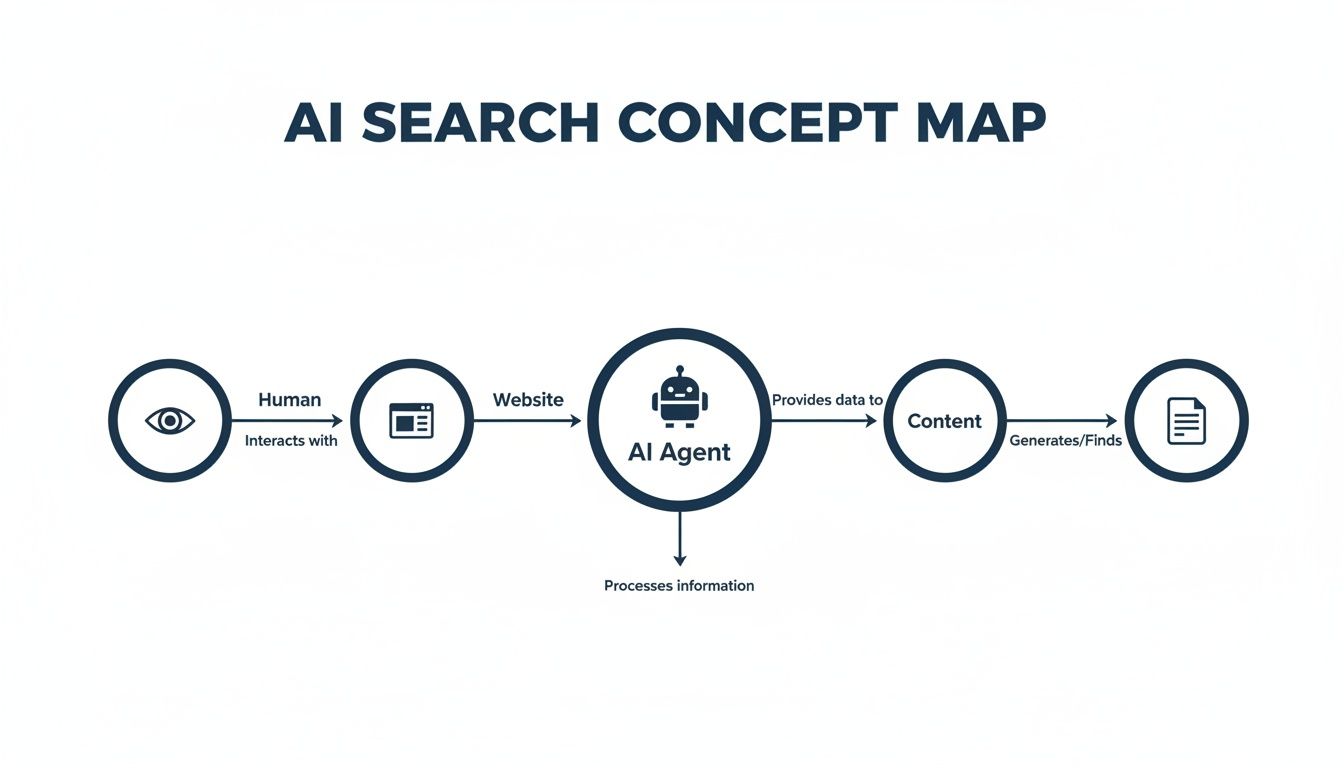
The image drives home a key shift: while your customers see the design, AI agents and search engines see the raw data and text. Nailing this underlying content is essential for both human persuasion and machine readability.
Crafting Unique, Benefit-Led Descriptions
Great product descriptions are the heart of persuasion. They don’t just list features; they translate those features into real-world benefits and outcomes for the customer. This is how you turn a basic supplier feed into a genuine sales asset.
A truly effective description should:
- Answer Key Questions: Get ahead of common queries about usage, fit, material, and compatibility. A description for a leather sofa shouldn’t just say "full-grain leather" but also mention that it’s "easy to clean and durable enough for family life."
- Reflect Brand Voice: Moving away from duplicated supplier content is your chance to inject your unique brand personality, building a much stronger connection with your audience.
- Focus on Outcomes: Instead of saying "fast processor," an electronics retailer should say "edit videos and multitask without any lag." The focus moves from the what to the why it matters.
Getting this right across thousands of SKUs is the exact challenge retail content automation was built to solve. For a deeper dive into these principles, our guide on how to craft high-converting product descriptions for Shopify has you covered.
The Power of Comprehensive Product Attributes
Beyond the main description, structured product attributes are the unsung heroes of conversion. These are the specific data points, like dimensions, material, colour, and compatibility, that power your website’s faceted search and filtering systems.
When a customer can easily filter for "a blue, cotton, queen-sized quilt cover," they are significantly closer to a purchase. Poor attribute data makes this discovery process impossible, leading directly to frustration and abandonment.
Product data enrichment is the process of systematically expanding and standardising these attributes. By turning a sparse supplier feed into a rich, structured dataset, you directly improve the on-site experience and empower customers to find exactly what they need, fast.
The table below breaks down how these content optimisations directly influence the customer journey without any UX changes.
Content Optimisation Impact on Customer Journey
This table illustrates the direct impact of specific product content improvements on key stages of the customer journey, without altering site design.
| Content Element | Problem (Without Optimisation) | Solution (With AI Enrichment) | Conversion Impact |
|---|---|---|---|
| Product Titles | Generic, keyword-stuffed, or truncated titles confuse users and hurt search visibility. | Unique, benefit-driven titles that answer user intent and include key attributes. | + Higher CTR from search results. + Reduced bounce rate as users land on relevant pages. |
| Descriptions | Duplicated supplier copy that lacks brand voice, persuasion, and answers to key questions. | Original, benefit-led copy that reflects brand voice and addresses customer pain points. | + Increased add-to-carts. + Lower return rates due to clearer expectations. |
| Product Attributes | Missing or inconsistent data (size, colour, material) leading to poor on-site filtering. | Complete and standardised attributes powering accurate faceted search and comparison. | + Improved product discovery. + Higher conversion from users who filter. |
| Imagery & Alt Text | Low-quality images with generic filenames (IMG_1234.jpg) and empty alt text. |
High-res images with descriptive, keyword-rich alt text generated at scale. | + Better image search visibility. + Improved accessibility and on-page SEO. |
| Reviews & UGC | Limited or no customer reviews, creating a lack of social proof and trust. | Systems to encourage reviews and showcase user-generated content (UGC) prominently. | + Increased trust and confidence. + Higher conversion (up to 270%). |
As you can see, each element addresses a specific friction point, guiding the customer more smoothly toward a purchase simply by providing better information.
AI Image Recognition and Structured Data
Visuals are obviously critical, but it’s the data behind the visuals that makes them work for search engines and AI agents. AI image recognition and tagging is a game-changer here, especially for retailers in fashion, homewares, or furniture.
This tech automatically analyses product images to generate descriptive, keyword-rich alt tags at scale. An image of a dress is no longer just IMG_5071.jpg; it becomes "woman wearing a navy blue A-line midi dress with floral print and short sleeves." This boosts accessibility and provides crucial context for AI SEO.
Finally, structured data (or schema markup) ties it all together. It’s a layer of code that explicitly tells search engines and AI agents what each piece of your content means. It confirms the price, availability, brand, and reviews, making your product pages perfectly AI-compatible. Understanding all the elements that make content persuasive is key; this practical guide on creating product videos that convert offers a fantastic breakdown.
By pulling these elements together in an AI-powered content workflow, retailers can finally achieve SKU-level SEO at scale, turning every single product page into a high-performing conversion asset.
Using Content-Led CRO to Address the Mobile Conversion Gap
For years, Australian retailers have been wrestling with the stubborn gap between mobile and desktop conversion rates. The default response? Blame the UX and kick off yet another expensive template redesign. But what if we've been looking in the wrong place? More often than not, this isn't a layout problem, it's a content problem.
Think about it. On a smaller screen, every word and image carries so much more weight. Mobile shoppers are usually short on time and screen space. They need clear, concise, benefit-driven information, and they need it instantly. When they land on a page and find a dense, generic product description lifted straight from a supplier feed, they won't stick around to decipher it. They'll just leave.
This is where content-led conversion rate optimisation (CRO) comes in. It’s a powerful, and frankly overlooked, strategy that focuses on refining the message itself, not just the container it sits in.
Why Mobile Content Demands a Different Approach
The mobile shopping experience is a completely different beast. Users aren't reading; they're scanning. They’re looking for quick answers to decide if a product is right for them. Those long paragraphs and feature lists that seem fine on a desktop monitor become impenetrable walls of text on a phone.
The data backs this up. Device-level insights from Australian retail show that content quality is a key driver of who converts and where. Local benchmarks reveal desktop users convert at around 3.2%, while mobile users trail behind at a dismal 1.8%. This is despite mobile dominating browsing traffic. Since most stores use responsive designs that are largely the same across devices, that gap points squarely at the content. Vague descriptions, missing benefits, and poor imagery force mobile shoppers to work too hard to understand what you’re selling.
A simple content uplift can have a dramatic impact. If improved product copy nudges your mobile conversion from 1.8% to just 2.2%, your total site conversion climbs to nearly 2.15%, a ~7.5% uplift in total orders without touching a single design template.
Scaling Mobile-First Narratives with AI
Fixing this problem manually across a catalogue of thousands of products is just not feasible. It demands a strategic shift toward AI-powered content workflows that are built for retail efficiency. This is about more than just shortening descriptions; it’s about completely restructuring them for mobile-first consumption.
Here’s how it works:
- Benefit-Led Bullet Points: AI can tear through dense supplier data to pull out the most important benefits, presenting them as scannable bullet points right at the top of the description.
- Concise Summaries: Generative AI crafts short, punchy opening paragraphs that capture a product's essence in a couple of lines, perfect for the limited mobile view.
- Structured Attribute Data: Through product data enrichment, AI ensures vital specs like dimensions, materials, or compatibility are pulled out of paragraphs and organised into clean, easy-to-read tables.
This approach ensures every product page is optimised for the device your customers are actually using to browse. Our guide on product page optimisation with AI dives deeper into how these automated workflows can boost your store's performance at scale.
By generating mobile-first product narratives, you directly improve your digital shelf performance and start closing that frustrating revenue gap between devices. It’s a tangible return on investment, all driven by a smarter content strategy.
From Manual SEO to AI-Powered Retail Efficiency
The traditional way of handling product content is fundamentally broken for modern retail. For years, ecommerce teams have been stuck in a manual, reactive loop: a new product line lands, and a small team scrambles to get descriptions written. More often than not, they resort to copying and pasting supplier content just to get the pages live.
This process is painfully slow, riddled with inconsistency, and simply impossible to manage across a catalogue of thousands of products. It’s the single biggest source of content bottlenecks, creating a huge backlog of pages with thin, generic copy that fails to convince a customer or rank in search. Trying to fix all that duplicated content by hand is so expensive it rarely gets done, leaving revenue on the table and risking SEO penalties. It’s an old model that just can’t keep pace anymore.
A New Way of Working for Retail
The solution isn’t just hiring more writers to type faster. It’s about completely changing the workflow with AI. This is the shift from manual SEO to AI SEO, where technology takes on the repetitive, heavy lifting. This frees up your talented people to focus on what humans do best: strategy, creativity, and quality control.
At the heart of this new approach are automated content workflows. These systems are built for SEO at scale, letting retailers get things done in days that would have previously taken months, or even years. This is the future of work in retail: a powerful human + AI collaboration in SEO that drives efficiency we’ve never seen before.
In this model, AI isn't here to replace your team; it's a force multiplier. It automates the tedious grind of enriching product data and generating descriptions, letting your experts graduate from content creators to content curators and strategists.
Making this strategic shift away from manual tasks is also how you prepare for the agentic commerce future, where AI agents will rely on deep, structured data to make buying decisions for shoppers.
The Power of Automated Content Workflows
So, what does this actually look like in practice? Instead of writing descriptions one by one, an AI-powered system can pull in entire supplier feeds and run multiple optimisations at once. It’s a streamlined path to genuine retail efficiency.
An AI-driven approach makes several things possible:
- Product Data Enrichment: The system automatically pulls key attributes from raw supplier data, turning sparse feeds into the rich, structured content needed to power faceted search and improve your digital shelf performance.
- Unique Description Generation: AI can generate thousands of unique, benefit-focused product descriptions that match your specific brand voice and SEO rules, completely wiping out the supplier content duplication problem.
- Metadata Optimisation at Scale: It creates optimised titles, meta descriptions, and alt tags for every single product. It can even use AI image recognition to add detailed tags for complex fashion or furniture items.
By using AI agents for retail efficiency, businesses can finally break through the content bottlenecks that have been holding them back. This isn't just a smarter way to do SEO; it's a necessary evolution to stay competitive. To see how these principles come to life, take a look at our complete range of AI SEO services. It’s time to fix what customers and AI agents want to read, not just what they click on.
Putting Your Scalable Product Content Strategy Into Action
Knowing what to do is one thing, but actually putting these ideas into practice requires a clear, scalable plan. For retail leaders ready to get started, the journey begins with a hard look at your existing content and the raw data feeds you get from suppliers. This audit gives you a baseline, a starting point from which everything else will grow.
From there, the real work begins: setting up an AI-powered content workflow. This is the engine room of modern retail content automation. The goal isn't just to write faster; it's to build a system that handles product data enrichment, generates unique descriptions, and optimises all your metadata without missing a beat. This is how you achieve real SEO at scale, at a pace manual teams could never match.
What the Automated Workflow Actually Looks Like
An AI-driven platform does more than just spit out text. It completely re-engineers your content pipeline. It takes messy, inconsistent supplier data and systematically cleans, structures, and enriches it with all the attributes needed for on-site filters and readiness for agentic search. An automated process like this can breathe new life into a catalogue of over 10,000 pages in just a few days, not months.
This workflow directly tackles stubborn problems like supplier content duplication and thin product pages, which are notorious for tanking your digital shelf performance. By automating these foundational tasks, you free up your team to focus on strategy and quality control. It’s a shift towards a more powerful human + AI collaboration in SEO. For a deeper dive into structuring content for both people and search engines, our guide on writing content for your website offers some great frameworks.
Tying Content Directly to Commercial Results
At the end of the day, this is a core business strategy. It’s all about building buyer confidence and cutting down cart abandonment. In Australia, the average cart abandonment rate is a staggering 70%. That means seven out of every ten potential customers are lost at the final step.
Think about the impact of a small improvement. Shifting that rate from 70% to 65% would deliver a ~17% lift in completed sales from the exact same amount of traffic. That’s the power of giving customers the clarity and detail they need.
This strategy is about more than just SEO. It’s about answering the customer’s final questions, reinforcing their decision, and giving them every reason to complete their purchase with you.
We also know that 66.5% of Australian shoppers say free delivery is a major factor in their decision to buy. How you communicate that benefit on your product pages matters. As you can see from other insights into Australian ecommerce conversion rates, clear content removes friction and builds the confidence needed to click "buy now."
This is the future of work in retail. It’s a strategic move towards AI workflow automation that creates better customer experiences and delivers real commercial growth. It’s how you prepare your business for the inevitable rise of agentic commerce and win the battle for the digital shelf. The focus is simple: fix what your customers, and the AI agents shopping for them, actually want to read, not just what they click on.
Frequently Asked Questions
How Can Product Content Really Improve Conversions if My Website Design Stays the Same?
Think of it this way: your website design gets a customer in the door, but your product content is the salesperson that closes the deal. When a shopper lands on a product page, they’re looking for reasons to feel confident in their purchase. Great content gives them exactly that.
Clear benefits, detailed specs, and answers to their questions right there on the page reduce friction and build trust. This is about persuading the shopper who is already on your site, a critical step that design alone can't accomplish. Better content also fuels your AI SEO, attracting higher-intent traffic that is already primed to convert.
Isn't Using AI to Write Product Descriptions Risky for Our Brand Voice?
That's a completely valid concern, and it’s why a human-led AI content QA process is non-negotiable. Modern retail content automation isn't about hitting a button and getting generic, robotic text. It's far more sophisticated.
The platform is first trained on your unique brand guidelines, your specific tone of voice, and even your best-performing existing content. The AI then generates drafts at scale based on those rules, and your team provides the crucial final layer of strategic quality assurance. This human + AI collaboration in SEO delivers the best of both worlds: brand integrity and massive scale.
We Have Thousands of SKUs. How Can We Realistically Optimise All of Them?
This is precisely the problem that AI-powered retail efficiency tools were created to solve. Trying to do this manually across a large catalogue is a recipe for failure; it’s just not feasible. An automated content workflow can tackle the entire job.
It can ingest supplier feeds, handle all the necessary product data enrichment, generate unique descriptions, and optimise metadata for thousands of SKUs in a matter of days, not years. This is what SEO at scale truly means. It allows you to finally fix long-standing issues like duplicated supplier content and thin descriptions across your entire digital shelf.
What Is Agentic Search Optimisation and Why Should I Care About It Now?
Agentic Search Optimisation (or AI SEO) is all about optimising your product content so it can be understood and recommended by AI shopping agents like Google's AI Overviews, Perplexity, and Amazon Rufus. These agents don't browse websites like a human; they analyse structured data, clear attributes, and detailed descriptions to find products that match a user's request.
If your content is thin, generic, or poorly structured, these agents will simply ignore it. You need to care about this now because agentic commerce is the future of retail search. Creating AI-compatible content today ensures your products stay visible and competitive as your customers' search habits continue to shift.
Ready to fix the content that customers and AI agents actually want to read, not just what they click on? Discover how Optidan AI can transform your product content at scale by visiting https://optidan.com.
