


Think of your product content as a digital passport. For that product to move seamlessly across a customer's world, from a Google search to their TikTok feed, that passport needs to be flawless. The quality of your product content is what ultimately decides if your items get seen, considered, and eventually, purchased.
Your Product's Journey Through Modern Retail Discovery
The path from discovery to purchase isn't a straight line anymore. It’s a winding journey where your product's story must be told consistently and compellingly at every single turn. Relying on generic, duplicated supplier content just creates friction. It makes your products invisible on the crowded digital shelf and completely undermines your brand’s unique voice.
This problem is only getting bigger with the shift towards a new era of retail search. We're seeing the rise of agentic commerce, where AI agents like Google’s AI Overviews and Amazon’s Rufus are the new gatekeepers. These systems don't just scan for keywords, they're smart enough to evaluate the quality, structure, and uniqueness of your product data to make direct recommendations. In this AI-driven retail world, low-effort content isn't just a missed opportunity, it's a liability.
Navigating the Multi-Touchpoint Customer Journey
For retail leaders, the first step is simply understanding this fragmented journey. According to the IAB Australia Commerce Report 2025, the average Australian online shopper uses 4.8 touchpoints before buying something. That multi-channel experience puts a spotlight on just how easily inconsistent or poor-quality product data can kill your visibility.
Key discovery channels now include:
- Online Search: Still the dominant force, especially for shoppers over 50, where 64% start their journey.
- Social Media: Absolutely crucial for younger demographics, with 59% of 18-39-year-olds using it for discovery.
- Retailer-Owned Content: Your website, app, and email marketing remain vital touchpoints you control.
- Influencers and Personal Connections: Good old word-of-mouth, now supercharged by compelling content.
This concept map shows how your central product content acts as that passport, connecting your items to every key discovery touchpoint.
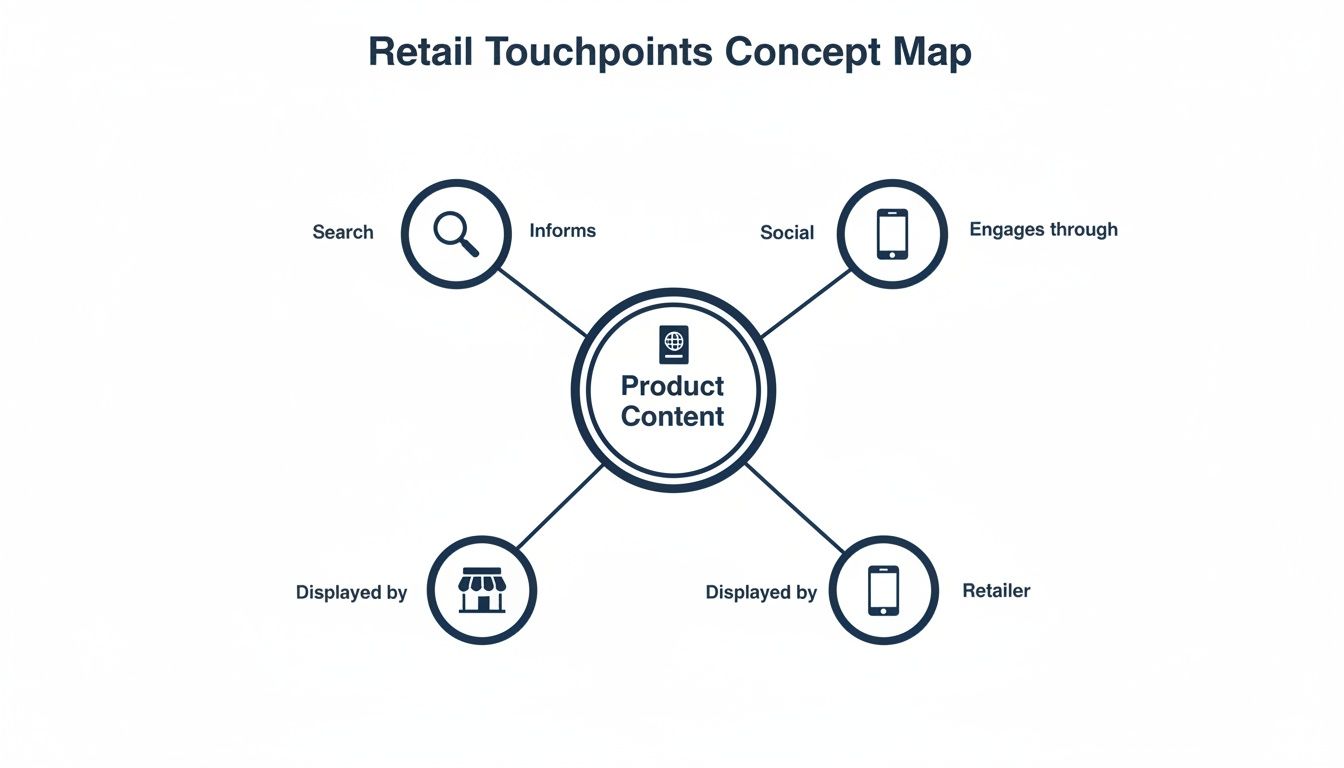
The map makes it clear: a single source of high-quality product data is essential for staying consistent across search, social, and your own retail channels. This is where AI-driven workflow automation becomes non-negotiable, especially when you're managing thousands of SKUs.
To help visualise this, here’s a breakdown of the main discovery touchpoints and what they demand from your product content.
Key Discovery Touchpoints and Their Content Demands
| Discovery Touchpoint | Primary Audience | Required Content Optimisation |
|---|---|---|
| Organic Search (Google) | High-intent, problem-aware shoppers | Unique, keyword-rich descriptions; structured data (schema); optimised titles. |
| Paid Search (Google Ads) | Solution-seeking, ready-to-buy customers | Compelling ad copy derived from product benefits; keyword-aligned landing pages. |
| Marketplaces (Amazon) | Comparison shoppers looking for value and trust | A+ content; keyword-optimised titles and bullet points; high-quality imagery. |
| Social Commerce (TikTok) | Browsing, trend-focused consumers | Short-form video content; lifestyle context; authentic, user-centric descriptions. |
| On-site Search | Existing visitors with specific needs | Accurate attributes and tags; consistent taxonomy; detailed, searchable descriptions. |
| Email & CRM | Loyal, repeat customers | Personalised content highlighting new features, benefits, or use cases. |
| AI Agents (AI Overviews) | Shoppers seeking direct answers and recommendations | Factual, well-structured, and attribute-rich content that directly answers queries. |
Each channel speaks a slightly different language, but the core message must come from the same playbook. A holistic, AI-driven content strategy is the only way to win at every border crossing of the digital shelf. You can learn more about the future of product discovery and how large language models are changing retail.
Preparing Your Digital Shelf for AI and Agentic Search
The way people search is changing right under our noses. We're moving away from typing keywords into a box and into having actual conversations with AI. For any large-scale retailer, this isn't some far-off concept, it’s happening now. Getting your digital shelf ready means understanding how your product content looks to this new kind of shopper.
AI assistants and generative search engines don't just crawl your content anymore, they judge it. They're looking at its quality, how unique it is, and whether it’s structured properly. Think of platforms like Google's AI Overviews and Amazon's Rufus as the new gatekeepers, making direct recommendations based on the data they can trust. This is the new reality of agentic commerce, where the quality of your SKU-level SEO determines if you get the recommendation or get ignored.

The Problem with Duplicated Supplier Content
One of the biggest roadblocks to a high-performing digital shelf is relying on the same old supplier content everyone else uses. When hundreds of retailers use the exact same descriptions, images, and specs, search engines see a wall of noise. This is a massive red flag for AI systems that are built to reward originality and authority.
This isn't just about failing to rank, it can actively hurt your visibility. Search engines often see duplicated content as low-value, and that can lead to being pushed down in the results. For a retailer managing thousands of products, this is a huge headache. Manually rewriting every single product description is simply not an option, creating a content bottleneck that stalls growth.
To an AI agent, duplicated content means you offer no unique value. It can’t confidently recommend your product over another if the information is identical. This is why product data enrichment is now a critical competitive advantage.
Fixing this at scale requires a new way of thinking. Retail content automation is the key to turning basic supplier feeds into unique, brand-aligned assets. This isn't just about dodging penalties, it’s about building a distinct voice that connects with both human shoppers and the AI agents guiding them.
From Basic Feeds to Enriched, AI-Ready Data
To get your digital shelf ready for AI and agentic search, you need to turn your product data from a simple list of features into a rich, structured asset that AI can easily understand. Utilising advancements like AI models for e-commerce for things like product imagery is just the start.
This transformation really comes down to a few key steps:
- Supplier Feed Enrichment: Taking raw data and fleshing it out with detailed attributes, benefit-focused descriptions, and structured information.
- Unique Product Description SEO: Using AI-powered workflows to generate original, keyword-optimised content for every product, so no two pages are the same.
- Image Recognition and Tagging: Automatically analysing product images to create descriptive alt text and tags. This is absolutely vital for fashion SEO optimisation and other visual-heavy categories like furniture.
Here in Australia, search engines dominate brand discovery at 62.5%. The quality of this enriched content determines whether you can grab a customer's attention. But the journey doesn't stop there. Success across the entire path to purchase, which includes 36.8% direct site visits and an average of 4.8 touchpoints, starts with data an AI can trust. You can learn more about preparing your product catalogue for this new era of agentic search.
Ultimately, the goal of this AI-powered retail transformation is to create content that isn’t just visible, but selectable. When an AI agent is asked for "the best lightweight running shoes for marathon training," it will sift through data from countless retailers. It will look for structured attributes like weight and cushioning, unique content that explains the benefits, and consistent information everywhere. The retailer whose content best answers that question will get the recommendation. That’s the new reality of retail optimised at scale.
Winning Attention in Social Commerce and Marketplaces
Beyond your own website, the real fight for a customer's attention happens on social media and third-party marketplaces. These platforms are incredibly crowded and visually driven. Whether it’s a TikTok feed or an Amazon search result, the one thing that helps you stand out and actually make a sale is consistently excellent product content.
In Australia, you can't afford to ignore this. A massive 58% of Australians now turn to social media to research brands and products, which is almost neck-and-neck with traditional search engines at 62%. That's a huge shift. It means having optimised product content isn't just a nice-to-have, it's absolutely essential for being discovered where millions of your potential customers are spending their time. You can read more on this in the Digital 2025 Australia report.
Fuelling Discovery on Visually-Driven Platforms
Think about platforms like Instagram and Pinterest. Discovery is instant and it's all about the visuals. A shopper might see a photo of a beautifully styled room and notice your armchair, or spot a jacket as part of a complete outfit. To grab that fleeting attention, your product content needs to work a lot harder than just a simple title. This is where AI image recognition and tagging become serious game-changers.
For retailers in categories like fashion or homewares, this tech delivers a clear competitive edge:
- Fashion SEO Optimisation: AI can look at a photo of a dress and instantly tag it with attributes like "V-neck," "linen blend," or "floral print." This granular detail means your products show up in very specific visual searches that a basic description would miss.
- Furniture Image Tagging SEO: An AI can recognise styles like "mid-century modern," materials such as "solid oak," and features like "tapered legs." Suddenly, your catalogue is searchable by the aesthetic and feel a customer is looking for, not just a product name.
- Electronics SEO Optimisation: For electronics, AI can identify and tag visual cues shoppers search for, like a "bezel-less display" or a "brushed metal finish," connecting your products to the terms real people use.
This automated process gets your team away from the soul-destroying task of manual tagging. It creates a scalable SEO solution where every single product image becomes a new opportunity for discovery.
Mastering Marketplace Performance at Scale
Marketplaces like Amazon, The Iconic, or Kogan are a different beast entirely. Your product is sitting right next to your competitors, and it's the marketplace's algorithm that decides who gets seen. Success here comes down to one thing: providing perfectly structured, comprehensive, and unique product data that plays by that platform's rules.
Just dumping a generic supplier feed onto a marketplace is a surefire way to end up invisible. These platforms actively penalise duplicate content and reward sellers who put in the effort to provide rich, detailed information. We're talking about optimised titles, benefit-focused bullet points, and crisp, high-resolution images with accurate alt text.
The golden rule is consistency. If a shopper discovers your product on social media, the link they click must take them to a marketplace or product page where everything matches perfectly. Any mismatch in price, description, or imagery shatters trust and tanks the sale.
Trying to maintain this level of consistency across thousands of products and multiple channels manually is a recipe for disaster. It's simply not possible. AI-powered content workflows are the only practical way to manage this. By automating your product feed optimisation, you can ensure every single SKU is perfectly tailored for each marketplace, fixing duplicated supplier content and injecting your unique brand voice. This level of ecommerce content optimisation is what gets you higher rankings and wins sales.
For a deeper look into this, check out our guide on boosting your marketplace performance with proven AI strategies.
Powering Your Internal Search and Personalised Marketing
Getting customers to your site is one thing, but the real work starts once they arrive. The most critical discovery moments often happen right on your own turf. Your product content is the engine that drives everything from the search bar to your email campaigns, turning a casual visitor into a loyal customer.

If shoppers can’t find what they want, they’ll leave. It's that simple. The quality of your internal discovery experience has a direct line to your conversions and retention. This is where rich, detailed product data stops being a 'nice-to-have' and becomes your most valuable asset, transforming a static catalogue into an intuitive shopping tool.
From Frustration to Conversion with On-Site Search
Nothing kills a potential sale faster than the dreaded ‘no results found’ page. We've all been there. This isn't usually a problem with your search technology, it's a symptom of weak product data. When a customer searches for "summer dresses" or a "waterproof running jacket," your site's search relies entirely on the underlying product attributes to connect the dots. If that data is thin, your search bar is useless.
When a customer uses your search bar, they’re telling you exactly what they want to buy. Failing to give them a relevant result is like turning away a customer at the door, cash in hand.
AI-powered content workflows tackle this head-on by making sure every single product is loaded with rich, relevant attributes. This goes way beyond a basic title and SKU.
- Granular Attributes: Tagging products with specifics like material ("linen blend"), style ("A-line"), or features ("side pockets") creates a catalogue that understands how real people shop.
- Synonym Mapping: An automated system gets that a search for "trackies" should show "tracksuit pants," connecting everyday language to your product data.
- SKU-Level SEO: By optimising each product with searchable details, you don't just fix your internal search, you boost your digital shelf performance on external channels, too.
This kind of meticulous supplier feed enrichment turns your search bar from a liability into your most powerful conversion tool. To see just how deep this connection runs, you can read more about how metadata connects directly to customer intent.
Turning Your Catalogue into a Personalisation Engine
That same rich product data is also the fuel for your personalised marketing, whether it’s email, social ads, or on-site recommendations. Without detailed attributes, "personalisation" is often just using a customer's first name. With it, you can create hyper-relevant campaigns that genuinely speak to individual tastes.
Think about it. A customer who bought a "mid-century modern" armchair can be automatically shown matching side tables in their social feed. Someone who browsed "vegan leather" boots gets an email showcasing new arrivals made from the same material. Suddenly, your massive product catalogue becomes a one-to-one marketing engine, powered by AI agents for retail efficiency instead of manual guesswork.
This is where the industry is heading. It’s a move away from building campaigns by hand and towards a system where human + AI collaboration in SEO and marketing drives dynamic, automated content. By investing in product feed optimisation, you’re not just making your search bar work better, you’re building the foundation for a smarter, more effective marketing machine across every channel you own.
From Manual Bottlenecks to Automated AI Workflows
For years, retail content teams have been stuck in a reactive loop. Manually updating product info, writing endless descriptions, and fixing messy supplier feeds creates huge bottlenecks. It slows everything down, kills your time-to-market, and puts a serious handbrake on growth.
Let's be honest, the old way is slow, riddled with human error, and completely unprepared for modern retail. We're talking about thousands of SKUs that need constant attention across a dozen different channels. It's just not sustainable.
Shifting from manual processes to AI-powered workflows isn't just an upgrade, it’s a complete operational rethink. It’s about leaving behind the endless spreadsheets and content tickets for an intelligent system that just works. This is how you unlock SEO performance at a scale that was impossible before.
Fixing Supplier Content Duplication at Scale
One of the biggest headaches for any large retailer is supplier content duplication. Just copying and pasting the manufacturer's generic descriptions is a fast track to terrible search visibility and a brand voice that sounds like everyone else.
Manually rewriting descriptions for a catalogue of 10,000+ products? That’s a project that could swallow months, even years, of your team's time for very little reward.
This is where automated workflows deliver immediate, undeniable value. A modern platform can pull in entire supplier feeds, find all the duplicate content instantly, and then kick off a massive content refresh.
AI-powered content workflows can generate thousands of unique, on-brand, and SEO-ready product descriptions in days, not years. This crushes duplication penalties, carves out a unique brand voice, and boosts your digital shelf performance without burying your team in busywork.
From Basic Data Feeds to Enriched Product Assets
Fixing duplicates is just the first step. The real game-changer is product data enrichment. A supplier feed is just a starting point, a collection of basic facts. To really compete today, you need to transform that data into a rich, structured asset that both customers and AI search agents can easily understand.
AI agents are crucial here. They automate the heavy lifting of turning thin supplier data into a complete, compelling product story.
- Attribute Extraction: Using AI image recognition, the system can look at a product photo and automatically tag it with attributes like "V-neck," "linen blend," or "mid-century modern." This is gold for things like fashion product image SEO.
- Benefit-Focused Copy: Automated product descriptions can move beyond a dry list of features to talk about compelling benefits, all written in your specific tone of voice.
- Metadata Optimisation at Scale: AI workflows can generate optimised meta titles, descriptions, and alt tags for thousands of pages at once, making sure every single product is set up for discovery.
This is a world away from the old method, where one person might spend an entire day just to get a handful of pages optimised. You can see how this changes the game by reading our deep dive on moving from manual updates to autonomous workflows.
The difference between these two approaches is night and day. A traditional, manual process is slow, resource-intensive, and simply can't keep up with the demands of a large retail catalogue. In contrast, an AI-powered workflow automates the grunt work, allowing for speed and consistency that's impossible to achieve manually.
Traditional vs AI-Powered Content Workflows
| Metric | Traditional Manual Process | AI-Powered Workflow |
|---|---|---|
| Time to Market | Weeks or months per category | Days for entire catalogue |
| Scale | A few hundred pages a month | Tens of thousands of pages |
| Consistency | Varies by writer and editor | 100% consistent with brand rules |
| Error Rate | Prone to human error & typos | Near-zero, with automated checks |
| Team Focus | Repetitive writing & data entry | Strategy, analysis & creative |
| Strategic Impact | Reactive, incremental gains | Proactive, large-scale performance uplift |
As the table shows, adopting an AI-powered approach doesn't just speed things up, it fundamentally changes what your team is capable of achieving, moving them from maintenance to true strategic growth.
Redefining the Future of Work in Retail
Bringing in content automation isn't about replacing people, it's about making them more effective. When AI takes care of the repetitive, high-volume tasks, it frees up your team to focus on what humans do best: strategy, creative direction, and making smart decisions.
This human + AI collaboration is at the heart of building a modern, resilient retail team.
Instead of drowning in an ocean of content requests, your team can start analysing performance data, refining brand messaging, and finding new market opportunities. A human-led AI content QA process ensures that while the scale is automated, the final output always meets your brand's high standards. This is the future of work in retail in action, creating a more efficient, strategic, and powerful ecommerce operation.
Building Your AI-Ready Retail Team for Tomorrow
We've covered a lot of ground, but it all comes down to one thing: high-quality, consistent product content is the single most critical asset for success in modern retail. It dictates how your brand shows up at every single discovery touchpoint, from a simple Google search to social feeds, marketplaces, and your own website.
In the emerging era of agentic commerce, this isn't just about visibility anymore, it's about being selected.
AI systems will increasingly act as gatekeepers, making choices on behalf of consumers. And what will they base those decisions on? The quality, structure, and uniqueness of the data they can parse. Poor, duplicated, or thin content will render your products invisible to this new generation of AI shoppers. It’s that simple.
Shifting from Manual Tasks to Strategic Oversight
This new reality completely reshapes the future of work in retail. It demands a fundamental shift away from manual, repetitive SEO tasks and toward strategic, AI-driven content optimisation. The most valuable retail teams of tomorrow won't be the ones who can write the most product descriptions, they'll be the ones who can effectively manage AI workflows for ecommerce.
This new standard of human + AI collaboration in SEO is the only way to achieve excellence at scale. It’s about giving your team the tools to handle the heavy lifting, like product data enrichment and fixing endless supplier content duplication issues, which frees them up to focus on the high-value strategic work that actually moves the needle.
The goal is to evolve your team from content creators into content strategists. By embracing retail content automation, you empower your people to analyse performance, refine brand messaging, and guide the AI, rather than competing with it on manual tasks.
Preparing for the Future of Agentic Commerce
Making the jump from traditional SEO to AI SEO isn't just a tech upgrade, it's a strategic imperative. Your team's focus has to move beyond just being seen in a crowded market to being actively chosen by the next wave of shoppers and the AI agents that guide them.
This means you need to invest in scalable SEO solutions that can handle your entire product catalogue, ensuring every single SKU is perfectly optimised. Key capabilities to look for should include:
- AI Image Recognition SEO for visual-heavy categories like fashion and furniture.
- Metadata Optimisation at Scale to ensure every page is technically sound.
- Automated Content Workflows that deliver both speed and consistency.
By adopting an AI-powered retail transformation, you're not just solving today’s content bottlenecks. You are building a resilient, future-ready operation prepared for the agentic shopping landscape. It's a strategic shift that ensures your brand isn't just discovered but becomes the preferred choice in an increasingly AI-driven world.
Frequently Asked Questions
What Is Agentic Search and Why Does It Matter for Product Content?
Think of agentic search as a smart AI assistant, like Google's AI Overviews, that doesn't just give you a list of links. Instead, it goes out, finds the best information, evaluates it, and then presents a direct answer or recommendation to the user.
This is a massive shift for retail. These AI agents rely entirely on high-quality, structured, and unique product data to feel confident enough to recommend something. If your product content is just a copy-paste from a supplier feed or lacks real detail, the AI will simply skip over it and feature a competitor with richer information. In this new world, optimising for agentic search means getting your SKU-level SEO and data enrichment right so AI trusts your catalogue enough to show it to shoppers.
How Can We Fix Thousands of Pages of Duplicated Supplier Content Efficiently?
This is the classic bottleneck that holds so many retailers back, and it's exactly what AI workflow automation was built to solve. The thought of manually rewriting thousands of product descriptions is completely unworkable, it's a huge barrier that stops businesses from improving their performance on the digital shelf.
An AI-powered platform can take in your entire supplier feed, check it for duplicated content, and then get to work rewriting and enriching every product detail at scale. This whole process can be done in days, not months, all while embedding your unique brand voice and SEO best practices across the entire catalogue. It’s the perfect blend of AI’s power to handle massive scale, guided by human-led AI content QA to make sure the quality is spot on.
Is AI SEO Just About Automating Product Descriptions?
Not at all, that’s just one piece of a much bigger puzzle. A proper AI SEO strategy for retail is about building a complete content ecosystem that’s ready for how modern shoppers, and AI agents, discover products across every single touchpoint.
It’s about getting several key activities to work together seamlessly:
- Product data enrichment to build the structured, detailed data that AI agents need to understand what you sell.
- AI image recognition to automate image tagging and alt text, which is absolutely critical for SEO in visual categories like fashion and furniture.
- Metadata optimisation at scale across thousands of category, brand, and product pages, not just the top sellers.
- Continuous quality audits to make sure your content integrity and performance don't slip over time.
This is a holistic approach that ensures your products are discoverable and compelling, no matter where a customer starts their journey. It represents a fundamental shift in how retail teams will work, moving them away from tedious manual tasks to focus on strategy, while AI handles the execution.
Ready to prepare your product catalogue for the future of agentic commerce? Optidan AI transforms your supplier feeds into high-performing, AI-ready content at scale. Visit https://optidan.com to learn how we help retailers win on the modern digital shelf.
