

Think of structured data as the universal translator for your product catalogue. It takes all your basic product details and repackages them into a clean, machine-readable format that search engines and AI agents can instantly understand. This tidy digital label is what makes your products discoverable everywhere your customers are shopping.
Your Foundation for Omnichannel Success
Imagine your product data is a brilliant expert, fluent in the native language of Google, Amazon, and Instagram. Instead of the messy, inconsistent information that often comes from supplier feeds, structured data creates a single source of truth for your entire retail operation.
For Australian retailers, this isn't just a technical nice-to-have anymore. It's a commercial necessity.
This clean data layer is what powers everything from advanced AI SEO to consistent digital shelf performance. It solves huge headaches like fixing duplicated supplier content and makes it possible to perform optimisation at scale, handling thousands of product pages in days. For retailers in visual sectors like fashion or furniture, it's the key to unlocking AI-powered image recognition and tagging, making sure every single attribute is searchable.
Why Structured Data is a Commercial Necessity
The Australian eCommerce market has absolutely exploded, making organised product data critical for any retail leader who wants to be seen. In 2024, around 17.08 million Australians were shopping online every month, a staggering 45% jump from 2020. This massive growth means your listings have to be perfectly structured to even stand a chance of being discovered across all the different places people now shop. You can dig deeper into the numbers in this comprehensive report on Australian eCommerce stats.
Without this clarity, your products are basically invisible to the very systems designed to promote them.
Structured data is the difference between shouting into a void and having a clear conversation with every search engine, AI shopping agent, and marketplace algorithm. It’s the prerequisite for moving from manual SEO to a scalable, AI-powered retail transformation.
Getting your data house in order now prepares your business for the next wave of retail search. AI agents and agentic commerce will rely exclusively on clean, structured information to make recommendations. By investing in product data enrichment and automated content workflows, you’re not just cleaning up a spreadsheet; you're building the essential infrastructure for future growth.
This ensures your products aren't just listed, but are truly visible and competitive across every channel that matters.
To really bring this home, let's look at how structured data works its magic across different retail channels. The table below breaks down the common problems retailers face without it and the key benefits they gain once it's in place.
Impact of Structured Data Across Retail Channels
| Retail Channel | Without Structured Data (Common Problem) | With Structured Data (Key Benefit) |
|---|---|---|
| Your Website | Poor SEO rankings, generic search results, low user engagement. | Rich snippets (reviews, pricing, stock), better rankings, higher click-through rates. |
| Marketplaces | Inaccurate listings, products in wrong categories, suppressed visibility. | Improved product matching, better filter results, increased buy-box eligibility. |
| Social Media | Non-clickable product tags, manual data entry for shops, weak catalogue sync. | Dynamic product ads, accurate shoppable posts, seamless catalogue integration. |
| Voice Assistants | "Sorry, I can't find that." Inability to answer specific product queries. | Direct, accurate answers to voice queries like "Where can I buy…?" |
| AI Shopping Agents | Skipped over entirely due to messy, unreliable data. | Products are surfaced in AI-driven recommendations and comparisons. |
As you can see, the impact is huge. Moving from unstructured to structured data is like flipping a switch from "invisible" to "front and centre" wherever your customers are looking. It's a foundational change that lifts your performance everywhere.
Moving From Manual SEO to AI Automation

For years, retail SEO has been a manual, reactive grind. It’s a familiar story, marketing teams spend countless hours wrestling with messy metadata, fixing errors from supplier feeds, and trying to achieve the near-impossible task of optimising thousands of individual SKUs.
This old-school approach is a huge content bottleneck. It’s slow, inefficient, and simply can’t keep pace with the scale of modern ecommerce. The sheer volume of products overwhelms even the best teams, leading to widespread issues like supplier content duplication and inconsistent data that hurts both search rankings and the customer experience.
Overcoming Traditional Content Bottlenecks
The move from manual work to AI workflow automation for retail isn’t just an upgrade; it’s a fundamental shift in strategy. It’s about getting out of the reactive cycle of fixing problems and instead building a system that prevents them from happening in the first place.
Today, AI agents can execute complex tasks that were once reserved for human teams, but they do it at a speed and scale that was previously unimaginable. This is where human + AI collaboration in SEO is heading, defining the future of work in retail.
Key automated tasks now include:
- Product Data Enrichment: AI agents systematically turn basic supplier info into the kind of rich, structured content that both search engines and shoppers love.
- Fixing Duplicate Content: Instead of manually tweaking a few pages, generative AI can rewrite thousands of generic supplier descriptions into unique, on-brand narratives.
- Metadata Optimisation at Scale: AI can generate and roll out perfectly formatted titles, descriptions, and alt tags for your entire product catalogue in days, not months.
Amplifying Your Team with Scalable SEO Solutions
Adopting an AI SEO vs Traditional SEO mindset isn't about replacing your team. It’s about amplifying their strategic impact.
When AI handles the repetitive, high-volume work of content creation and optimisation, your people are freed from the daily grind. They can shift from being manual content creators to strategic leaders who guide AI systems, analyse performance, and focus on high-value growth initiatives. To get a better sense of this new model, you can learn more about how AI SEO for ecommerce is redefining retail strategy.
This transition empowers your team to become architects of your digital shelf, not just janitors cleaning up messy data. It’s a strategic shift that prepares your business for the next generation of agentic commerce.
By embracing retail content automation, you give your business the tools it needs to not only compete but to lead. This is how you achieve serious retail efficiency and lock in your visibility across every channel that matters, both now and in the future.
Enriching Product Data for a Competitive Edge
Relying on basic supplier feeds is one of the biggest risks to your digital shelf performance. They’re almost always sparse on detail and, even worse, they're the exact same feeds your competitors are using. This creates a huge duplicate content problem that actively damages your search rankings.
The fix is product data enrichment, the process of turning those basic files into unique, AI-ready product listings built to win.
This isn't about a simple clean-up. It involves using AI agents for retail efficiency to systematically upgrade every piece of your product information. Instead of using the same generic, one-size-fits-all descriptions as everyone else, automated content workflows can generate thousands of compelling, on-brand narratives at a scale your team could never match manually. This automated approach to creating unique product descriptions is central to modern ecommerce SEO automation.
From Generic Feeds to Unique Assets
For retailers in visual categories like fashion or furniture, this enrichment process is even more essential. This is where AI image recognition SEO comes into play, automatically scanning product images to identify and tag crucial attributes that shoppers are searching for.
Key enrichment strategies include:
- AI-Powered Descriptions: Automatically rewriting duplicated supplier content to create SEO-optimised, unique descriptions for every single SKU.
- Automated Image Tagging: Using AI image recognition to pick out and tag attributes like colour, material, style, and pattern, an absolute must for fashion SEO optimisation.
- Attribute Expansion: Filling in all the missing data points like dimensions, technical specs, or compatibility information, which is critical for electronics and furniture retailers.
Adding this level of detail makes your products far more discoverable in filtered searches and long-tail queries, giving your SKU-level SEO a direct boost.
By turning a generic supplier feed into a rich, structured, and unique asset, you’re not just avoiding SEO penalties. You are building a powerful competitive advantage that prepares your entire catalogue for the future of agentic search.
The impact of getting this right is massive, especially in Australia's booming eCommerce market. With online retail spending expected to hit AU$69 billion in 2024, enriched and structured data is non-negotiable for capturing shopper attention. As nearly 9.8 million Australian households shopped online this year, providing detailed and consistent product information across every channel has become a key driver for both sales and visibility. You can see more data on these Australian eCommerce trends.
Ultimately, enriching your product content is about future-proofing your business. It makes sure your listings are not only primed for today’s search engines but are also fully compatible with next-gen AI shopping assistants like Google’s AI Overviews. To learn more about how this works, check out our insights on optimising your product data. This process ensures you meet customers with rich, helpful information at every single touchpoint.
Achieving Omnichannel Visibility at Scale
Real omnichannel success isn’t about just being present on multiple channels; it’s about being perfectly visible wherever your customers are looking. A solid foundation of structured data gets you there, turning fragmented efforts into a unified, scalable presence that just works.
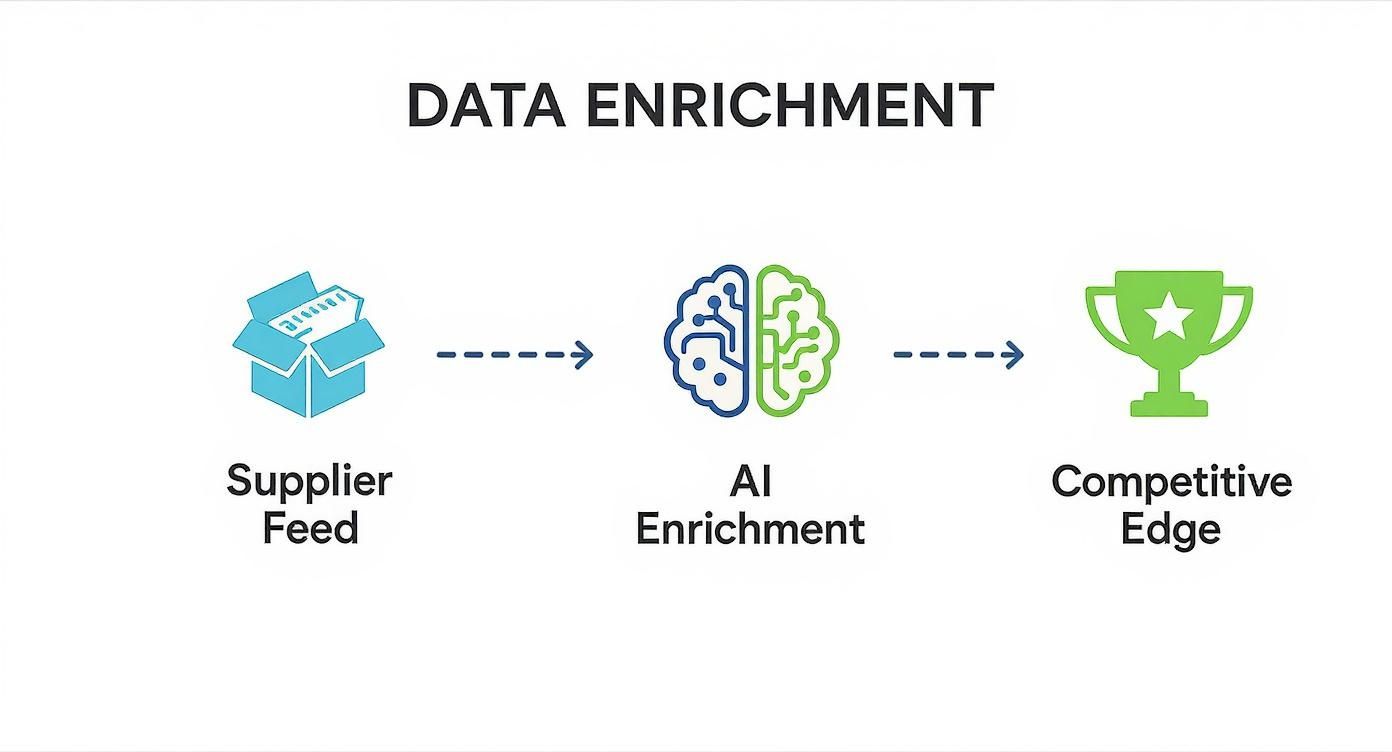
The core idea is refreshingly simple. You create a single, master product feed, enrich it with AI, and make that your source of truth for every single channel.
This approach completely gets rid of the operational nightmare of managing dozens of separate listings. Forget manually updating your website, then logging into a marketplace, then tweaking your social commerce channels. Instead, multi-channel product optimisation happens automatically. This shift from manual data entry to a syndicated system is where you unlock real efficiency.
The journey from a basic supplier feed to a genuine competitive advantage is all about this intelligent enrichment process. It builds a powerful, consistent foundation for all your sales channels.
Powering Every Channel from a Single Source
Once you have an optimised feed, you can start to dominate channels that were previously too difficult or time-consuming to manage at scale. We’re talking major online marketplaces, social platforms like Instagram Shops, and even the growing world of voice search and AI shopping assistants.
Most importantly, it ensures your brand message and product details are consistent everywhere, which is a massive factor in building customer trust.
This unified strategy is absolutely critical in the packed Australian online shopping ecosystem. With over 116,000 online businesses all fighting for attention, structured data is what allows smart retailers to scale efficiently and reach different customer segments without tripling their workload.
And with online shopping revenue projected to hit nearly AU$64.9 billion in 2025, the ability to manage promotions and personalised campaigns across every touchpoint isn't just a nice-to-have; it's a huge competitive advantage. You can see the full picture by exploring the local online shopping industry.
By treating your product data as a central, strategic asset, you move from a reactive, channel-by-channel approach to a proactive, omnichannel strategy. This ensures every customer has the same high-quality experience with your brand, no matter where they discover you.
This centralised model isn't just about consistency. It's about getting ready for the future of retail search.
AI agents and new commerce platforms rely on clean, structured data to make their recommendations. By implementing a robust and scalable solution for your product feeds now, you’re making sure your entire catalogue is ready for this next wave. You can find more strategies on this in our guide to optimising your product feed management.
This is how you take control of your brand's digital shelf, everywhere at once.
Preparing for the Future of Agentic Commerce
The future of retail search isn't some far-off concept anymore. It's already here, and it's being powered by AI agents. This is the start of agentic commerce, a massive shift in how customers find, compare, and buy products. The age of agentic shopping is dawning, and retailers need to get ready, fast.
Shoppers are already handing over their buying decisions to AI assistants like ChatGPT, Perplexity, and Amazon's Rufus. The thing is, these AI agents don't scroll through your website looking at pretty pictures. They consume and analyse raw, structured data to figure out what to recommend. For your business, this means your product catalogue’s structured data is now the only language these powerful new gatekeepers speak.
Why Structured Data Is Your Ticket to the Future
In this new world of agentic search optimisation, retailers with messy, unstructured, or incomplete product information are going to be invisible. It's that simple. If an AI agent can't read and trust your data, your products won't ever make the shortlist, no matter how great they are.
This is a genuine turning point for the industry. Investing in AI-powered content workflows is no longer just a nice-to-have for improving efficiency. It’s now a core strategy for future-proofing your business so you don't become obsolete in an AI-driven retail world. It forces a whole new way of thinking about your product information, you have to start treating it as a strategic asset built for machines to understand.
As more shoppers trust AI for product advice, your structured data becomes your main salesperson. Without it, you're effectively silent in the most important new conversations happening in commerce.
Building Your Competitive Advantage Now
The move to agentic commerce isn't a "what if" scenario. Major platforms are already building these capabilities, and shoppers are adopting them quicker than you'd think. For any retail leader, the time to get this sorted is right now.
This means you need to be focused on:
- Deep Product Data Enrichment: Making sure every possible attribute is tagged, from colour and material right down to the nitty-gritty technical specs.
- Automated Content Workflows: Using AI to clean, structure, and standardise all your product information at scale.
- Future of Work in Retail Planning: Getting your teams the skills and retail efficiency tools they need to run a data-first strategy.
Building a lasting competitive edge for the inevitable shift to AI-driven retail starts today. You can get ahead of this change by learning more about preparing your product catalogue for agentic search. Think of it as your blueprint for staying visible and relevant in the agentic era.
Implementing Your Scalable Data Strategy
Knowing the theory is one thing, but getting results comes down to execution. For retail leaders ready to build a scalable structured data strategy, this is the roadmap to get you from manual SEO grunt work to a future powered by AI agents.
The first move is always a full audit of your product feeds. This isn’t just a quick scan; it's a deep dive to find the gaps, inconsistencies, and the all-too-common problem of supplier content duplication. Think of it as a diagnostic check-up. It tells you exactly where the pain points are and helps build the business case for investing in the right retail efficiency tools.
From Audit to Automation
Once you’ve got a clear picture of your data’s health, it’s time to bring in AI workflow automation for retail. This is where you really start to see the magic happen at scale. A solid workflow should be doing a few key things for you:
- Automated Data Cleansing: It systematically finds and fixes errors, standardising formats across your entire product catalogue so everything is clean and consistent.
- AI-Powered Enrichment: This is about using generative AI for retail teams to rewrite all that duplicated supplier copy, turning it into unique, SEO-friendly product descriptions that actually sell.
- Image Recognition and Tagging: The system can automatically “see” and tag key attributes in your product images, think materials in fashion or ports on electronics, massively enriching your SKU-level SEO.
A critical piece of the puzzle is setting up a human-led AI content QA workflow. This ensures that while you're creating content at incredible speed, it still hits the mark for accuracy, brand voice, and your overall strategy. It's the perfect blend of AI efficiency and human expertise.
Building a Lasting Foundation
When you follow a structured approach like this, your product content stops being a cost centre and becomes a genuine strategic asset. To really nail a scalable data strategy, retailers need to get comfortable with using big data for retail to make smarter selling decisions.
This isn't just an investment to boost today’s digital shelf performance. It's about setting your business up for the future of work in retail and the rise of agentic commerce, making sure your brand stays visible and competitive for years to come.
Frequently Asked Questions About Retail Data
Retail leaders often run into the same hurdles when they start shifting towards a data-first strategy. Here are some clear, straight-to-the-point answers to help you move from manual grunt work to scalable, AI-driven success.
What Is the First Step My Business Should Take?
Start with a full audit of your current product data. This isn’t a quick glance; it means getting into the weeds of your supplier feeds, your existing product information management (PIM) system, and what’s actually live on your website.
You'll be looking for common culprits like missing attributes, messy formatting, and the biggest one of all, duplicated supplier content. This audit doesn't just show you the problems; it builds a rock-solid business case for investing in retail content automation and AI-powered workflows to clean up, enrich, and properly structure your data.
How Does Structured Data Help Specific Categories?
Structured data is a game-changer for category-specific SEO because it boosts your digital shelf performance in ways generic content can't.
- For Fashion SEO: You can tag specific attributes like ‘colour’, ‘material’, and ‘style’. This is how your products show up when shoppers get super specific with their search filters.
- For Electronics SEO: Tagging technical specs is non-negotiable. Think ‘model number’, ‘processor type’, and other details that tech buyers rely on to make a decision.
This level of detail, which can be massively sped up with AI image recognition and tagging, makes your products eligible for rich results and puts you in front of customers making long-tail searches.
Can We Automate Fixing Duplicate Supplier Content?
Absolutely. In fact, this is one of the biggest wins you'll get from modern AI SEO services. Generative AI platforms are built to rewrite thousands of generic, copy-pasted supplier descriptions at scale.
The result is unique, on-brand, and optimised content for every single SKU you sell. This automated content workflow finally solves the duplicate content SEO fix that plagues so many retailers, freeing up your team to focus on bigger strategic plays. A human-led AI content QA process ensures the final output is always up to scratch, perfectly blending the speed of automation with expert oversight.
Ready to transform your retail content operations and prepare for the future of agentic commerce? Optidan AI uses advanced AI to create thousands of SEO-ready product pages at scale, solving data bottlenecks and driving visibility. Discover how Optidan AI can help you achieve unparalleled efficiency today.
