


The way your customers find products is going through a massive shift. For retail leaders in Australia, this is not some far-off prediction, it's happening right now. Large Language Models (LLMs) are quickly moving from a tech curiosity to a core business tool, powering the conversational AI agents that are completely changing the game for ecommerce search.
How LLMs Are Redefining Retail Search
Get ready to say goodbye to traditional keyword searches. They’re becoming a relic of the past. Shoppers no longer just type "women's running shoes" into a search bar. Instead, they're asking AI assistants complex, conversational questions like, "Find me lightweight, waterproof running shoes suitable for trail running in the Blue Mountains, under $250, from a sustainable brand." This is a fundamental change, and it demands a total rethink of how you approach your digital shelf performance and SEO.
Adapting to this new world means ditching manual SEO for a smarter, AI-first strategy. This new approach, often called AI SEO or Agentic Search Optimisation, is built on three key pillars:
- Product Data Enrichment: This is about turning basic supplier feeds into detailed, structured, and unique product content that AI agents can actually understand and trust.
- Correcting Duplicated Supplier Content: You have to get rid of those generic product descriptions from suppliers. They kill your search rankings and rob you of a unique brand voice across your product catalogue.
- Optimised at Scale: It’s all about implementing automated content workflows. This lets you enrich and optimise tens of thousands of product pages in days, not months, smashing through those traditional retail content bottlenecks.
This AI-powered shift is already changing how people shop in Australia. Recent benchmarks show that 11.8% of Australian brands now report customers referencing an LLM in their product discovery journey. That's a huge leap from less than 1% just a year ago. You can check out more on this trend in Fairing's latest report. This means for roughly one in every eight brands, AI is now directly influencing how they acquire customers.
Getting ready for this new reality isn't just a good idea, it's essential for survival and growth. The future of retail search will be dominated by AI agents shopping on behalf of people, a concept we call agentic commerce. To learn more, check out our guide on how AI agents will find products in the agentic commerce future. For ecommerce managers, the time to build AI-compatible SEO content and adopt AI workflows is now.
Understanding the New Path to Purchase
So, what exactly are LLMs, and how are they fundamentally changing the way customers find and buy products?
For years, the path to purchase was predictable and heavily reliant on keywords. Think of old-school SEO as a library catalogue, a shopper had to know the exact title or author to find the right book. It was a rigid, structured process that put the entire burden of discovery on the customer.
LLM-driven discovery, on the other hand, is like having a conversation with an expert librarian. This librarian understands nuance, context, and intent. A customer can walk in and say, "I'm looking for a book about Australian history, but not too academic, something engaging for a long flight," and the librarian will instantly know the perfect title.
That is precisely what AI agents are starting to do for retail.
Beyond Keywords to Conversational Intent
This new model is not just about matching words, it's about understanding complex, multi-layered requests in natural language. A modern shopper is not just typing "hiking boots" anymore. They're asking an AI shopping agent questions like:
- "Find durable, waterproof hiking boots from an Australian brand that suit wide feet and cost under $300."
- "I need a mid-century modern armchair in a pet-friendly fabric, available for delivery to Melbourne within a week."
- "Show me organic, gluten-free snacks for a toddler's lunchbox, with no added sugar."
To even begin to answer these, an AI agent needs to process multiple attributes at once: brand origin, technical specs (waterproof), fit (wide feet), price, style (mid-century modern), material properties (pet-friendly), logistics (delivery window), and dietary needs (organic, gluten-free).
This level of detail simply is not available in generic supplier content.
For an AI agent to confidently recommend your product, it must have access to rich, structured, and contextually relevant data. Vague or duplicated content creates uncertainty, causing the AI to favour competitors with clearer, more comprehensive product information.
Preparing Your Catalogue for AI Agents
This shift puts an enormous premium on product data enrichment. Your catalogue is no longer just a list of items, it’s the foundational dataset that trains AI agents on what you sell and why it’s the best choice for a specific query.
Fixing duplicated supplier content and creating unique, descriptive narratives for every single SKU is now a mission-critical task for improving your digital shelf performance.
Every product attribute, from colour and material to dimensions and use cases, becomes a vital signal. For fashion SEO optimisation, this means tagging not just a "dress" but an "A-line linen midi dress with puff sleeves." For electronics SEO optimisation, it means detailing compatibility, power output, and specific features. You can get a deeper sense of how shoppers are already using these tools in our article on the rise of ChatGPT shopping.
Ultimately, preparing for this agentic commerce future means moving away from a content strategy built for human eyes alone. You have to build a robust data infrastructure that allows AI to become your most effective salesperson. This is the core of modern AI SEO.
Moving from Manual SEO to Agentic Search Optimisation
The SEO playbook that got us through the last decade is starting to feel a bit dated, especially in retail. Sticking to the old ways of doing things, like manually writing unique, optimised content for thousands of different products, just does not work anymore. It’s slow, expensive, and creates huge content bottlenecks that simply cannot keep up with where search is headed.
This is where the idea of Agentic Search Optimisation (ASO), or AI SEO, comes into play. It’s less of a tactic and more of a complete shift in mindset. We are moving away from the endless chase for keywords and towards building a smarter, data-first strategy. The new goal is not just to land on a results page, it’s to get your product content ready to be understood, trusted, and ultimately recommended by AI shopping agents like Amazon's Rufus or ChatGPT.
Think of these AI agents as the new personal shoppers, acting as the go-between for customers and your products. To get their seal of approval, your content needs to be structured for machines first, humans second. This is a fundamental change, and it is reshaping how we approach retail content.
The Pillars of AI SEO
Agentic Search Optimisation is all about prepping your entire product catalogue for machine learning models to interpret. While traditional SEO teams have been laser-focused on backlinks and keyword density, an AI SEO strategy prioritises the quality and structure of your underlying product data. It’s a glimpse into the future of work in retail, where human expertise guides powerful AI workflows.
The core pillars of a solid ASO strategy are surprisingly straightforward:
- Structured Product Data: This means using schema markup to explicitly label every single product attribute. Colour, material, dimensions, compatibility, you name it. This leaves no room for ambiguity and allows AI agents to pull the exact information they need.
- Semantic Relevance: It’s time to think beyond keywords. We need rich, descriptive content that explains a product’s real-world purpose, its best use cases, and who it’s perfect for. This gives an LLM the context it needs to match your products with complex, conversational questions.
- Data Freshness and Accuracy: Simple but critical. Information like stock levels, pricing, and availability must be up-to-the-minute. AI agents will quickly learn to ignore retailers with stale or unreliable data, making automated content workflows absolutely essential.
The core difference between AI SEO and traditional SEO comes down to the audience. Traditional SEO targets a human using a keyword-based search engine. AI SEO targets an AI agent that needs deep, structured, machine-readable data to make smart, context-aware decisions on behalf of that human.
From Keywords to Comprehensive Data
Before we get into the nitty-gritty, let’s look at how this changes the game for your team. The comparison below breaks down the key differences between the old way and the new.
| Aspect | Traditional SEO (Manual) | AI SEO (Agentic-Ready) |
|---|---|---|
| Primary Goal | Rank pages for specific keywords | Get products recommended by AI agents |
| Content Focus | On-page copy, blogs, backlinks | Structured product data, attributes, schema |
| Target Audience | Human searchers on Google | AI agents and LLMs |
| Key Metric | Keyword rankings, organic traffic | Feed quality, data completeness, inclusion rate |
| Core Question | "What keywords can we rank for?" | "Is our data complete enough for an AI?" |
| Workflow | Manual writing, link building | Automated data enrichment, schema markup |
| Scalability | Slow and resource-intensive | Fast, tech-driven, and scalable |
This shift requires a new way of thinking for retail and ecommerce teams. Instead of asking, "What keywords should this page target?" the new question is, "Have we provided every last detail an AI would need to confidently recommend this product to a customer?"
Making this transition is crucial for improving your digital shelf performance over the next few years. As traditional search continues to evolve, understanding concepts like the rise of Generative Engine Optimisation (GEO) will give you a serious competitive edge.
Ultimately, Agentic Search Optimisation is about future-proofing your business. It forces you to solve long-standing problems like supplier content duplication by creating unique and valuable product stories. By adopting this approach now, you’re preparing your catalogue for a future where AI is not just a buzzword, it’s the engine driving retail.
To explore this topic further, check out our detailed guide on the role of artificial intelligence in e-commerce. It’s time to ensure your products are not just seen, but deeply understood, by the next generation of search.
Why Your Product Data Is Your Best Marketing Asset
In a world driven by AI, your product data is your marketing. The old playbook of pushing traffic to a product page and hoping flashy images will seal the deal is losing its edge. The new gatekeepers, AI shopping agents, do not look at pictures, they read data. If your product information is thin, generic, or just copied from a supplier, it simply will not have the substance an AI needs to recommend it with confidence.
This is the new reality of agentic commerce. When a customer asks an AI to find "a durable, charcoal grey linen sofa that's easy to clean and fits a small apartment living room," the AI is not browsing websites. It is querying structured data from thousands of retailers to find the perfect match. A generic description like "grey sofa" will be completely overlooked, leading to poor digital shelf performance and lost sales.
The solution is a mindset shift. Stop treating product content as a chore and start treating it as your most valuable asset. That means investing in serious product data enrichment.
From Supplier Feeds to Optimised Content
Most retailers start with a basic supplier feed, which is often a mess of duplicated content, sparse details, and zero brand voice. For AI SEO, this is a huge liability. The first critical step is fixing this supplier content duplication. Not only does this sidestep potential SEO penalties, but it also creates the unique, trustworthy data that AI agents are built to find.
This transformation is all about turning basic information into rich, machine-readable content. Think of it like this:
-
From: "Women's Blouse"
-
To: A detailed description tagged with attributes like 'V-neck cotton blouse,' 'bishop sleeves,' 'mother-of-pearl buttons,' and 'ethically sourced fabric.'
-
From: "Bookshelf"
-
To: A structured entry detailing 'solid oak construction,' 'mid-century modern style,' 'five adjustable shelves,' and 'flat-pack assembly with tools included.'
Trying to achieve this level of detail across thousands of SKUs manually is impossible. This is where AI workflow automation becomes a genuine game-changer for retail efficiency.
Unlocking SKU-Level SEO at Scale
Modern AI agents for retail efficiency can automate the entire product data enrichment process from start to finish. By plugging directly into your product feeds, these systems can generate unique, SEO-optimised product descriptions that are rich with detail and perfectly aligned with your brand's voice. This is SEO at scale, turning a job that once took years into a workflow that can optimise 10,000+ pages in just a few days.
One of the most powerful tools in this process is AI image recognition. This tech analyses your product photos and automatically creates descriptive tags and alt text. For a fashion retailer, it might spot a "scoop neckline," "floral print," or "ruched detailing." For a furniture store, it could tag "tapered legs," "walnut finish," or "bouclé upholstery." This image SEO for ecommerce adds layers of context that are priceless for AI agents.
The future of work in retail isn't about replacing people with AI. It's about empowering retail teams with AI efficiency tools. This frees up your ecommerce managers from the grind of tedious content tasks, letting them focus on strategy, quality control, and fine-tuning the automated workflows that drive real growth.
The Australian AI market is growing at a blistering pace, and the early adopters are already seeing clear financial returns. Valued at about AUD 4.8 billion, the market is projected to hit nearly AUD 295.81 billion by 2034. With 48% of businesses reporting a positive ROI within the first year of AI implementation, the message is clear: investing in these workflows gives you a serious competitive advantage. You can find more insights on AI use cases in Melbourne and Australia on appinventiv.com.
By embracing this AI-powered retail transformation, you not only solve the critical content bottleneck but also get your entire catalogue ready for the new era of product discovery.
Building Your AI-Powered Content Workflow
Alright, let's move from theory to action. Getting this right means building a structured workflow that blends the raw speed of AI with the sharp oversight of your own team. This is exactly how smart retailers are shifting from old-school manual SEO to what we call agentic search optimisation. It’s not about replacing people, it's about giving them AI agents to crush content bottlenecks and finally scale SEO across thousands of products.
It all kicks off with an honest audit of your product catalogue to find the gaps. Most retailers quickly discover their product data is a messy mix of thin descriptions and copy-pasted supplier content, a dead end for AI shopping agents. Once you know what’s broken, you can unleash AI to do the heavy lifting.
This first pass uses AI to generate optimised titles, meta descriptions, and unique product descriptions straight from the raw supplier feed. At the same time, AI image recognition gets to work analysing your product photos to create hyper-specific alt tags, a goldmine for fashion product image SEO and furniture image tagging SEO. For instance, it can spot the difference between a generic dress and a "V-neck midi dress," or a table and a "solid oak dining table with tapered legs." That’s the kind of context AI agents need.
This infographic breaks down that foundational process, showing how a basic supplier feed is transformed into AI-ready product data.
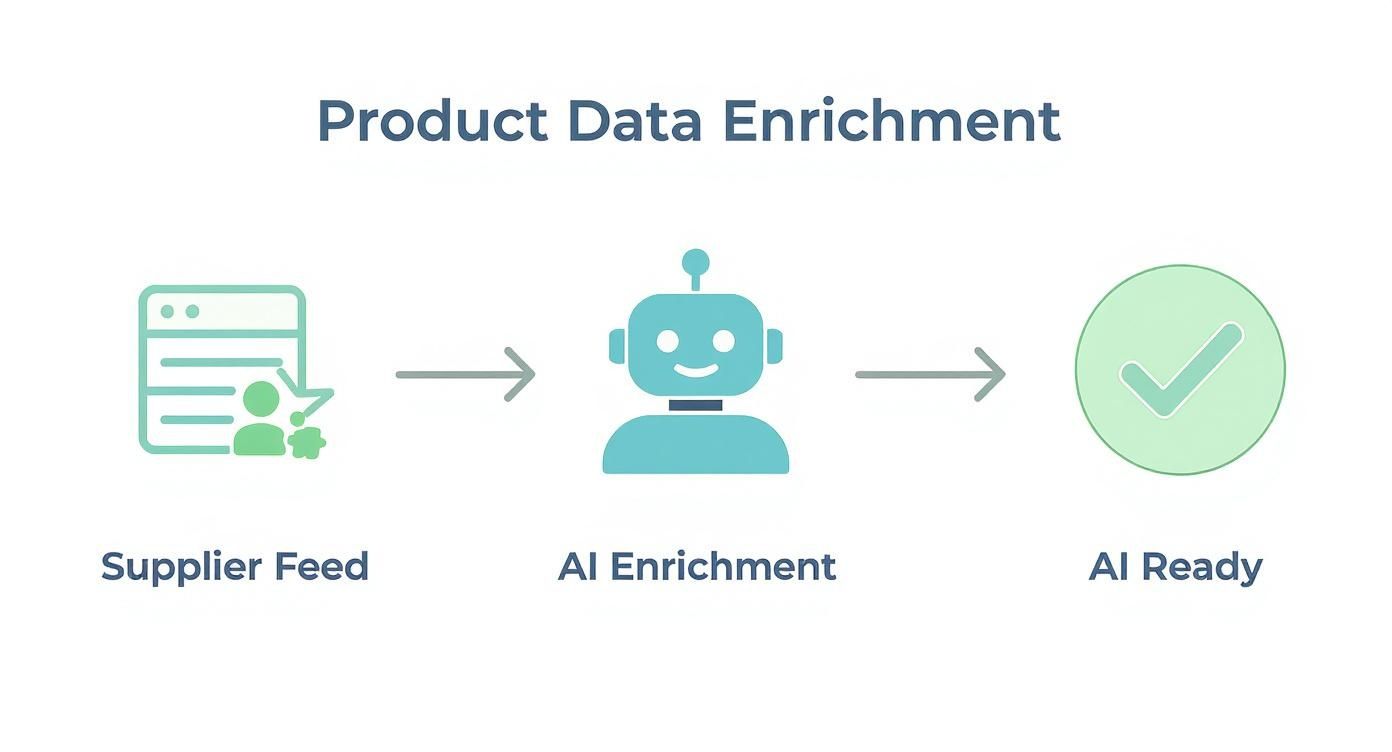
This journey from messy data to clean, structured content is the backbone of any real retail content automation strategy. It’s what prepares your products for AI discovery.
The Human-Led Quality Assurance Layer
Automation gets you scale, but it is human oversight that guarantees quality. This is the most important step in the entire workflow, where your team’s expertise really shines. The human-led AI content QA process is where you fine-tune the AI’s output to make sure it sounds like you, double-check technical details, and ensure everything is completely original.
This model is the future of work in retail. Your ecommerce managers and content specialists stop being manual writers and become strategic editors and AI system optimisers. They’re now free to focus on the high-value stuff machines just cannot do, like:
- Brand Voice Alignment: Making sure the tone and style of AI-generated copy truly reflect your brand’s personality.
- Fact-Checking: Verifying that tech specs for electronics or fabric details for clothing are 100% accurate.
- Originality Audits: Confirming the new content is unique and bears no resemblance to the original supplier copy.
As you bring LLMs into your workflow, it is also crucial to have safeguards against originality issues. This definitive guide on how to avoid plagiarism offers some excellent strategies for creating content ethically. This final human touch is what turns machine-generated text into marketing assets that actually perform.
Implementing the Workflow Across Verticals
The great thing is, this AI-powered approach works across different retail sectors. The core ideas of product feed optimisation and SKU-level SEO do not change, but the specific details you target certainly do.
- For Fashion SEO Optimisation: AI can be trained to tag granular details like neckline styles (scoop, V-neck), sleeve types (bishop, cap), fabric textures (bouclé, linen), and patterns (gingham, floral).
- For Electronics SEO Optimisation: The workflow can pull out and structure critical tech specs from messy text, like processor speed, screen resolution, and port compatibility.
- For Furniture SEO Services: AI is brilliant at identifying materials (solid mango wood, powder-coated steel), design styles (mid-century modern, industrial), and features (flat-pack, adjustable shelving).
By building these automated content workflows, you create a system that doesn’t just fix today's content problems but prepares your entire catalogue for the future of agentic commerce. It’s fundamental to improving your digital shelf and unlocking a whole new level of efficiency. To see this in action, check out our deep dive into the real driver of AI ROI for retailers.
The Future of Your Retail and Ecommerce Teams
The rise of AI agents in ecommerce is about to trigger a massive shift, not just in technology, but in people. It’s a fundamental change that redefines roles and finally unlocks the true strategic potential of your team. The future of work here is not about replacing talented ecommerce managers, SEO specialists, and content writers. It’s about elevating them from the daily grind of manual tasks to strategic command.
Think about it. Instead of spending weeks manually fixing duplicated supplier content or writing product descriptions one by one, your team's focus will pivot entirely. Their new mission will be to design, manage, and refine the AI workflows for ecommerce that do all the heavy lifting. This creates a new operational model built on human-AI collaboration, where technology handles the scale and people provide the critical strategic direction and quality control.
From Manual Labour to Strategic Command
The day-to-day reality for a modern retail team is set to evolve, big time. The focus will move away from repetitive, low-impact activities and steer directly toward high-value strategic functions that genuinely influence digital shelf performance and revenue. Making this transition is non-negotiable if you want to build a next-generation retail operation ready for the agentic commerce future.
Here’s how key roles are going to transform:
- Ecommerce Managers: Will stop overseeing manual data entry and become AI workflow architects. Their job will be to design and implement the systems for product data enrichment, making sure the technology aligns perfectly with broader business goals.
- SEO Specialists: Will shift their attention from keyword research to agentic search optimisation. The new game is all about ensuring product data is flawlessly structured for AI agents, managing schema, and optimising for conversational questions.
- Content Writers: Will graduate into brand guardians and quality assurance leads. They'll be responsible for human-led AI content QA, refining the tone of AI-generated copy, and ensuring every single product description is accurate, compelling, and perfectly on-brand.
This evolution is critical, especially for Australia's economic landscape. AI technologies are projected to add up to AUD 142 billion annually to Australia’s GDP by 2030, which is a massive signal of their foundational importance. Investing in these retail efficiency tools does not just drive productivity, it aligns your business with a major national economic driver. You can dive deeper into this in the comprehensive Australia’s AI Opportunity Report.
By embracing retail content automation, you’re not just adopting a new tool. You are fundamentally changing the nature of work, creating more strategic, data-driven, and ultimately more fulfilling roles for your team.
This AI-powered retail transformation allows your organisation to achieve a level of scalable SEO solutions that was once pure fantasy. By freeing your best people from tedious manual work, you empower them to focus on what humans do best: strategy, creativity, and innovation. That powerful combination of human expertise and machine efficiency is the key to locking in a lasting competitive advantage in an increasingly automated retail world.
Frequently Asked Questions
The shift to AI-driven retail is happening fast, and it’s natural to have questions. Here are some straight answers to the most common queries we hear from Australian retail leaders and eCommerce managers.
What Is the Difference Between AI SEO and Traditional SEO?
Think of it this way: traditional SEO helps humans find your products using keywords in a search engine.
AI SEO, or Agentic Search Optimisation, is all about making sure AI agents can find, understand, and trust your products. It’s less about keywords and more about highly structured, machine-readable data like schema and granular product attributes. The goal is to get your products recommended in complex, conversational searches.
How Does Product Data Enrichment Help with AI Search?
AI shopping agents are incredibly powerful, but they need deep, structured data to work their magic. They will not recommend a product if they are not confident about what it is.
Product data enrichment turns your basic supplier feeds into the rich, detailed content these agents crave. This means generating unique descriptions, using AI image recognition to add specific tags, and filling out every single attribute. It’s the key to strong digital shelf performance in this new era of search.
Can We Still Use Supplier Content for Our Products?
Relying on duplicated supplier content is one of the biggest risks you can take with AI SEO. It’s generic, lacks the unique detail AI agents need to tell your products apart from competitors, and can actively harm your search rankings.
Fixing supplier content duplication is one of the first, most critical steps to prepare your catalogue for what’s next. It’s your chance to establish a unique brand voice and provide the rich, trustworthy data that AI requires.
How Can We Optimise Thousands of SKUs Without a Huge Team?
This is exactly where AI workflow automation comes in. Trying to do this manually is a non-starter.
Modern retail content automation platforms can process and enrich tens of thousands of SKUs in a matter of days. These retail efficiency tools take care of the heavy lifting, generating unique descriptions, optimising metadata, and writing image alt tags, letting you achieve SEO at scale without the massive overheads.
How Will AI Change the Roles of My Ecommerce Team?
Your team is not being replaced, it is being upgraded. The future here is about human + AI collaboration.
Instead of mind-numbing data entry, your team will shift to more strategic work. They'll be designing and overseeing automated content workflows, running quality checks on AI-generated content, and focusing on high-level strategy. This AI-powered retail transformation makes your team more efficient, more data-driven, and far more impactful.
Ready to future-proof your product catalogue and dominate the new era of search? Optidan AI provides the scalable SEO solutions you need to transform your product data, eliminate content bottlenecks, and get your brand ready for the future of agentic commerce. Learn more at https://optidan.com.
