

Agentic search is a way of saying your next customer is an AI agent. Think of it as a tireless personal shopper that makes buying decisions based on cold, hard data, not brand loyalty. Now, the real question is, What agentic search means for retail visibility?
For retail leaders, this is a massive shift. Success no longer just depends on a flashy website; it hinges on how well machines can understand your products. This directly impacts your digital shelf performance and, ultimately, your conversion rates. It’s time to move on from manual SEO and embrace a scalable AI SEO strategy, one built on deep product data enrichment and smart retail content automation.
Your New Customer Is an AI Agent
Imagine a customer who never actually visits your website. They don’t see your carefully crafted branding or your beautiful product photos, but they still buy from you. That’s the new reality of agentic search.
Instead of a person typing “women’s black linen pants size 12” into Google, they’ll simply tell an AI assistant like ChatGPT, Perplexity, or Amazon’s Rufus to find and buy the best option for them.
This changes everything for retail visibility. The AI agent is now the primary “shopper” consuming your product information, acting on a user’s behalf to research, compare, and complete the purchase. These AI agents in ecommerce don’t browse; they analyse. They rely on structured, granular data to make decisions, not just a few keywords. This is the heart of agentic commerce: the shift from human-led discovery to machine-led purchasing, a core part of the future of work in retail.
The New Currency for Digital Shelf Performance
In this new world, rich, structured product information is your most valuable asset. Your products must be described in a way that’s not just appealing to a person but is crystal clear to an AI. If your product catalogue is full of duplicated supplier content or thin, unhelpful descriptions, AI agents will simply ignore it.
This isn’t some far-off future. It’s happening right now in Australia. Recent data shows that nearly half of Australians (48%) have already used AI assistants to find products online. That figure jumps to a staggering 66% for consumers under 45, showing just how quickly this behaviour is being adopted.
With 78% of Australians believing AI shopping tools will soon be a normal part of online retail, the need for a solid agentic search optimisation strategy is no longer a “nice-to-have.” To dig deeper into this trend, check out our guide on how ChatGPT is changing the online shopping experience.
The table below breaks down just how different this new approach is.
How Agentic Search Rewrites the Rules for Retailers
To truly grasp the shift, it helps to see the old and new ways side-by-side. The traditional eCommerce playbook focused on attracting human eyes to a webpage, but agentic search is all about feeding structured data to an algorithm. This is the core difference between AI SEO vs traditional SEO teams.
| Attribute | Traditional Search | Agentic Search |
|---|---|---|
| Primary Target | Human shoppers browsing websites | AI agents analysing data feeds |
| Key Optimisation | Keywords, on-page SEO, backlinks | Structured data, unique attributes, schema |
| Content Focus | Persuasive, brand-focused copy | Factual, detailed, machine-readable info |
| Visibility Driver | Google ranking for specific queries | Inclusion in AI-generated answers |
| Success Metric | Website traffic, time on page | Feed quality, data completeness |
| Tools Used | SEO platforms, keyword research tools | AI workflow automation, data enrichment |
As you can see, what worked before won’t be enough to compete in an AI-driven market. The focus must move from pages to product feed optimisation.
Preparing for Agentic SEO at Scale
For your products to be seen, they must first be understood by machines. This requires a strategic leap from manual, one-off SEO tasks to scalable AI SEO services. The biggest challenge for most retailers is transforming messy supplier feeds into optimised, unique, and structured product content across thousands of SKUs. This is where automated content workflows become essential.
These AI workflows for ecommerce allow retailers to:
- Enrich Product Data: Turn basic supplier info into detailed, machine-readable attributes that agents can process.
- Generate Unique Content: Correct duplicated supplier content to build brand authority and avoid being penalised.
- Optimise at Scale: Apply sophisticated SEO strategies to over 10,000 pages in days, not months.
To get a clearer picture of the immediate advantages these new AI customers offer, it’s worth exploring the key benefits of AI chatbots for business. After all, it’s no longer just about getting found on Google; it’s about being chosen by an AI.
Why Your Product Data Is Invisible to AI
AI shopping agents are incredibly powerful, but they have one glaring weakness: they can’t make sense of poor-quality or incomplete data. For countless Australian retailers, this means their product catalogues are effectively invisible in this new agentic era. This problem runs much deeper than traditional SEO.
Put simply, if an AI agent can’t understand your products, it can’t recommend them.
The real issue lies in the data most retail websites are built on. We’re talking about thin descriptions, unstructured attributes, and worst of all, duplicated supplier content. Together, they create a digital fog that machines just can’t see through. An agent searching for a “100% organic cotton, navy blue crew-neck t-shirt, made in Australia” is never going to find your product if its page just says “blue shirt”.
Ignoring this means you’re being filtered out of the race before the customer’s journey even starts, leading to a massive hit to your digital shelf performance.
The Problem with Duplicated Supplier Content
The single biggest barrier to agentic search visibility is the reliance on generic supplier content. It’s a widespread problem. When hundreds of retailers use the exact same descriptions, images, and specs straight from the manufacturer, AI agents have no way to tell one from another. It’s a massive red flag that requires a duplicate content SEO fix and is a clear signal of low value.
An AI’s job is to find the best option, not just any option. To do that, it needs unique data points to compare.
AI agents rely on rich, specific, and unique attributes to make complex comparisons and logical decisions. Without a unique voice and detailed data, your products just blend into the background noise, becoming indistinguishable from your competitors.
This is why getting your head around how AI consumes information is so critical; these systems are built to parse and prioritise originality and structure. Your website isn’t broken, but it might as well be invisible to this new wave of AI search. We explain more about this in our guide on why your website isn’t broken, it’s invisible to AI search.
The Solution: Product Data Enrichment
The only real solution is Product Data Enrichment. This isn’t just about tweaking a few descriptions; it’s a strategic move to create AI-compatible SEO content at scale. The goal is to turn those basic supplier feeds into deeply structured, optimised product assets that machines can actually read and understand.
This supplier feed enrichment process involves a few key steps:
- Correcting Supplier Duplication: Creating completely unique product descriptions SEO that establish your brand’s voice and authority.
- Adding Granular Attributes: Structuring data like materials, dimensions, features, and compatibility so machines can easily parse and compare it.
- Leveraging Image Recognition: Using AI image recognition SEO for visual-heavy categories like fashion, furniture, and electronics to automatically generate descriptive tags (e.g., “v-neck,” “mahogany finish,” “stainless steel hardware”).
This SKU-level SEO approach gives AI agents the granular detail they need to make informed, confident recommendations. It ensures your products are not just seen, but actually selected. This is the future of retail content automation.
Building Your AI-Ready Product Catalogue
I’ve watched teams spend months wrestling with inconsistent supplier sheets. It doesn’t have to be that way. By embracing retail content automation, you turn a chaotic feed into a polished, AI-trusted product catalogue in days, not quarters.
This isn’t a tech gimmick, it’s about freeing your marketers from endless data chores. An AI-driven workflow ingests, cleans, and enriches thousands of SKUs on the fly. Suddenly, your digital shelf reflects accurate, up-to-date information and your team can focus on strategy rather than spreadsheets, a clear example of AI-powered retail transformation.
The real payoff shows up in search visibility and conversion rates. When AI agents encounter well-structured, SEO-friendly content, they rank you higher and shoppers click through more often.
From Duplication to Distinction At Scale
Before an AI agent can recommend your products, it needs confidence that your content is unique. Supplier descriptions are often recycled across hundreds of sites. That’s a red flag for both search engines and AI shopping assistants. Automating product descriptions is the only scalable solution.
An automated rewrite engine tackles this by:
- Identifying Duplicate Blocks: Spotting sections lifted verbatim from manufacturers
- Injecting Brand Voice: Recasting copy so it feels authentically yours
- Highlighting Key Attributes: Weaving in must-know details that set you apart
In practice, this means hundreds or even thousands of generic descriptions become individual stories, tailored to each product. No more “one-size-fits-all” blurbs. Instead, you provide the rich context AI agents crave, helping them serve confident, accurate recommendations and scale SEO content for retail.
By shifting from listing specs to narrating benefits, you give AI the cues it needs to answer complex shopper queries, like “Which merino scarf holds its shape after washing?”, with precise suggestions.
Structuring Data For Machine Understanding
Imagine your catalogue as a library. Basic tags like “colour” or “size” are the spine labels. But readers, our AI agents, also want chapter summaries, author bios, and cross-references.
That’s where AI workflow automation for retail steps in. It drills into each SKU and tags granular attributes such as:
- Material Composition: “100% Australian Merino Wool” rather than just “wool”
- Dimensions & Fit: Exact measurements plus style notes, vital for fashion and furniture SEO
- Technical Specifications: Compatibility, power output, and connectivity details for electronics SEO optimisation
On top of that, incorporating AI image recognition and tagging adds a visual layer. The system scans your product shots and generates alt tags like “v-neck collar,” “brushed nickel finish,” or “USB-C port,” all without human intervention. This alt tag optimisation for retail is crucial.
This depth of detail is nearly impossible to achieve by hand at scale. Yet it’s exactly what AI agents need to run sophisticated comparisons and deliver spot-on answers to shopper queries.
For those ready to take the next step, our deep dive into product data enrichment services lays out the tools and workflows that make this level of catalogue intelligence a reality. By offloading the grunt work to AI, your team can concentrate on the creative and strategic tasks that drive real growth.
The Commercial Impact on Australian Retail
For Australian retail leaders, this shift towards agentic search isn’t some far-off theory; it’s a direct challenge to your current revenue model. This is where concepts like AI SEO and product data enrichment stop being buzzwords and start translating into real business outcomes. We’re talking about a direct line from better visibility to higher conversion rates and a healthier bottom line.
It’s about securing your spot on a digital shelf that’s changing fast, where AI agents for retail efficiency are the new gatekeepers.
Retailers who get ahead of this with AI-powered optimisation are tapping into a growing and incredibly valuable group of AI-driven shoppers. When an AI agent can instantly understand and trust your product data, it’s far more likely to recommend your SKU over a competitor’s. This is the new frontier of digital shelf performance.
From Friction to Flow with Agentic Commerce
Think about how much friction exists in a typical online shopping journey. Agent-led, personalised recommendations slash right through it. An AI agent can sift through thousands of products in seconds to find the perfect item for a shopper’s very specific needs, a task that could take a person hours of frustrating searches and filtering.
This isn’t just a nicer customer experience; it has a direct impact on your sales metrics.
By feeding AI agents clear, structured, and helpful data, you’re empowering them to:
- Increase Average Order Value (AOV): Agents can intelligently bundle compatible products or suggest relevant upsells based on genuine product compatibility, not just a vague browsing history.
- Boost Conversion Rates: By surfacing the perfect product almost instantly, agents cut through decision fatigue and dramatically reduce cart abandonment.
- Drive Repeat Purchases: A great first experience led by an agent builds trust. That positive outcome makes your store the go-to choice for future purchases.
The Urgency for Australian Ecommerce Leaders
The financial incentive to get this right is huge and growing every day. The Australian AI in retail market, currently valued at around AUD 310.9 million, is forecast to explode to roughly AUD 1.99 billion by 2030. That’s a massive compound annual growth rate of over 30%, and it’s being driven by the sheer efficiency of AI in retail. You can find more data on Australia’s AI in retail market growth on appinventiv.com.
This isn’t just about adopting new tech. It’s about fighting for market share in a new economic reality. Using AI to build operational efficiency is now the single biggest lever you have to build a competitive edge and future-proof your business.
For Australian retailers, the message is simple: the future of agentic commerce has arrived. Doing nothing means becoming invisible to a massive, fast-growing sales channel. To understand more about how this is fundamentally changing the customer journey, check out our guide on the new era of AI-driven online shopping.
Embracing retail content automation and scalable SEO solutions is no longer a “nice-to-have.” It’s essential for survival and growth.
Moving from Manual SEO to AI-Powered Workflows
The move towards agentic commerce means retail teams need a fresh playbook. Manual SEO struggles under the weight of huge catalogues. AI-powered content workflows don’t replace your people; they empower them through human + AI collaboration in SEO.
Picture this: a seasonal launch with thousands of new SKUs. A manual crew would drown in spreadsheets and copy for weeks or months. AI, by contrast, spins up product descriptions and metadata in days. This transition from manual SEO to AI SEO is critical for reducing retail content bottlenecks.
This isn’t about swapping humans for machines. It’s a strategic shift, your experts craft the plan, while AI handles the heavy lifting.
The Power of Scalable SEO Solutions
Manual updates grind to a halt when you wrestle with volume. AI workflows sweep away those bottlenecks. They turn SEO at scale into a living, breathing process rather than a one-off project.
- React instantly to market shifts
- Keep your digital shelf updated 24/7
- Streamline catalogue optimisations across tens of thousands of products
Here’s the proof in numbers. This chart tracks the Australian AI retail market’s rise, underlining the scale of investment in retail efficiency tools.
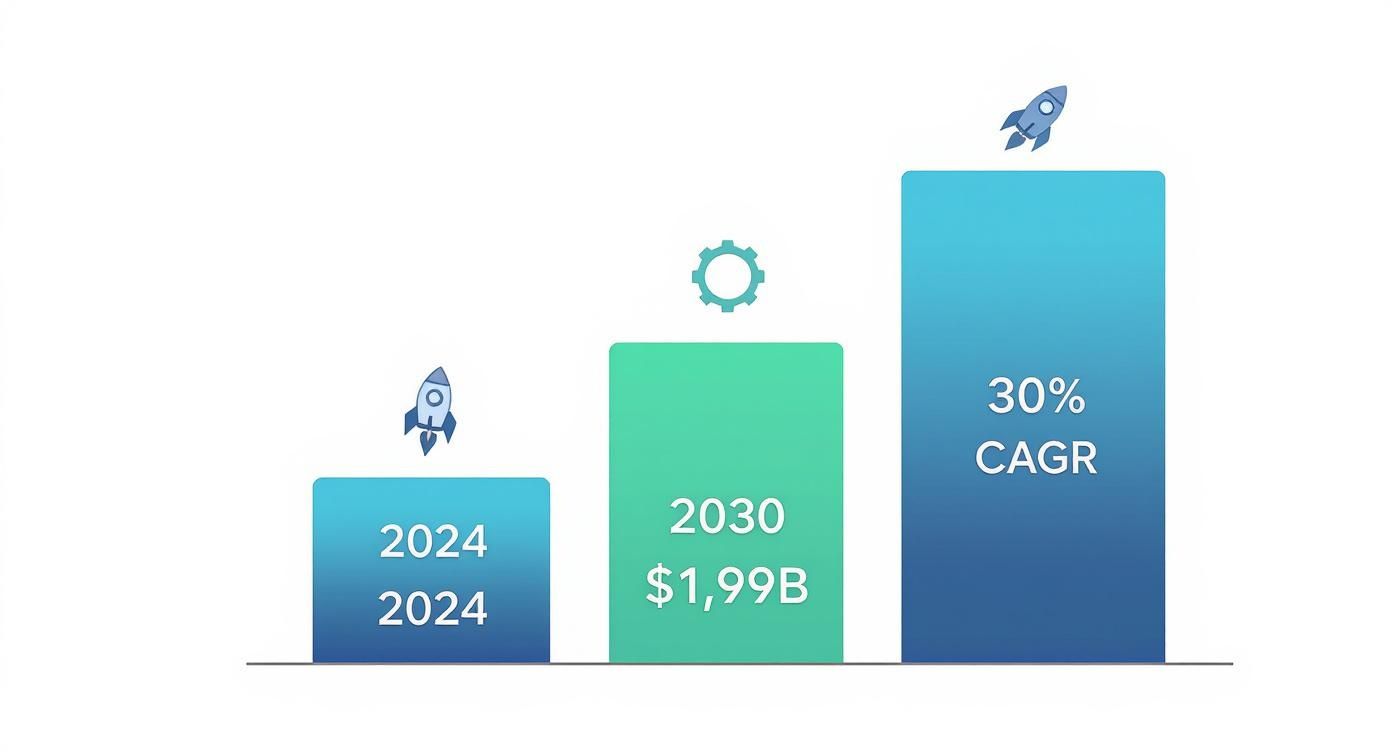
The numbers speak for themselves: AI adoption is shifting from boutique to baseline.
This human-plus-AI partnership scales far beyond anything a single team could manage. Your strategists set the direction, AI executes across every SKU. To see this in action, dive deeper into the workflow as the real driver of AI ROI for retailers.
Optimising 10,000 SKUs Manual vs AI-Powered Workflows
To bring this shift into focus, let’s look at a head-to-head comparison for 10,000 SKUs, from data enrichment to description writing and metadata generation. The gaps in time, cost, and consistency are night and day.
| Metric | Traditional SEO Team | AI-Powered Workflow |
|---|---|---|
| Time to Complete | 3–6 months | 3–5 business days |
| Team Size Required | 4–6 Content Specialists | 1 Strategist + AI Platform |
| Estimated Cost | $60,000 – $120,000 | $10,000 – $20,000 |
| Content Consistency | Varies by writer | 100% consistent brand voice |
| Error Rate | Prone to human error | Minimal, with built-in QA |
This snapshot underlines why AI agents are becoming the backbone of retail content workflows. It’s not just about speed, though faster results are a game-changer, it’s about lifting your entire catalogue to a uniform, high-quality standard. Freed from content drudgery, your team can focus on strategy, creativity, and growth across a far larger digital shelf.
Preparing for the Future of Agentic Commerce
The shift to agentic commerce isn’t some far-off threat; it’s the next-gen SEO for retailers in Australia. Embracing this change means seeing AI agents not as a disruption, but as a direct channel to a whole new generation of shoppers. Your readiness for the future of agentic shopping hangs entirely on the quality and structure of your product data.
Agentic AI adoption in Australia is moving fast. The number of users jumped by 50% in just three months, with 18% of Australians now using it regularly. The key insight here is that 42% expect to fold it into their daily lives within a year, signalling that this behaviour is quickly becoming the new normal. Consumer trust is also growing, with nearly 60% open to AI agents handling purchases for them. You can learn more about the soaring adoption of agentic AI in Australia on bandt.com.au.
This is your chance to get ahead. The first strategic steps are clear and completely actionable.
Your Roadmap to Agentic Readiness
Start by auditing your current product data to see where the weaknesses are, especially when it comes to duplicated supplier content. From there, explore how AI agents for retail efficiency can automate the heavy lifting of enriching that data.
The real goal here is to move from a manual, reactive SEO model to proactive, scalable AI content workflows. Making this transition is fundamental to unlocking any sustained growth in an AI-driven market.
By focusing on building an AI-ready catalogue, you’re not just optimising for search engines. You are preparing for the future of work in retail and building a more resilient, competitive, and efficient business for the years to come.
Frequently Asked Questions
Here are some of the most common questions eCommerce leaders ask as they prepare for agentic search.
What Is the First Step to Optimise for Agentic Search?
Start with a thorough audit of your product data. Without a clear baseline, every optimisation feels like a shot in the dark.
Assess the:
- Quality of your descriptions, images, and attributes
- Uniqueness, spotting duplicated supplier copy
- Structure, ensuring each field is consistent and detailed
This audit becomes your roadmap for product data enrichment, highlighting where AI workflow automation will have the biggest impact on your visibility to AI agents.
How Is AI SEO Different From Traditional SEO?
Traditional SEO is all about keywords on web pages for humans. AI SEO focuses on machine-readable, granular product data so autonomous agents can make logical decisions.
You’ll need:
- Structured specs like material, dimensions, and compatibility
- Unique, descriptive content for AI agents to compare offerings
- Data organised for rapid, programmatic access
The goal shifts from securing a top spot in search results to being selected as the best option by an AI agent.
Will AI Content Workflows Replace Our Marketing Team?
Not at all. The most effective approach is human-led AI execution. Think of AI as your new teammate, taking care of the heavy lifting so your experts can drive strategy. This collaboration between retail teams and AI efficiency is the future.
AI workflows can:
- Automate repetitive catalogue updates at scale
- Draft unique product descriptions in bulk
- Free your team to refine brand voice and conduct quality checks
Human oversight ensures you retain creative control while enjoying the speed and consistency that AI delivers.
Ready to make your product catalogue visible to AI and drive conversions in the agentic era? Discover how Optidan AI automates product data enrichment and content optimisation at scale.
