


For large-scale retailers, an AI-powered content infrastructure isn't just a nice-to-have. It’s the only way to break free from the crippling limits of manual workflows and get your digital shelves ready for the future of search and agentic commerce.
This is how you turn generic, uninspired supplier feeds into unique, optimised content at a scale human teams simply can't touch. It’s the jump from being stuck in a constant content bottleneck to achieving automated, scalable, and future-proof digital shelf performance.
The Breaking Point for Manual Retail Content
Enterprise retailers across Australia are hitting a wall. The old way of manually managing product information for tens of thousands of SKUs isn't just inefficient anymore, it's actively holding back growth.
The sheer volume of products, coupled with the relentless pressure to launch new lines, creates massive content bottlenecks. These logjams kill your agility and, even worse, tank your search visibility.
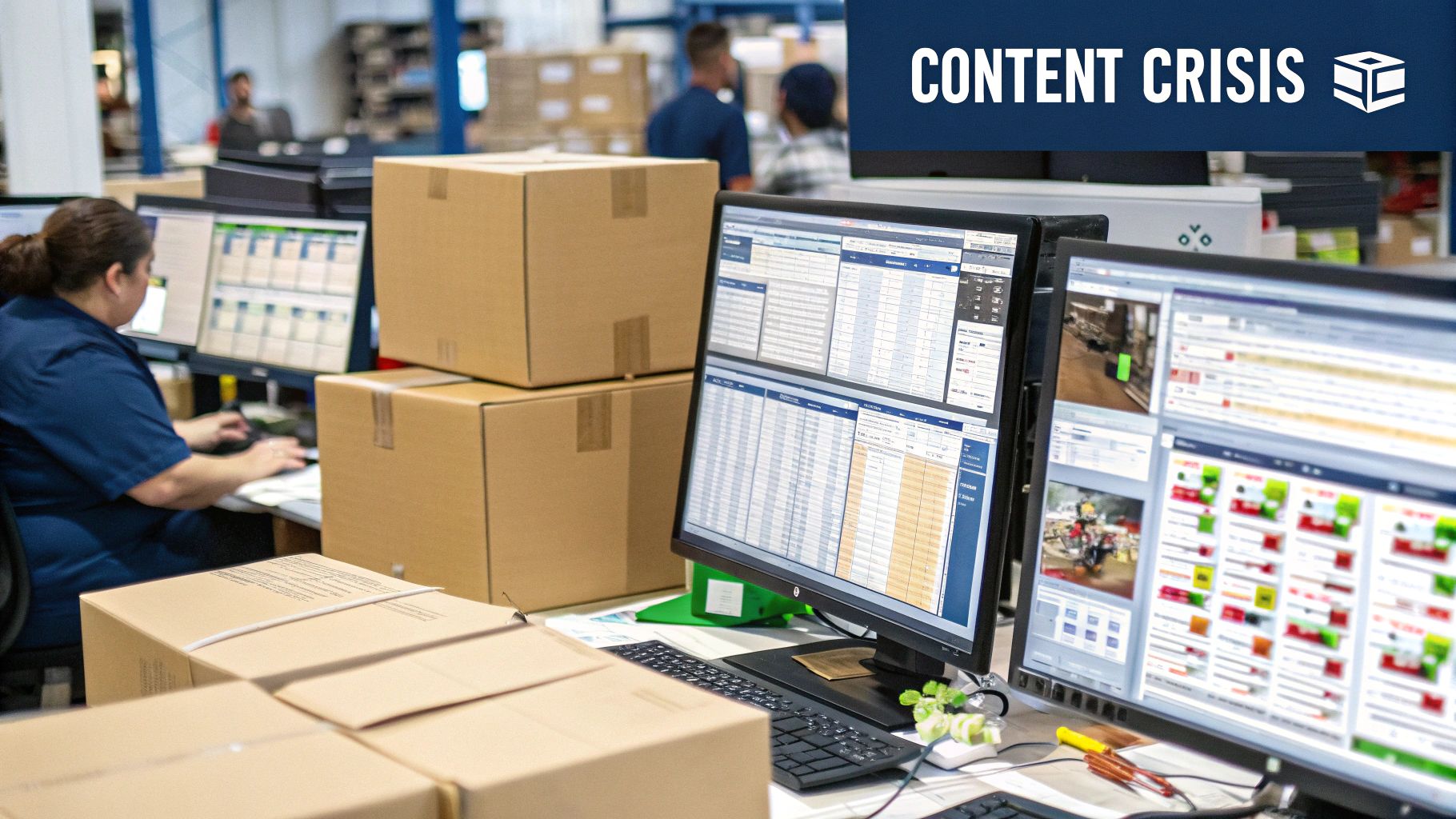
This struggle is most obvious when you're dealing with raw supplier feeds. These files are notorious for generic, duplicated descriptions used by countless other retailers. Trying to manually rewrite thousands of these to address the issue of duplicated supplier content is a soul-crushing task that burns through resources and pushes back launch dates, ultimately hurting your SEO.
From Manual SEO to AI-Driven Optimisation
Moving to an AI-powered infrastructure is a fundamental shift from manual SEO to AI SEO. It’s not just about doing things faster; it’s about gaining a genuine strategic advantage. A traditional SEO team might be able to optimise a handful of high-priority pages. An AI system can deliver SKU-level SEO for your entire catalogue in a matter of days. This is the difference between traditional SEO teams and AI-powered retail transformation.
This leap forward is critical for a few key reasons:
- Correcting Duplicated Supplier Content: AI can systematically rewrite thousands of generic descriptions, creating unique, valuable content that search engines reward, fixing a major ecommerce content quality assurance issue.
- Achieving Optimisation at Scale: It makes creating optimised titles, metadata, and product descriptions for 10,000+ pages possible, a scale manual efforts could never dream of. This is SEO at scale in action.
- Preparing for Agentic Search: As AI shopping agents like Google's AI Overviews and Amazon's Rufus become the norm, having structured, high-quality data is non-negotiable for your products to be found and recommended. This is the future of retail search.
An AI-powered infrastructure isn't a luxury for the future. It’s the essential fix for today’s content bottlenecks and the foundation for the next generation of retail search. This is what modern retail efficiency looks like.
The table below breaks down exactly where old methods fail and how AI-powered infrastructure steps in to solve the problem.
Traditional Content Bottlenecks vs AI-Powered Solutions
| Retail Challenge | Traditional Manual Approach (The Bottleneck) | AI-Powered Infrastructure (The Solution) |
|---|---|---|
| Supplier Content | Manually rewriting thousands of duplicated descriptions. Slow, costly, and inconsistent. | Programmatically rewrites all supplier content to be unique and on-brand in days, solving supplier content duplication. |
| Time-to-Market | New product launches are delayed for weeks or months waiting for content creation. | Content is generated and optimised instantly, allowing products to go live in hours via automated content workflows. |
| SEO Coverage | Optimisation is limited to a few high-priority "hero" products and categories. | Delivers 100% SEO coverage across the entire product catalogue, from top sellers to long-tail items, enabling true retail SEO automation. |
| Data Consistency | Titles, attributes, and descriptions are inconsistent, leading to poor filtering and search experience. | Standardises and structures all product data through product feed optimisation, ensuring a clean customer experience. |
| Future Readiness | Unstructured, generic content is invisible to emerging AI shopping agents and conversational search. | Creates structured, rich, AI-compatible SEO content perfectly formatted for discovery by AI agents like ChatGPT and Perplexity. |
It's a clear-cut case: manual processes create friction and missed opportunities, while AI provides the scale and precision needed to compete.
Embracing AI for a Competitive Edge
Australian enterprise retailers are catching on fast. The National AI Centre's AI Adoption Tracker reveals that 82% of retail businesses with 200–500 employees have already adopted some form of AI, showing that the bigger players are leading the way.
This move is driven by the urgent need for automated content workflows that can handle everything from enriching product data to AI image recognition and tagging. The end goal is to get beyond manual updates and embrace autonomous workflows, a necessary step for any retailer operating at scale.
By making this shift, businesses don't just fix their current content headaches; they build a resilient, scalable SEO strategy that’s ready for whatever comes next.
Transforming Product Data Chaos into a Competitive Edge
For any large retailer, your digital shelf is built on one thing: product data. But for most, that foundation is cracked. It’s a chaotic mess of inconsistent, incomplete, and duplicated supplier feeds that is actively torpedoing your SEO and frustrating your customers.
An AI-powered content infrastructure is designed to fix this exact problem. Think of it as a sophisticated refinery. It ingests messy, raw data from hundreds of different suppliers and transforms it into a clean, structured, and powerful asset. This is the very heart of modern product data enrichment.
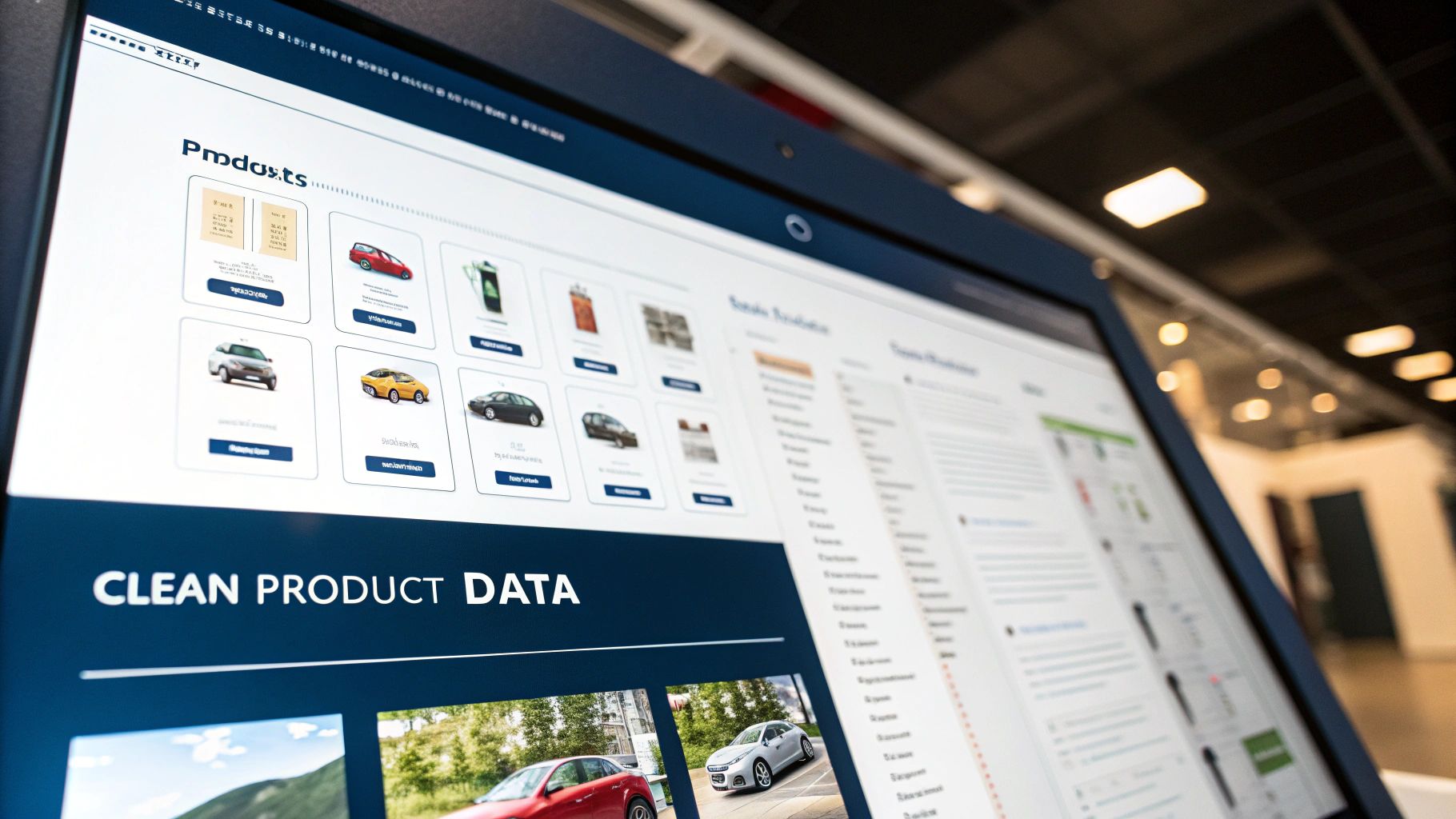
This process is about much more than just a simple clean-up. It's about intelligent augmentation, where AI models actually understand the context of each product and start filling in the gaps. This systematic approach turns a massive operational headache into a serious competitive advantage, creating a single source of truth for your entire product catalogue.
Correcting Duplicated Supplier Content
One of the most damaging and widespread issues for enterprise retailers is supplier content duplication. When you use the same generic descriptions provided by a manufacturer, the same ones used by dozens of your competitors, search engines see it as low-value, repetitive content. This can lead to ranking penalties and make you invisible for crucial keywords.
An AI-powered system delivers the definitive duplicate content SEO fix. It programmatically rewrites every single product description to be unique, on-brand, and optimised for how people actually search, creating unique product descriptions at scale.
- For Fashion Retail: An AI can take a supplier’s basic description like "blue cotton t-shirt" and enrich it with compelling, brand-aligned copy. It can talk about the fabric’s soft feel, the flattering fit, and suggest ideal styling combinations for a complete look, boosting fashion SEO optimisation.
- For Furniture Retail: A generic feed for a sofa can be transformed into a unique description detailing the texture of the upholstery, the specific timber used for the legs, and its suitability for different interior design styles, a key part of furniture SEO services.
This automated workflow is the only way to achieve real SEO at scale. It ensures every single product page is actively building your site's authority, not dragging it down.
By eliminating duplicate content, you're not just dodging penalties. You're building a much stronger SEO foundation that lifts your entire domain and improves your performance on the digital shelf.
Automating Product Data and Image Tagging
Beyond the text, an AI-powered infrastructure brings order to your visual content through advanced AI image recognition. This is an absolute game-changer for retailers in visually driven categories like fashion, furniture, electronics, and beauty.
The system analyses your product images to automatically generate descriptive tags and optimised alt text, tasks that are simply impossible to manage by hand across thousands of SKUs. This AI image recognition SEO is crucial for modern ecommerce.
How AI Image Recognition Works for Retail
| Retail Vertical | Supplier Provides | AI System Generates and Applies | SEO Benefit |
|---|---|---|---|
| Fashion | A flat image of a dress. | Tags: "A-line silhouette," "puffed sleeves," "floral print." Alt Text: "Model wearing a knee-length floral print dress with puffed sleeves." | Captures long-tail searches for specific fashion trends and features, improving fashion product image SEO. |
| Furniture | An image of a dining table. | Tags: "Scandinavian design," "solid oak," "seats six." Alt Text: "Solid oak Scandinavian dining table with tapered legs for six people." | Ranks for specific design and material-based queries, attracting high-intent buyers through furniture image tagging SEO. |
| Electronics | A front-facing shot of a TV. | Tags: "bezel-less screen," "4K UHD," "smart TV." Alt Text: "Front view of a 65-inch 4K UHD smart TV with a thin bezel design." | Improves visibility for technical feature searches, crucial for electronics SEO optimisation. |
This automated process ensures every image on your site becomes an SEO asset, contributing to better rankings in both standard and image search results. It’s a core component of how retailers are leveraging API-driven workflows to transform data enrichment and create a truly optimised online store.
By finally turning data chaos into structured intelligence, you build a resilient and high-performing digital shelf that’s ready for the future.
Achieving True SKU-Level SEO at Scale
Once you have clean, enriched product data sorted, the real magic of an AI content infrastructure begins. This is where you translate all that pristine data into actual SEO results. It’s the moment retailers stop tinkering with a handful of hero products and start the journey to true SKU-level SEO, applying high-quality optimisation to every single item in the catalogue.
This isn’t just a small step up; it’s a massive leap in what your team can actually do. Traditional SEO teams, stuck with manual processes, can only ever give their attention to a tiny fraction of a retailer’s inventory. An AI-driven workflow completely shatters that ceiling, enabling optimisation at scale that was previously unthinkable, even for the biggest players in the game.

From Months of Work to Days of Automation
Just imagine the task: writing unique product descriptions, optimised metadata, and descriptive image alt tags for 10,000 SKUs. Done the old way, you’d be looking at months, if not years, of work. That’s a huge investment in copywriters and SEO specialists.
AI workflow automation for retail flips this entire equation on its head. By connecting your enriched product data to generative AI models, all governed by your specific brand rules, an AI content engine can knock over this monumental task in days. This is the fundamental difference between old-school SEO and an AI-first approach. One makes small, incremental gains; the other delivers a complete, top-to-bottom optimisation.
This level of scalable SEO solution is exactly what you need to capture that incredibly valuable "long-tail" search traffic that so many high-volume retailers miss out on. We're talking about those super-specific, multi-word search queries like "women's black leather ankle boots with side zip" that signal someone is ready to buy. By optimising every single SKU, you give every product its best shot at ranking for these searches that convert.
A New Standard for Digital Shelf Performance
When you nail SEO at this scale, you directly lift your digital shelf performance. Each uniquely optimised product page becomes a brand-new, powerful doorway for organic traffic to find you. This creates a powerful compounding effect, boosting your site's authority and visibility across the board.
An AI-powered infrastructure doesn't just make your old SEO strategy faster. It unlocks a totally new, more granular strategy where every single product pulls its weight and contributes to your overall search dominance.
Think about the actual, tangible things an automated content workflow produces:
- Unique Product Descriptions: Every single item, from a fast-moving electronic gadget to a niche grocery product, gets a compelling, keyword-rich description.
- Optimised Metadata at Scale: Unique title tags and meta descriptions are automatically generated for thousands of pages, each one tailored to the specific attributes of the product.
- Comprehensive Alt Tag Optimisation: AI image recognition makes sure every product image has descriptive alt text, giving you a serious edge in image SEO for ecommerce, especially for fashion, furniture, and electronics.
This automated approach to optimising product feeds efficiently means your teams are no longer bogged down in the endless grind of content creation. Instead, they’re elevated to more strategic roles, focusing on analysing performance and providing that crucial human-led AI content QA over the AI's output.
Unlocking Long-Tail Revenue Streams
The business case for SKU-level optimisation is crystal clear. While your hero products will always drive a lot of revenue, the combined traffic and sales from thousands of long-tail products can often be even greater. Research consistently shows that businesses see a major boost in productivity and efficiency when they automate repetitive tasks, freeing up their people to focus on higher-value work.
Automating product descriptions and metadata ensures that even your least-seen products are working hard to attract qualified buyers. For retailers in hyper-competitive spaces like fashion or electronics, this isn't a "nice-to-have", it's a necessity for survival and growth. To dig deeper into how this impacts the bottom line, you can explore more about the benefits of scale for AI product feeds.
By putting these AI workflows for ecommerce in place, you give every single product the chance to be a winner. You effectively transform your entire catalogue into a powerful engine for organic growth and dramatically improve your visibility where it counts.
Future-Proofing Your Business for Agentic Commerce
The ground is shifting underneath online retail. For years, the game was all about winning on traditional search engines. But a new era is dawning, one defined by agentic commerce. Here, AI agents in ecommerce like ChatGPT, Perplexity, and Amazon's Rufus are fast becoming the go-to tools for product discovery, and this change demands a complete rethink of your content strategy.
Getting ready for this future means building an infrastructure today that creates AI-compatible SEO content. AI shopping agents don't just hunt for keywords; they digest structured, detailed product data to truly understand context, features, and benefits. An AI-powered content infrastructure is the only realistic way to produce this kind of rich, machine-readable content at the scale large retailers need. This is the new frontier of agentic search optimisation.
Preparing for the Future of Retail Search
The move towards agentic search isn't some far-off concept, it’s happening right now. Shoppers are already using these tools to ask complex questions and get curated product recommendations. If your product pages are built on thin, duplicated supplier content, these powerful AI agents will simply look straight past you.
To show up in this new ecosystem, your product catalogue must be a source of clear, unambiguous information. This is where an AI-powered content infrastructure gives you a critical edge. It ensures your content is ready for what's next.
- Structured for AI Agents: It organises product attributes, specifications, and benefits into a logical format that AI can easily parse and understand. This is SEO for AI agents.
- Contextually Rich: It generates detailed, descriptive content that answers the nuanced questions customers will ask AI assistants.
- Optimised for Conversational Queries: It naturally weaves in the language and phrasing real people use when they're looking for advice on what to buy, preparing you for the future of work in retail.
As agentic commerce matures, a huge part of future-proofing your business involves optimising for generative AI search and overhauling your content strategy. This isn't just about tweaking SEO for AI; it's about making your products discoverable in the conversational interfaces that will define the next generation of ecommerce.
Human + AI Collaboration in SEO
This AI-driven shift in retail isn't about replacing your talented teams. It’s about supercharging them. The future is one of human + AI collaboration in SEO, where technology handles the sheer scale of content creation, freeing up your people to focus on strategy, creativity, and quality control.
AI agents in ecommerce are getting incredibly sophisticated, but they still need a human eye to ensure brand voice, accuracy, and strategic alignment are spot on. This partnership lets your teams move away from manual, repetitive tasks and into high-value roles that actually drive business growth, improving retail teams and AI efficiency.
The goal is to build a system where AI workflows handle the heavy lifting, allowing your human experts to guide the strategy and perfect the final output. This synergy is what will separate the winners from the laggards in the agentic commerce future.
This new approach is already clicking with Australian consumers. According to Salesforce’s Agentic Enterprise Index, consumers who interact with AI agents report 64% higher customer satisfaction. In retail specifically, those who have used AI agents are 170% more likely to say their experience has improved. These numbers point to a clear preference for the efficiency and personalisation that AI brings to the table.
By investing in the right infrastructure now, you’re not just optimising for today's search engines. You are building a resilient, adaptable content engine that positions your brand to win as customers increasingly turn to AI for their shopping needs. For a deeper look at this trend, learn more about how AI agents will find products in 2026 and what it means for your business. This is how you secure your spot on the future digital shelf.
Calculating the ROI of Your AI Content Engine
Bringing an AI-powered content infrastructure into your business is a major strategic call. And like any significant investment, the business case can't just be built on buzzwords or vague promises, it needs to be grounded in clear, measurable results. Leaders want to see a tangible return on investment (ROI). It's time to move past abstract ideas and focus on the hard metrics that directly hit your bottom line.
Figuring out the ROI of your AI content engine comes down to three things: cost savings, revenue gains, and operational efficiencies. It’s about quantifying the jump from slow, manual processes to fast, automated workflows that actually drive business growth. This is where the real power of AI workflow automation for retail becomes undeniable, connecting the technology directly to your profitability.
Hard Metrics for a Clear Business Case
The value of an AI content engine shows up across several key areas of your retail operation. By tracking specific key performance indicators (KPIs), you can build a powerful picture of its impact.
Here’s where you should be measuring:
- Slash Content Production Costs: First, calculate the hours your team or external agencies spend manually writing product descriptions, metadata, and alt tags. It all adds up. An AI engine can cut these costs by over 90%, freeing up that budget and letting you point your talented people toward more strategic work.
- Accelerate Time-to-Market: Think about it: how much revenue do you lose when a new product line is stuck in limbo for weeks, or even months, just waiting on content? AI-powered workflows shrink that timeline down to days. You can launch products faster, jump on trends while they're hot, and start making money sooner.
- Boost Organic Traffic and Conversions: By achieving SKU-level SEO, you unlock thousands of long-tail keywords you were never targeting before. This translates directly into more organic traffic. Keep a close eye on the lift in non-branded organic sessions and the conversion rate increases on these newly optimised pages.
Quantifying the Efficiency Gains
Beyond the direct costs and revenue, the efficiency gains you get from these retail efficiency tools are massive. Consider the ripple effect of freeing your teams from the repetitive grind of manual content creation. Suddenly, they have the bandwidth to analyse performance, fine-tune campaign strategies, and innovate. This is what true human + AI collaboration in SEO looks like.
The real win isn’t just automating tasks; it’s about shifting your team's focus from execution to strategy. That shift is what builds a sustainable competitive advantage and drives long-term profitability.
The economic impact here is huge. A report from Deloitte found that increased AI adoption could pump an extra $44 billion into Australia's economy each year. For large retailers, the numbers are even more compelling. Businesses that level up from basic to intermediate AI use see a 45% jump in profitability. This really highlights the financial potential locked inside an AI-powered content infrastructure.
To give you a clearer idea of what to track, here’s a breakdown of the key metrics.
Measuring the Impact of AI Content Infrastructure
| Metric Category | Key Performance Indicator (KPI) | Expected Business Outcome |
|---|---|---|
| Cost Savings | Cost per product description (manual vs. AI) | Over 90% reduction in content creation expenses. |
| Agency/freelancer spend on content writing | Significant reduction or reallocation of external budget. | |
| Operational Efficiency | Average time-to-market for new products | Launch products weeks or months faster. |
| Team hours spent on manual content tasks | Free up hundreds of hours for strategic, high-value work. | |
| Revenue Growth | Non-branded organic traffic growth | Increased visibility and customer acquisition. |
| Conversion rate on optimised product pages | Higher sales from more relevant, compelling content. | |
| Number of ranking long-tail keywords | Capture highly specific, purchase-ready search traffic. |
Tracking these KPIs will give you a rock-solid, data-backed view of how your investment is performing and where it's delivering the most value.
Ultimately, the ROI calculation paints a very clear picture. An AI content engine isn't a cost centre; it's a profit driver that delivers measurable returns through cost reduction, faster revenue, and smarter operations. To see how these automated processes function in the real world, you can learn more about the real driver of AI ROI for retailers.
Your Strategic Roadmap to AI Implementation
Jumping into an AI-powered retail transformation isn't about flicking a switch. It needs a clear, phased game plan. Moving from ideas to real results is more than just buying new tech; it’s a fundamental shift in how your entire business thinks about and handles content.
This roadmap gives retail leaders a practical framework to move smoothly from clunky manual processes to scalable, AI-driven workflows.
The first step isn't actually about AI at all. It’s about your data. You have to start by taking a hard look at your existing product information, from messy supplier feeds to the quality of your own internal data. Finding the inconsistencies and gaps is what will shape your initial pilot program.
Phase 1: Initial Assessment and Pilot Program
You have to start small. The goal here is to prove the concept and build some internal momentum. Pick a specific product category to run a pilot, maybe one that’s notorious for having terrible supplier content. You want to show real, tangible value, and fast.
This means plugging a pilot AI workflow into your existing PIM or DAM systems to automate product data enrichment for a small batch of SKUs. Measure the time saved and the jump in content quality against your old manual methods. This quick win becomes your best argument for rolling it out further.
Phase 2: Scaled Implementation and Integration
Once you’ve got a successful pilot under your belt, it’s time to scale the solution across your entire product catalogue. This is where choosing the right technology partner is critical. You need someone who gets the specific challenges of enterprise retail, like the need for SEO at scale and building robust AI agents for retail efficiency.
Integration has to be seamless. Your AI content infrastructure can't just be bolted on; it needs to work in harmony with your current systems to create one cohesive, automated content pipeline. This is when you'll start to see the real muscle of retail content automation as it turns raw product feeds into perfectly optimised assets.
Phase 3: Human-Led AI Content QA and Optimisation
This is the most important part: AI is here to augment your team, not replace them. The final phase is all about setting up a human-led AI content QA process. Your teams, no longer bogged down in repetitive content creation, can now focus on the bigger picture, strategic oversight, brand voice alignment, and performance analysis.
They become the guardians of quality, making sure every piece of AI-generated output meets your high standards.
As you build out your AI implementation roadmap, think about other ways AI can boost your reach. For instance, extending your strategy to include AI-powered strategies for retail advertising can seriously amplify the impact of all that new, high-quality content you're creating.
The infographic below maps out how these operational changes lead directly to measurable growth.
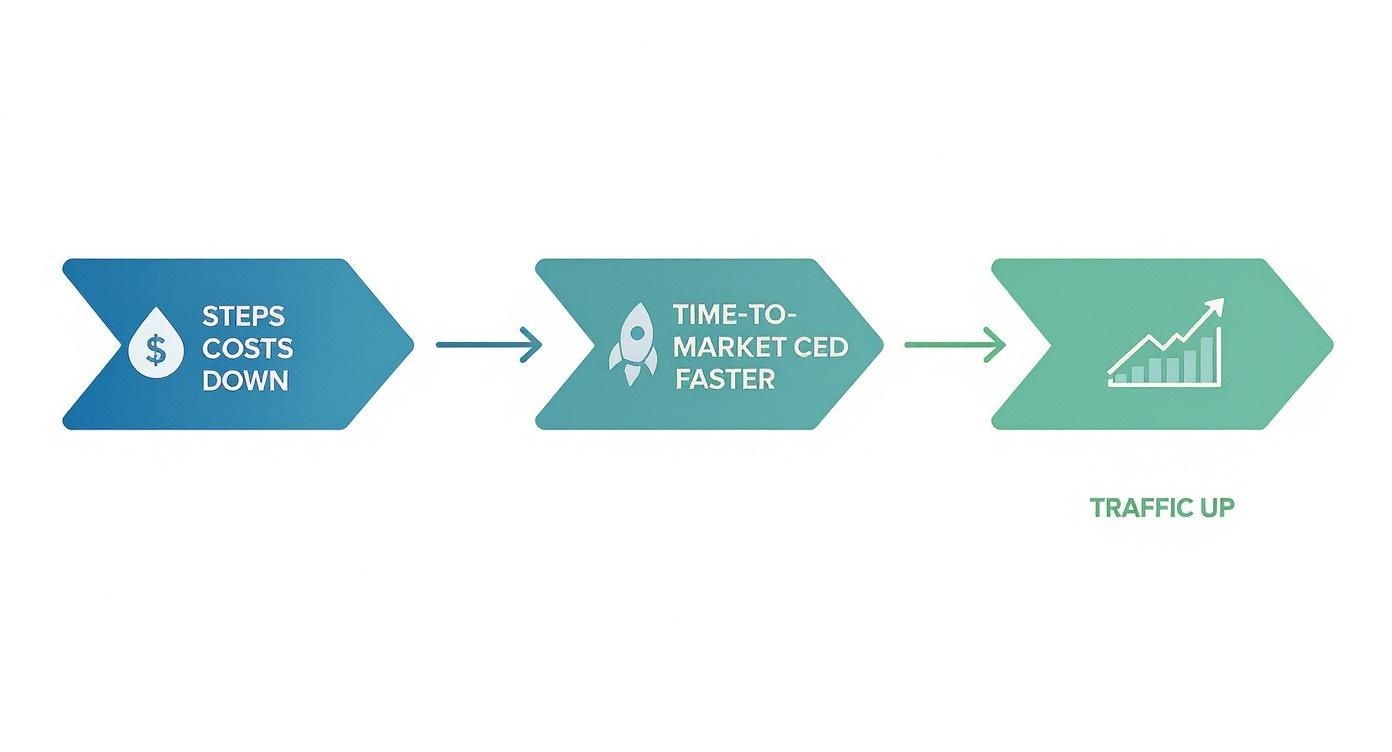
This strategic flow makes it clear: automated content workflows directly translate to lower operational costs, faster product launches, and better organic traffic. Following this roadmap will help you navigate your AI rollout with confidence and build a content engine that’s truly ready for the future.
Got Questions? We've Got Answers
Here are a few common questions we hear from enterprise retailers when they're looking at an AI-powered content infrastructure for the first time.
How Does AI Fix the Supplier Content Problem?
Simple: AI rewrites and enriches every single product description, automatically and at a massive scale. Instead of just copying and pasting the generic text from your suppliers, which is a huge red flag for search engines, the AI gets to work.
It looks at the product’s attributes, images, and other data points to understand what it actually is and what it does. From there, it generates completely unique, on-brand, and keyword-optimised descriptions for every SKU in your catalogue. This is the definitive duplicate content SEO fix for large retailers because it tells Google that every one of your product pages is distinct and valuable, helping you climb the rankings instead of getting penalised.
Will This Technology Make Our SEO and Content Teams Redundant?
Absolutely not. The goal here is to augment your team, not replace them. Think of it as giving your experts a powerful tool to handle the repetitive, mind-numbing tasks that no human could ever do efficiently, like writing 20,000 unique descriptions in a week.
This frees up your team from the grunt work. They can finally focus on what they do best: high-level strategy, creative direction, analysing performance, and quality control. This model of human and AI collaboration in SEO is where retail is headed. Your experts guide the AI, and the AI executes the large-scale tasks, leading to better results for the business.
What Is Agentic Search and Why Should We Care Now?
Agentic search is what happens when people use AI agents like ChatGPT, Perplexity, or even built-in shopping assistants like Amazon Rufus, to find and compare products. These tools don't just look for keywords; they read and interpret highly structured product data to understand what a user really wants.
This is critical right now because the foundation for being found in agentic search is clean, comprehensive, and perfectly structured product information. An AI-powered content infrastructure builds that foundation today. It creates AI-compatible SEO content that ensures your products are understood and recommended by the AI systems driving the next wave of commerce. Getting this right isn't just an advantage; it's about future-proofing your entire business.
Ready to turn your content chaos into a competitive edge? Discover how Optidan AI can automate your product content optimisation, clear your bottlenecks, and get your business ready for the future of retail search. Visit us at https://optidan.com to see how it works.
