
Agentic shopping SEO isn't some far-off concept. It's already here, reshaping how Australian customers find and buy your products. This new reality is driven by AI assistants like Google's AI Overviews and Amazon's Rufus, which act as personal shoppers to answer complex questions. The game has changed. The focus is no longer on traditional keywords but on providing clean, structured product data that these AI agents can understand and trust.
The New Frontier of Australian Retail Search
Welcome to the new era of Australian retail. For ecommerce managers, adapting to agentic search means moving beyond simply ranking pages. The real goal is to make your entire product catalogue 'AI-compatible', so these new assistants don't just find your products but confidently recommend them. This guide is your roadmap for navigating this shift, focusing on AI-powered data enrichment and scalable content workflows to secure your brand's place on the digital shelf of tomorrow.
A Fundamental Shift in Consumer Behaviour
The move to agentic commerce is happening faster than many realise. The numbers don't lie: nearly half of Australians (48%) have already used AI assistants to look for products online. It's even more common among younger shoppers, with usage jumping to a massive 66% for those under 45.
This is a clear generational shift in how people shop.
With 78% of Australians believing AI shopping tools will become a regular part of their online life, the time to act is now. This isn't just a tech update, it's a profound change in how retailers compete. Agentic AI is rewriting the rules, and being prepared is what will set you apart. You can learn more about how agentic AI is changing the way retailers compete online.
For retail leaders, the core challenge is transforming a catalogue built for human eyes into a dataset built for machine intelligence. This involves a strategic pivot towards product data enrichment, correcting supplier content duplication, and implementing AI workflow automation to operate at scale.
This transformation requires a focus on several key pillars:
- AI SEO Readiness: Optimising your digital assets so they can be understood and favoured by generative AI search engines and shopping assistants, paving the way for the future of retail search.
- Product Data Enrichment: Turning basic supplier feeds into detailed, structured, and optimised product content that answers every potential customer question. This is the core of AI-powered retail transformation.
- Unique Content at Scale: Using retail content automation to fix duplicate content issues and develop a distinct brand voice across thousands of SKUs, achieving SEO at scale.
- Enhanced Digital Shelf Performance: Improving rankings, visibility, and conversions by providing the rich, accurate data that AI agents prioritise.

Why Product Data Is the New SEO Foundation
Think of an AI shopping agent less like a casual window shopper and more like a hyper-efficient data analyst. For this new breed of customer, your beautifully designed product pages are a secondary concern. Your product catalogue isn't a collection of pages to be indexed, it’s a dataset to be interrogated.
This is the fundamental reason why product data enrichment is now the absolute bedrock of modern agentic SEO.
In the past, retail SEO was all about optimising pages for human eyes. Now, it’s about structuring data for machine intelligence. AI agents aren't swayed by clever marketing copy. They make decisions based on the quality, completeness, and accuracy of the data you provide. If your data is messy, incomplete, or buried in unstructured text, your products are effectively invisible in this new era of agentic commerce future.
The goal is to move from manual SEO to an AI-first approach, turning inconsistent supplier feeds into the clean, structured, and comprehensive data that AI agents need. It's a crucial shift from traditional SEO to AI SEO, one that directly impacts your digital shelf performance and your ability to scale.
Beyond Basic Product Specifications
Optimising for agentic search means going far deeper than basic specs like colour and size. AI agents are tasked with answering complex, contextual questions from users, like, "find me a waterproof, lightweight jacket suitable for hiking in Tasmania during autumn." To answer that, the agent needs a lot more than just "black jacket, size large."
AI agents prioritise a much deeper layer of attributes, including:
- Precise Materials: Not just 'fabric', but '100% merino wool' or 'Gore-Tex Active shell'.
- Specific Compatibility: This is essential for electronics SEO, with details like 'compatible with iPhone 15 Pro' or 'requires a USB-C connection'.
- Usage and Occasion Context: This is where you connect products to lifestyles, tagging a dress as 'perfect for beach weddings' or a sofa as 'ideal for small-apartment living'. This is critical for fashion SEO optimisation.
- Rich Metadata: This includes detailed alt tags for images, structured data markup (Schema), and clear specifications that an AI can parse without any ambiguity.
This granular level of detail is impossible to manage manually across thousands of SKUs. AI-powered content workflows are essential for processing and optimising product data at scale, making your entire catalogue legible and desirable to AI recommendation engines.
From Manual Data Entry to AI Workflow Automation
The traditional approach of manually updating product details has become a massive bottleneck for retailers. It’s slow, it’s prone to human error, and it simply cannot keep pace with the demands of AI SEO. The future of work in retail is a human and AI collaboration, where technology handles the heavy lifting of data processing, freeing up your team for strategic oversight.
AI workflow automation for retail makes SKU-level SEO a reality. These systems can ingest raw supplier feeds, identify critical data gaps, and enrich thousands of product listings in days, not months. This process is core to preparing for the future of agentic commerce, ensuring your products aren't just found, but recommended with confidence by AI agents for retail efficiency.
Understanding the principles of product data enrichment is the first step towards building this capability.
The strategic pivot from human-first page optimisation to an AI-first data strategy is what will separate retailers who are ready for agentic shopping from those who will get left behind. The table below outlines just how fundamental this evolution is.
Shifting from Traditional SEO to Agentic Shopping SEO
| Focus Area | Traditional SEO (Human-First) | Agentic Shopping SEO (AI-First) |
|---|---|---|
| Primary Goal | Rank webpages for keywords | Get products recommended by AI agents |
| Core Asset | Optimised landing pages and blog content | Structured, enriched product data feeds |
| Key Tactic | Keyword research and on-page optimisation | Product data enrichment and schema markup |
| Content Focus | Engaging, persuasive copy for humans | Machine-readable attributes and context |
| Metric of Success | Organic traffic and keyword rankings | AI-driven visibility and conversions |
Ultimately, the shift is clear: the battlefield has moved from the webpage to the product feed. The winner will be the retailer with the cleanest, most comprehensive, and most helpful data.
Solving Supplier Content Duplication at Scale
For a huge number of Australian retailers, supplier content duplication is the silent killer of performance on the digital shelf. It’s a common shortcut: you populate your product catalogue by copying and pasting directly from supplier feeds. But in doing so, you inherit generic, uninspired, and duplicated descriptions used by dozens, if not hundreds, of other stores.
This practice creates two massive headaches. First, it tanks your traditional search rankings because search engines penalise sites with heaps of duplicate content. Second, and far more critical for agentic shopping, it completely washes out your brand voice. You fail to provide the unique, valuable context AI agents need to confidently recommend your products. Generic content just doesn't cut it when a machine is making the call.
From Manual Rewrites to Automated Enrichment
The old-school solution to this problem, manually rewriting thousands upon thousands of product descriptions, is a non-starter. It's a hugely resource-intensive job that creates enormous content bottlenecks, often taking months or even years to finish. This is where AI-powered retail content automation completely changes the game.
Modern AI platforms can take your raw supplier feeds and, in a matter of days, rewrite and enrich your entire product catalogue. The aim isn't just to dodge duplication, it's to create unique, valuable, and brand-aligned content at a scale that was previously unthinkable. It’s a core part of building a competitive moat in this new AI-driven era. You can explore best practices and tools for avoiding supplier product feed duplication in our detailed guide.
This rapid shift is mirrored in how people are shopping. The use of agentic AI in Australian retail has surged, with a 50% increase in consumers using AI assistants in under three months. With about one in three Aussies now regularly using AI for shopping and 68% of retailers using AI in their operations, the pressure to deliver unique, AI-ready content is immense. Discover more insights about the use of AI in the Australian retail industry.
The Human-Led AI Content QA Model
Getting SEO right at scale isn’t about replacing human experts, it’s about augmenting them. The most effective strategy is a Human-led AI Content QA model. This is a workflow where automation does the heavy lifting, freeing up your expert teams to focus on strategy, refinement, and quality assurance.
This collaborative approach brings together the best of both worlds:
- AI-Powered Speed: Generates thousands of unique product descriptions, metadata fields, and rich attributes based on your brand guidelines.
- Human Expertise: Your marketing and SEO teams review, approve, and refine the AI-generated content, ensuring it perfectly captures your brand’s tone and hits strategic goals.
- Continuous Improvement: The feedback from your team is used to train the AI further, making its outputs progressively better and more aligned with your brand over time.
This hybrid workflow represents a major shift in the future of work in retail. It transforms the role of content and SEO teams from manual content producers into strategic editors and quality controllers, dramatically increasing their impact and efficiency.
By automating product descriptions and implementing these AI workflows for ecommerce, you smash through one of the biggest retail content bottlenecks. You can finally make sure every single product in your catalogue has a unique voice, rich data, and the specific details needed to perform well in both traditional search and the new world of agentic shopping. This is how you move from doing SEO manually to delivering next-gen SEO for retailers.
Optimising Product Images and Metadata with AI
In categories like fashion, furniture, and electronics, customers buy with their eyes first. This has always been true for humans, and now it's true for the AI shopping agents that are reshaping ecommerce. These agents interpret your products by combining what they 'see' in an image with the metadata you provide.
For retailers, this means optimising images is no longer just a box-ticking exercise for traditional SEO. It's fundamental to being found in the new world of agentic shopping. If your metadata is generic or missing, the agent's understanding is incomplete, and it's far less likely to recommend your product. Trying to fix this manually across a large catalogue is impossible, automated content workflows are the only way to compete.
Moving Beyond Basic Alt Tags
Writing unique alt tags for thousands of product images is a task no human team can handle. This is where AI-powered image recognition becomes a genuine game-changer for ecommerce content optimisation. These systems don't just spit out a basic description like 'red dress'. They create detailed, structured metadata that gives the AI agent real context.
An AI photo analyzer can take this even further, enabling a far more granular analysis of your visual content and extracting details that would otherwise be lost.
Imagine an AI looking at a photo of a dress and instantly generating tags like:
- Silhouette: A-line silhouette
- Fabric: 100% linen fabric
- Occasion: Ideal for summer garden parties
- Details: Ruffled hem, V-neckline
- Length: Midi-length
This is the kind of SKU-level detail that wins in an agentic search environment. It feeds AI agents the specific, structured information they crave, allowing them to match your product to complex, conversational queries with confidence. To see how this fits into the bigger picture, you can learn more about product page optimisation with AI.
The Dual Benefit of AI-Powered Image SEO
Using AI for image and metadata optimisation delivers two critical benefits. First, it massively improves your accessibility and performance in traditional image search, driving organic traffic from people making visual queries. Every descriptive tag is another chance to be discovered.
Second, and more importantly for the future, it makes your products completely understandable, and desirable, to AI agents. When a user asks an AI assistant to find "a minimalist oak coffee table with black metal legs for a small living room," the agent scans its data for products with exactly those attributes. If your metadata includes 'solid oak construction', 'minimalist design', and 'powder-coated metal legs', your product makes the shortlist. This is where furniture image tagging SEO becomes vital.
This shift from generic descriptions to structured, contextual attributes is a core part of creating AI-compatible content. It’s not just about describing what an image shows; it’s about explaining what the product is in a language that machines can understand and act upon.
Ultimately, AI-powered image and metadata optimisation is a non-negotiable part of preparing for agentic commerce. It's a scalable SEO solution that ensures your products aren't just seen by humans but are also understood, validated, and recommended by the AI agents shaping the future of retail.
Building Your AI Workflow Automation Strategy
Getting from theory to practice with agentic SEO isn't about flipping a switch overnight. It's about methodically building a smart AI workflow automation system that grows with your retail business. This journey starts with a simple audit and ends with fully automated content workflows that empower, not replace, your expert teams.
The real shift is moving away from manual, repetitive SEO tasks to a collaborative Human and AI model. This is more than just adopting a few new tools. It's about fundamentally changing how work gets done, where AI agents act as force multipliers for your team, letting them achieve a scale and strategic impact that was impossible before.
Starting With a Comprehensive Data Audit
Your first step into agentic SEO has to be an honest look at your current product data. Before you can automate anything, you need to know exactly what you’re working with, its quality, its consistency, and its completeness. This audit is the foundation for everything that follows.
You need to get into the weeds and scrutinise a few key areas:
- Supplier Feed Consistency: Are you getting clean, uniform data from all your suppliers? Or is it a messy jumble of different formats and missing attributes?
- Attribute Completeness: How many of your products are missing crucial details like material, dimensions, compatibility, or how to use them?
- Content Uniqueness: What percentage of your product descriptions are just copied from supplier feeds? This is a huge red flag that hurts both your rankings and your brand voice.
This process will quickly show you where your biggest content bottlenecks are and highlight where AI workflow automation can make the most immediate difference. For a deeper dive on this, our guide on what's inside the workflow that drives AI ROI for retailers breaks down these initial steps.
The numbers don't lie. The Australian artificial intelligence market in retail hit USD $310.9 million in 2024 and is on track to reach USD $1.99 billion by 2030. With 77% of Australian and New Zealand retailers calling agentic AI essential to stay competitive and 74% planning to boost their AI investment, the time to build these workflows is now. Retailers already testing the waters are reporting 66% productivity gains and 54% better customer experiences. Learn more about these retail AI investment findings.
Implementing Scalable SEO Solutions
Once your data audit is done, the next move is to put scalable SEO solutions in place to fix the gaps you found. This is where AI-powered content workflows really shine, automating the kind of tasks that are simply impossible to manage by hand across thousands of products.
A huge part of this is automated image optimisation. Getting your visual assets ready for AI agents is critical. This infographic shows just how simple the process of using AI for image recognition and tagging can be.
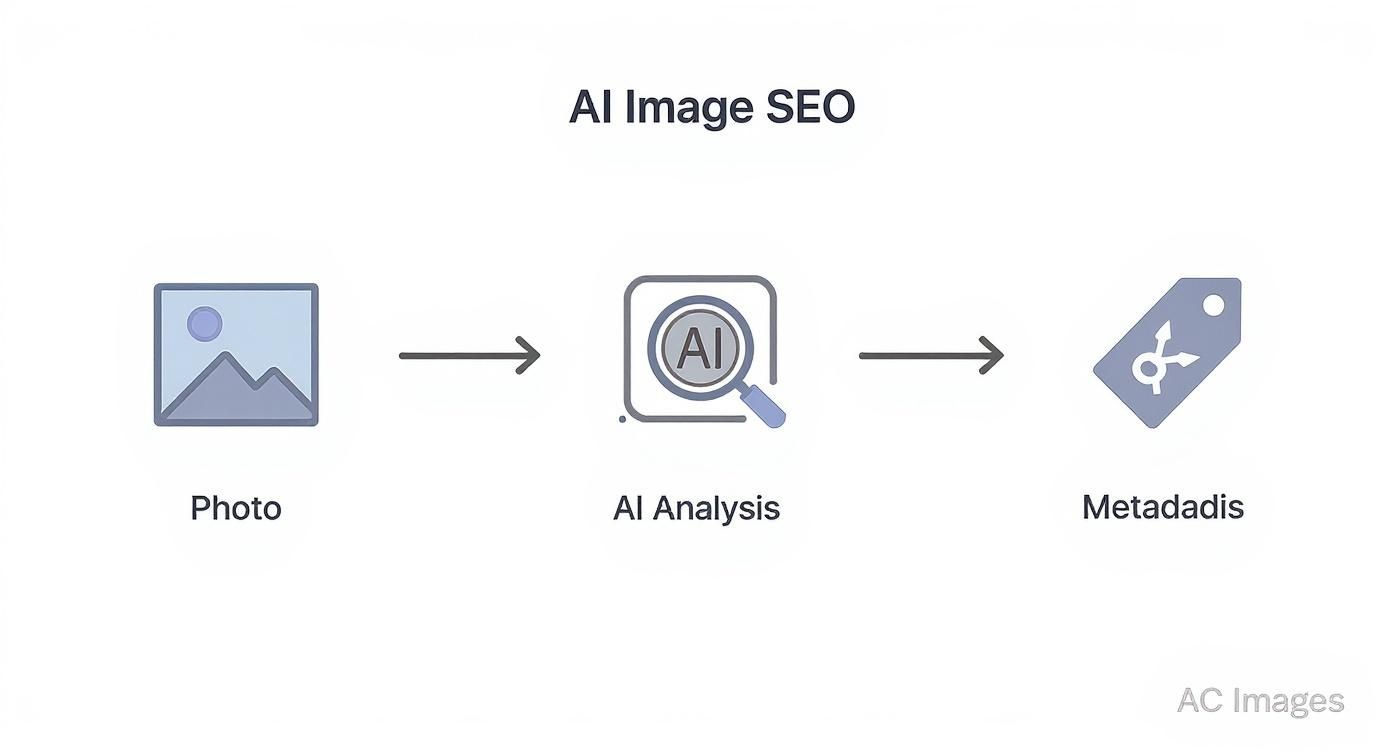
This workflow is a perfect example of how AI can instantly pull rich, structured data from your product images. It creates the detailed, machine-readable attributes needed for agentic search, ensuring every single image adds valuable context to your product listings.
Fostering Human and AI Collaboration
Ultimately, the goal isn't to replace your SEO team, it's to elevate them. When AI agents in ecommerce like Perplexity handle the initial research and data crunching, your human experts are freed up to focus on high-value strategic work.
Agentic SEO redefines the role of the retail SEO professional. They transition from being manual content creators to strategic workflow architects and quality assurance specialists, guiding the AI to produce brand-aligned, high-performing content at an unprecedented scale.
This Human and AI partnership is the future of work in retail. It creates a cycle of continuous improvement, where human feedback refines the AI models over time, leading to more accurate and effective content. By building this automated engine, you're not just optimising for today’s search engines, you’re future-proofing your business for the inevitable rise of agentic commerce.
Preparing for the Future of Agentic Commerce
The shift to agentic commerce isn’t some far-off prediction anymore, it’s the new reality Australian retailers are facing right now. Getting ready isn't just a good idea, it's fast becoming the key competitive edge that will separate the businesses that thrive from those left behind on the digital shelf. This is more than a fleeting tech trend, it’s a fundamental change in how people shop, driven by AI agents built for retail efficiency.
For retail leaders, the writing is on the wall. Winning in this new arena means making a clean break from outdated, manual SEO and embracing AI-powered optimisation. The foundation you lay today with smart investments in agentic SEO will directly determine how visible and successful you are tomorrow.
This journey is about re-engineering your operations from the inside out, focusing on the core pillars that machines care about most.
Your Strategic Imperatives for Agentic Readiness
To come out on top, Australian retailers need to nail three critical areas.
First, a relentless focus on product data enrichment. This means transforming messy supplier feeds into clean, structured, and complete data that AI agents can understand and trust, no questions asked. Your product catalogue isn't just a storefront anymore, it’s a dataset ready for machine interrogation.
Second is solving supplier content duplication at scale. Using automated workflows to create unique, valuable product descriptions is non-negotiable. This not only fixes old SEO headaches but also gives your brand a clear voice, helping AI agents pick your products out from a sea of generic competitors.
Finally, you must implement AI workflow automation for retail. This is the engine that drives efficiency, allowing you to optimise tens of thousands of SKUs in days, not years. It marks a huge shift in the future of work, where your teams move from doing the manual grunt work to providing strategic oversight in a human and AI collaboration.
The key takeaway for every retail leader is simple: agentic SEO is not an IT project. It’s a business transformation imperative that reshapes how you manage content, measure performance, and connect with the next generation of shoppers.
Embracing Next-Generation Retail SEO
This new era demands a proactive, not reactive, approach. Retailers in visual-heavy sectors like fashion, furniture, and electronics also need to prioritise AI image recognition and tagging. Why? To provide the deep, contextual metadata that AI agents rely on to make smart recommendations.
The path forward is clear. By embracing AI SEO services and putting scalable solutions in place, you’re not just optimising for algorithms. You’re building a more efficient, resilient, and competitive retail operation that’s ready for what's next. To get a deeper look at what’s coming, resources like The Future of AI Sales Agents offer some incredible foresight.
The time to build your agentic SEO foundation is now. The retailers who invest strategically in product data, automation, and AI-powered workflows will be the ones who don't just survive but lead the next wave of ecommerce.
Got Questions? We've Got Answers
Stepping into agentic shopping SEO can feel like uncharted territory, even for seasoned Australian retail leaders. Here are a few straightforward answers to the common questions we hear, designed to help you get your ecommerce business ready for what's next in search.
What's the Real Difference Between Traditional and Agentic SEO?
The main difference comes down to who, or what, you're trying to impress.
Traditional SEO is all about optimising individual web pages for human searchers. You pick keywords, tweak your on-page content, and hope your page ranks high enough for a person to click on it.
Agentic SEO, on the other hand, is about structuring your entire product catalogue's data so an AI assistant can understand it. It’s a shift from targeting simple keywords to providing rich, machine-readable information that helps AI compare your products and recommend them in complex, conversational searches.
What's the First Thing My Business Should Do to Prepare?
Before you even think about AI workflows or new tech, your first and most important step is a full-scale audit of your product data. You need to get a clear picture of the quality, completeness, and consistency of your product information as it stands today.
This audit will shine a light on the hidden gaps in your content and become the roadmap for your data enrichment strategy. Fixing duplicated supplier content and adding missing product attributes are the foundations of being agent-ready, and it all starts with knowing exactly where you are now.
How Do We Measure the ROI of Investing in Agentic SEO?
Measuring the return on your agentic SEO efforts involves a mix of familiar metrics and new ones that show how well you're performing on the digital shelf.
Investing in agentic SEO isn’t just an expense, it's about future-proofing your revenue. The goal is to make your products the obvious choice for AI shopping agents, opening up a powerful new sales channel that most of your competitors are probably ignoring.
Here are the key performance indicators you should be tracking:
- Better Organic Visibility: Keep an eye on your rankings for long, conversational search queries, the kind of questions people would ask an AI assistant when looking for a product recommendation.
- Higher Conversion Rates: Start tracking conversions from traffic sources you can identify as AI-driven, like Google's AI Overviews or other agent-based platforms.
- Lower Content Costs: Work out the efficiency gains and money saved by using retail content automation for tasks like writing thousands of unique product descriptions and alt tags.
- Stronger Digital Shelf Performance: Over time, you should see your market share and visibility grow for key product categories as AI agents start favouring your clean, well-structured data.
By focusing on these metrics, you can build a solid business case for adopting scalable SEO solutions and preparing your retail business for the AI-powered shift in ecommerce.
Ready to transform your product catalogue and dominate the digital shelf in the era of AI? Optidan AI provides the AI-powered content workflows and scalable SEO solutions you need to move from manual SEO to agentic readiness. Discover how we can help you optimise thousands of SKUs in days.
