

SEO and copywriting are two sides of the same coin. One helps your audience find you, the other persuades them to buy. For Australian retailers, getting both right isn't just an option anymore, it’s the very core of a winning digital strategy.
The New Retail Battlefield
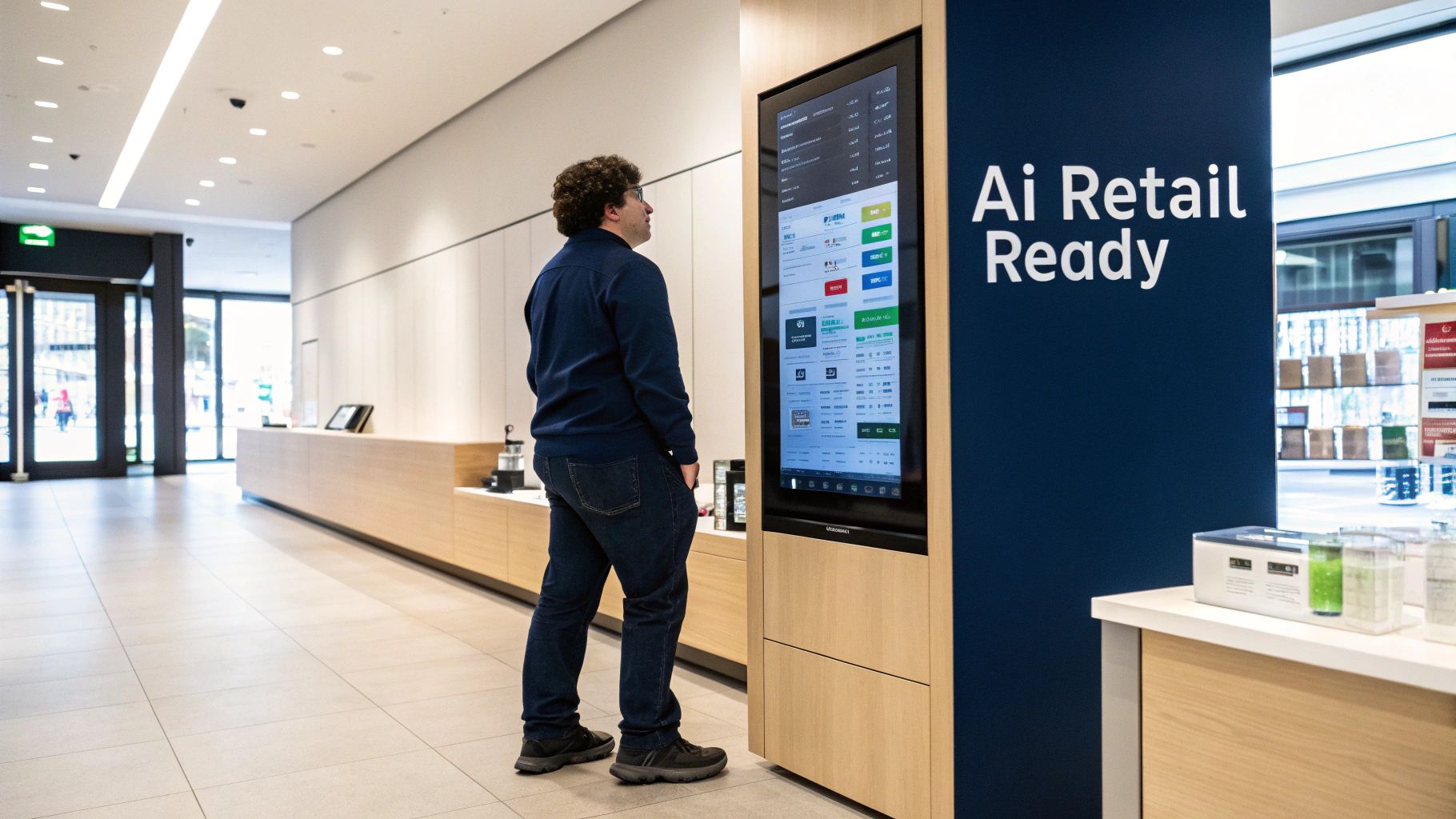
Welcome to the new frontier of Australian retail. Success is no longer defined by traditional SEO and copywriting alone. These disciplines have merged into a single, powerful engine you need to navigate an AI-driven market. Forget the old tactics of keyword stuffing and slow, manual content updates. They’re obsolete.
The conversation for retail leaders and ecommerce managers must shift towards preparing for the next generation of discovery. We’re moving into an era of AI shopping agents and the dawn of agentic commerce, where algorithms make direct recommendations to shoppers.
Embracing Next-Gen SEO for Retailers
To compete, you have to adopt a modern approach that prioritises both machine readability and human persuasion. It’s about moving from manual SEO to AI SEO, a strategy built on speed, scale, and data intelligence. Your focus now needs to be on:
- AI SEO Readiness: Optimising your entire digital presence so it can be discovered, understood, and trusted by AI agents like ChatGPT and Amazon Rufus. This is the future of retail search.
- Product Data Enrichment: Turning generic supplier feeds into richly detailed, structured product content that answers every possible customer question and is compatible with AI agents.
- Correcting Duplicated Supplier Content: Ditching the generic, copy-pasted descriptions that create SEO penalties and fail to establish a unique brand voice, making your catalogue invisible to AI.
This strategic shift is about more than just better rankings. It’s about building a foundation for superior digital shelf performance and future-proofing your business against the massive changes coming from AI-powered retail transformation.
The Power of Scalable Content Workflows
The real challenge for large retailers is achieving this level of quality at scale. Manually optimising thousands of SKUs is a huge content bottleneck. This is where AI-powered content workflows and retail efficiency tools become non-negotiable.
By implementing retail content automation, you can rewrite 10,000+ pages in days, not months. This includes using AI image recognition to automatically tag products in categories like fashion or furniture, a vital piece of the puzzle for SKU-level SEO and multi-channel product optimisation.
As you can learn more about in this guide to search engine optimisation copywriting, this blend of technology and strategy turns a massive operational hurdle into a genuine competitive advantage. This guide is your primer on why these AI workflows for ecommerce are so essential for modern retail.
Preparing Your Content for Agentic Search

Think about getting your best salesperson ready to answer any customer question on the spot, with flawless accuracy and perfect brand alignment. That’s exactly what you’re doing when you optimise for AI agents like ChatGPT, Perplexity, and Amazon's Rufus. We've moved beyond old-school keyword tactics into a new world: agentic search optimisation.
This isn't about trying to trick an algorithm. It's about earning the trust of the AI agents that are increasingly becoming the gatekeepers for consumer decisions. The future of agentic commerce hinges on your ability to feed these systems clear, structured, and authoritative information they can confidently recommend to shoppers.
Making Your Catalogue AI-Compatible
The first thing to realise is that AI agents analyse your product data, content quality, and site-wide consistency with forensic detail. They need to understand your products as deeply as an expert category manager. To make that happen, your content has to be built for machines to read without sounding like it was written by one.
This is a shift from manual SEO to AI-powered workflows that can actually keep up with the scale of modern retail. A big part of this is learning how to optimize content for SEO in a way that makes your product information discoverable and structured for these new conversational interfaces.
Here’s where retail leaders should focus their efforts:
- Structured Product Data: Make sure every product attribute, from dimensions to materials, is clearly defined and consistently formatted. This is the bedrock of product data enrichment.
- Supplier Feed Enrichment: You need to transform those generic supplier feeds into unique, compelling product stories that actually reflect your brand’s voice and value. This is a core part of optimising product feeds efficiently.
- Unique, Authoritative Content: Get rid of supplier content duplication. Build a library of original descriptions, guides, and comparisons that AI agents can trust as a definitive source.
Agentic SEO is less about keywords and more about becoming a definitive source of truth for your product category. An AI agent is more likely to recommend a product when it can verify its features, benefits, and suitability from unambiguous, high-quality content.
The Role of Human-Led AI Quality Assurance
While automation is the only way to achieve optimisation at scale, human oversight is what protects your brand's integrity. An effective AI-powered retail strategy isn't about replacing your team, it's about amplifying their expertise. It's the very definition of human + AI collaboration in SEO.
A human-led quality assurance (QA) process ensures that even content generated for tens of thousands of SKUs remains authentic and authoritative. Your team’s role evolves from repetitive, manual writing to strategic review, making sure every piece of content aligns with your brand’s voice and commercial goals. This is a critical aspect of the future of work in retail.
This blended approach lifts your digital shelf performance across the board. You win over shoppers who are looking for genuinely helpful information, and you win over the AI agents programmed to find exactly that. For any retail leader, figuring out how to start preparing your product catalogue for agentic search is the most critical step you can take to future-proof your e-commerce strategy. It’s the bridge between today’s search and tomorrow's agent-driven world.
Solving Duplicated Supplier Content at Scale
For big Australian retailers, generic supplier content is the silent killer of digital shelf performance. It’s a hangover from an era when just having a product online was good enough. Today, it's not just a risk for SEO penalties, it's a direct barrier to being recommended by AI shopping agents who are built to prioritise unique, authoritative information.
Relying on these copy-pasted descriptions is like stocking your physical shelves with unlabelled, generic white boxes. Customers, and now AI agents, will simply move on to the competitor who provides a richer, more informative experience. This duplication waters down your brand identity, confuses search algorithms, and ultimately, hurts your bottom line.
From Manual Rewrites to AI SEO Workflows
The old-school approach of manually rewriting thousands of product descriptions is a complete non-starter. It’s a classic retail content bottleneck: slow, expensive, and totally impossible to scale across a catalogue of 10,000+ SKUs. This is where moving from manual processes to an AI-led workflow, a key part of AI SEO vs traditional SEO, solves the problem for good.
Modern AI workflows for ecommerce are designed for this exact challenge. They don't just swap out a few words, they transform basic supplier feeds into high-quality, brand-aligned assets. The process usually involves a few key stages:
- Duplication Identification: First, AI systems audit your entire product catalogue, pinpointing every single instance of duplicated or thin content.
- Unique Content Generation: Generative AI then gets to work creating compelling and unique product descriptions, pulling from core product data while infusing your brand's specific tone of voice.
- Strategic Data Enrichment: The system also enhances the content with valuable attributes like style, material, and use-case. It often uses AI image recognition SEO to tag visual elements in categories like fashion or furniture, adding another layer of detail.
This blend of SEO and copywriting ensures every product page becomes a unique, hard-working asset. In fact, Australian websites that maintain a steady stream of high-quality content see a 55% increase in traffic compared to those that don't, as highlighted in these Australian digital marketing statistics. For retailers using retail efficiency tools, this just underlines the immense value of scalable, unique content.
Achieving Optimisation at Scale
The real magic here is achieving optimisation at scale. Instead of a marketing team spending months trying to chip away at a mountain of SKUs, an AI-powered system can rewrite and enrich over 10,000 product pages in a matter of days. This shift from manual labour to strategic oversight turns a major SEO weakness into a powerful competitive edge.
By automating the repetitive task of fixing duplicate content, your team is freed up to focus on higher-value strategic initiatives. The result isn’t just better SEO, but a smarter, more efficient retail content operation ready for the future of agentic commerce.
This process of product feed enrichment is fundamental to building a catalogue that’s not only visible on today’s search engines but is also trusted by the AI agents of tomorrow. By ensuring every SKU has a unique voice and detailed data, you dramatically improve your digital shelf performance. You can explore a deeper dive into these techniques in our complete guide on product feed enrichment. This is how smart retailers win in an increasingly automated and competitive market.
Building AI-Powered Retail Content Workflows
Let's move from theory to action. It’s one thing to talk about AI, but it’s another to build a practical workflow that actually changes how your retail team operates. The difference between the old, manual process and a modern, AI-enabled one is night and day. It’s the difference between reacting to the market and strategically getting ahead of it.
For too long, content has been the biggest bottleneck for retailers, especially those juggling thousands of products. Traditional SEO teams, stuck rewriting product descriptions in endless spreadsheets, just can't keep pace. An AI-powered team, on the other hand, completely flips this around. The focus shifts from mind-numbing execution to high-level strategy and retail efficiency.
From Manual SEO to AI SEO Workflows
The real change happens when you stop thinking in one-off tasks and start building integrated, automated content workflows. This means letting technology do the heavy lifting, freeing up your human experts to guide, refine, and give the final sign-off. This is the heart of effective human + AI collaboration in SEO.
A smart workflow starts by taking in raw supplier product feeds and instantly auditing them for quality. The process below shows how basic, duplicated information gets transformed into unique, optimised content ready for the digital shelf.
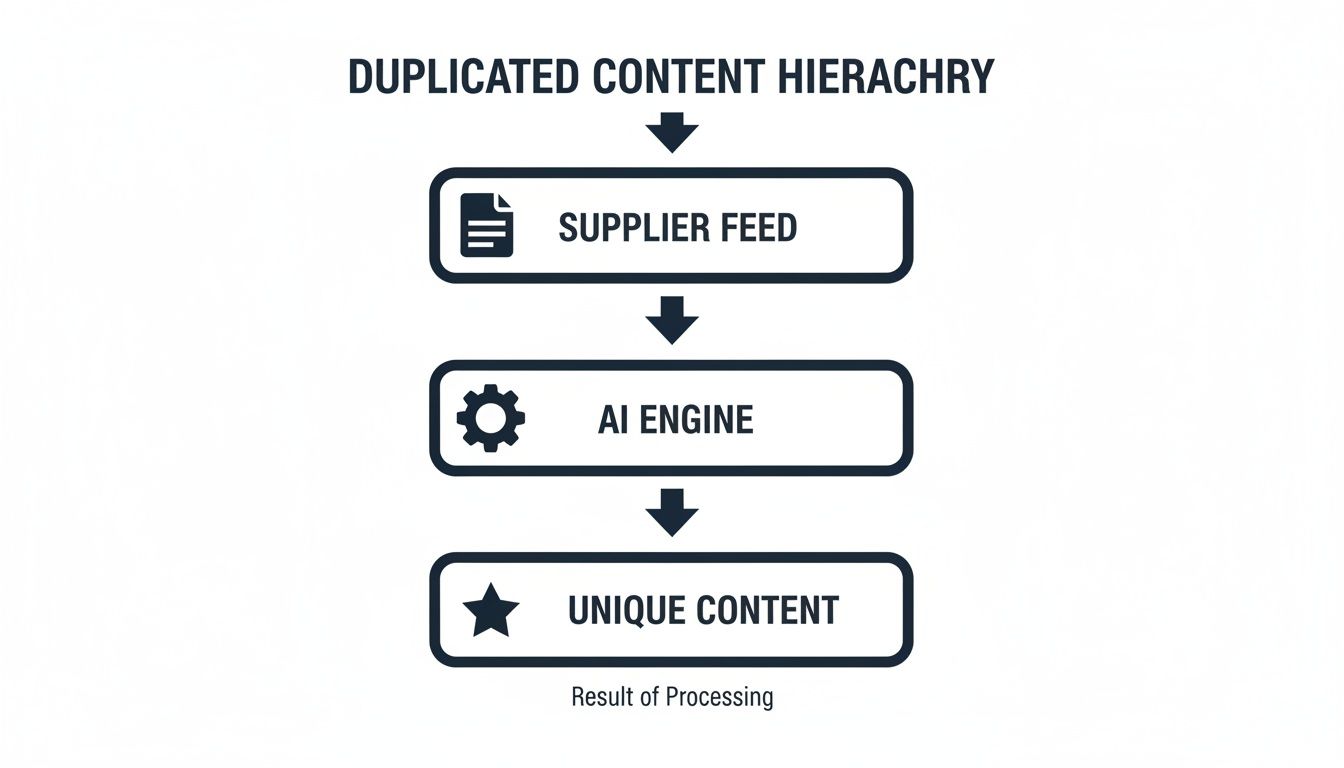
The crucial takeaway here is the systematic removal of supplier content duplication. This turns what was once a huge SEO headache into a genuine competitive advantage, delivered at scale.
This approach makes rapid, catalogue-wide improvements a reality. Things that used to take weeks, like optimising all your metadata, can now be done in minutes. This dramatically speeds up your time-to-market and makes sure every single product is pulling its weight.
Practical Applications for Retail Efficiency
The true power of these workflows shines when you see them in action. By building scalable systems, you can smash through content bottlenecks and drive real, measurable growth in rankings and sales.
Think about these retail-specific examples:
- AI-Powered Image Recognition: In fashion SEO optimisation or for furniture SEO services, AI can "see" product images and automatically generate descriptive tags. It spots attributes like "long-sleeve," "v-neck," "oak finish," or "mid-century modern style," enriching your product data for better on-site filtering and hitting those super-specific search queries.
- Automated Alt Tag and Metadata Generation: Instead of a human manually writing thousands of alt tags, an automated workflow can create descriptive, keyword-rich tags in an instant. This takes care of compliance and gives your image SEO for ecommerce a massive boost across the entire site.
- SKU-Level Content Uniqueness: For an electronics or beauty retailer, AI can take thousands of generic feature lists from suppliers and rewrite them into unique, benefit-focused descriptions. This is the duplicate content SEO fix that’s essential for standing out.
The aim is to build a content engine that's ready for the future. This isn't about replacing your team; it's about giving them the tools to achieve SEO at scale and focus on what really matters: growing the business.
We've found that moving from traditional, manual SEO processes to an AI-powered approach fundamentally changes where your team spends its time and energy. It's less about ticking boxes and more about making strategic decisions.
Comparing Traditional vs AI-Powered SEO Workflows in Retail
| Process | Traditional SEO Approach (Manual) | AI-Powered SEO Approach (Automated) | Impact on Retail Efficiency |
|---|---|---|---|
| Content Creation | Manual writing for each SKU; slow, inconsistent, and prone to error. | AI generates thousands of unique, brand-aligned descriptions in hours. | Frees up copywriters for high-value brand storytelling and campaign work. |
| Keyword Research | Tedious analysis in spreadsheets, often focused on a few "hero" products. | Continuous, automated analysis of keywords for the entire catalogue. | Shifts focus from data entry to strategic keyword targeting and trend analysis. |
| Metadata Optimisation | Manually updating titles and descriptions one by one; often neglected. | Catalogue-wide updates are deployed instantly, ensuring 100% coverage. | Eliminates a major time sink and ensures consistent SEO best practices. |
| Duplicate Content Fixes | A never-ending task of identifying and rewriting supplier copy. | Systematically flags and rewrites duplicate content upon ingestion. | Turns a constant defensive task into a one-time setup, solving the problem at its root. |
| Image SEO (Alt Tags) | Often skipped or done inconsistently due to the sheer volume of images. | AI automatically generates descriptive, keyword-rich alt tags for every image. | Improves accessibility and boosts image search visibility without manual effort. |
By adopting these automated content workflows, retail leaders don't just get more efficient; they build a real competitive advantage. This strategic move prepares your business for the future of work in retail and gets you ready for the next wave of agentic commerce. The efficiency gains are massive, a topic we explore more in our guide to human-in-the-loop automation, which shows how to get the perfect balance of AI speed and human oversight. This is how you win today and prepare for tomorrow.
Measuring Success in the New Era of Search
So, how do you measure the return on your SEO and copywriting efforts when the rules of the game have completely changed? Legacy metrics like basic keyword rankings and raw traffic numbers just don't cut it anymore. In a world increasingly shaped by AI Overviews and zero-click searches, we need a new set of benchmarks to see what's actually driving commercial results.
For retail leaders, the focus has to shift from vanity metrics to genuine digital shelf performance. It’s no longer just about getting a click, it’s about earning a recommendation from an AI agent and driving high-value customer actions. Success is now defined by revenue and eligibility, not just rankings.
Moving Beyond Traditional Metrics
Old-school SEO reports, fixated on ranking positions for a handful of keywords, paint a dangerously incomplete picture. For any modern seo and copywriting strategy, knowing What Is SERP Tracking and How It Shapes Your SEO Strategy is a must, but it's only the starting point. The metrics that truly matter now are welded to commercial outcomes.
A modern measurement framework for retail SEO automation needs to prioritise:
- Conversion Rate from Organic Traffic: This is the ultimate test. What percentage of visitors from search actually buy something? If this number isn't healthy, the rest doesn't matter.
- SKU-Level Visibility: Stop just tracking brand terms. You need to measure how often specific products show up in search results. This is the lifeblood of product catalogue SEO.
- Share of Voice in AI-Generated Answers: How often are your brand and products mentioned in AI Overviews and by AI shopping agents? This is a massive leading indicator of success in agentic search optimisation.
- Organic Traffic Quality: Look beyond the numbers. Use engagement signals like time on page, bounce rate, and pages per session to make sure you're attracting qualified, high-intent shoppers, not just tyre-kickers.
The Commercial Impact of Enriched Content
The link between high-quality content and business results is direct and undeniable. When you ditch the duplicated supplier content and invest in unique, enriched product data, you see a clear uplift in performance. Better content, scaled through AI-powered content workflows, creates more informed customers who are far more likely to convert.
Success in this new era of search is less about where you rank and more about whether you are recommended. Enriched product data and high-quality, unique content are the primary signals AI agents use to decide which products are worthy of that recommendation.
This shift is already having a huge impact. For instance, research predicts that by 2026, Australian businesses stuck on outdated SEO tactics will see their organic traffic collapse by 20-40%. At the same time, those adapting to AI-driven search are holding their ground or even growing, despite AI Overviews now appearing in 60% of searches and gutting traditional organic click-through rates. You can find more details in this essential SEO checklist for Australian businesses. It all points to one thing: topical authority and structured content, the kind AI trusts for citations, are now mission-critical.
Ultimately, measuring success today means tracking the entire journey from a search query to a sale. It demands a holistic view that connects product feed optimisation and ecommerce content optimisation directly to your bottom line, proving the commercial value of getting your digital shelf ready for the future of agentic commerce.
Your Blueprint for Agentic Commerce Readiness
Getting ready for the future of retail search isn’t something you can put off until tomorrow. It’s a strategic decision you need to make today. For Australian retailers, the shift from manual SEO to an AI-powered optimisation strategy is both the biggest challenge and the greatest opportunity on the horizon. Agentic shopping is already here, and your readiness will define your place in the market.
The path to success is clear. It all comes down to a serious commitment to unique, high-quality content, the strategic enrichment of your product data, and the automation of your content workflows. Think of these as the building blocks for a powerful AI SEO framework.
An Actionable Checklist for Retail Leaders
To make the leap from old-school SEO to an AI SEO model, you need a clear, step-by-step plan. This blueprint gives you the foundational actions needed to build a real competitive edge in the age of AI agents in ecommerce.
Here’s your starting checklist:
-
Audit for Supplier Content Duplication: Kick things off with a deep dive into your entire product catalogue. Use AI-powered tools to hunt down every single instance of duplicated or thin content that’s been pulled straight from supplier feeds. This first step is vital, it shows you the true scale of the problem and gives you a baseline to measure your progress against.
-
Establish Your Product Data Enrichment Strategy: You need to define what ‘great’ product content actually means for your brand. This isn’t just about words, it involves creating detailed guidelines for your tone of voice and pinpointing key product attributes to enrich. Think materials, specific features, and unique use cases, especially for verticals like fashion SEO optimisation where details make the sale.
-
Evaluate AI Technology Partners: Let's be honest, manual optimisation just isn't going to cut it anymore. It’s time to research and evaluate tech partners offering scalable SEO solutions built specifically for retail. Look for platforms that can handle product feed optimisation efficiently, automate the creation of unique descriptions, and offer human-led AI content QA to keep everything on-brand.
-
Implement a Pilot Program: Don’t try to boil the ocean. Start with a single, high-priority category. Apply your new automated content workflows to a small set of SKUs to test the process and measure the impact on your digital shelf performance. This minimises risk, helps you fine-tune your approach, and gives you some early wins to share with stakeholders.
-
Empower Your Team for Human + AI Collaboration: The future isn't about replacing your expert teams, it's about empowering them. Train your copywriters and SEO specialists to manage, guide, and refine AI-generated outputs. Their roles will evolve from doing the manual grunt work of content creation to providing strategic oversight, ensuring the AI’s execution is flawless and perfectly aligned with your brand.
Preparing for agentic commerce means fundamentally rethinking your approach to product information. Your goal is to transform your product catalogue into a trusted, authoritative source that both customers and AI agents can rely on for accurate, helpful recommendations.
This isn’t just a tech upgrade, it’s about building a smarter, more efficient retail operation from the ground up. The message is simple: the retailers who act now to fix their content foundations and embrace AI workflow automation for retail are the ones who will thrive.
For a deeper tactical guide, you can explore the principles behind our Agentic Commerce Protocol, which outlines the technical and strategic layers required. The time to build for the agentic shopping future is now.
Your Questions, Answered
Here are a few quick answers to the questions we hear most often from Australian retail leaders trying to connect AI with their SEO and copywriting.
How Can Our Retail Team Start Using AI Without Losing Brand Voice?
The key is to start smart, not big. Use AI for foundational tasks first, like auditing your catalogue for supplier content duplication or enriching raw product data.
A great first step is what's called a ‘human-in-the-loop’ workflow. In this model, AI does the heavy lifting, generating initial drafts for product descriptions based on strict brand guidelines you've set. Your expert copywriters then step in to review, refine, and give the final sign-off. This isn't about replacing your team's expertise, it's about giving them retail efficiency tools so they can scale their impact.
What Is Agentic SEO?
This is a big one. Traditional SEO is all about getting a human to click on your webpage from a search results list. You optimise for keywords, build links, and hope for the best.
Agentic SEO (or Agentic Search Optimisation) is different. It’s about making your product data so clean, structured, and trustworthy that AI agents, think Google's AI Overviews or ChatGPT, pick your products and recommend them directly to users. The goal is to become a preferred source for AI, winning the sale before a user even lands on a website. It’s a shift from just ranking pages to being the definitive answer.
How Can We Realistically Optimise a Massive Product Catalogue?
Manually? You can't. It's simply not possible to keep up. This is where SEO at scale, driven by AI-powered content workflows, becomes non-negotiable for any large retailer.
The process involves using retail content automation to manage your entire product information lifecycle. It starts with ingesting supplier feeds, automatically finding and fixing duplicate content, and enriching products with unique attributes. We can even use AI image recognition SEO to tag features on fashion or furniture items. The system then generates optimised, on-brand descriptions and metadata for thousands of products at once, a job that would take a human team months to complete.
Ready to stop wrestling with manual SEO and build a scalable strategy for the future? Optidan AI is the platform built for large retailers preparing for AI-led commerce. We turn messy supplier feeds into high-quality, unique content that wins on both traditional search and the new wave of agentic shopping platforms.
Learn how Optidan AI can get your digital shelf ready for what's next
