


It's a frustratingly common story for Australian retailers: your website traffic is climbing, but sales are stubbornly flat. This isn't just a quirky anomaly; it's a massive red flag. Focusing on traffic volume alone is a flawed strategy, especially in today's competitive ecommerce landscape.
The truth is, high visitor numbers are a vanity metric if they don't convert into actual revenue. More often than not, this scenario points to deeper issues with either the quality of your traffic or the experience people have once they land on your site. For retail leaders, understanding this disconnect is the first step towards building a truly profitable online presence.
The Great Traffic Myth in Australian Retail
For ecommerce managers and retail leaders, the relentless chase for more visitors can feel like the most important goal. But this approach often masks critical problems hiding just beneath the surface, creating significant retail content bottlenecks.
When your SEO strategy brings in shoppers with the wrong intent, or your product pages fail to convince them to buy, that hard-won traffic simply leaves. This problem is magnified for retailers managing thousands of products, where the main culprit is often generic, duplicated supplier content that fails to connect with customers or achieve strong digital shelf performance. Unpacking this disconnect demands a strategic shift from chasing quantity to optimising for quality and conversion, leveraging AI workflow automation to achieve scalable SEO solutions.
Why Traffic Volume is Deceiving
A quick look at Australia's ecommerce landscape reveals a stark truth: more traffic doesn't guarantee more sales. While Western Australia saw a healthy 5.1% year-over-year ecommerce growth, New South Wales actually dropped by -2.1% and Victoria fell by -1%. This is despite a national online spend of over $40 billion.
What does this tell us? High-traffic hubs like NSW and VIC are likely suffering from saturated markets where more visitors just lead to more bounces, not more sales. It's no surprise the national conversion rate hovers at a dismal 1.78%. You can dive deeper into the latest Australian eCommerce trends to see the full picture.
This data highlights a vital lesson. Instead of just chasing more clicks, the focus has to shift to building a resilient digital shelf through smart, scalable solutions. By embracing AI SEO and Product Data Enrichment, retailers can finally turn high-volume traffic into high-value sales. This means correcting duplicated supplier content and setting up automated content workflows to ensure every product page is optimised to convert, getting your business ready for the future of agentic commerce and the next generation of retail search.
Understanding Your Traffic Quality Problem
Just because your site is attracting visitors doesn't mean they're the right visitors. Getting to the root of why more traffic isn't leading to more sales means shifting your focus from pure volume to actual quality. The problem usually comes down to a fundamental disconnect between who you're attracting and who you want to attract.
When your analytics show high bounce rates and low conversion, that’s a clear signal you have a quality problem. This often happens when your content appeals to researchers, not buyers, or when poorly targeted ad campaigns pull in users with zero genuine interest in your products. These visitors add to your traffic count but drain your profitability.

Pinpointing the Leaks in Your Funnel
To solve this puzzle, you need to figure out where potential customers are dropping off. Several factors could be causing friction, actively pushing away even well-intentioned shoppers and quietly killing your sales.
You need to put these key areas under the microscope:
- Mismatched Search Intent: Your SEO might be great at attracting informational queries like ("how to style a linen shirt") but failing to capture transactional ones ("buy white linen shirt Sydney"). Getting this right is crucial, and it starts with aligning your metadata with customer intent.
- On-Site Friction: Slow page load times, a confusing navigation menu, or a clunky checkout process are absolute conversion killers. Even tiny delays can lead directly to abandoned carts and lost revenue.
- Poor Mobile Experience: With a huge chunk of ecommerce traffic now coming from mobile devices, a clunky or non-responsive mobile site is just not an option anymore. It creates a frustrating experience that sends buyers straight to your competitors.
To truly understand your traffic quality and move beyond the myth of sheer volume, focusing on actionable customer segmentation is crucial. Segmenting your audience allows you to tailor your messaging and targeting, ensuring you attract visitors who are more likely to convert.
Shifting Focus From Volume to Value
Ultimately, fixing a traffic quality problem requires a strategic pivot. Instead of pouring more resources into simply boosting visitor numbers, the real goal is to attract and convert high-intent shoppers. This means getting laser-focused on your target audience and ensuring your digital shelf is perfectly optimised to meet their needs.
To make this happen, retailers have to move beyond surface-level analytics. By diving deep into user behaviour and segmenting your traffic sources, you can build a powerful, data-backed case for investing in a smarter, conversion-focused strategy. This could mean exploring actionable customer segmentation strategies to truly understand and serve your ideal customers. This approach doesn't just improve your conversion rate, it prepares your brand for the future of retail search, where AI-powered retail transformation and agentic search optimisation are paramount.
The Content Bottleneck From Generic Supplier Feeds
For large Australian retailers managing thousands of products, one of the biggest reasons high traffic fails to convert is often hidden in plain sight: the generic product content pulled directly from supplier feeds.
Relying on this duplicated, uninspired information creates a poor digital shelf experience that actively harms your SEO and pushes potential customers away. It’s the digital equivalent of a physical store where every single product has the same bland, unhelpful tag.
This copy-paste approach is a direct route to major SEO penalties. Search engines are designed to reward unique, valuable content. When they find identical product descriptions across multiple websites, they devalue those pages. This Supplier Content Duplication makes it incredibly difficult to rank, essentially making your products invisible to high-intent shoppers. Beyond the technical SEO damage, this practice does nothing to build a unique brand voice or provide the compelling details a customer needs to make a purchase. It creates a monotonous and unhelpful shopping experience, which is a big reason why more traffic doesn’t always mean more sales.
From Basic Feeds to Enriched Content
The solution is a strategic shift towards Product Data Enrichment. This process involves transforming basic, raw supplier information into unique, compelling, and highly optimised content that resonates with both human shoppers and the AI agents powering the future of search. Put simply, it's about turning a simple product feed into a powerful sales tool through efficient optimisation.
This kind of transformation requires moving away from manual updates, which are impossible to manage at scale. Instead, it involves leveraging AI Workflow Automation for Retail to achieve several critical outcomes:
- Correcting Duplicated Content: Automatically rewriting thousands of generic descriptions to create unique, SEO-friendly content for every single product.
- Enhancing Product Details: Adding rich attributes, specifications, and benefits that answer customer questions before they are even asked.
- Optimising for Search Intent: Structuring content to align with how customers actually search, ensuring you show up for those valuable transactional keywords.
This transition from manual SEO to AI SEO is fundamental for modern retail. It addresses the core content bottleneck by enabling Optimised at Scale workflows, turning a cumbersome manual task into an efficient, automated process that can handle 10,000+ pages in days, not years.
The Impact on Digital Shelf Performance
By systematically enriching your product data, you directly improve your Digital Shelf Performance. Unique, detailed content doesn't just solve the duplicate content problem, it also builds authority and trust with both customers and search engines. This leads to better rankings, increased visibility, and, most importantly, higher conversion rates.
This is where Retail Content Automation provides a decisive advantage, particularly for categories like fashion and electronics where detailed specifications and AI image recognition are critical. To learn more, you can explore our guide on how to align supplier feeds with search performance and start fixing the data disconnect. This strategic investment is no longer optional; it's essential for turning clicks into customers.
Moving From Manual Fixes to AI SEO at Scale
Trying to manually optimise thousands of SKUs is an impossible task for any retail team. It creates a permanent bottleneck that throttles growth and revenue. For too long, the only answer has been slow, expensive, and piecemeal manual SEO fixes that barely scratch the surface of the problem.
This is exactly why pouring more traffic onto a site doesn't always lead to more sales, your team is simply outmatched by the sheer scale of the catalogue.
But what if you could sidestep the manual grind entirely? Modern AI-driven workflows are the only realistic solution for large, dynamic catalogues. This is about more than just tweaking a few pages; it's a complete shift from manual tinkering to strategic, automated optimisation that gets results in days, not years.
The flowchart below shows the content bottleneck most retailers are stuck in. It starts with raw supplier feeds, leads directly to generic, duplicated content, and ends, inevitably, with poor sales.
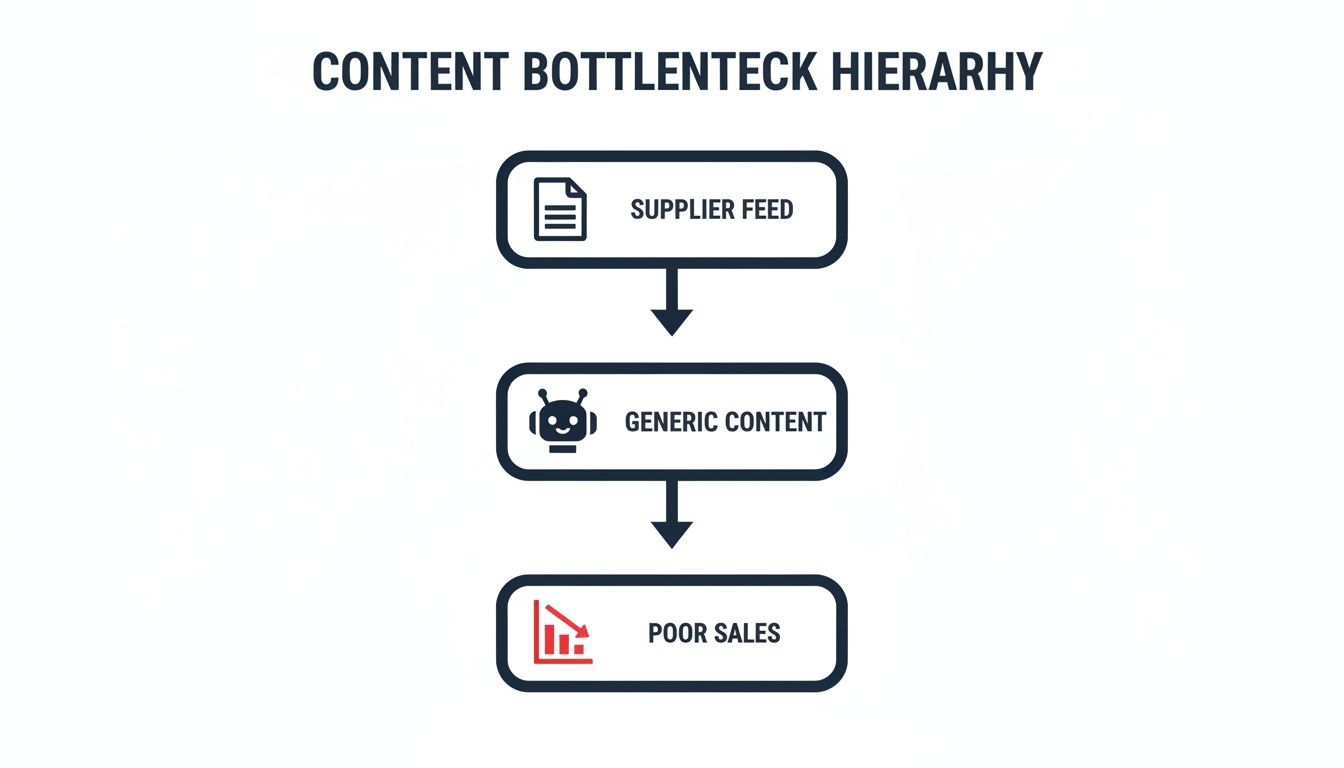
This hierarchy makes it clear: without the right intervention, the default state of a large product catalogue actively works against your conversion and SEO goals from day one.
The Power of Automated Content Workflows
Platforms built on AI-Powered Content Workflows can take those raw supplier feeds and automatically orchestrate the entire optimisation process. This isn’t just about writing text. It's about fixing SKU-level SEO at its core.
These systems do what manual teams physically can't:
- Generate Unique Descriptions: Instantly create thousands of unique, on-brand product descriptions, wiping out supplier content duplication issues for good.
- Optimise Metadata at Scale: Automate the creation of SEO-friendly titles and meta descriptions for every single product in your catalogue.
- Enrich Product Data: Add structured data and rich attributes that drastically improve filtering, on-site search, and your overall digital shelf performance.
This level of automation means a retailer can completely transform 10,000+ pages in the time it would take a traditional SEO team to handle just a handful. That’s the real difference between legacy SEO and a modern AI SEO approach.
The table below illustrates the efficiency, scale, and strategic gains of adopting an AI-driven approach for large retail catalogues.
Comparing Traditional SEO with an AI-Powered Workflow
| Task | Traditional Manual SEO | AI-Powered Workflow |
|---|---|---|
| Product Descriptions | A copywriter manually rewrites a few key pages per month. | Instantly generates thousands of unique, brand-aligned descriptions. |
| Metadata Optimisation | SEO specialist manually creates titles/metas for top categories. | Automatically creates and optimises for every product and category. |
| Data Enrichment | Often skipped due to the time required. | Adds structured data and rich attributes across the entire catalogue. |
| Time to Impact | 6-12 months to see results on a small subset of pages. | Measurable sitewide improvements visible in weeks. |
| Scalability | Very low. Every new product adds to a growing backlog. | Infinitely scalable. New products are optimised automatically as they are added. |
| Team Focus | Buried in repetitive, manual content tasks. | Freed up for high-level strategy, campaign planning, and creative work. |
By automating the foundational work, AI-powered workflows don’t just make things faster, they enable a more strategic and effective approach to SEO that was previously out of reach for large-scale retailers.
Preparing for an Agentic Future
This automated approach goes beyond just text. For visual-heavy sectors like fashion and furniture, AI image recognition becomes a game-changer. It can automatically analyse product images to generate highly descriptive alt tags and metadata, a task that is simply impossible to do manually across an entire catalogue. This ensures every single element of your product page is working for you.
The future of work in retail hinges on this human + AI collaboration. By automating repetitive content tasks, teams are freed to focus on high-level strategy, preparing their business for the rise of Agentic Commerce and AI agents for retail efficiency.
This isn't just about efficiency; it's about survival. As AI agents like Google’s AI Overviews and Amazon Rufus start to influence buying decisions, retailers with optimised, structured, and AI-compatible content will have a massive advantage. Making the move from manual updates to automated workflows is the most important step a retailer can take to turn traffic into revenue and secure its future.
To see how this works in practice, you can learn more about automating retail at scale in our in-depth guide.
Getting Your Digital Shelf Ready for Agentic Commerce
Fixing today's conversion problems is a huge win, but it's really only half the battle. The bigger challenge on the horizon is getting your business ready for the next evolution of search, something we call Agentic Commerce. This isn't some far-off concept; it's already happening, with AI agents like Google’s AI Overviews and Amazon’s Rufus starting to make purchase decisions on our behalf.
These AI shopping assistants don't browse websites the way people do. Instead, they scan for high-quality, structured product data to find, compare, and recommend products. For retailers whose digital shelves are built on thin, duplicated, or inconsistent supplier content, the risk is massive: they’ll simply become invisible in this new world.
The Rise of Agentic Search Optimisation
This new reality demands a completely new strategy: Agentic Search Optimisation (ASO). It's a big shift away from just chasing keywords and clicks. The new game is about creating rich, machine-readable product information that an AI agent can actually understand and trust.
Think about it this way: if an AI can't confidently figure out what your product is, what it does, and why it's a good choice, it won't take the risk. It will just recommend a competitor's product instead.
This is why having AI-Compatible SEO Content is no longer a nice-to-have; it's a critical investment for survival. It’s not just about lifting your current conversion rates. It’s about securing your brand's visibility when AI gatekeepers increasingly stand between you and your customers.
The future of work in retail will be all about this human + AI collaboration. Teams that embrace AI Workflow Automation can finally step back from the grind and focus on high-level strategy, while AI handles the massive task of content optimisation needed to compete in an agentic world.
What AI Agents Are Actually Looking For
To have any chance of success in this new landscape, your product data needs to be impeccable. AI agents are programmed to prioritise accuracy, completeness, and consistency above all else when they make a recommendation.
Here’s what they’re scanning for:
- Unique and Detailed Descriptions: Generic, copy-pasted supplier content is a huge red flag. AI agents need unique descriptions that clearly spell out the features, benefits, and real-world uses of a product.
- Structured Data and Rich Attributes: All that crucial info, like dimensions, materials, compatibility, and care instructions, has to be structured correctly so an AI can easily parse and compare it against other products.
- High-Quality Image Metadata: For visually-driven categories like Fashion SEO Optimisation or furniture, AI image recognition leans heavily on descriptive alt tags and metadata to understand the visual context of what you're selling.
Ultimately, this is the modern answer to why more traffic doesn't always lead to more sales, especially as we head into the future. A flood of unqualified traffic is useless if the new gatekeepers of commerce, the AI agents, can’t understand or trust your product information.
Preparing your digital shelf today is the only way to make sure you’re still visible and profitable tomorrow. If you're looking to get ahead of the curve, you can start by preparing your product catalogue for agentic search with the right strategies.
Your Action Plan to Turn Traffic Into Revenue
Moving from a traffic-obsessed mindset to one that’s laser-focused on revenue demands a clear, practical roadmap. The reason more traffic doesn't automatically equal more sales is simple: traffic is a vanity metric. What truly drives profitable growth for Australian retailers is the quality of that traffic, how shoppers engage, and whether they actually convert.
This plan is about shifting your team from putting out fires to proactively building a high-performance ecommerce engine.
A Five-Step Roadmap to Profitability
To start turning your existing traffic into reliable revenue, you need a solid foundation. Implementing smart strategies like these 10 proven ecommerce conversion rate optimization tips is a great starting point before moving to a more structured approach.
Here’s a step-by-step plan to kickstart your transformation:
-
Conduct a Deep-Dive Audit: Start with a thorough audit of your traffic sources and the content on your site. Work out where your highest-value customers are coming from and, just as importantly, find the pages with the biggest conversion leaks, especially those still using duplicated supplier content.
-
Make Product Data Your Priority: Put Product Data Enrichment at the very top of your list. It’s the only way to break free from generic supplier feeds and build a unique digital shelf that actually answers customer questions and satisfies search engines.
-
Bring in AI Workflow Automation: Adopt an AI Workflow Automation platform to handle content optimisation at a scale you just can't manage manually. This is non-negotiable for large catalogues, letting you rewrite thousands of product descriptions, optimise metadata, and get ready for Agentic Commerce without bogging down your team.
-
Optimise the Entire Customer Journey: Think beyond just the product page. Make sure the whole experience, from the initial search that brought them to you, right through to a seamless mobile checkout, is completely frictionless. As you dive into this, you can learn more about how better product content improves conversion without changing UX.
-
Shift Your Core Metrics: Stop obsessing over traffic volume. Instead, focus on the numbers that actually matter to your bottom line: conversion rate, average order value, and your overall digital shelf performance.
The secret to sustainable growth isn't just about attracting more visitors. It's about converting the ones you already have. This is only possible with a foundation of high-quality, structured, and AI-ready content, which can now finally be achieved at scale.
Ready to turn your traffic into tangible revenue and prepare for the future of agentic commerce? Discover how Optidan AI can transform your product catalogue at scale. Learn more about our AI-powered retail optimisation platform.
