

So, what exactly is AI Engine Search Optimisation?
Think of it as preparing your website's content, especially your product data, to be easily understood and highly ranked by AI-driven search platforms like ChatGPT and Google's AI Overviews. This approach goes far beyond traditional SEO. It focuses on structured data, semantic clarity, and AI workflow automation for retail to make sure your products show up in this new era of search.
The New Frontier of Retail SEO
For Australian retail leaders, the old, familiar rhythm of search engine optimisation is officially broken.
Manual keyword research and painstakingly slow content updates for massive product catalogues just don't cut it anymore. The rapid rise of AI assistants and generative search requires a total shift in strategy, moving from the old rulebook of traditional SEO to what we call AI Engine Search Optimisation (AIESO).
This new game is all about prepping your digital shelf for a future where AI agents, not just humans, are the ones finding and evaluating your products. It means you must transform your product information from basic supplier feeds into richly detailed, structured data that an AI can parse, understand, and, most importantly, trust. This is the very core of agentic search readiness and the future of work in retail.
From Manual Effort to Automated Excellence
The biggest difference between the old and new way comes down to two things: speed and scale.
Traditional SEO teams simply can't keep up. They struggle to manually fix duplicated supplier content or enrich thousands of individual SKUs, creating huge content bottlenecks that slow everything down. AI-powered workflows, on the other hand, can complete these tasks with incredible efficiency. This is SEO at scale in action.
AI SEO is not just about replacing manual tasks; it's about achieving a level of quality and scale that was previously impossible. It's the key to unlocking superior digital shelf performance in a crowded market through retail content automation.
This chart really drives home the massive efficiency gains you get when you switch from a traditional model to an AI-powered one.
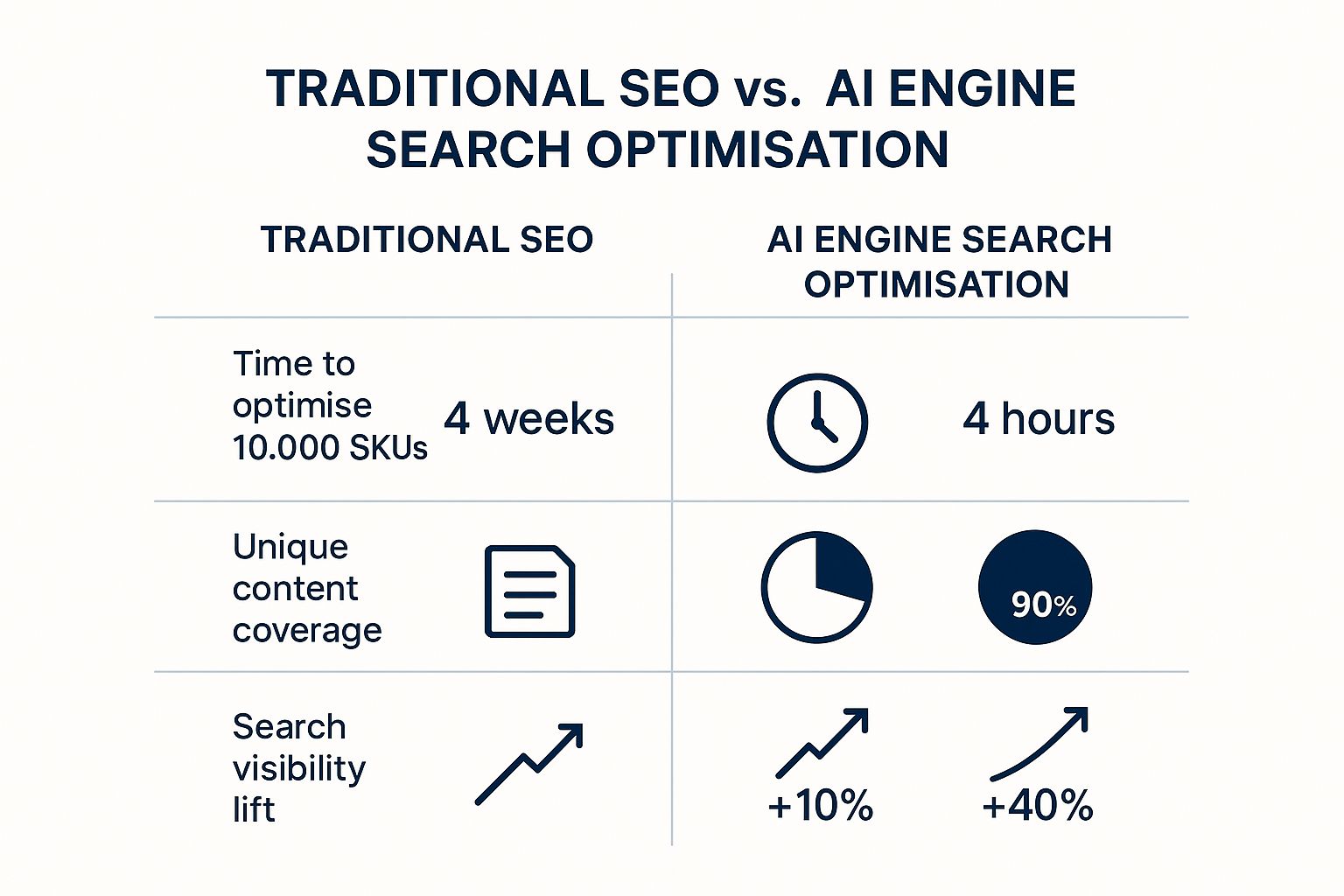
As you can see, automated content workflows don't just reduce the time it takes to get things done, they achieve far greater unique content coverage, which directly leads to a major lift in search visibility.
To put it in perspective, let's compare the two approaches side-by-side.
Traditional SEO vs AI Engine Search Optimisation
The table below breaks down the fundamental shift in strategy and execution, highlighting why AI-powered retail transformation is so critical for modern ecommerce.
| Aspect | Traditional SEO | AI Engine Search Optimisation |
|---|---|---|
| Core Focus | Keywords and backlinks | Structured data and semantic context |
| Content Strategy | Manual content creation, blog posts | Automating product descriptions & data |
| Primary Goal | Rank pages on Google | Surface products in AI-generated answers |
| Key Metrics | Keyword rankings, organic traffic | Feed quality, data completeness, visibility |
| Execution Speed | Slow, manual, project-based | Fast, automated, continuous |
| Scalability | Limited by human resources | Scalable SEO solutions for huge catalogues |
This is not just a minor tweak; it's a complete reimagining of how product discovery works. Retailers still stuck in the "Traditional SEO" column are going to find it harder and harder to compete in the future of retail search.
Why AI Engine Search Optimisation Matters Now
The integration of AI into search is already hitting Australian businesses, whether they're ready or not.
Unlike old-school SEO, AI-compatible SEO content is all about semantic relevance and connecting the dots between entities to get you seen on platforms like ChatGPT and Perplexity. In fact, a recent study shows that Answer Engine Optimisation (AEO), a key part of this, is set to be adopted by 23% of advanced practitioners in 2025. The urgency is real.
Of course, as businesses navigate this new digital shelf, understanding the fundamentals is still critical. You should always review these essential ecommerce SEO best practices to ensure your foundations are solid.
Ultimately, though, adopting an AI-powered approach to retail is the only way to maintain and improve your digital shelf performance today and into the fast-approaching future of agentic commerce.
Solving the Supplier Data Trap at Scale
For many Australian retailers, the biggest hurdle in ecommerce SEO is not a complex algorithm or a missing strategy, it's the data itself. Relying on generic supplier feeds creates a quiet but damaging cycle of duplicated content that kills your performance on the digital shelf. When hundreds, or even thousands, of your product pages use the exact same descriptions as your competitors, it tells search engines one thing: your content offers nothing new.
This is not just a small problem; it's a massive barrier to getting noticed and building a brand. Historically, applying a duplicate content SEO fix was a nightmare. It meant hiring entire teams to manually rewrite product descriptions, one by one. This approach is not only incredibly slow and expensive but completely impossible to maintain for catalogues with 10,000+ SKUs.
The result is a retail content bottleneck, where your growth is capped by the sheer volume of manual work needed. This is the supplier data trap, and it’s why so many retailers get stuck spinning their wheels, unable to improve their search rankings.

From Manual Rewrites to Automated Enrichment
The move from manual SEO to AI SEO is the only realistic way out of this trap. AI-powered content workflows are built for this exact challenge, allowing retailers to achieve unique product descriptions SEO at a scale that was previously unimaginable. Instead of treating your supplier feed as the final product, AI sees it as a starting point for product data enrichment.
These automated content workflows take basic supplier data, figure out the core product attributes, and then rewrite and enrich everything based on your brand’s unique voice and SEO framework. This is how you can turn tens of thousands of generic product pages into compelling, optimised content in days, not months or years.
This shift is more than just an efficiency boost. It’s a strategic pivot towards building a high-quality, AI-compatible product catalogue that’s ready for the future of agentic commerce and agentic search optimisation.
By automating the creation of unique content, you don't just fix existing SEO penalties, you build a foundation of quality that will support your growth for years to come. To get a better handle on this, our guide on avoiding supplier product feed duplication breaks down best practices that work hand-in-hand with an AI-driven strategy.
A Practical Example in Fashion SEO
Let's look at a common scenario in fashion SEO optimisation. A retailer gets a supplier feed for a new line of women's dresses. The original data is bare-bones and identical across every single wholesale partner.
Before AI SEO (Original Supplier Data):
- Product Name: "Ladies Blue Dress"
- Description: "Blue dress. 100% cotton. Available in sizes S, M, L."
This description is thin, boring, and duplicated across countless other websites. Now, let’s see what happens when an AI-powered content workflow gets to work. The system analyses the product title, existing data, and even the product image using AI image recognition SEO to pull out key attributes.
After AI SEO (Enriched and Unique Content):
- Optimised Title: "Azure Sky Cotton A-Line Midi Dress"
- Unique Description: "Embrace effortless style with our Azure Sky A-Line Midi Dress, crafted from pure, breathable 100% cotton. Featuring a flattering V-neckline and a cinched waist that flows into a classic A-line silhouette, this dress is perfect for weekend brunches or a day at the office. Its vibrant azure blue hue ensures you’ll stand out, while the comfortable midi length offers versatile styling options. Available in sizes S-L."
- Generated Tags: V-neck, A-line, Midi Length, Summer Style, Cotton Fabric, Casual Wear
This AI-driven transformation turns a liability into a genuine asset. It creates a unique, descriptive, and emotionally resonant product story that matches what shoppers are looking for, improves your SKU-level SEO, and gives AI search agents the rich, structured information they need to confidently recommend your product over a competitor's.
Automating Product Data Enrichment for a Smarter Catalogue
Fixing duplicated supplier content is a crucial first step, but real leadership in ai engine search optimization comes from proactively enriching your entire product catalogue. It’s about shifting your mindset. You're not just managing a list of products; you're building a highly structured, intelligent asset that both customers and AI agents can easily understand.
This process, known as product data enrichment, is a genuine game-changer for retailers, especially in competitive sectors like fashion, furniture, and beauty. Instead of just fixing problems after the fact, you start building value into every single SKU. AI-powered tools let you layer in descriptive details, technical specs, and contextual tags, turning a flat, uninspired product page into a rich source of information that directly fuels better performance. This is the core of optimising product feeds efficiently.
Unlocking Product Insights with AI Image Recognition
One of the most powerful retail efficiency tools in this process is AI image recognition SEO. For visually driven categories like fashion SEO optimisation or furniture SEO services, your product images are sitting on a goldmine of data that standard supplier feeds completely ignore. An AI workflow can analyse these images at scale, automatically identifying and tagging specific attributes that matter to shoppers.
Think about a simple t-shirt. To a human, it’s just a blue shirt. But to an AI, it can be so much more. The system can instantly generate tags like:
- Style Attributes: 'V-neck', 'crew neck', 'slim-fit', 'relaxed fit'
- Material and Texture: '100% cotton', 'jersey knit', 'heathered fabric'
- Design Elements: 'short sleeve', 'cuffed sleeve', 'pocket tee'
This automated product image tagging enriches your data with the exact terms shoppers are using in their searches. It also allows for the automatic creation of highly descriptive alt text for every image, a critical but often overlooked aspect of metadata optimisation at scale.
Building an AI-Compatible Product Catalogue
The endgame here is to create an AI-compatible catalogue. AI search agents, like those powering Google’s AI Overviews, Rufus, or ChatGPT, thrive on structured, detailed, and unambiguous information. A richer dataset allows these agents to categorise your products with far greater accuracy and recommend them with more confidence.
When an AI agent can clearly understand that a sofa is a '3-seater', 'upholstered in velvet', with 'mid-century modern tapered legs', it can confidently match that product to a user’s highly specific query. This is the foundation of agentic search optimisation.
This level of detail moves your products beyond simple keyword matches and into the realm of true semantic understanding. This is not just about preparing you for the future of retail search; it delivers immediate benefits by improving the filtering options on your website, enhancing internal search, and enabling more effective multi-channel product optimisation. For a deeper dive, our guide on strategic product data enrichment offers detailed insights into building a smarter catalogue from the ground up.
From Basic Feed to Superior Digital Shelf Performance
By automating the enrichment process, you break free from the shackles of manual data entry and inconsistent supplier information. AI agents for retail efficiency can process and enhance thousands of SKUs in the time it would take a human team to complete a handful.
This is not just about stuffing in more keywords. It's about building a structured, logical data foundation that improves every single aspect of your digital shelf performance. The benefits are clear, and they build on each other.
- Improved Search Visibility: Highly detailed and structured data makes your products more discoverable by both traditional search engines and emerging AI agents.
- Higher Conversion Rates: Rich product details and attributes answer customer questions upfront, leading to more confident and faster buying decisions.
- Enhanced User Experience: Detailed filtering and search options, all powered by enriched data, help shoppers find exactly what they need without the frustration.
Ultimately, this automated approach to supplier feed enrichment is a core component of modern retail. It transforms a basic operational task into a powerful strategic advantage, ensuring your product catalogue SEO is optimised for performance today and ready for the agentic commerce future.
Building Your AI-Powered SEO Workflow
Moving from old-school, manual SEO to an AI-powered framework is a fundamental shift in how retail content gets made. It’s not about replacing your team’s expertise. It’s about supercharging it.
Think of it as a new partnership where AI agents in ecommerce handle the repetitive, heavy lifting, freeing up your team to focus on big-picture strategy and creative direction. This lets you swap slow, frustrating tasks for a smooth, automated content workflow built for scale.
This structured approach completely transforms your operations. It’s a blueprint for deploying optimised content across thousands of product pages at a speed that was once unimaginable, preparing your brand for the future of agentic shopping. The goal is simple: move from fixing problems reactively to creating powerful content proactively.
From Manual Bottlenecks to Automated Pipelines
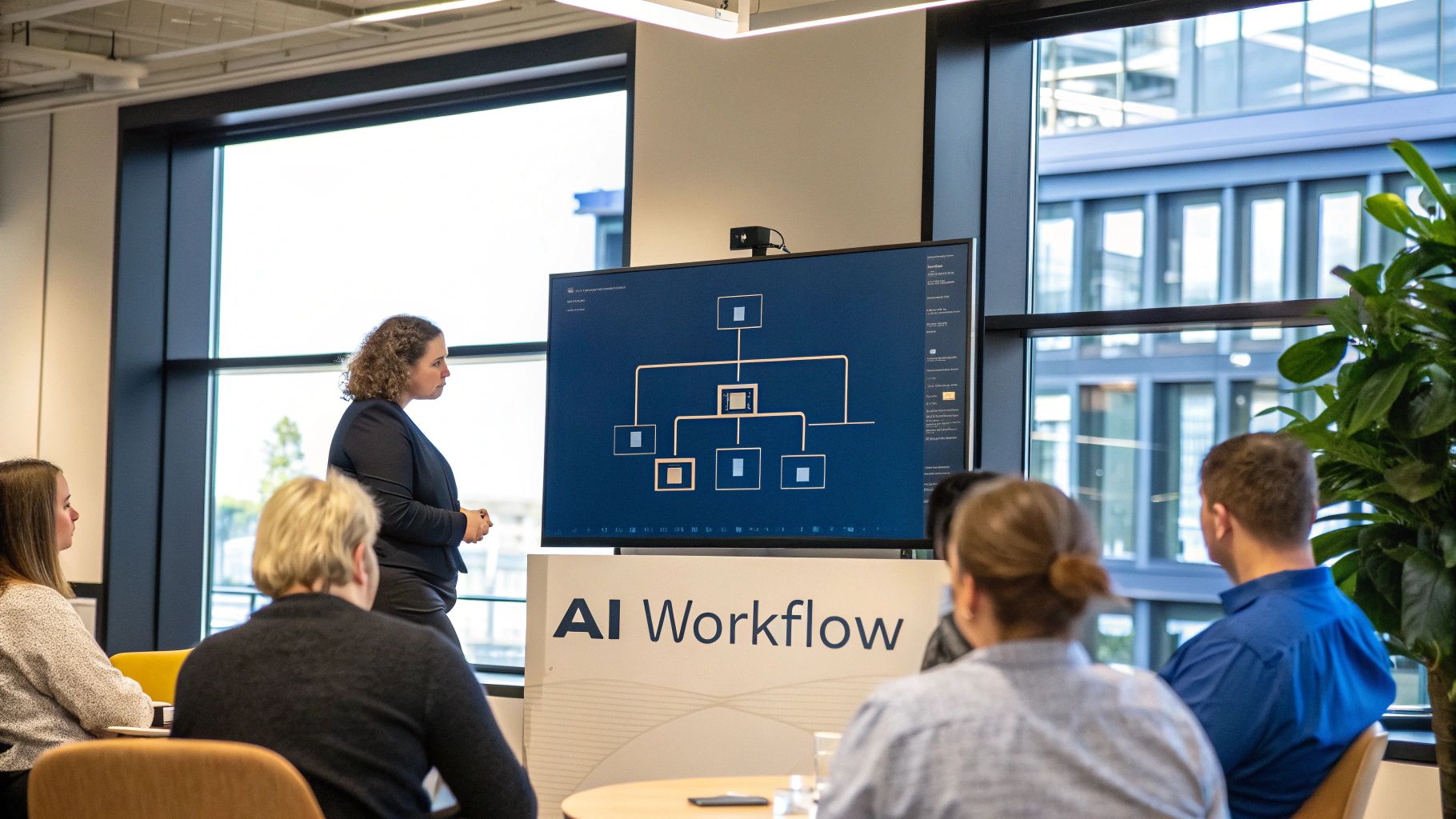
The first step is setting up an automated content workflow. It all starts by pulling in raw supplier data feeds, which serve as the foundation. Instead of treating this data as the final product, the AI system sees it as the raw material for optimisation.
To build an efficient pipeline, you need to understand how to leverage tools that can automate keyword research and analysis. This initial stage is crucial because it ensures every piece of content is built on a solid, data-driven SEO strategy from the get-go.
Core Stages of an AI SEO Workflow
A solid retail content automation pipeline is made up of a few key stages. Each step builds on the last, turning basic data into a high-performing asset that drives traffic and sales.
- Data Ingestion and Standardisation: The system first grabs the raw supplier feeds, cleaning up errors and organising the data into a consistent, usable format. This gets everything ready for the AI to do its work.
- AI Content Enrichment and Generation: Using generative AI for retail teams, the workflow rewrites those tired, duplicated supplier descriptions, beefs up thin content, and applies your brand’s unique voice. It also uses image recognition and tagging to pull out visual details, adding rich, descriptive layers.
- Human-Led Quality Assurance (QA): This is where human + AI collaboration in SEO really shines. Your team steps in to review the AI’s output, not for typos, but for brand alignment, strategic accuracy, and the right tone. This ensures the content is not just correct, it’s effective.
- Deployment and Monitoring: Once approved, the optimised content is rolled out across thousands of SKUs. The system then keeps an eye on performance, tracking rankings and conversions to feed back into future improvements.
This process is the key to producing high-quality SEO content at scale for your retail business, locking in consistency and quality across your entire product range.
This workflow isn’t just theory. It’s a practical framework for reducing retail content bottlenecks. By automating the most time-consuming jobs, you free your team to work on a strategic level that actually grows the business.
The Tangible Benefits of AI Adoption
The shift to AI-powered workflows is already paying off for Australian businesses. Recent data shows that 56% of Australian businesses have adopted AI-driven SEO tools, and 34% are already using AI for content generation.
The results speak for themselves. Businesses making this move are reporting a 23% improvement in how fast their keywords rank, a 31% reduction in content production time, and an 18% increase in organic click-through rates.
This is not just a trend; it's a clear competitive advantage. Adopting AI workflow automation for retail is no longer optional. It’s essential for achieving better digital shelf performance and getting ready for the next wave of search. It’s simply the future of how work gets done in retail.
Preparing Your Business for Agentic Commerce
The AI-driven workflows we've covered are not just about getting an edge today. They are the essential groundwork for the next seismic shift in retail, a concept called agentic commerce. This is the future of how shopping gets done, and it's coming a lot faster than most people think.
In the very near future, your customers will start delegating their shopping to AI agents. Instead of spending hours browsing websites, a person will simply tell their AI assistant, "Find me the best navy blue, linen blazer for under $300, available in a size 12, from a brand that offers express shipping to Melbourne."
That AI agent will then go out and research options, compare products based on incredibly specific details, and even complete the purchase on the user's behalf. This completely redraws the customer journey. Suddenly, the "customer" you need to win over is a machine. This is the heart of the agentic commerce future, and it demands a totally new way of thinking about SEO and your product data.
Why Structured Data Is Non-Negotiable
In this new world, your beautifully designed website and slick branding take a backseat. An AI shopping agent is not going to be impressed by your clever marketing copy or gorgeous lifestyle photos. Its decisions will be made based on one thing: cold, hard, structured data.
If your product information is thin, duplicated from a supplier, or unstructured, your products will be completely invisible to these agents. They'll just be skipped over in favour of a competitor whose data is rich, accurate, and easy for a machine to understand. This is exactly why ai engine search optimisation is a non-negotiable strategy for survival.
The shift to agentic commerce makes product data the single most critical asset for any retailer. Your ability to structure, enrich, and maintain this data will directly decide your visibility and sales in an AI-driven marketplace.
All the work you do now to fix supplier content duplication and implement product data enrichment is the foundational prep for this future. It’s how you make your catalogue trustworthy and readable to the AI agents that will soon control a huge slice of online retail. For a deeper dive into this coming shift, check out our complete guide to agentic commerce and what it means for retail.
From AIESO to Agentic Shopping Readiness
Every optimisation tactic we've discussed feeds directly into getting your business ready for this new reality. Think of it as one connected strategy building towards the future of retail search.
- Unique Product Descriptions: Getting rid of duplicate content gives your product a unique fingerprint that AI agents can tell apart from your competitors.
- AI Image Recognition: Automatically tagging visual details like 'V-neck' or 'slim-fit' provides the granular information agents need to match those highly specific user requests.
- Metadata Optimisation at Scale: Clean, consistent metadata across thousands of products creates a reliable and coherent catalogue for an AI to analyse.
This is not just about making your operations more efficient; it's about future-proofing your entire business. An investment in AI SEO today is a direct investment in your relevance tomorrow. The collaboration between retail teams and AI efficiency is no longer a forward-thinking idea, it's a present-day necessity for any retailer who wants to thrive in the era of agentic search optimisation. The businesses that get this right now will be the ones leading the market for years to come.
Common Questions About AI Engine Search Optimisation
Making the jump from traditional SEO to an AI-powered approach is a big strategic move. For retail leaders and ecommerce managers here in Australia, that shift naturally brings up questions about how it all works, what it takes to manage, and what the return on investment really looks like.
Let's break down the most common queries to give you a clear picture as you get ready for the future of retail search.
How Much Human Oversight Is Needed in an AI Workflow?
There’s a common myth that bringing in AI means showing your team the door. In reality, it’s the exact opposite. The best systems are built on human + AI collaboration in SEO, where AI does the heavy lifting and your team provides the strategic brainpower.
AI agents are incredible at chewing through massive datasets, spotting patterns, and churning out optimised content at a speed no human team could ever hope to match. They can rewrite 10,000+ product descriptions in a matter of days, wipe out nagging supplier content duplication issues, and handle metadata optimisation at scale.
But your team's expertise is what makes it all work. People are still responsible for what matters most:
- Setting the Strategy: Defining the brand voice, who you’re talking to, and the core SEO goals that steer the AI.
- Quality Assurance: This is not about checking for typos. It's about ensuring the AI-generated content nails the brand's tone, aligns with strategy, and has the right nuance. Think of it as human-led AI content QA.
- Analysing Performance: Your team interprets the results and makes the high-level strategic calls based on digital shelf performance metrics.
Think of AI as a massively powerful tool that frees up your team to focus on strategy, not a replacement for them.
What Are the First Steps to Implementing AI SEO?
You don’t need to rip and replace your entire operation overnight to get started with ai engine search optimisation. It’s a step-by-step process that should begin by tackling your biggest, most frustrating content headaches.
- Audit Your Biggest Problem: A great place to start is with duplicate content SEO fixes. Use an AI tool to scan your product catalogue and see just how bad the duplicated supplier content problem really is. This gives you a clear, measurable win right out of the gate.
- Run a Pilot Program: Pick a specific category or brand in your catalogue to test an automated content workflow. This lets you fine-tune your process on a smaller, more manageable scale, getting everything from data ingestion to the final human QA check just right.
- Focus on Data Enrichment: Once you’ve sorted out the duplication issues, the next logical step is product data enrichment. You could start by using AI image recognition SEO to tag attributes for a high-value category, like fashion or furniture. You'll see a direct impact on how customers can filter and find products.
Taking these first steps delivers real results quickly and helps build the business case for rolling out AI SEO services across your entire operation.
How Do We Measure the ROI of AI SEO?
Measuring the return on AI SEO vs traditional SEO is actually quite straightforward, the results just show up a lot faster. While traditional SEO can feel like a slow burn, taking months to show traction, AI-powered optimisation delivers a measurable impact much quicker simply because you're fixing so much, so fast.
The real value of AI SEO is its ability to unlock performance gains that were simply impossible to reach manually. It’s not just about saving money on content writing; it’s about achieving a level of quality and scale that directly grows your revenue.
Here are the key metrics to keep an eye on:
- Organic Search Visibility: Watch for better rankings on non-branded, long-tail keywords, especially at the individual product (SKU) level.
- Conversion Rate Uplift: Unique and enriched product descriptions answer customer questions before they're even asked, which naturally leads to higher conversion rates.
- Reduction in Content Production Time: Just compare the time and cost it takes to optimise 1,000 SKUs with AI versus your old manual process. The efficiency gain is often staggering.
- Improved Digital Shelf Performance: Keep track of your share of voice and visibility across key retail channels and marketplaces.
These numbers give you a crystal-clear view of how scalable SEO solutions directly boost both top-line growth and operational efficiency.
What Specific Tools Are Required for This?
You don't need to build a complex system from scratch. An effective AI-powered content workflow is about connecting a few key technologies, and there are specialised platforms designed specifically for retail SEO automation.
The core components of your toolkit should include a platform that can handle:
- Product Feed Optimisation: A system that can take in raw data from multiple supplier feeds, standardise it, and manage it without causing headaches.
- Generative AI for Content: An AI engine trained specifically on high-performing ecommerce content to create unique, SEO-friendly product titles and descriptions.
- AI Image Recognition: Technology for product image tagging that can analyse visual attributes to automatically generate descriptive tags and alt text.
- Content Management Integration: A seamless way to push all that optimised content directly to your ecommerce platform, whether it's Shopify or BigCommerce.
The aim is to build a connected system where data flows smoothly from ingestion to enrichment and finally to deployment. This is how you achieve SEO at scale without the crushing manual workload.
Ready to move from manual bottlenecks to scalable, AI-powered growth? Optidan AI provides the complete platform to transform your supplier feeds into high-performing, unique product content. Discover how our retail-focused AI can enhance your digital shelf performance and prepare your business for the future of agentic commerce. Learn more and book a demo at Optidan.com.
