
For Australian retail leaders, artificial intelligence SEO isn't a future trend; it's the new benchmark for digital shelf visibility and growth. Relying on traditional SEO methods is no longer enough to compete, especially when you're managing thousands of products. It�s time to move from manual, resource-heavy tasks to smart, automated workflows that deliver SEO at scale.
The New Reality of Retail Artificial Intelligence SEO
The way customers find products online has fundamentally changed. For Australian eCommerce managers, the challenge is no longer just about ranking on a search results page. It's about ensuring your products appear in AI-driven search environments, a key part of the future of retail search. Old-school tactics, like manually optimising thousands of SKUs one by one, create massive content bottlenecks and simply can't keep up.
This is where a strategic shift to AI SEO becomes non-negotiable. It's about building a system ready for the future of search, where AI agents for retail efficiency and generative summaries call the shots. This means leaving inefficient manual processes behind and embracing AI workflow automation for retail. This modern approach finally solves retail's biggest headaches, like correcting duplicated supplier content and incomplete product data, setting you up for agentic search readiness.
From Manual Effort to Automated Excellence
Traditional SEO consumes human hours with research, writing, and optimising. An AI-powered content workflow, on the other hand, automates these repetitive jobs, freeing up your team to focus on high-level strategy and quality control. This approach makes scalable SEO solutions a reality, allowing you to optimise over 10,000 pages in just days, not months. The transition from manual SEO to AI SEO is a core part of retail efficiency.
This image shows the stark difference in time and performance between the two approaches, highlighting just how much more efficient AI is.
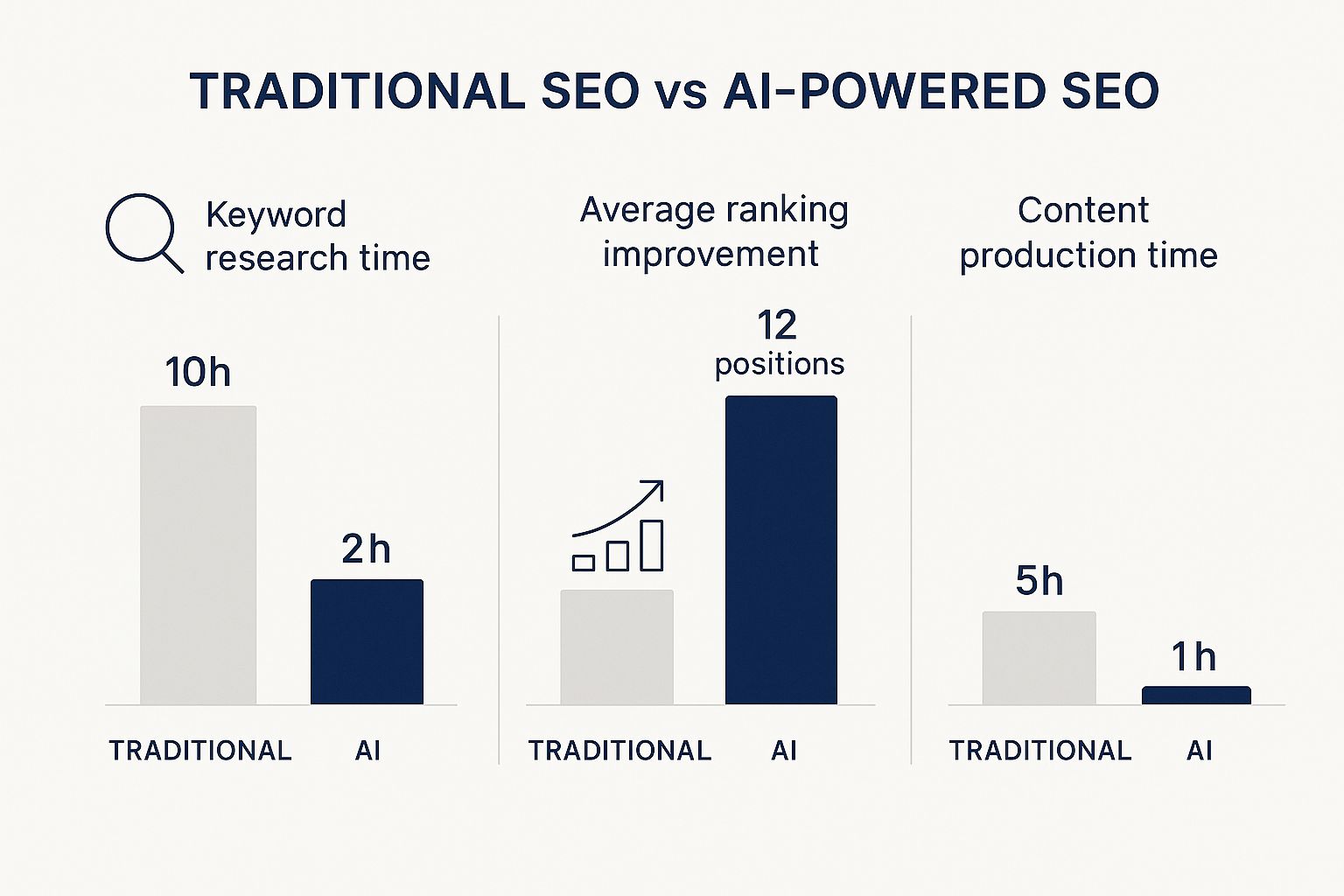
The data is clear: AI SEO doesn't just speed up content creation; it delivers far better ranking improvements, a key goal for digital shelf performance.
To give you a clearer picture, let's break down the differences side-by-side.
Traditional SEO vs AI SEO for Retail: A Quick Comparison
This table contrasts the old and new methods, highlighting the efficiency gains and strategic advantages of adopting an AI-first approach for eCommerce. When considering AI SEO vs traditional SEO, the benefits of automation become obvious.
| Aspect | Traditional SEO (Manual Approach) | Artificial Intelligence SEO (Automated Approach) |
|---|---|---|
| Speed & Scale | Slow, resource-intensive. Optimising a large catalogue can take months or years. | Rapid, scalable. Thousands of pages can be optimised in days using automated content workflows. |
| Content Quality | Inconsistent, prone to human error, and often generic, especially at scale. | Consistent brand voice, structured data, and high-quality, unique content across all pages. |
| Cost | High ongoing labour costs for writers, editors, and SEO specialists. | Lower operational costs by automating repetitive tasks and reducing manual labour, a key aspect of AI-powered retail transformation. |
| Future-Readiness | Focussed on current search engine algorithms; not prepared for agentic search. | Built for both traditional search and emerging AI agents like ChatGPT, Perplexity, and Rufus, ensuring future visibility. |
| Data Handling | Struggles with messy supplier feeds and incomplete product information. | Cleans, enriches, and structures product data to be machine-readable and compelling through product data enrichment. |
The takeaway is simple: while the traditional approach keeps you running on a hamster wheel, AI SEO provides the engine to move forward and win in the future of agentic commerce.
Preparing for Agentic Search Readiness
The SEO landscape in Australia is shifting under our feet as AI reshapes how visibility is won. Tools like ChatGPT and Google's Gemini are changing how people shop, making it vital for businesses to appear in AI-driven results, not just the old blue links. With AI-generated summaries already appearing in about 50% of search queries, staying visible demands a new game plan. For more on this, check out these insights on AI SEO in the era of ChatGPT and LLMs.
Agentic search readiness means structuring your product data so that AI agents can easily understand, trust, and recommend your products. It�s about creating AI-compatible SEO content that positions your brand for the agentic commerce future.
This transition from manual to AI-driven optimisation is the key to improving your digital shelf performance and achieving SEO at a scale that was previously impossible. This is the core of agentic search optimisation. To see how this works in practice, explore our detailed guide on the role of AI for SEO.
Solving Retail�s Biggest Content Bottlenecks
For many Australian retailers, the single biggest roadblock to scaling SEO isn't strategy, it's the sheer volume of content required. When you're managing a catalogue with thousands of SKUs, it�s all too easy to fall back on generic supplier feeds. But this creates two critical problems: a diluted brand voice and widespread duplicate content issues that can get you penalised by search engines. This is a primary driver for reducing retail content bottlenecks.
It's a slow, manual process that creates a persistent bottleneck, holding back your digital shelf performance.
This is where artificial intelligence SEO changes the game entirely. Instead of treating content creation as a painstaking, one-by-one task, AI-powered workflows turn it into a scalable, automated system. The key here is product data enrichment, a process that transforms basic, often messy, supplier information into unique, structured, and on-brand product content.
Suddenly, your team shifts from tedious copywriting to strategic oversight, finally solving the core challenge of achieving optimised at scale.
From Supplier Feeds to Optimised Assets
Supplier feeds are a necessary evil. They get the basic data into your system, but they are rarely customer-ready or SEO-friendly. They often lack descriptive detail, use inconsistent formatting, and are identical to the feeds your competitors are using. Relying on this raw data is a recipe for poor search visibility and creates a significant supplier content duplication problem.
An AI-driven retail content system tackles this head-on. It ingests these basic feeds and systematically enriches them, generating unique product descriptions, metadata, and structured data points for every single SKU. This automated content workflow ensures every product page speaks with a distinct voice and is properly optimised for search, forming the basis of product feed optimisation.
The goal is to move from manual SEO to AI SEO, where an AI agent for retail efficiency can process 10,000+ pages in days, not months. This demolishes the content bottleneck and fast-tracks your path to a better digital shelf.
Correcting Duplicated Content at Scale
Supplier content duplication is one of the most common and damaging issues in eCommerce SEO. When hundreds of retailers use the exact same product descriptions, search engines struggle to figure out which page is the original or most valuable. The result? Lower rankings for everyone involved. This requires a scalable duplicate content SEO fix.
AI provides a scalable solution to this chronic problem. By generating unique product narratives for each item, it ensures your catalogue stands out. This isn't just about rewording a few sentences; it's about building a unique value proposition for each product based on its specific attributes. This is a crucial step towards building a robust, penalty-free SEO foundation and is a key part of automating product descriptions.
This is a core part of eCommerce content quality assurance, but executed with a speed that manual teams simply cannot match.
The Power of Automated Workflows for Retail
Bringing an AI-powered system into your operations introduces a new level of efficiency. It�s not just about writing faster; it�s about creating smarter, more structured content that�s ready for the future of retail search. Exploring powerful AI-powered content creation tools can also offer valuable insights into what's possible.
Think about the key advantages this approach gives you:
- Speed and Consistency: Generate thousands of unique, on-brand product descriptions and meta tags with perfect consistency every time.
- SKU-Level SEO: Ensure every single product, not just your bestsellers, is fully optimised to pull in organic traffic.
- Reduced Manual Labour: Free your marketing and eCommerce teams from repetitive content tasks, letting them focus on high-value strategy and human-led AI content QA.
- Agentic Search Readiness: Create richly detailed, structured product data that AI shopping agents like Google's AI Overviews and Amazon's Rufus can easily understand and recommend to shoppers.
By automating your product feed optimisation, you build a powerful engine for scalable SEO that directly translates to better rankings, increased visibility, and higher conversions across your entire catalogue. This is retail content automation in action.
Winning with AI-Powered Visual Search
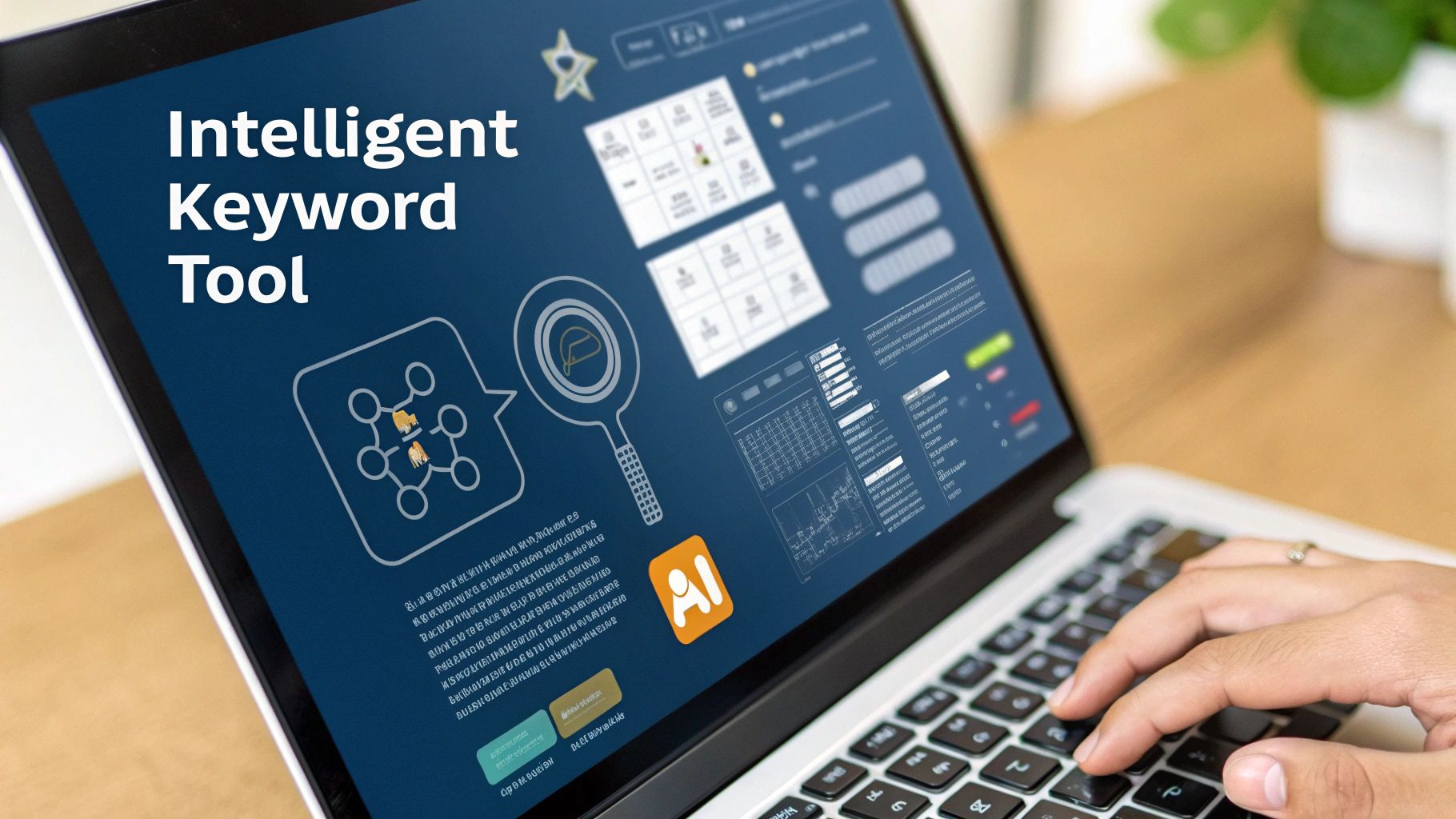
For retailers in fashion, furniture, and electronics, visual content isn't just nice to have, it's everything. It�s what grabs a shopper�s attention and drives them to click.
This is where AI image recognition and tagging come in. It�s a core part of a smart AI SEO strategy, turning your product photos into a goldmine of rich metadata that both search engines and the new wave of AI shopping agents can understand instantly. This is crucial for image SEO for eCommerce.
Key Benefits of AI-Powered Visual Search
- Enhanced Visibility: Every single product gets loaded with descriptive alt tags and attributes, making them discoverable on platforms like Google Lens and Pinterest.
- Improved Accessibility: Forget manual tagging. Automation makes it far easier to meet accessibility standards, opening your store to more customers.
- Greater Conversions: When shoppers can find exactly what they�re looking for with an image, they�re far less likely to bounce. That means more sales.
How AI Agents Analyse Images
Think of AI agents as super-powered assistants that scan every pixel of your product images. They don't just see a picture; they identify colours, shapes, textures, and patterns.
The magic happens when they map these visual details to structured keywords, things like �v-neck collar� or �mahogany wood finish�. This entire process enriches your product data automatically, without a single person on your team lifting a finger. It's the engine behind effective product data enrichment and scaled-up AI-powered optimisation.
- An image upload kicks off the AI analysis.
- The AI automatically pulls out key attributes and context.
- Your product feeds are instantly populated with accurate alt tags and metadata.
Impact on the Consumer Experience
Let's face it, customers are using visual search more and more to find what they want. AI-driven tags make your products pop up in these image-based queries, giving you a huge advantage on the digital shelf.
By doing this, you're also getting your store ready for what's next: agentic search. AI shopping agents, like Amazon�s Rufus, rely on this exact kind of metadata to understand and recommend products from your catalogue.
The market is moving fast. In 2025, spending on SEO in Australia is projected to hit $1.5 billion, a 12% jump from 2024. To keep up, small businesses are already spending around $1,200 a month. And with 33% of Australians using voice search daily for longer queries, the need for detailed, machine-readable content is only growing.
AI-Powered Visual Search isn�t just about adding a few tags. It's about building an entire AI-ready content ecosystem that fuels discovery and drives sales.
Getting Started with AI Visual Search
First things first, take a look at your current image library. A quick audit will show you where the gaps are, think missing alt tags and messy, unstructured product photos.
From there, it's about plugging in an AI image recognition tool like Optidan AI. These services connect directly to your eCommerce platform and automate the entire process of tagging, classifying, and updating your metadata.
For a deeper dive into how this all connects, check out our guide on AI shopping agents for Shopify and see how these workflows can be integrated into your store.
Best Practices for AI Image Tagging
- Give the AI a head start with high-resolution images on clear backgrounds.
- Get your file-naming conventions in order before you start the analysis.
- Make sure your tags align with major retail categories to boost your fashion SEO or furniture image tagging SEO.
- For maximum impact, pair AI image tagging with SKU-level SEO to cover all your bases.
Automating your visual search is a game-changer for your SEO strategy. It takes the tedious work of manual metadata off your team's plate and seriously boosts your performance on the digital shelf.
Real-World Examples
The proof is in the results.
Leading fashion retailers have seen their image-based search traffic jump by 45% after bringing in AI tagging.
A furniture brand boosted its conversions by 30% simply by using AI to automatically identify material attributes in its product photos.
An electronics store cut its product returns by 20% because visual search was matching customers with the right products far more accurately.
These aren't just numbers; they show how a solid AI-powered visual search strategy delivers a real, measurable return on investment. It's the critical link between image recognition, product data enrichment, and metadata optimisation at scale. By using Optidan AI, you can tag thousands of assets in a fraction of the time and see an immediate lift in your digital shelf performance.
Preparing for the Future of Agentic Commerce

Agentic commerce is the next big shift in how people find and buy products online. Think of AI agents like Google�s AI Overviews and Amazon�s Rufus as digital personal shoppers, doing the hard work of discovery for your customers. This means your product data needs to be ready to be understood, trusted, and ultimately, recommended by a machine. This is the agentic shopping and the future of work in retail.
Waiting for AI agents to completely take over search is a recipe for being left behind. The retailers who get ahead are the ones optimising today, ensuring their catalogues stand out when these new systems are making the choices. It�s a move from chasing today�s algorithm to making sure your data and content speak the language of tomorrow's AI.
What Agentic Search Means
Agentic search is where AI SEO meets automated recommendation engines. Instead of just showing a list of blue links, these platforms deliver direct answers, summarised comparisons, and ranked suggestions. Google�s AI Overviews, for example, will pull key product details into a neat little snippet, while Amazon�s Rufus can curate a collection of products based on what a shopper is trying to achieve.
This changes the game entirely. Keywords alone are not going to cut it when an AI agent is parsing structured data and rich product attributes to make a decision. Retailers now need to feed these systems with clear, machine-readable details that build trust and signal quality. Let�s break down the key pieces that get your ecommerce site ready for this new world.
- Structured Data Markup: This is the technical language that ensures your products appear correctly in AI-generated summaries.
- Enriched Attributes: Details like dimensions, materials, and specific use cases help agents properly evaluate how relevant your product is to a shopper's query.
- Unique Product Voice: This stops you from getting penalised for duplication and gives AI agents much richer context to work with.
Building Machine-Ready Product Data
The first step in preparing for agentic commerce is to take a hard look at your product feeds. Start by auditing them to find any missing attributes and, more importantly, any duplicated descriptions you've pulled from suppliers. A typical supplier feed might give you the basics, like product name, SKU, and price, but AI agents are hungry for much deeper information, like benefits, materials, and compatibility.
This is where product data enrichment tools come in. Automated workflows can add up to 20 data points per SKU, drastically improving your chances of being featured in AI recommendations. A good AI-driven enrichment process will also flag any inconsistent or confusing content, sending it back for a quick human review. This is optimising product feeds efficiently.
When your product data becomes truly machine-readable, AI agents don�t just see your listings, they recognise and prioritise them over the generic competition.
This approach solves two huge problems at once. First, it kills the duplication issue by generating unique, high-quality descriptions for every single product, no matter how large your catalogue. Second, it gives AI agents the precise, structured information they need to create those personalised shopping experiences that customers are starting to expect.
Steps to Get Ready
- Start with a full product feed audit to see where the content gaps are.
- Bring in an AI enrichment platform to automate the process of adding those missing attributes.
- Generate unique descriptions and alt tags for every single SKU in your catalogue.
- Use a human-led quality assurance process to validate data accuracy and brand voice.
- Keep an eye on your agentic search performance and be ready to refine your approach.
Read also: Learn more now about the shift from manual to automated AI SEO in our article on how Optidan AI reshapes online retail.
| Aspect | Reactive SEO Focus | Agentic Readiness |
|---|---|---|
| Content Scale | Manual updates across a few pages | Automated enrichment for thousands of SKUs |
| Data Depth | Basic supplier fields only | Detailed attributes and use case context |
| AI Agent Visibility | Low | High |
Putting these steps into practice is how you equip your catalogue for the new wave of AI-powered shopping agents. This isn't about chasing short-term rankings; it's about building a sustainable, scalable SEO ecosystem that's ready for the future.
Embracing agentic commerce readiness today is what will set your retail business apart. By investing in enriched, unique data workflows now, you get ahead of the curve and ensure your products are the ones that rise to the top when AI agents are running the shopping journey.
Starting now gives you a serious edge for when agentic commerce really takes hold.
Retailers who align their digital shelf performance with what AI agents need will see better visibility, more trust, higher conversions, and sustained growth in the new era of AI retail search.
Building a Human and AI Collaboration Workflow
In today's retail world, the winning formula isn't human versus AI, it's human plus AI. The best teams know how to blend human creativity with the raw efficiency of artificial intelligence. This is the future of work in retail.
This collaborative approach frees up your eCommerce managers to focus on high-value strategy, while AI takes care of the grunt work. Think of it this way:
- AI can generate thousands of unique product descriptions in a fraction of the time.
- Automated workflows can enrich messy supplier feeds at a scale no human team could match.
- Image recognition tools can tag your visuals with detailed, relevant attributes.
- Your human experts then step in for QA, creative direction, and brand alignment.
Integrating Human Oversight and AI Automation
A successful workflow starts with assigning clear roles. Let machines do what they do best, and let your people do what only they can do. This is the essence of human + AI collaboration in SEO.
The process typically begins with AI agents processing raw product data, generating the first drafts of titles, descriptions, and metadata.
�By combining AI�s speed with human expertise, retailers can optimise over 10,000 pages in days and maintain a unique brand voice.�
Once the AI has done its part, your team steps in to refine the output. This is where you ensure consistency, inject your brand's unique tone, and correct any duplicated content inherited from supplier feeds. It's the human touch that turns generic copy into something that connects with customers. Generative AI for retail teams works best with this model.
- Audit your product feeds to spot gaps, duplicates, and missing attributes.
- Configure AI parameters with your specific content rules and SEO tags.
- Review and approve all AI-generated drafts in a human-led QA process.
- Deploy the enriched content and start monitoring its performance on the digital shelf.
By 2025, artificial intelligence has become an essential part of SEO strategies across Australia. A huge majority of professionals are now adapting AI tools to get ahead. In fact, 86% of SEO professionals have already brought AI into their workflows, and 82% of enterprise-level SEO teams are planning to increase their investment in AI tech.
So, what's driving this shift? Automation. A massive 67% of SEO experts say the main benefit they get from AI SEO tools is streamlining repetitive tasks like keyword research and meta-tag optimisation. It saves time and massively boosts efficiency. You can learn more about these findings on SearchAtlas.
To really get the most out of AI in your content and marketing strategy, it�s worth digging into specific platforms and what they can do. For a deeper dive, check out a complete guide to AI lead generation tools.
This human-led AI content QA approach is what keeps your brand voice consistent across thousands of SKUs and protects you from damaging duplication penalties. Your retail teams can then shift their focus to performance analysis, creative campaigns, and conversion optimisation, the work that truly moves the needle.
This process also creates a powerful feedback loop. The AI learns from the human edits, becoming more accurate and aligned with your brand over time. By embracing this kind of human and AI collaboration, retailers unlock scalable, efficient optimisation that drives both visibility and sales.
Maintaining Brand Voice and Quality
AI is a fantastic tool for drafting copy at scale, but it can�t capture your brand's personality on its own. That's a human job.
eCommerce managers must review AI outputs, tweaking phrasing, verifying facts, and ensuring the tone of voice aligns perfectly with your brand and campaign goals.
- Check for product-specific nuances that an AI might easily miss.
- Validate all technical specifications and measurements for accuracy.
- Adjust keywords for localised language or AU-specific shopper preferences.
- Ensure everything complies with your brand guidelines and any legal requirements.
This QA process is your quality gate, the point where machine efficiency meets human judgment. As your team makes edits, the AI learns, leading to fewer errors and better first drafts in the future.
Scaling The Workflow Across Teams
Once you've nailed down your human-AI workflow, you can scale it across different product categories and even international regions.
A smart way to start is with your top-selling SKUs. Refine the process with this core group, and then expand it to cover your long-tail items and niche market segments.
Make sure to track key metrics like time saved, error rate reduction, and uplift in search rankings to measure your success. By documenting your AI workflows for eCommerce and creating shareable templates, new team members can get up to speed quickly and start adding value right away.
Putting a human-plus-AI collaboration workflow in place is what truly drives future-ready artificial intelligence SEO at scale.
Achieving Digital Shelf Dominance in Your Vertical
Theoretical benefits are one thing, but tangible results are what really matter to retail leaders. So let's move from concept to reality and look at how an artificial intelligence SEO strategy actually delivers measurable returns for different types of retailers.
The core principle is the same no matter what you sell: turning basic, often messy, supplier data into a powerful asset that drives sales.
Picture a common scenario for an Australian electronics retailer. They receive a supplier feed for 10,000 new products, packed with generic, duplicated descriptions and sparse technical details. The old way meant a months-long project for a content team to manually rewrite everything. This created a massive bottleneck and held up getting new products to market.
With an AI-powered content workflow, that whole process is turned on its head. The system takes that raw feed and, within days, generates unique, SEO-optimised product descriptions, detailed specs, and accurate metadata for every single SKU. That�s SEO at scale in action, delivering a fully optimised catalogue in under a week.
Real-World Impact Across Key Retail Verticals
The power of this approach gets even clearer when you see it applied to specific sectors. Every vertical has its own unique challenges, but AI SEO services provide solutions that lead to much better digital shelf performance. The goal is always to create content that�s not just optimised for today's search engines, but also ready for the future of agentic commerce.
-
Fashion SEO Optimisation: For a fashion brand, AI can use image recognition to automatically tag attributes like 'linen blend', 'puffed sleeves', or 'midi length'. This enriched data helps products show up in highly specific long-tail searches, driving qualified traffic from shoppers who know exactly what they�re looking for.
-
Furniture SEO Services: A furniture retailer can use AI to turn a simple product name like 'Oak Dining Table' into a rich description that highlights its 'solid American oak construction', 'hand-finished details', and 'seating capacity for eight'. This level of detail answers customer questions upfront and helps you rank for valuable, conversion-focussed keywords.
-
Electronics SEO Optimisation: For electronics, where tech specs are everything, AI can structure complex data into easy-to-read formats. It can generate comparison tables, highlight key features like '4K resolution' or '120Hz refresh rate', and make sure every product page is a comprehensive resource for potential buyers.
This table shows how these AI solutions tackle specific challenges to produce clear business outcomes across different sectors.
AI SEO Impact Across Retail Verticals
The application of AI-powered SEO isn't a one-size-fits-all solution; it's a strategic tool that adapts to the specific pain points of each retail vertical. From the fast-paced world of fashion to the detail-oriented electronics market, AI delivers targeted improvements that translate directly into business growth. The table below breaks down how this works in practice.
| Retail Vertical | Key Challenge | AI SEO Solution | Expected Business Outcome |
|---|---|---|---|
| Fashion | High competition, fast-moving trends, visual search dependency. | AI image tagging and automated attribute enrichment for SKU-level SEO. | +35% increase in organic traffic from long-tail and image searches. |
| Furniture | Generic supplier descriptions, need for detailed material info. | Unique product description generation and automated data structuring. | +25% improvement in conversion rates due to richer product details. |
| Electronics | Complex technical specs, frequent new product launches. | Automated content workflows for rapid, accurate content creation. | -70% reduction in time-to-market for new product listings. |
| Beauty | Ingredient transparency, matching products to skin concerns. | AI-driven content that highlights key ingredients and benefits. | Improved rankings for "problem/solution" queries and increased customer trust. |
As you can see, the outcomes are not just about rankings. They are about solving real business problems, from getting products online faster to helping customers make more confident purchasing decisions.
From Optimisation to Measurable ROI
Ultimately, the success of any SEO strategy is measured by its results. By shifting from manual SEO to AI SEO, retailers unlock real, tangible outcomes that directly impact the bottom line. The initial investment in retail SEO automation quickly pays for itself through greater efficiency, higher rankings, and more sales. For a deeper dive, you can find more valuable strategies on optimising your digital shelf for performance.
The proof is in the performance. A strategic investment in AI-powered product data enrichment and content generation is the most direct path to securing a dominant position on the digital shelf, leading to sustained growth and a significant competitive advantage in your market.
Your Questions On Artificial Intelligence SEO Answered
For Australian retail leaders, a shift to artificial intelligence SEO raises plenty of questions. Here, we dive into the queries ecommerce managers ask most often, offering clear, practical insights to help guide your next move.
How Is AI SEO Different From Traditional SEO?
Traditional SEO often feels like a never-ending juggle of keyword lists, on-page tweaks and link outreach.
By contrast, AI SEO automates much of that grunt work. It can enrich product data, tackle supplier content duplication and optimise metadata across thousands of SKUs in a single workflow.
Most importantly, it sets up your catalogue not just for today�s search engines, but for the future of agentic commerce, where AI agents drive discovery.
Will AI Replace My SEO Team?
Short answer: no. The goal is a genuine human + AI collaboration in SEO, not replacement.
AI agents handle the heavy lifting, think generating unique product descriptions or tagging images, freeing your specialists to focus on strategy, creative direction and human-led AI content QA.
How Does AI Fix Duplicate Content From Suppliers?
Generic supplier feeds can drag down your rankings and even trigger penalties.
An AI workflow ingests these feeds and spins out unique, on-brand narratives for each item. This scale of duplicate content SEO fix is beyond manual teams, ensuring every page adds fresh value for better digital shelf performance.
AI-powered optimisation isn�t just about rewriting text. It�s about transforming a generic supplier feed into a unique, structured and machine-readable asset that stands out to both customers and AI discovery agents. This step is critical for SEO at scale.
Can AI SEO Help With Visuals For Fashion Or Furniture?
Absolutely. In visually driven sectors like fashion SEO optimisation or furniture, AI image recognition SEO makes all the difference.
Agents analyse your product images to auto-generate precise alt tags and extract attributes, like �v-neck collar� or �solid oak finish�, that serve as rich metadata. This approach dramatically boosts visibility for visual search queries, a must-have in modern retail SEO automation.
Ready to eliminate content bottlenecks and prepare your catalogue for the next generation of search? Explore Optidan AI�s automated workflows and see how our platform transforms your product data into a powerful driver of organic growth. Explore Optidan AI
Article created using Outrank
