

Imagine a content team that can write compelling, SEO-optimised copy for thousands of products in a single day. That's the real power of artificial intelligence copywriting. For Australian retail leaders, this is a practical solution to persistent headaches like managing enormous product catalogues and fixing the endless problem of duplicated supplier content.
The New Reality of Retail Content Creation
For years, content creation in retail has been a slow, manual grind. A small team of copywriters would methodically work through product lists, struggling to keep pace with seasonal changes, new arrivals, and the sheer volume of a modern ecommerce catalogue. This old-school approach creates massive content bottlenecks, slows down your time-to-market, and often results in generic or duplicated content that actively hurts your search engine rankings.
Artificial intelligence copywriting completely flips this on its head. It is not just a single tool, but an infinitely scalable, highly skilled content workflow. It is a system built to handle the repetitive, detail-heavy work of writing product descriptions, optimising metadata, and enriching content at a scale that was previously unimaginable. This is how retailers achieve true SEO at Scale, optimising tens of thousands of pages in days, not months, through effective retail content automation.
From Manual SEO to AI SEO
The shift from traditional methods to AI-powered workflows is a strategic one, moving your team from being stuck in tactical execution to having high-level oversight. An AI SEO system can take raw, inconsistent, and generic supplier feeds and transform them into unique, brand-aligned, and customer-focused product stories. For a deeper look at how real-time, personalised interactions are changing the content game, it's worth understanding the principles of conversational marketing.
This transition, a key part of the future of work in retail, tackles several core challenges all at once:
- Correcting Duplicated Supplier Content: AI rewrites those generic descriptions from suppliers, killing the risk of SEO penalties and establishing a unique brand voice across your entire digital shelf. This is a critical duplicate content SEO fix.
- Product Data Enrichment: It turns a basic attribute like 'blue cotton t-shirt' into compelling copy that highlights benefits, materials, and styling suggestions, which directly improves conversions and digital shelf performance.
- Agentic Search Readiness: By creating structured, detailed, and unique content for every single SKU, you�re preparing your catalogue for the next wave of AI-powered search agents like Google�s AI Overviews and Amazon Rufus. This is the essence of agentic search optimisation.
The core benefit of artificial intelligence copywriting for retailers is its ability to create high-quality, optimised content at a velocity that matches the speed of modern ecommerce. It�s about transforming content from a bottleneck into a competitive advantage.
To fully grasp the operational shift, let's compare the old and new ways of working side-by-side.
AI SEO vs Traditional SEO Teams
| Operational Aspect | Traditional Manual Copywriting | Artificial Intelligence Copywriting |
|---|---|---|
| Scale & Speed | A few dozen pages per day, at best. | Thousands of unique, optimised pages per day. |
| Content Quality | Inconsistent, prone to human error and fatigue. | Consistent tone, style, and quality across all SKUs. |
| Supplier Content | Often published "as-is," creating supplier content duplication issues. | Automatically rewrites and enriches supplier data into unique copy. |
| Time-to-Market | New products can wait weeks to get a proper description. | New products are live with optimised content in hours or minutes. |
| Team Focus | Bogged down in repetitive writing and data entry. | Focused on strategy, creative direction, and performance analysis. |
| SEO Impact | Slow, piecemeal optimisation with limited sitewide impact. | Rapid, sitewide optimisation that boosts overall domain authority. |
This table illustrates that AI isn't just about doing the same work faster. It's about fundamentally changing how the work gets done, freeing up your team for more valuable strategic tasks as part of a modern AI workflow for ecommerce.
Preparing for the Future of Retail Search
The move toward AI SEO is not just about efficiency, it is about future-proofing your business. As search becomes more conversational and agent-driven, having a deep, richly detailed product catalogue is non-negotiable for visibility. AI agents in ecommerce will rely on comprehensive, well-structured data to answer complex user questions.
By automating the creation of this content now, you position your brand to win in the emerging landscape of agentic commerce. This is the foundation of next-gen SEO for retailers, making sure your products are seen, understood, and recommended by both humans and AI.
Transforming Supplier Feeds into Customer-Ready Content
For most Australian retailers, product data shows up as a raw, inconsistent, and frankly, uninspiring supplier feed. It is usually little more than a SKU, a model number, and a few basic attributes like 'blue shirt' or '24-inch monitor'. This creates a massive content bottleneck, forcing your team to manually rewrite and enrich thousands of product pages. It is a slow, soul-crushing, and repetitive task.
This is where artificial intelligence copywriting becomes a core part of your operations. It automates the entire process of Product Data Enrichment, turning those bare-bones supplier feeds into compelling, customer-facing content that�s built for modern search. This is not just about moving faster, it is a strategic fix for one of ecommerce's most stubborn SEO problems.

The system works by taking in raw supplier data, then cleansing, structuring, and enhancing it through automated content workflows. This systematic approach ensures every single product page is not only unique but also sings in your brand voice and is fine-tuned for maximum search visibility and digital shelf performance.
Solving the Duplicate Content Dilemma at Scale
One of the biggest own goals in ecommerce is using supplier data directly, which leads to the dreaded duplicate content SEO fix problem. When dozens, or even hundreds, of retailers use the same generic description from a manufacturer, search engines have no idea which page is the original or most authoritative source. The result? Your rankings get suppressed, or worse, you get penalised, making your products invisible to shoppers.
The widespread issue of supplier content duplication actively harms your digital shelf performance. AI-powered content workflows are designed to systematically eliminate this risk by generating unique product descriptions SEO for every item in your catalogue, no matter how large.
This process is absolutely critical for building a distinct and authoritative online presence. By making sure every product description is unique, you signal to search engines that your content provides original value, a huge factor for achieving higher rankings. For a deeper look into the mechanics, our guide on product feed management offers valuable insights into optimising and scaling your strategy.
From Basic Attributes to Rich Product Narratives
Let's break down how this transformation actually works in different retail sectors. An automated content workflow can take a simple data point and spin it into a rich, engaging story that gets people to click 'add to cart'.
-
Fashion SEO Optimisation: A supplier feed might just say "Dress, Blue, Size 12, Cotton". An AI system enriches this into something like: "Stay cool and chic in this stunning navy blue sundress, crafted from 100% breathable organic cotton. Featuring a flattering A-line silhouette and adjustable spaghetti straps, it�s the perfect choice for weekend brunches or a stroll along the beach."
-
Electronics SEO Optimisation: A feed entry could be "TV, 65-inch, 4K, Smart". This becomes: "Immerse yourself in cinematic brilliance with this 65-inch 4K UHD Smart TV. Experience lifelike colours and incredible detail with its advanced HDR processor, while the intuitive smart platform gives you instant access to Netflix, Stan, and more."
This process of supplier feed enrichment is the foundation of modern retail SEO automation. It ensures every single SKU is pulling its weight and contributing positively to your overall search performance. It�s a scalable approach that allows you to achieve a level of SKU-level SEO that�s impossible to maintain manually, giving you a powerful edge over competitors still stuck wrestling with generic, duplicated content.
Achieving True SEO at Scale with AI Workflows
So, how do you actually optimise 10,000 product pages without hiring an entire army of copywriters?
The answer is to stop thinking in terms of manual effort and start building intelligent automation. For Australian retailers, this is where AI content workflows turn the concept of SEO at Scale from a lofty goal into a practical reality. It's about creating a system that can consistently churn out high-quality, optimised content for your entire product catalogue.
This is not just about going faster, it is about creating a machine for Retail Content Automation. This machine can handle everything from generating metadata for thousands of individual SKUs to optimising product pages across multiple channels. To really get why this works, it helps to understand what workflow automation entails. At its core, it is a structured approach that demolishes the human bottlenecks that have always held back retail operations.
AI SEO vs Traditional SEO Teams
The rise of automated content workflows marks a huge shift away from old-school SEO practices. A traditional SEO team, no matter how good they are, is always limited by the number of hours in a day. They might get around to optimising a few key category pages or a handful of your hero products each month. This piecemeal approach leaves the vast majority of your product pages sitting there, completely underperforming.
An AI SEO strategy, on the other hand, uses automation to get the job done comprehensively.
- Traditional Approach: Manually optimising pages one by one. It's slow, expensive, and can never keep up with a large product catalogue.
- AI-Powered Approach: Systematically optimising every single product page with unique descriptions, titles, and alt tags. This ensures your entire site is consistent and performing at its peak.
This is the fundamental difference between manual work and AI SEO services. One is about making small, incremental gains. The other is about driving exponential growth across your entire digital shelf and getting you ready for agentic search.
The goal of Retail Efficiency Tools like AI copywriting is not to replace your talented marketing team. It's to empower them. By automating the high-volume, repetitive tasks, you free up your human experts to focus on big-picture brand strategy, creative direction, and performance analysis, the stuff where their skills really move the needle.
This shift is happening everywhere. Investment in AI R&D is skyrocketing as businesses realise how critical it is for their operations. Between 2021-22 and 2023-24, Australian business spending on AI R&D shot up by a massive 142%, climbing from A$276.3 million to A$668.3 million. This is not just a trend, it's a clear signal that technologies like automated content generation are becoming foundational.
Human-Led AI Workflows for Quality Assurance
Bringing AI agents for retail efficiency into your business does not mean you have to sacrifice quality. Quite the opposite. The best systems are built with human-led AI content QA baked right into the process. The AI does the heavy lifting, generating thousands of optimised product descriptions, but your team provides the final, strategic sign-off.
This infographic lays out a simple but powerful workflow for ensuring the quality of AI-generated content.
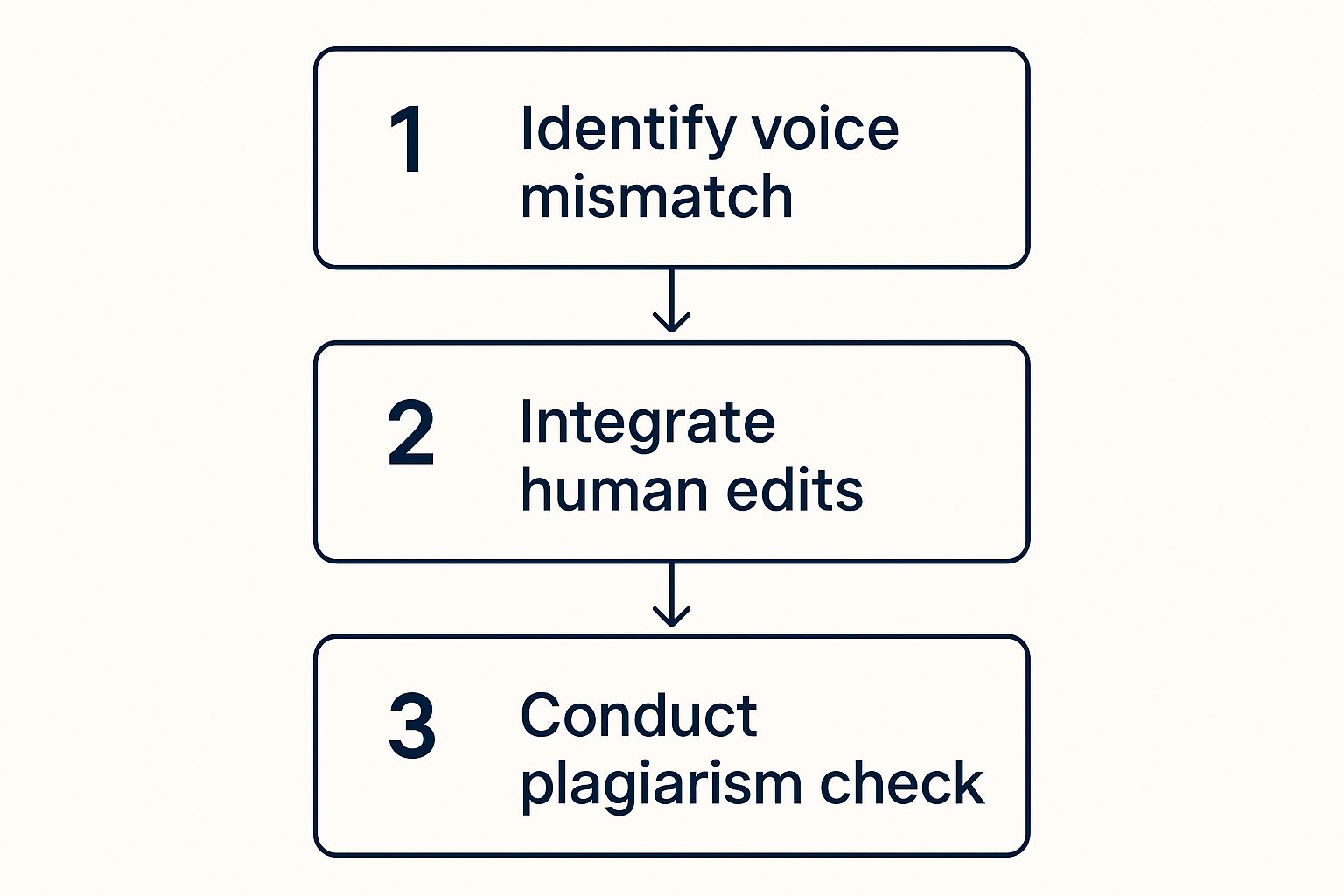
As you can see, human oversight and automated checks work together to make sure the final output is on-brand, unique, and actually effective. By combining the raw speed of AI with the strategic nuance of human experts, you get the best of both worlds and create a powerful engine for growth.
This is what building a next-gen SEO strategy for retailers is all about. Our deep dive on the fundamentals of AI for SEO offers more context on how these technologies are reshaping the entire search landscape.
Winning the Visual Search Game with AI Image Tagging
In retail categories like fashion, furniture, and electronics, customers shop with their eyes first. They are not just looking for a "dress", they are searching for a "black V-neck midi dress with a floral print". Traditional, text-only SEO often misses these cues, but this is exactly where artificial intelligence copywriting excels.
AI-powered image recognition and tagging is a massive leap forward for ecommerce SEO. This is not just about recognising that a photo contains a product, it is about analysing and understanding its visual DNA. A sophisticated AI can pull out dozens of specific attributes from a single product image, building a rich layer of metadata that was practically impossible to create at scale before.
This automated process is a vital part of modern AI SEO services. It is how you make your product photos discoverable, not just to people browsing your site, but to the next wave of AI shopping assistants.
From Pixels to Precise Product Attributes
Imagine manually tagging every single attribute for a catalogue of 10,000 fashion items. It would be a slow, painful, and mistake-ridden job. An AI, on the other hand, can churn through that volume in hours, identifying features with remarkable accuracy.
This is product data enrichment in action, driven by visuals.
- For a sofa, an AI can spot attributes like 'charcoal grey', 'three-seater', 'linen upholstery', 'mid-century modern style', and 'tapered wooden legs'.
- For a smartphone, it can identify 'triple-lens camera system', 'graphite finish', and 'edge-to-edge display'.
These granular details are then automatically turned into highly descriptive alt tags, file names, and structured data. This kind of alt tag optimisation for retail is far more than an SEO box-ticking exercise. It is a foundational move to improve your site's accessibility and prepare your entire catalogue for the visual-first world of agentic search optimisation.
AI image tagging transforms your product photos from simple pictures into structured, searchable data points. This directly boosts digital shelf performance by ensuring your products appear in highly specific, long-tail visual searches that indicate strong purchase intent.
Getting Ready for an Agentic Commerce Future
As search evolves with tools like Google�s AI Overviews and Amazon Rufus, the depth and quality of your metadata become your competitive advantage. SEO for AI agents depends on having detailed, machine-readable information that allows these systems to truly understand your products.
When a shopper asks their AI assistant to "find me a rustic oak coffee table with black metal legs," the agent will scan for products with exactly those tagged image attributes. Retailers who have invested in AI image recognition SEO will show up. Those with generic metadata will be left in the dark.
This is why automation is such a critical piece of any scalable SEO solution. By automating the tagging process, you ensure every single image in your catalogue is optimised for today�s search engines and the future of retail search, locking in your visibility for years to come.
To put it into perspective, here�s a quick summary of how these AI applications solve common retail challenges and directly improve your digital shelf performance.
Key AI Applications in Retail Content Optimisation
This table summarises the practical use cases of AI across different content types to enhance digital shelf performance and SEO at scale.
| Retail Challenge | AI Application | Primary Benefit |
|---|---|---|
| Poor Visual Search Visibility | Automated image recognition and product image tagging. | Improved rankings for long-tail, specific visual queries. |
| Manual Metadata Bottlenecks | AI-driven generation of alt tags and file names. | SEO at scale for thousands of images in minutes, not weeks. |
| Generic Product Data | Granular identification of style, colour, material, and features. | Enriched product data that fuels better filtering and agentic search. |
| Inconsistent Accessibility | Consistent and descriptive alt tag optimisation for retail. | Enhanced user experience for visually impaired customers. |
Ultimately, using AI to enrich your visual assets is not just a "nice-to-have" anymore. It's becoming a fundamental requirement for staying competitive in a search landscape that's increasingly driven by visuals and intelligent agents.
Redefining Roles with Human and AI Collaboration
Bringing artificial intelligence copywriting into your retail operation is not about replacing your team. It is about supercharging them. This is the real conversation around the future of work in retail, a powerful synergy where human and AI collaboration in SEO drives efficiency you could previously only dream of.
This approach marks a fundamental shift in how content gets made. Instead of getting bogged down in repetitive, high-volume tasks, you can delegate them to AI agents for retail efficiency. Suddenly, your skilled marketing and SEO teams are free from the soul-crushing grind of correcting duplicated supplier content or manually writing thousands of product descriptions.
With that tactical work handled, their focus moves upwards. They become the conductors of the content orchestra, focusing on brand strategy, creative direction, and campaign innovation. This is the very essence of moving from manual SEO to AI SEO.
Empowering Strategists, Not Just Writers
When AI agents in ecommerce do the heavy lifting, your team�s roles evolve for the better. This is the heart of a true AI-powered retail transformation, where human expertise guides automated execution.
Your team�s new responsibilities will look more like this:
- Strategic Oversight: Defining the brand voice, tone, and style guidelines that the AI follows to the letter, ensuring rock-solid consistency across every single SKU.
- Creative Direction: Dreaming up the big campaign concepts and promotional messaging that the AI can then adapt and scale across different product lines or channels.
- Performance Analysis: Digging into the data and insights from AI-optimised content to sharpen SEO strategies and spot new market opportunities.
- Quality Assurance: Acting as the final checkpoint, making sure the AI-generated copy meets the highest standards and perfectly reflects your brand.
This model of human-led AI content QA allows your team to achieve outcomes that were simply impossible before due to resource constraints. It is about making your entire operation more strategic and less tactical, unlocking a whole new level of retail efficiency.
The Economic and Organisational Impact
The ripple effects of adopting AI are going to be huge. The Australian Productivity Commission, for instance, estimates that artificial intelligence could pump up to A$116 billion into the Australian economy over the next decade. This highlights the immense potential of technologies like AI agents for retail efficiency, though it also raises complex questions around how AI models are trained on existing content. You can read more on the implications of AI on Australian copyright.
For retail leaders, the most immediate impact is organisational. By implementing automated content workflows, you smash through retail content bottlenecks and build a more agile, resilient team that�s ready for the future of retail search.
This future is one of agentic commerce, where AI-powered shopping assistants need incredibly detailed and structured product information to work properly. A team augmented by AI is perfectly positioned to create and manage this data at scale. Our guide on how to overcome brand voice challenges from multiple supplier feeds shows exactly how this works in practice.
Getting this right is not just about solving today's problems. It's about strategically aligning your business for the evolving demands of tomorrow's shoppers.
A Practical Framework for AI Copywriting Implementation

Jumping into an AI-powered content strategy is not a single leap, it is a series of deliberate steps. For Australian retail leaders, implementing artificial intelligence copywriting starts with a clear, phased approach that minimises disruption and maximises returns. The very first step is always an internal audit.
Start by taking a hard look at your current product data and content workflows. Where are the biggest headaches? Are you struggling with duplicated supplier content, slow time-to-market for new products, or a brand voice that's all over the place? Pinpointing these specific pain points gives you a solid business case for adopting retail content automation.
Building Your AI Implementation Roadmap
Once you have identified your core challenges, it is time to build a practical roadmap. This is not about replacing your team, it is about giving them powerful new tools to amplify their skills.
- Define Clear Objectives: What does success actually look like? Your goals might be to wipe out all duplicated content in three months, nail SKU-level SEO across your top categories, or slash content production time by 75%.
- Select the Right AI Partner: Do not settle for a generic tool. Look for a solution built specifically for retail and ecommerce that excels at product data enrichment and understands the nuances of fashion SEO optimisation or electronics SEO optimisation. Crucially, it should offer robust, human-led quality assurance workflows.
- Run a Pilot Program: Do not go all-in at once. Start small with a specific product category or brand. This lets you test the workflow, tweak your style prompts, and measure the impact on key metrics like organic traffic and conversions before rolling it out everywhere.
- Establish Quality Assurance Protocols: The final piece of the puzzle is creating a human-led AI content QA process. Your team provides the strategic oversight, reviewing and approving the AI-generated copy to ensure it�s on-brand and meets customer expectations.
Measuring Success and Scaling Up
This measured approach ensures a smooth transition from manual SEO to AI SEO. In Australia, businesses are catching on fast. Recent figures show that over 76% of Australian companies have already integrated AI into their marketing, leading to conversion rate improvements of more than 60%.
By focusing on practical steps and clear goals, you can confidently begin your AI-powered retail transformation. The focus is on achieving optimised at scale, solving persistent content issues, and preparing your business for the future of agentic commerce.
For those looking to integrate AI into their content strategy, exploring the various available AI content creation tools can provide valuable context. This framework ensures your implementation is strategic, effective, and delivers tangible improvements to your digital shelf performance.
Frequently Asked Questions
Here are some of the most common questions Australian retail leaders ask about using artificial intelligence for copywriting, covering everything from quality and team dynamics to the future of search.
Is AI-Generated Content SEO-Friendly?
Yes, but only if it's high-quality and genuinely helps the user. Google's core mission has always been to reward helpful, original content, whether a human or an AI wrote it.
The kind of low-quality, spammy AI content designed to trick algorithms will get penalised, just like bad human-written content. The trick is to use AI SEO strategically for things like Product Data Enrichment and fixing supplier content duplication, not just pumping out generic text. A well-managed AI system creates unique, structured content that directly boosts your digital shelf performance.
Will AI Replace My Content and SEO Team?
No, it will make them better. The future here is all about human + AI collaboration.
AI agents for retail efficiency are perfect for handling the high-volume, repetitive work, like writing thousands of first-draft product descriptions or optimising metadata at scale. This frees up your human experts to focus on what they do best: high-level strategy, creative direction, refining the brand voice, and final quality checks. Your team becomes more strategic and efficient, finally breaking through retail content bottlenecks that were holding back growth.
How Do We Maintain Brand Voice with AI?
This is a critical piece of the puzzle. Good AI copywriting platforms are not just generic text spinners, they are trained specifically on your brand guidelines.
You feed the system your detailed style guides, brand personas, and plenty of examples of what "good" looks like. The AI then uses these rules to generate copy that fits your tone. The process is never complete without a human-led AI content QA step, where your team gives the final stamp of approval, ensuring every word is spot-on.
Can AI Really Handle Complex Product Categories?
Absolutely. This is actually where AI shines, especially in complex areas like fashion, electronics, or furniture.
Using AI image recognition, the system can look at a product photo and identify tiny details like a 'V-neckline' on a dress or a 'walnut finish' on a table. This allows it to create incredibly detailed and specific descriptions, which is a game-changer for things like Fashion SEO Optimisation. It transforms a basic supplier feed into rich, optimised content that�s perfect for SKU-level SEO.
To dig deeper, check out our guide on understanding AI SEO and its impact on search strategies. This kind of advanced capability is exactly what you need to get your catalogue ready for AI shopping agents and the next wave of commerce.
Ready to eliminate content bottlenecks and achieve SEO at scale? Discover how Optidan can transform your product feeds into thousands of optimised, customer-ready pages in days, not months. Visit us at https://optidan.com to book a demo.
