

For Australian retail leaders wondering, ‘what do copywriters do?’, the answer has changed dramatically. A modern copywriter is not just a writer; they are a strategic partner whose main job is to drive sales and boost your digital shelf performance with compelling, optimised content.
The Modern Retail Copywriter's Strategic Role
In today's crowded ecommerce space, a copywriter does far more than just tap out product descriptions. They have become content strategists, tasked with turning generic supplier feeds into a powerful sales engine. This takes more than creative flair, it requires a deep understanding of retail content automation and scalable SEO solutions.
Their work has a direct line to your key business metrics. By making sure every product page is geared to attract, engage, and convert shoppers, they solve widespread problems like duplicated supplier content that can absolutely tank your search rankings.
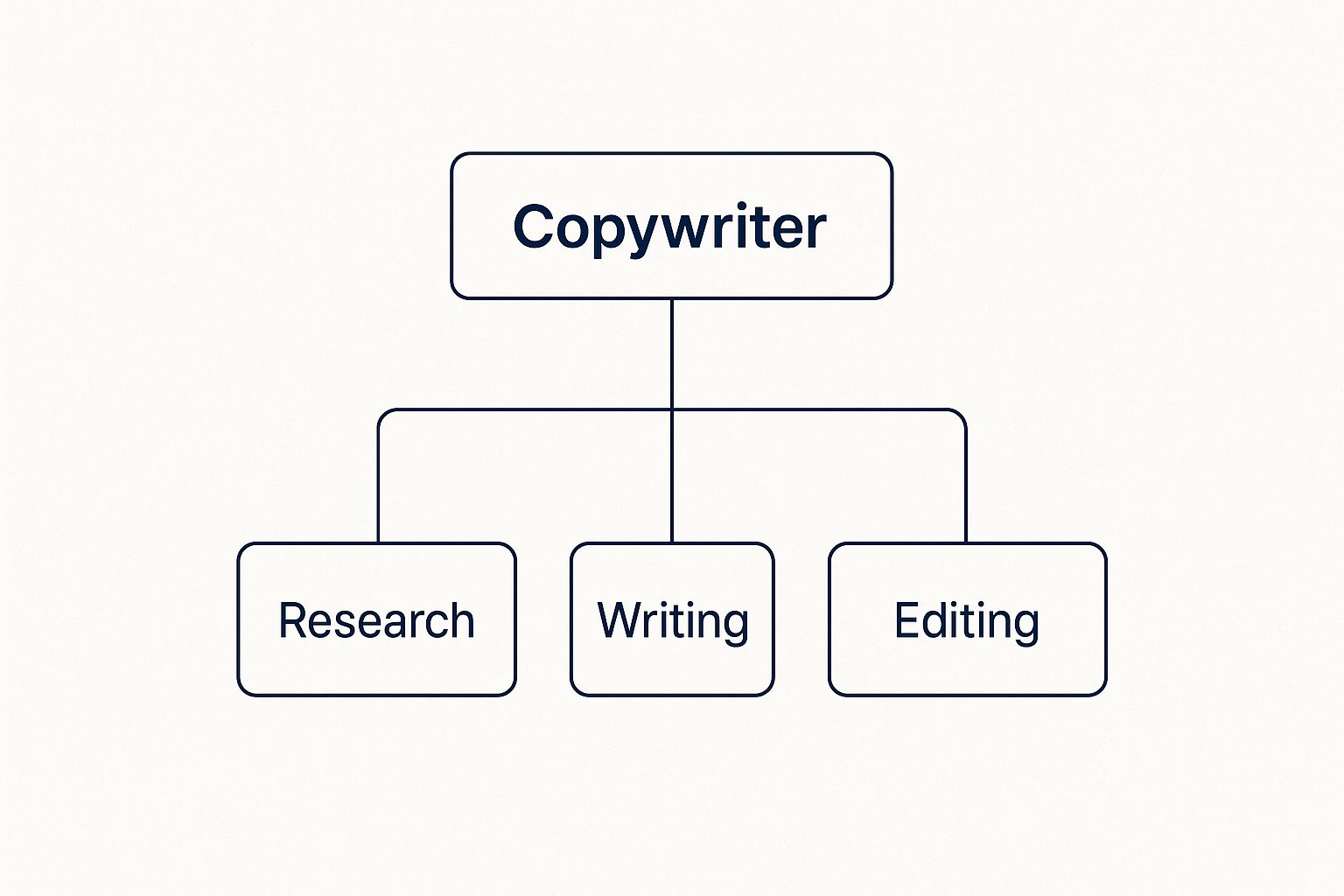
This really breaks down the process. Writing is just one piece of the puzzle, held up by solid research and careful editing to deliver strategic results.
Beyond Words to Workflows
The real value of a modern retail copywriter is in their ability to manage AI-powered content workflows. They oversee the automated creation of unique content for thousands of pages at a time, keeping the brand voice consistent and preparing your catalogue for the future of agentic search. This strategic oversight reduces retail content bottlenecks, transforming a manual process into a streamlined engine for optimising product feeds efficiently.
This strategic oversight transforms what could be a massive content bottleneck into a streamlined process for getting seen online. Our detailed guide on crafting effective website copy dives deeper into these principles.
The shift is clear: from manual SEO to AI SEO. A copywriter's success is now measured not just by the quality of a single page, but by their ability to elevate an entire product catalogue's digital shelf performance.
Interestingly, this evolving field is attracting a unique crowd. In Australia, the copywriting profession is made up of around 3,000 specialists, and women account for a huge 66% of the workforce. The median age is 37, a little younger than the national average, which points to a dynamic and growing creative industry. You can explore more about these demographics from the Australian Government's Jobs and Skills data.
The role has moved far beyond simple writing tasks. Here's a look at how the day-to-day responsibilities have shifted to focus on driving real business outcomes for retailers.
How the Retail Copywriter's Role Is Evolving
| Traditional Task | Modern Retail Application | Business Impact |
|---|---|---|
| Writing product descriptions | Product data enrichment and AI optimisation | Increases organic traffic and sales at scale |
| Proofreading marketing materials | Auditing supplier feeds for duplication | Improves search rankings and brand voice |
| Crafting ad copy | Managing automated content workflows | Delivers SEO at scale for retailers efficiently |
| Writing blog posts | Developing sitewide AI SEO strategies | Builds readiness for agentic search and AI agents |
As you can see, the modern copywriter is less of a wordsmith and more of a content performance manager. They blend creativity with technology to ensure every piece of content works harder for your business, turning the digital shelf into a genuine competitive advantage.
Shifting From Manual Writing to AI SEO Workflows
The old-school image of a copywriter spending days polishing a single product description is officially outdated. Today, the answer to "what do copywriters do?" involves directing sophisticated AI SEO workflows that are completely overhauling retail content. It's a fundamental shift away from manual, one-off tasks and towards strategic, scalable SEO solutions that can handle an entire product catalogue at once.
Instead of writing page by page, a modern copywriter now oversees AI agents for retail efficiency. These systems can process, rewrite, and enrich tens of thousands of SKUs in days, not months. This approach finally gives retailers a way to tackle one of the biggest headaches in ecommerce: rampant duplicated supplier content that torpedoes search visibility.

Human Oversight Meets AI Speed
Let's be clear: this isn't about replacing skilled writers. It's about augmenting their strategic value. The most powerful model is human + AI collaboration in SEO. A copywriter sets the strategy, defines the brand voice, and builds the quality control framework. The AI then gets to work, handling the repetitive, heavy-lifting tasks with incredible speed.
This collaborative approach finally smashes through the retail content bottleneck. It frees up copywriters to focus on high-impact activities that drive digital shelf performance, ensuring every single product is optimised and ready for what's next in the future of work in retail. You can get a deeper sense of this integration by exploring the role of artificial intelligence in ecommerce and how it's being applied today.
The core change is from content creator to content architect. The copywriter now designs the blueprint for retail content automation, guiding AI to build a search-optimised product catalogue at a scale previously unimaginable.
Scaling up like this is absolutely critical for getting seen on major retail platforms. For copywriters using AI for SEO, knowing the ins and outs of each platform's algorithm is a must. A great resource on this is the guide to Amazon Search Engine Optimization, which breaks down the specific nuances for one of the world's biggest marketplaces.
Preparing for the Future of Retail Search
This new workflow does more than just fix today's SEO problems. It actively prepares your product feed for the future of agentic search. AI shopping assistants like Rufus and Perplexity depend on structured, attribute-rich data to deliver answers. They are not browsing your website, they are reading your data feed.
By implementing AI-powered content workflows, copywriters make sure product information is not just human-readable but also AI-compatible. This involves:
- Product Data Enrichment: Adding specific attributes, like material, colour, or dimensions, that AI agents can easily understand and compare.
- SKU-Level SEO: Creating unique, keyword-rich descriptions for every single item, not just your bestsellers.
- Metadata Optimisation at Scale: Generating consistent and optimised titles and meta descriptions across your entire site automatically.
This proactive approach ensures your products show up not only in traditional search results but also in the conversational, intent-driven queries of tomorrow's shoppers. It transforms the copywriter’s role into a vital function for future-proofing your entire retail business for the agentic commerce future.
Mastering Product Data Enrichment at Scale
One of the most critical jobs for a modern copywriter is product data enrichment. Think of it as turning messy, raw supplier feeds into structured, SEO-ready content that both customers and search engines can actually understand. It's the engine that powers a high-performing digital shelf and a core retail efficiency tool.
A copywriter orchestrates this by enriching basic data with crucial attributes like material, size, colour, and technical specs. This is the information that powers the faceted search filters customers rely on, things like sorting by "brand" or "sleeve length" in fashion SEO optimisation. Without it, your products are practically invisible to anyone who filters their search.

This meticulous work of optimising product feeds ensures your products are correctly categorised for multi-channel platforms like Google Shopping and Amazon. In short, it maximises your visibility where it counts most.
From Raw Feeds to Rich Customer Experiences
Imagine getting a raw feed for a new laptop. It might just list a model number and a generic title. That’s not going to sell anything. A copywriter, often guiding AI-powered content workflows, transforms that flimsy listing into a detailed profile. They make sure it includes essential specs like screen size, resolution, and connectivity options, all critical for electronics SEO optimisation.
A huge part of a retail copywriter's job is also writing compelling product descriptions. This is what turns a simple listing into a sales pitch that answers customer questions before they even have to ask. The demand for this skill is exploding. The global market for copywriting services was valued at roughly USD $25.29 billion in 2023 and is projected to clear $42 billion by 2032.
This whole process turns your product catalogue from a simple list into a powerful, searchable database that improves the entire customer journey. For retail leaders looking to do this at speed, exploring an AI product description generator can show just how technology can support these scalable content strategies.
Driving Performance at the SKU Level
Enrichment isn’t just about adding more information, it's about adding the right information to drive SKU-level SEO. When every single product has unique, attribute-rich data, each one becomes its own individual landing page, capable of ranking for highly specific, long-tail search queries.
Product data enrichment is the foundational layer of modern retail SEO. It’s the difference between a product being lost in a vast catalogue and appearing at the exact moment a customer is ready to buy.
This process directly impacts your bottom line. Here’s how:
- Improving Search Visibility: Enriched data helps search engines and AI agents understand exactly what your product is, leading to better rankings for more specific terms.
- Boosting Conversion Rates: Detailed and accurate attributes give customers the confidence they need to make a purchase, which helps reduce cart abandonment.
- Enhancing User Experience: Powerful filtering and accurate search results make it easier for shoppers to find what they want, fast.
Ultimately, a copywriter's work in data enrichment elevates your digital shelf from a simple storefront to an intelligent, responsive, and highly efficient sales channel.
Solving the Retail Duplicate Content Crisis
One of the most stubborn challenges any retailer faces is supplier content duplication. It’s a silent killer for SEO. When hundreds, or even thousands, of your product pages use the exact same generic descriptions from manufacturers, your search rankings plummet and your brand voice gets completely lost in the noise.
So when retail leaders ask, what do copywriters do about this mess? The answer is simple: they deploy strategic retail content automation.
A modern copywriter is the key to solving this problem once and for all. Armed with AI-powered content workflows, they can execute a duplicate content SEO fix across an entire product catalogue with incredible speed. This is not about grinding through manual rewrites one by one, it’s about architecting an automated system for automating product descriptions and generating unique, SEO-optimised content for every single product you sell.
This process is a fundamental shift away from outdated manual SEO and toward a next-gen AI SEO strategy. It directly tackles a huge retail bottleneck, turning a massive liability into a powerful asset that drives performance on the digital shelf.
Orchestrating Uniqueness at Scale
The copywriter’s role here is to act as the director of these automated content workflows. They’re not just writing copy, they are setting the brand voice, defining the SEO parameters, and then overseeing the AI as it systematically rewrites and enriches every product description.
This is how you ensure that even for huge catalogues in competitive sectors like electronics SEO optimisation or fast fashion, every single page is distinct and valuable in the eyes of search engines.
A typical workflow looks something like this:
- Auditing the Catalogue: First, you identify every single instance of duplicated supplier content lurking in the product feed.
- Defining New Content Rules: Next, you establish the templates and guidelines for the AI, ensuring it sticks to your brand’s tone and style.
- Executing Rewrites: Then, you run the AI tool to generate unique descriptions, titles, and metadata across the board.
- Human-Led AI Content QA: Finally, an expert reviews and refines the output to guarantee quality and accuracy before it goes live.
The goal isn't just to dodge a penalty from Google. It's about carving out a genuine competitive advantage. By systematically replacing generic text with unique, optimised content, a copywriter creates a distinct market position for your brand, turning every product page into a new opportunity to rank.
This strategic approach makes sure every SKU contributes positively to your site’s overall SEO health. Eradicating duplication sends a clear signal to search engines that your website provides unique value. For a deeper dive into the mechanics, our guide offers detailed marketplace content duplication solutions to help you avoid those painful penalties.
Ultimately, this scalable SEO solution lets retailers finally take control of their product narrative. It’s a core part of the human + AI collaboration in SEO model, where a copywriter’s strategic oversight guides powerful technology to achieve results that were previously impossible. It doesn’t just boost your search performance, it builds a stronger, more consistent brand experience for every customer who lands on your site.
Optimising Visual Commerce with AI Image Tagging
In modern retail, a copywriter’s job goes far beyond the text on a page. These days, answering "what do copywriters do?" involves getting the most out of your most valuable assets: your product images. For visually-driven sectors like fashion SEO optimisation or furniture SEO services, high-quality images are everything. But here’s the catch, if search engines can’t understand what’s in those images, their value is seriously limited.
This is where copywriters are now stepping in to lead image SEO for ecommerce. Their role has grown to include overseeing AI image recognition technologies that can generate descriptive alt tags and detailed product metadata at scale. Let's be realistic, it’s no longer feasible to manually write alt text for thousands of SKUs, especially when a single product might have several different images.

From Pixels to Performance Data
A copywriter’s strategic oversight is what turns raw pixels into structured data that actually drives performance. They manage the AI-powered content workflows that analyse images and spit out relevant tags. For a fashion retailer, this means the AI can automatically identify attributes like "V-neck," "long-sleeve," "floral print," or "linen fabric" straight from the product photo.
This automated product image tagging is a complete game-changer. It doesn’t just create SEO-friendly alt text for accessibility and search rankings, it also enriches the entire product feed with granular details. These attributes are essential for powering on-site filters, improving the customer experience, and making sure your products show up in specific, long-tail searches.
The modern copywriter acts as a bridge between creative assets and technical SEO. They ensure AI-generated image tags are not only accurate for search engines but also aligned with brand voice and customer search intent, preparing visual content for the agentic shopping future.
Preparing Visuals for Agentic Search
Getting this process right is a core part of agentic search optimisation. AI shopping assistants rely on this kind of structured, descriptive data to answer user queries. When someone asks an AI agent to find a "black leather armchair with wooden legs," the agent needs to parse image tags and metadata, it can’t just look at the pictures.
By implementing AI image recognition SEO, a copywriter ensures your visual catalogue is fully compatible with this new era of search. This work involves a few key tasks:
- Alt Tag Optimisation for Retail: Making sure every single image has descriptive, keyword-rich alt text that boosts its visibility in image search results.
- Metadata Optimisation at Scale: Systematically applying consistent and detailed tags across the entire product range, leaving no stone unturned.
- Human-Led AI Content QA: Reviewing the automated outputs to verify accuracy, check for brand alignment, and fine-tune strategic keyword usage.
Ultimately, a copywriter’s role in visual commerce is about making your images work harder. It's about transforming them from static visuals into powerful drivers of discoverability and sales.
Preparing Content for the Future of Agentic Search
Just when you thought you had SEO figured out, the goalposts have moved again. A copywriter's role is once again expanding, this time beyond traditional SEO and into the new frontier of agentic search.
This is a whole new ball game, often called agentic search optimisation. It’s no longer about climbing to the top of a Google results page. Now, it's about feeding direct, structured answers to AI agents like ChatGPT, Perplexity, and Amazon's Rufus.
Think about it. When a customer asks an AI shopping assistant to find a product, that agent is not admiring your website’s beautiful design. It's digging through your site's underlying data, looking for cold, hard facts. This is where the copywriter becomes absolutely critical, creating AI-compatible SEO content that is highly structured and packed with attributes that AI agents can gobble up and understand instantly.
From Keywords to Structured Answers
We're witnessing a major pivot away from simply targeting keywords. The new job is to engineer data that directly answers complex user questions. The copywriter, now guiding AI-powered content workflows, has to make sure every product is described with almost microscopic precision.
Take furniture image tagging SEO, for example. A sofa is no longer just a "grey sofa." In the world of agentic search, it's a collection of structured attributes: material: boucle, colour: light grey, style: minimalist, legs: tapered wood.
This is exactly the level of detail an AI agent needs to make a spot-on recommendation. The copywriter's job is to manage this product data enrichment process, ensuring these specific attributes are applied consistently across the entire product catalogue.
In the era of agentic commerce, your product data is your marketing. A copywriter’s main function is to translate your product catalogue into a language AI can speak fluently, making you the default choice for automated recommendations.
Architecting Content for AI Agents
To win in this new environment, copywriters are effectively becoming data architects. They’re the ones positioning retailers for the coming AI-powered retail transformation. This means getting comfortable with a more technical flavour of AI SEO. If you're looking to get your head around these advanced strategies, digging into the applications of AI for SEO is the perfect place to start.
This preparation breaks down into a few key responsibilities:
- Creating AI-Ready Feeds: This means optimising product feeds until they are clean, structured, and loaded with the exact attributes AI agents are hunting for.
- Targeting Conversational Queries: You need to structure your content to directly answer the natural, conversational questions people will ask their AI assistants.
- Ensuring Data Accuracy: It’s vital to implement human-led AI content QA to double-check that all the structured data is correct and does not contradict itself.
By mastering these skills, copywriters are no longer just writing for people. They're building the very foundation that will power the future of online shopping, making sure their company's products are seen and selected in an increasingly automated world.
Got Questions About Modern Copywriting? We’ve Got Answers.
Here are some of the most common questions we get from retail leaders trying to navigate a tech-driven market. Let's clear up how a modern copywriter can push your business forward.
Is AI Making Copywriters Redundant in Retail?
Not at all. AI is actually making them more valuable, not redundant. Think of it this way: retail content automation is brilliant at handling repetitive, high-volume tasks. This frees up human copywriters to focus on what they do best, high-level strategy, quality control, and fine-tuning content for things like agentic search.
The winning formula today is a human + AI collaboration. You get the speed and scale of AI, guided by the creativity, nuance, and strategic thinking that only a human can provide. This represents the future of work for retail teams and AI efficiency.
How Can a Copywriter Improve Our Digital Shelf Performance?
A great copywriter lifts your digital shelf performance in three specific ways. First, they handle product data enrichment, making sure your products actually show up when customers use filters. Second, they perform SKU-level SEO, which often involves fixing duplicated supplier content that's killing your organic search rankings.
Finally, they write compelling, persuasive copy that turns browsers into buyers, bumping up your conversion rates. Their work makes your products easier to find and much harder to resist.
What Skills Should I Look for in an Ecommerce Copywriter?
Strong writing is just the starting point. Today, you need a strategist with a data-driven mind. Look for someone who has a solid grasp of AI SEO and agentic search optimisation. They should also be comfortable managing automated content workflows and have real experience with product feed optimisation.
Today's top copywriters must be able to analyse performance data and think about content creation at the scale of your entire catalogue, not just a single page. They are architects of scalable SEO solutions.
They're no longer just wordsmiths. They're strategic partners who use technology to break through massive content bottlenecks, future-proofing your business for agentic commerce and AI-powered retail. Their ability to think at scale is what truly sets them apart.
Ready to turn your product content from a bottleneck into your biggest competitive advantage? At Optidan AI, we deploy advanced AI workflows to create thousands of unique, SEO-optimised product pages at scale. Learn how we can elevate your digital shelf performance.
